American sailors are taught Hawaiian history, 1925.

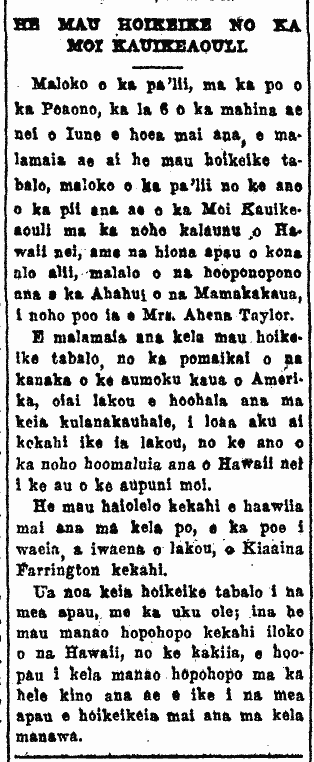
PLAYS ABOUT KING KAUIKEAOULI.

In the grounds of the palace on the night of Saturday, the 6th of this coming June, there will be pageants put on in the palace grounds pertaining to the rise of King Kauikeaouli  to the throne of Hawaii nei along with the appearance of his entire royal court; this will be arranged by the Mamakakaua Society headed by Mrs. Ahuena Taylor.

The pageant will be held for the benefit of the men of the fleet of American warships while they are spending time in this town, so that they obtain some knowledge of the nature of the governing of Hawaii nei i the time of the kingdom.

There will also be speeches presented that night by selected people, and amongst them is Governor Farrington.

This performance will be open to all, without charge; and if there are concerns amongst the Hawaiians that they will be charged, put an end to your worries by going down and witness everything that will be shown at that time.

(Kuokoa, 5/28/1925, p. 2)
Kuokoa_5_28_1925_2

Ka Nupepa Kuokoa, Buke LXIV, Helu 22, Aoao 2. Mei 28, 1925.
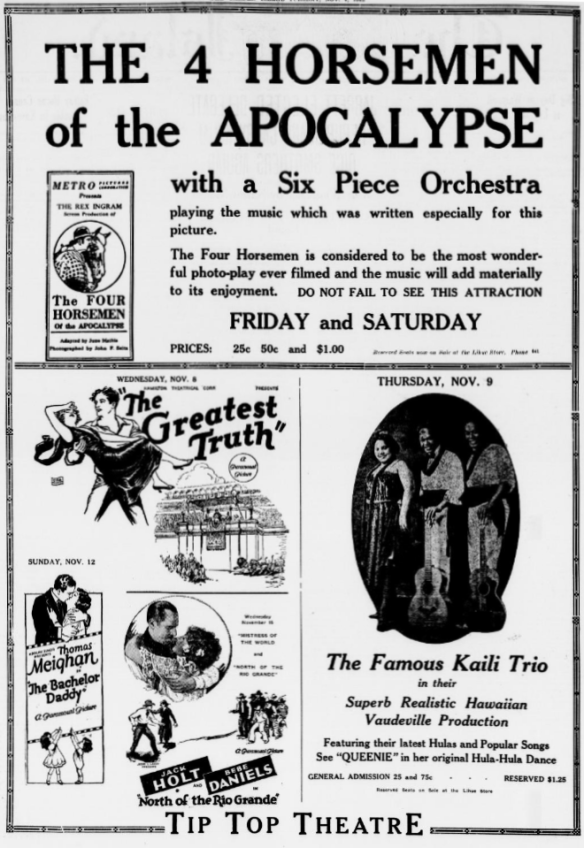
Kaili Trio performing at Kauai’s Tip Top Theatre, 1922.

THE 4 HORSEMEN of the APOCALYPSE

with a Six Piece Orchestra

playing the music which was written especially for this picture.

The Four Horsemen is considered to be the most wonderful photo-play ever filmed and the music will add materially to its enjoyment. DO NOT FAIL TO SEE THIS ATTRACTION

FRIDAY and SATURDAY

PRICES: 25c 50c and $1.00 Reserved Seats now on Sale at the Lihue Store, Phone 641

WEDNESDAY, NOV. 8

HAMILTON THEATRICAL CORP. PRESENTS

“The Greatest Truth”

A Paramount Picture

SUNDAY, NOV. 12

ADOLPH ZUKOR PRESENTS

Thomas Meighan in “The Bachelor Daddy”

A Paramount Picture

Wednesday

November 15

“MISTRESS OF THE WORLD

and

“NORTH OF THE RIO GRANDE”

JACK HOLT AND BEBE DANIELS

in

“North of the Rio Grande”

THURSDAY, NOV. 9

The Famous Kaili Trio

in their

Superb Realistic Hawaiian
Vaudeville Production

Featuring their latest Hulas and Popular Songs
See “QUEENIE” in her original Hula-Hula Dance

GENERAL ADMISSION 25 and 75c – – – RESERVED $1.25

Reserved Seats on Sale at the Lihue Store

TIP TOP THEATRE

(Garden Island, 11/7/1922, p. 2)

GardenIsland_11_7_1922_2.png

The Garden Island, Volume 18, Number 45, Page 2. November 7, 1922.

Ernest Kaai’s Hawaiian Troubadours in New Zealand, 1925.

AMUSEMENTS.

“NIGHT IN HONOLULU.”

The ukulele, the hula-hula, and the steel guitar, as entertaining products of Hawaii, are known all over the civilised world that comes under the influence of vaudeville circuits, but such segregated examples as have hitherto been shown in Auckland are mere museum specimens compared with the living actuality of the performance given in His Majesty’s Theatre on Saturday night by Ernest Kaai’s Hawaiian troubadours. These minstrels exhibited ukulele and guitar with all the sweet setting of their native haunts, the strains of the strings enriched by vocal harmonising in which the Hawaiian exccels, and the harmonising enhanced by quaint falsetto and yodelling effects that thoroughly delighted a house packed to the doors.

The curtain rose on a pretty palm-fringed beach scene, when it could be seen, for the house was in darkness when a harmonious chorus of Hawaiian voices, with stringed instrument accompaniment, was lifted in song to welcome the doming dawn. It was a native harmonising chorus set to music by Queen Liliuokalani, and entitled “Aloha Oe,” which swells to a paean of joy as the rising sun lights up the expectant world—in this case quite an effective stage scene. A similar characteristic effort of voice, strings, and light, symbolising twilight, with the stage fading melodiously into darkness, marked the ending of the first part of the programme, while in between dawn and twilight came a series of novel, interesting and thoroughly entertaining items. An Island folk-song by eddie Kniley, a ballad by Frank Luiz, hula dances by Gertila Byrnes and Layley Leywood, and a steel  guitar selection by Thelma Kaai were given with effective voice and string accompaniments. It was the part-singing in trios, however that most captivated the audience. One such number by David Kaili, Thelma Kaai and Eddie Kinley was emphatically encored, but when Queenie and David Kaili and Thelma Kaai appeared in whimsical part songs in which Queenie appeared as a soubrette of talent with a quaint gift for vocal ornamentation, the house was so vastly entertained and amused that the party were recalled four or five times. Continue reading

Hawaiian music in Aotearoa, 1925.

NEW ZEALAND IS JOYFUL WITH HAWAIIAN MUSIC.

A news item published in the newspaper Auckland Star on the 20th of April past described the enthusiasm of the people of New Zealand for Hawaiian songs, given at the concert held by Ernest Kaai and his band which is going around New Zealand.

When one of the concerts opened in the theater, the interior of the theater was decorated with greenery, and the theater was darkened, and when the music began, accompanied by the voices of the singers, it was as if the scene then was the coming of light at the break of dawn; and the audience held their breath when Aloha Oe was sung, as the instruments played along. Continue reading

More mele, because they can easily be found throughout the newspapers! 1929.

HE WAHI LEO MELE HAWAII

Ua pau kou mana e ka makua,
Ua hiki au i ka hoounauna,
I kuu wa liilii iluna kuu alo,
I mai oe ia’u hupekole,
A nui ae au a wahine ui,
Alaila oe la hooheno mai.
Ua hiki no au ke kuupau
I ka laki kikala o ka oiwi,
He iwi keia i hana a kani
He awihi maka no kau loaa
I loaa oe ia’u i ka la nui
I ka huikaulu o ka kaona
Onaona na maka o ka huapala,
Ua pulu i ka wai lohi o Maleka
Haina ia mai ana ka puana,
Ke aloha o ka ipo, mea pau ole.

Owau iho no me ka oiaio

Wahia Ii

[Cheeky!]

(Alakai o Hawaii, 2/7/1929, p. 4)

AlakaioHawaii_2_7_1929_4.png

Ke Alakai o Hawaii, Buke 1, Helu 41, Aoao 4. Pepeluali 7, 1929.

Hawaiian Band and the parade for the Knights Templar, 1883.

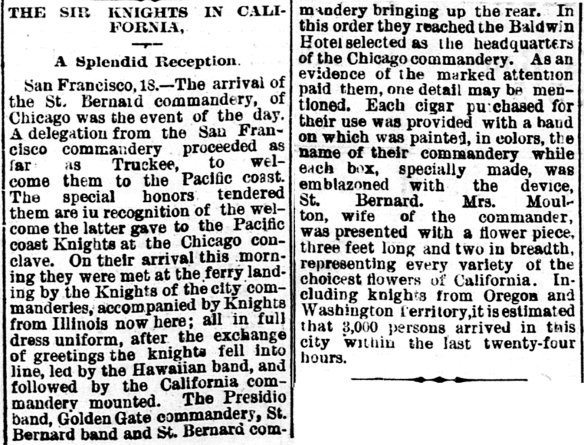
THE SIR KNIGHTS IN CALIFORNIA.

A Splendid Reception.

San Francisco, 18.—The arrival of the St. Bernard commandery, of Chicago was the event of the day. A delegation from the San Francisco Commandery proceeded as far as Truckee, to welcome them to the Pacific coast. The special honors tendered them are in recognition of the welcome the latter gave to the Pacific coast Knights at the Chicago conclave. On their arrival this morning they were met at the ferry landing by the Knights of the city commanderies, accompanied by Knights from Illinois now here; all in full dress uniform, after the exchange of greetings the knights fell into line, led by the Hawaiian band, and followed by the California commandery mounted. The Presidio band, Golden Gate commandery, St. Bernard band and St. Bernard commandery bringing up the rear. In this order they reached the Baldwin Hotel selected as the headquarters of the Chicago commandery. As an evidence of the marked attention paid them, one detail may be mentioned. Each cigar purchased for their use was provided with a band on which was painted, in colors, the name of their commandery while each box, specially made, was emblazoned with the device, St. Bernard. Mrs. Moulton, wife of the commander, was presented with a flower piece, three fee long and two in breadth, representing every variety of the choicest flowers of California. Including knights from Oregon and Washington Territory, it is estimated that 3,000 persons arrived in this city within the last twenty-four hours.

(Salt Lake Daily Herald, 8/19/1883, p. 1)

SaltLakeHerald_8_19_1883_1

Salt Lake Daily Herald, Volume XIV, Number 64, Page 1. August 19, 1883.

50th Anniversary of the Bana Hawaii, 1919

Pictures 1—The Hawaiian Band taken in San Francisco in 1883. 2—The band on the steps of the new Palace and the Executive Building [Hale Mana Hooko] today, taken in 1884. The new uniforms of the boys seen in this picture was sent by mistake from America to Honduras, Central America. 3—The Band lead by [Jose S.] Libornio that refused to swear under the Provisional Government in 1893. 4—The picture of J. K. Pohina [James K. Pohina], the only man left of the 26 who established the band 50 years ago, who is still with the Hawaiian Band. 5—The band at the Golden Gate, of San Francisco, at a banquet in 1895. 6—The band today at their new home on Waiakamilo Street, Kalihi. 7—The Bana Hawaii leading the parade of the Great Secret Society Knights Templars in San Francisco, August 20, 1883.

50 YEARS SINCE THE FORMATION OF THE BANA HAWAII

When Kamehameha V was ruling fifty years ago, the Hawaiian Band was established by a British man named Mr. Northcett, under orders of the King. On that day 26 young men were chosen for the band from the reformatory school of Keoneula, and the teaching of this knowledge to them was immediately began. The king had this idea first and so brass instruments were ordered earlier and they arrived here in Honolulu before he chose Mr. Northcett as the instructor to teach the boys. Continue reading

More old mele, 1919.

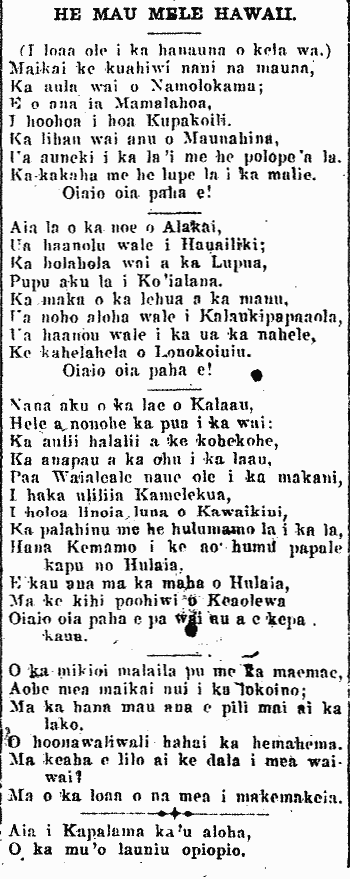
HAWAIIAN MELE

(That are not known to the generation of this time.)

Maikai ke kuahiwi nani na mauna,
Ka aula wai o Namolokama;
E o ana ia Mamalahoa,
I hoohoa i hoa Kupakoili.
Ka lihau wai anu o Maunahina,
Ua auneki i ka la’i me he polope’a la,
Ka-kakaha me he lupe la i ka malie.
Oiaio oia paha !

_____

Aia la o ka noe o Alakai,
Ua haanolu wale i Hauailiki;
Ka holahola wai a ka Lupua,
Pupu aku la i Ko’ialana.
Ka maka o ka lehua a ka manu,
Ua noho aloha wale i Kalaukipapaaola,
Ua haanou wale i ka ua ka nahele,
Ke kahelahela o Lonokoiuiu.
Oiaio oia paha e!

_____

Nana aku o ka lae o Kalaau,
Hele a nonohe ka pua i ka wai;
Ka aulii halalii a ke kohekohe,
Ka anapau a ka ohu i ka laau,
Paa Waialeale naue ole i ka makani,
I haka uliliia Kamelekula,
I holoa linoia luna o Kawaikini,
Ka palahinu me he hulumamo la i ka la,
Hana Kemamo i ke ao humu papale kapu no Hulaia,
Ma ke kihi poohiwi o Keaolewa
Oiaio oia paha e pa wai au a e kepa kaua.

_____

O ka mikioi malaila pu me ka maemae,
Aohe mea maikai nui i ka lokoino;
Ma ka hana mau ana e pili mai ai ka lako.
O hoonawaliwali hahai ka hemahema.
Ma keaha e lilo ai ke dala i mea waiwai?
Ma o ka loaa o na mea i makemakeia.

_____

Aia i Kapalama ka’u aloha,
O ka mu’o launiu opiopio.

(Kuokoa, 6/13/1919, p. 2)

Kuokoa_6_13_1919_2

Ka Nupepa Kuokoa, Buke LVII, Helu 24, Aoao 2. Iune 13, 1919.

A mele by Kaikioewa, 1919.

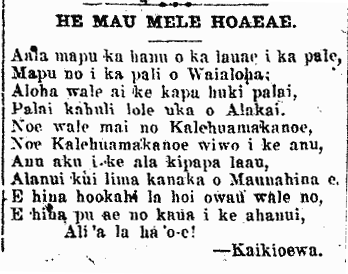
A MELE HOAEAE.

Aala mapu ka hanu o ka lauae i ka pale [pali],
Mapu no i ka pali o Waialoha;
Aloha wale ai ke kapa huki palai,
Palai kahuli lole uka o Alakai.
Noe wale mai no Kalehuamakanoe,
Noe Kalehuamakanoe wiwo i ke anu,
Anu aku i ke ala kipapa laau,
Alanui kui lima kanaka o Maunahina e.
E hina hookahi la hoi owau wale no,
E hina pu ae no kaua i ke ahanui,
Ali’a la ha’o-e!

—Kaikioewa.

(Kuokoa, 6/13/1919, p. 2)

Kuokoa_6_13_1919_2

Ka Nupepa Kuokoa, Buke LVII, Helu 24, Aoao 2. Iune 13, 1919.

Sheet music at Wall Nichols Co., 1900.

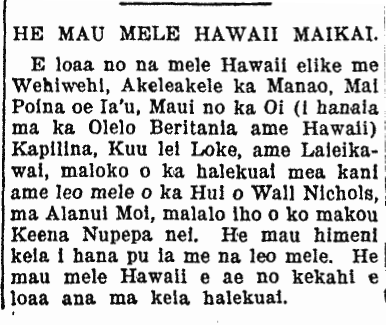
SOME FINE HAWAIIAN SONGS.

You can find Hawaiian music like Wehiwehi, Akelekele ka Manao, Mai Poina oe Ia’u, Maui no ka Oi (in English and Hawaiian), Kapilina, Kuu lei Loke, and Laieikawai, at the musical instrument and music store of Wall Nichols Company on King Street under our Newspaper Office. These are songs done with the music. There are other Hawaiian songs available at this store.

[This sounds like Johnny Noble’s “Aloha: Souvenir Collection of Rare Old Hawaiian Songs.”]

(Kuokoa, 1/26/1900, p. 2)

Kuokoa_1_26_1900_2

Ka Nupepa Kuokoa, Buke XXXVIII, Helu 4, Aoao 2. Ianuari 26, 1900.