Carl Kahalewai returned from Jarvis Island, 1938.

That youth was overcome by weakness.

The Ship Roger B. Taney Goes to Fetch Him.

CARL KAHALEWAI

There was news over the Radio in Honolulu from a small island to the south, that being from the island of Jarvis, speaking of the suffering of a Hawaiian boy, Carl Kahalewai, of a severe illness.

When the news reached Honolulu, to Mr. Black, the person looking after the rights of America in Hawaii, the news was told to a ship guarding the harbor and it prepared immediately for a speedy trip to this little island to take Doctors and medicine to save that Hawaiian boy. Uncle Samuel wasted no time and went directly to work and that ship left last week and went full speed to reach the island to save this boy. Continue reading

Fishponds seen on travels around Molokai, 1893.

[Found under: “Huakai Makaikai i ka Mokupuni o Molokainui a Hina.”]

FISHPONDS.

When I travelled from Kawela to Pukoo, it was perhaps ten or so miles, I saw 30 or more fishponds [loko ia] in the ocean, set apart by rock walls like the ponds at Kualoa, Koolau, Oahu. Some of the ponds I saw were almost a mile long. They [the walls] were five feet tall and four feet wide. Continue reading

Marriages, Births, & Deaths, 1924.

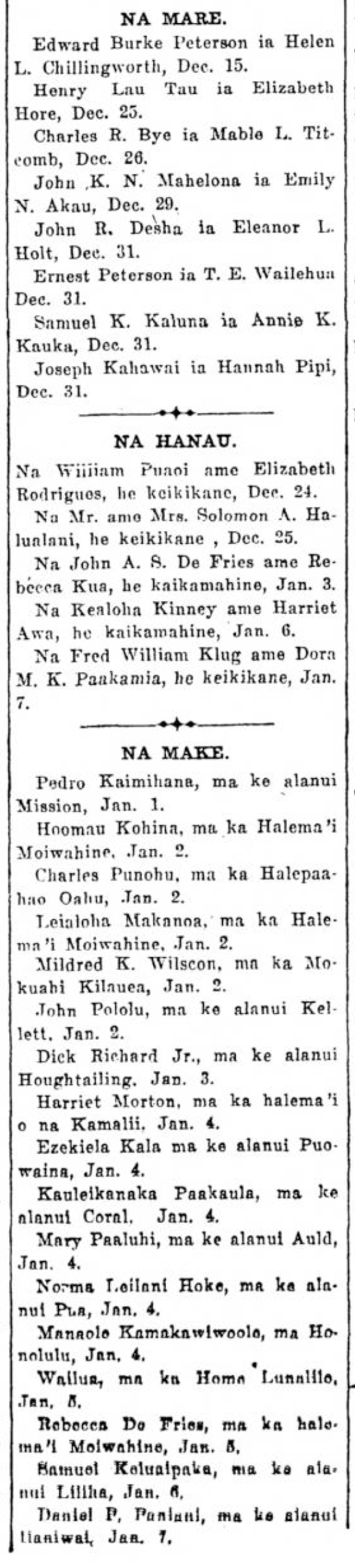
MARRIAGES.

Edward Burke Peterson to Helen L. Chillingworth, Dec. 15.
Henry  Lau Tau to Elizabeth Hore, Dec. 25.
Charles R. Bye to Mable L. Titcomb, Dec. 26.
John K. N. Mahelona to Emily N. Akau, Dec. 29.
John R. Desha to Eleanor L. Holt, Dec. 31.
Ernest Peterson to T. E. Wailehua, Dec. 31.
Samuel K. Kaluna to Annie K. Kauka, Dec. 31.
Joseph Kahawai to Hannah Pipi, Dec. 31.

BIRTHS.

To William Puaoi and Elizabeth Rodrigues, a son, Dec. 24.
To Mr. and Mrs. Solomon A. Halualani, a son, Dec. 26.
To John A. S. De Fries and Rebecca Kua, a daughter, Jan. 3.
To Kealoha Kinney and Harriet Awa, a daughter, Jan. 6.
To Fred William Klug and Dora M. K. Paakamia [? Dora M. K. Pokamia], a son, Jan. 7.

DEATHS.

Pedro Kaimihana, on Mission Street, Jan. 1.
Hoomau Kohina, at the Queen’s Hospital, Jan. 2.
Charles Punohu, at Oahu Prison, Jan. 2.
Leialoha Makanoa, at the Queen’s Hospital, Jan. 2.
Mildred K. Wilscon, on the steamship Kilauea, Jan. 2.
John Pololu, on Kellett Street, Jan. 2.
Dick Richard Jr., on Houghtailing Street, Jan. 3.
Harriet Morton, at the Children’s Hospital, Jan. 4.
Ezekiela Kala on Punchbowl Street [alanui Puowaina], Jan. 4.
Kauleikanaka Paakaula, on Coral Street, Jan. 4.
Mary Paaluhi, on Auld Street, Jan. 4.
Norma Leilani Hoke, on Pua Lane, Jan. 4.
Manaole Kamakawiwoole, in Honolulu, Jan. 4.
Wailua, at Lunalilo Home, Jan. 5.
Rebecca De Fries, at the Queen’s Hospital, Jan. 5.
Samuel Keluaipaka, on Liliha Street, Jan. 6.
Daniel P. Paniani, on Ilaniwai Street, Jan. 7.

(Kuokoa, 1/10/1924, p. 6)
Kuokoa_1_10_1924_6.png

Ka Nupepa Kuokoa, Buke LXIII, Helu 2, Aoao 6. Ianuari 10, 1924.

Might these be the feathers the Hawaiians were wearing in Salt Lake City? 1898.

CORSETS, HATS AND JEWELRY.

Some Late Fashion Hints—Philadelphia Physician Shows Women How to Lace.

A NEW PARIS COAT.

IBIS FEATHERS.

The promises of May are already being made, and tender hearts who will not have the plumage or bodies of dead songsters in their hats can this spring trim the hats with lovely ibis feathers that cost no avian lives, and are fair to look upon. Of course the purple ibis feathers from Egypt are to be classed among the costly beauties of millinery, but we have our own American scarlet ibis to borrow tail feathers from and fix in our new wide-brimmed hats.

This delicate plumage is, however, dyed many handsome colors, and, beside this and ostrich feathers, to be safely adopted by any Audubonite, we are going to have lovely hats later on trimmed so gracefully and economically with nothing but masses of shot taffeta silk cut on the bias and every edge closely pinked. This piece silk will assume, in fact, has already largely taken the place of ribbon bows for the trimming of simpler hats. Nothing can be more alluringly daring than a sapphire blue felt, with just a yard of cerise taffeta twisted about the crown, perky bows and ends starting up in every direction. Here and there the taffeta was caught down with cheap pins set with mock sapphires and rhinestones.

Nobody yet dares to assume which ways hats are going to tilt for spring wearing, but just in this midseason a tendency is making toward piling everything in front. Thake a look, for instance, at the crowning glory on the head of the model in the braided coat. It is typical of the daring frontage now used. Here the hat brim is of modes proportions; it is the mounting black and white ostrich tips that lend the stately effect. Another hat worth mentioning boasted a brim four and one-half inches wide, and this was turned directly off the face, bent into three perpendicular flutes, and over the edge of the brim, finished by puffings of black chiffon, nodded the heavy heads of half a dozen prize tall feathers.

(Salt Lake Hearld, 1/16/1898, p. 15)

SaltLakeHerald_1_16_1898_15.png

(The Salt Lake Herald, Number 49, Page 15. January 16, 1898.

The passing of Abbie Puaoi, 1918.

MY BELOVED ABBIE PUAOI HAS GONE.

O Kuokoa Newspaper, Aloha oe in sadness:—I ask for your patience in carrying my parcel of sadness in some space of your delicate body, and may it carry it forth and announce to the multitudes of family, companions, and friends of my dear wife, who live from the east where the sun rises at Kumukahi on the island of Keawe, all the way to [the west] where the sun sets at Lehua, that my dearly beloved wahine, Abbie Puaoi, has left this life, and has glided away on the path taken by all living beings.

She left me and our beloved lei [children] mourning in sadness and heart-wrenching sorrow in the morning of Friday, June 28, 1918, half past seven o’clock, after just being ill for one week. Auwe, how sorrowful!

My dearly beloved wahine was born in Hookena, South Kona, Hawaii, on the 22nd of December, 1887, from the loins of her parents, Mr. John Nahinu and Mrs. Kapule Nahinu. She was taken to hanai when she was a baby by her hanai parents, Mrs. Louisa Aukai and Joseph I [?? Mrs. Louis Aukai Josepeh I], of Nawiliwili, Kauai; and so that is how she was separated from her parents and lived on the island that snatches the sun [Kauai]. Continue reading

Tsunami, 1946.

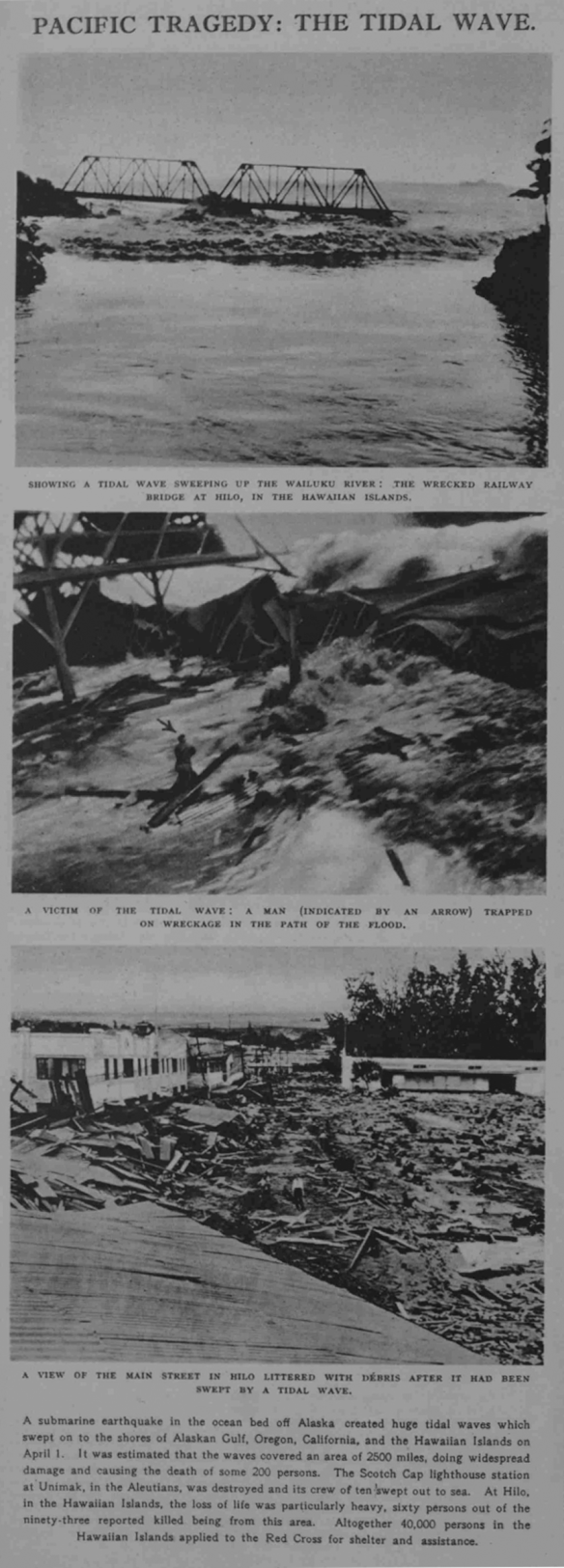
PACIFIC TRAGEDY: THE TIDAL WAVE.

SHOWING A TIDAL WAVE SWEEPING UP THE WAILUKU RIVER: THE WRECKED RAILWAY BRIDGE AT HILO, IN THE HAWAIIAN ISLANDS.

A VICTIM OF THE TIDAL WAVE: A MAN (INDICATED BY AN ARROW) TRAPPED ON WRECKAGE IN THE PATH OF THE FLOOD.

A VIEW OF THE MAIN STREET IN HILO LITTERED WITH DEBRIS AFTER IT HAD BEEN SWEPT BY A TIDAL WAVE.

A submarine earthquake in the ocean bed off Alaska created huge tidal waves which swept on to the shores of Alaskan Gulf, Oregon, California, and the Hawaiian Islands on April 1. It was estimated that the waves covered an area of 2500 miles, doing widespread damage and causing the death of some 200 persons. The Scotch Cap lighthouse station at Unimak, in the Aleutians, was destroyed and its crew of ten swept out to sea. At Hilo, in the Hawaiian Islands, the loss of life was particularly heavy, sixty persons out of the ninety-three reported killed being from this area. Altogether 40,000 persons in the Hawaiian Islands applied to the Red Cross for shelter and assistance.

[This was taken from The British Newspaper Archive, another awesome newspaper site online!]

(Illustrated London News, 4/20/1946, p. 14)

IllustratedLondonNews_4_20_1946_14

The Illustrated London News, Number 5583, Volume 208, Page 14. April 20, 1946.