This is an independent blog. Please note that I am nowhere near fluent, and that these are not translations, but merely works in progress. Please do comment if you come across misreads or anything else you think is important.
Just another place that posts random articles from the Hawaiian Newspapers! It would be awesome if this should become a space where open discussions happen on all topics written about in those papers!! And please note that these are definitely not polished translations, but are just drafts!!!
[This blog is not affiliated with any organization and receives no funding. Statements made here should in now way be seen as a reflection on other organizations or people. All errors in interpretation are my own.]
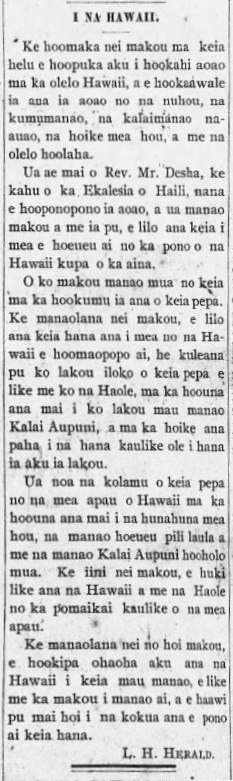
We begin in this issue to print a page in the Hawaiian language, and set aside that page for news, essays, wise discussion, announcements of what is new, as well as notices.
The Rev. Mr. Desha, the kahu of Haili Church, has agreed to edit that page, and we, as well as he believes that this will become something that will encourage the rights of native Hawaiians of the land.
This was our initial wish when establishing this paper. We hope that by this endeavor Hawaiians will realize they also have responsibility in this paper just like the Haole, in sending in their political ideas, and reporting on unfair practices carried out against them.
The columns of this paper are open to all people of Hawaii to send in bits of news, general encouragement, and progressive political ideas. We wish to support Hawaiians and Haole alike toward equal prosperity for all.
We hope that Hawaiians will take delight in welcoming these ideas as we imagined, and that they will give their assistance so that this endeavor will benefit.
Aloha oe, O Kuokoa Newspaper: On the night of the 10th of February, the compassionless hands of death fetched the breath of life from the baby of our Dr. J. Atcherley and took it away.
The Doctor tried with what he knew, but the strength of the sickness was greater. In the morning of the following day, the body of the baby was returned by the parents to Waimea.
PERTAINING TO THE SUGARCANE.
The sugarcane of Puako will be milled once again; the land of that barren field is green and beautiful.
This is under the leadership of the Head Luna, W. Vredenburg.
PRAISE.
We have much praise for you, O J. Seleni, for your prompt actions in the committee requesting funds for the Church of Kawaihae Kai and Uka, and to William Hookuanui for his thatching of the Kawaihae Kai Church at no cost, and to Z. Paakiki for his assisting with the bundles of pili so that the Kawaihae Kai Church could be completed.
Sincerely yours, JOHN KULA JR., Kawaihae, Hawaii, Feb. 20, 1903.
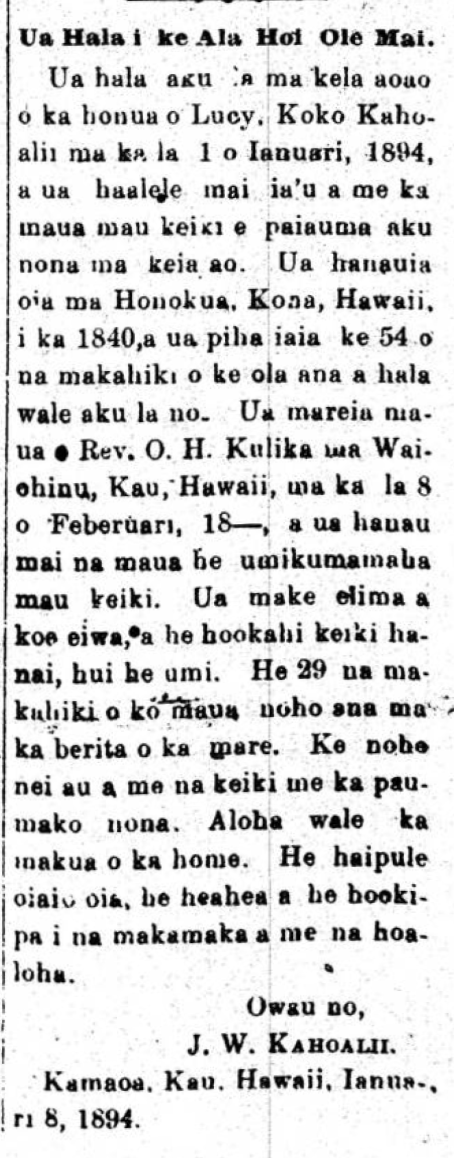
Lucy Koko Kahoalii has left for the other side of the world on the 1st of January 1894, and she left me and our children mourning for her in this world. She was born at Honokua, Kona, Hawaii, in 1840, and she was 54 years old when she passed. We were married by Rev. O. H. Gulick at Waiohinu, Kau, Hawaii, on the 8th of February, 18–, and we had fourteen children. Five have died and nine remain, and there is one hanai, totalling ten. We lived together in the covenant of marriage for 29 years. I and the children grieve for her. Aloha for the parent of the home. She was truly devout, and welcoming and hospitable to her intimates and friends.
It is me, J. W. Kahoalii. Kamaoa, Kau, Hawaii, January 8, 1894.
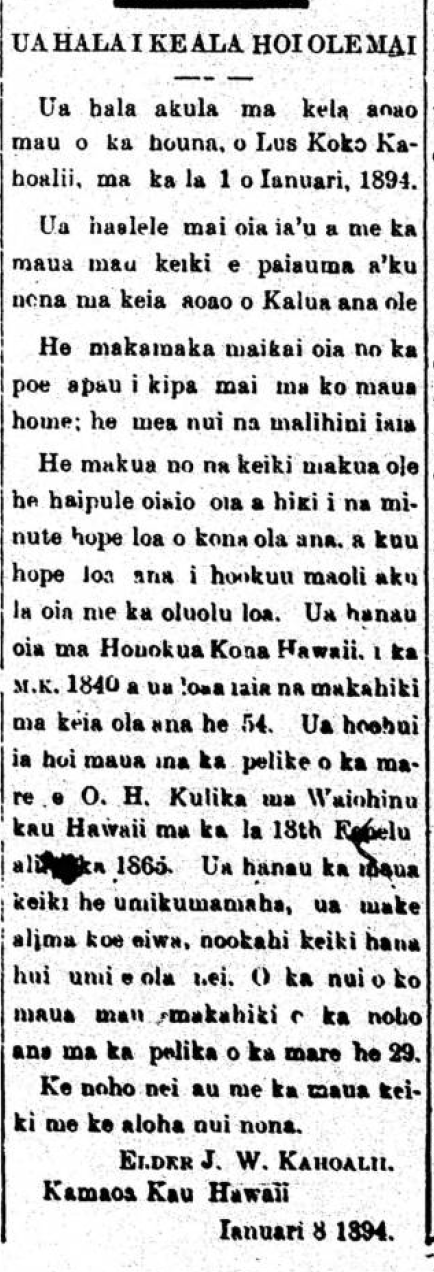
Lus Koko Kahoalii left for the other side of the world on the 1st of January 1894.
She left me and our children mourning for her on this side of the fathomless pit.
She was a good friend to all who visited our home; malihini were important to her.
She was a parent to orphans, she was truly devout until the last minutes of her life, until she let go peacefully. She was born at Honokua, Kona, Hawaii, in the year 1840, and she had 54 years of life. We were joined in the covenant of marriage by O. H. Gulick at Waiohinu, Kau, Hawaii on the 18th of February 1865. We had fourteen children; five died and nine remain; and there is one hanai child, totalling ten who are living. The number of years we lived together in the covenant of marriage were 29.
I remain with our children with much aloha for her.
Elder J. W. Kahoalii. Kamaoa, Kau, Hawaii January 8, 1894.
Lus Koko Kahoalii left for the other side of the world on the 1st of January 1894.
She left me and our children mourning for her on this side of the fathomless pit.
She was a good friend to all who visited our home; malihini were important to her.
She was a parent to orphans, she was truly devout until the last minutes of her life, until she let go peacefully. She was born at Honokua, Kona, Hawaii, in the year 1840, and she had 54 years of life. We were joined in the covenant of marriage by O. H. Gulick at Waiohinu, Kau, Hawaii on the 18th of February 1865. We had fourteen children; five died and nine remain; and there is one hanai child, totalling ten who are living. The number of years we lived together in the covenant of marriage were 29.
I remain with our children with much aloha for her.
Elder J. W. Kahoalii. Kamaoa, Kau, Hawaii January 8, 1894.
(Leo o ka Lahui, 1/15/1894, p. 2)
Ka Leo o ka Lahui, Buke II, Helu 854, Aoao 2. Ianuari 15, 1894.
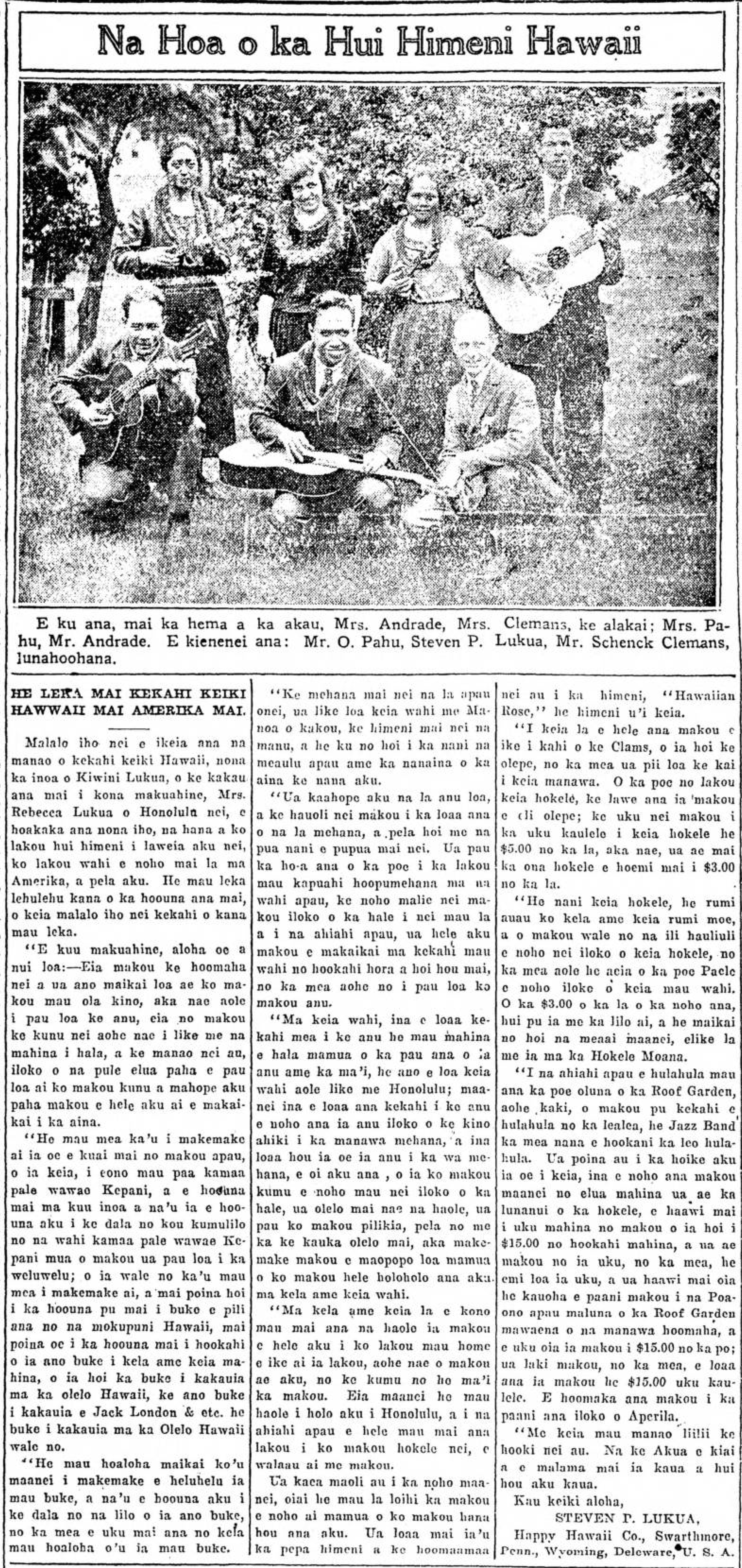
Standing from left to right, Mrs. Andrade; Mrs. Clemens, leader; Mrs. Pahu; Mr. Andrade. Squatting: Mr. O. Pahu; Steven P. Lukua; Mr. Schenck Clemens, manager.
A LETTER FROM A HAWAIIAN BOY FROM AMERICA.
Below you will see the thoughts of a Hawaiian boy by the name of Kiwini Lukua [Steven Lukua], writing to his mother Mrs. Rebecca Lukua of Honolulu nei, describing what his singing group is doing, where they are living in America, and so forth. He has sent many letters, and this below is one of his letters.
“Dear mother, much aloha to you:–Here we are on break, and we are doing better, but our cold are not completely cured; we are still coughing, but not like the previous months. I think within two weeks our colds will probably be over, and maybe we will go sightseeing.
“I have some things I want you to buy for all of us, that is this, six pairs of Japanese sandals [kamaa pale wawae], and send in under my name and I will send you the money for the expenses. Our old Japanese sandals are all shredded up. That is all I want, and do not forget to send send a book related to Hawaii; do not forget to send a book of that type every month, that being a book in Hawaiian like those written by Jack London, etc.; a book written only in Hawaiian.
“I have good friends here who I want to read those books, and I will send you money to cover the cost of those books, because my friends will pay for those books.
“The days here are getting warmer. This place is much like our Manoa. The birds are singing and all the plants and the landscapes are beautiful to see.
The frigid days have gone by and we are happy that we have warm days, and the blooming flowers. Everywhere people are no longer lighting their fireplaces. These days we are staying at home quietly, and each evening, we went exploring for an hour and returned, because our colds are not completely over.
“Here, if someone gets a cold, several months will go by before that cold and sickness is over. This place is strange and not like Honolulu. Here if someone catches a cold, that cold will live in the body until the warm period. And if you catch a cold once again during the warm period, it will be worse. That is the reason we are staying in the house. But the haole tell us that our troubles are over, and so too was what the doctor said. But we wanted to be very sure before going traveling about here and there.
“Everyday, that haole invite us to go to their homes to see them, but we do not accept because we are sick. Here there are haole who went to Honolulu, and each evening, they always come to our hotel to talk with us.
“I am truly tired of living here, because we have many days before we work again. I have the sheet music and am practicing singing, “Hawaiian Rose.” This is a beautiful song.
“Today we are going to see the place with clams, that being olepe, because it is high tide now. The owners of this hotel are taking us to dig for clams; we are paying this hotel an extra charge of $5 for the day. But the hotel owner is reducing it to $3.00 for the day.
“This hotel is nice; there is a bathroom in each room, and we are the only dark-skinned ones in this hotel, because Blacks are not allowed to stay here. The cost to stay here per day is $3.00, added to the cost for meals. And the meals here fine, just like the Moana Hotel.
“Each evening the people dance on top of the Roof Garden without charge. We dance as well because it is fun. The music for the dancing is played by a Jazz Band. I forgot to tell you this, if we live here for two months the manager of the hotel has agreed to give us a monthly rate, that being $15.00 for a month, and we agreed on that rate, because it is very cheap, and he put in a request that we play every Saturday on the Roof Garden during the breaks, and he will pay us $15.00 per night; we are lucky, because we will receive an extra payment of $15.00. We will begin playing in April.
“With these little thoughts, I will conclude. May God guide and watch over us until we meet again.
Your loving son, STEVEN P. LUKUA, Happy Hawaii Co., Swarthmore, Penn., Wyoming, Delaware, U. S. A.
(Kuokoa, 5/24/1923, p. 3)
Ka Nupepa Kuokoa, Buke LXII, Helu 21, Aoao 3. Mei 24, 1923.
The above are the first words of the very first law proclaimed upon the villages of Hawaii nei, and those words continue to be spoken by some in authority in our times. This is how the rest of the proclamation of the law truly went:
“Splintered Paddle Law–Let the old men go and lie by the road; let the old women go and lie by the road; let the children go and lie by the road.”
This first law proclamation was spoken by Paiea (Kamehameha I) after his head was struck by some fishermen on a shore at Puna, Hawaii, after he was mistaken for someone else. When his head was hit by the stroke of the paddle, the people fled. There were five of them. And them Paiea rose and grabbed a rock, and he started to chase after them, but one of his feet got stuck in a rock crevasse. And his chase was soon cut short. The rock in his hand was released and there was no time to catch them. And it was this unfulfillment of his intent that led him to proclaim those words of power and fame in our story. The place where Paiea’s foot was caught is still known to this day.
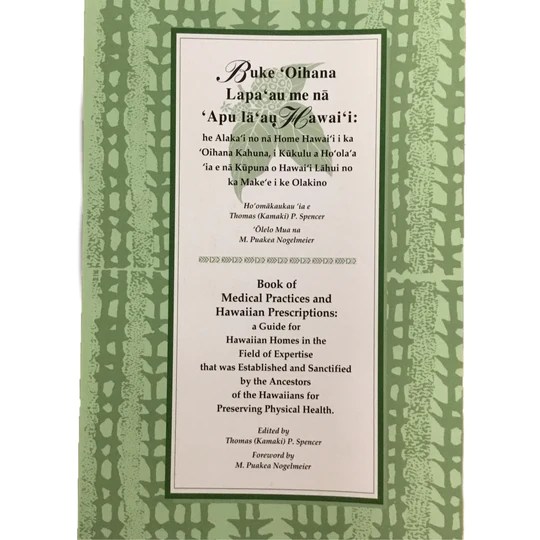
Here, we take what is shown on pages 94 and 95 of “Ka Buke Lapaau me na Mea Pili Kaulana” recently published by Thomas P. Spencer [Kamaki].*
“Right after this battle (Kepuwahaulaula), brought before Kamehameha by the warrior chiefs were the fishermen who struck his head with the paddle to the toward the sea some years prior. That shameless act carried out by them was made known to Kamehameha face to face. His warrior chiefs thus urged him that the fishermen should be killed by stoning.
“Kamehameha’s aloha for people led him to speak for the first time the famous pardon with these words:
“Splintered Paddle Law: You are prisoners of war, but you are being pardoned from your foolishly striking my head–I escaped but was almost in danger.”
Here, O readers, you see,–aloha for people was the cure whereby those rebels of Puna were forgiven by Kamehameha, without him considering the calls for killing them by his warrior chiefs. This is a good example for President Dole of the Republic. He and his Executive Power do not get close to 1/100 of the Splintered Paddle Law for the Hawaiian prisoners of the civil war of January 17, 1895, who remain imprisoned while the lahui is united in their desire for their release. That was a period of ignorance when they were pardoned victoriously by Kamehameha, while this is a period of enlightenment and learning. Still there has been no pardon which Dole has proclaimed for the Hawaiian captives, for the fame of his name and his Nation.”
Our explanation pertaining to this famous story differs from Spencer’s, but the gist of his explanation for Kamehameha’s pardoning those people who hurt him, that is something we want to clarify widely for this time, so that true aloha for people is recognized within them.
*This book by Tamaki Spencer was republished by the Bishop Museum Press twenty years ago, but unfortunately it is out of print today.
Just the other day, I saw that the Hawaiian Historical Society published a reprint of an important book, “Kaluaikoolau,” written by Kahikina Kelekona and first published in 1906.
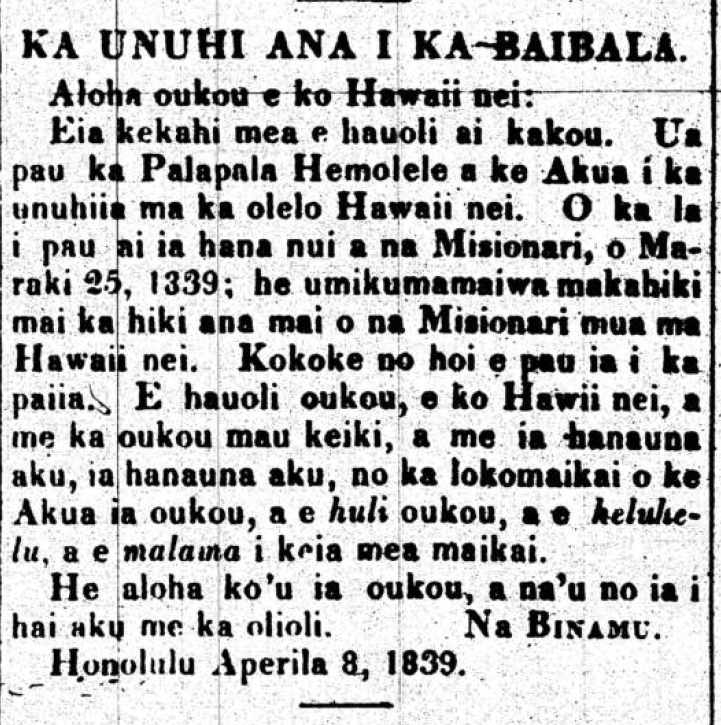
This is something for us to be happy about. The translation of the Holy Book of God into Hawaiian is complete. The day this great work of the Missionaries was completed was March 25, 1839; nineteen years since the first Missionaries arrived here in Hawaii. The printing is almost done. Rejoice, O Hawaii nei, and your children, and the generations to come, for the kindness of God to you. Seek it out, and read it, and take care of this fine thing.
I have aloha for you all, and I tell you this with joy.
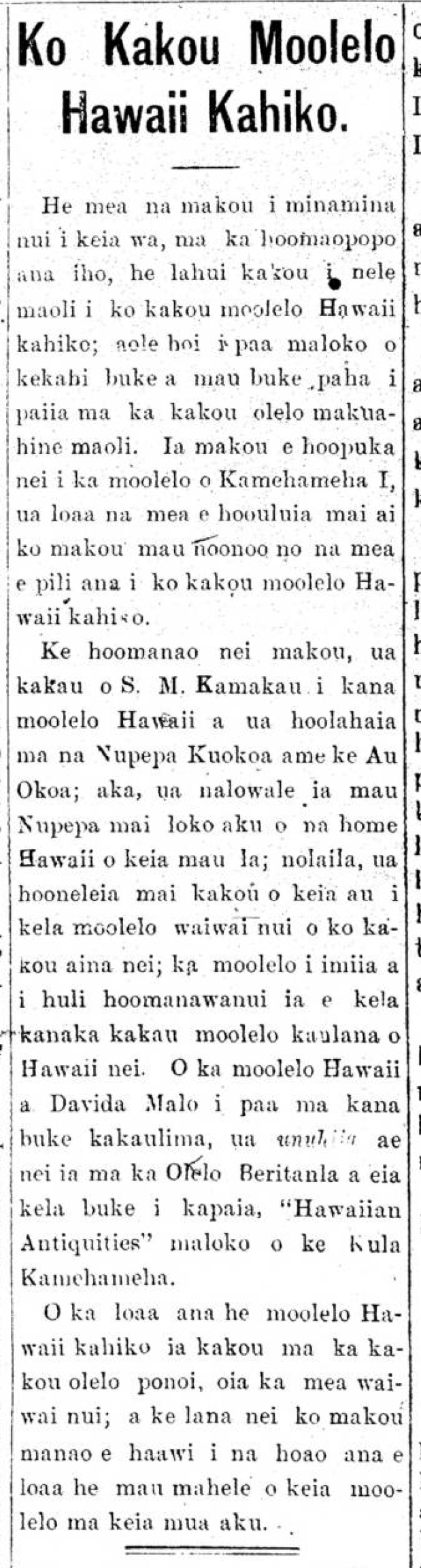
It is something we are regretful about at this time, as we realize, we are a lahui that truly is lacking in our Hawaiian history. It is not published in a book printed in our mother tongue. As we publish the history of Kamehameha I, we have found things that increasingly make us think about matters dealing with our Hawaiian history.
We remember that S. M. Kamakau wrote his Hawaiian history, and it was disseminated by the Nupepa Kuokoa and Au Okoa. But those newspapers have disappeared from the Hawaiian homes of these days; therefore, we are currently left without that very important history of our land, the history that was searched out and patiently studied by that famous historian of Hawaii nei. The Hawaiian history of Davida Malo that is set down in his handwritten book was translated into English and is now a book called, “Hawaiian Antiquities” at Kamehameha School.
Having a Hawaiian history in our own language is a very valuable thing; and we want to try to acquire some portions of this history in the future.
(Na’i Aupuni, 1/17/1906, p. 2)
Ka Na’i Aupuni, Buke I, Helu 44, Aoao 2. Ianuari 17, 1906.
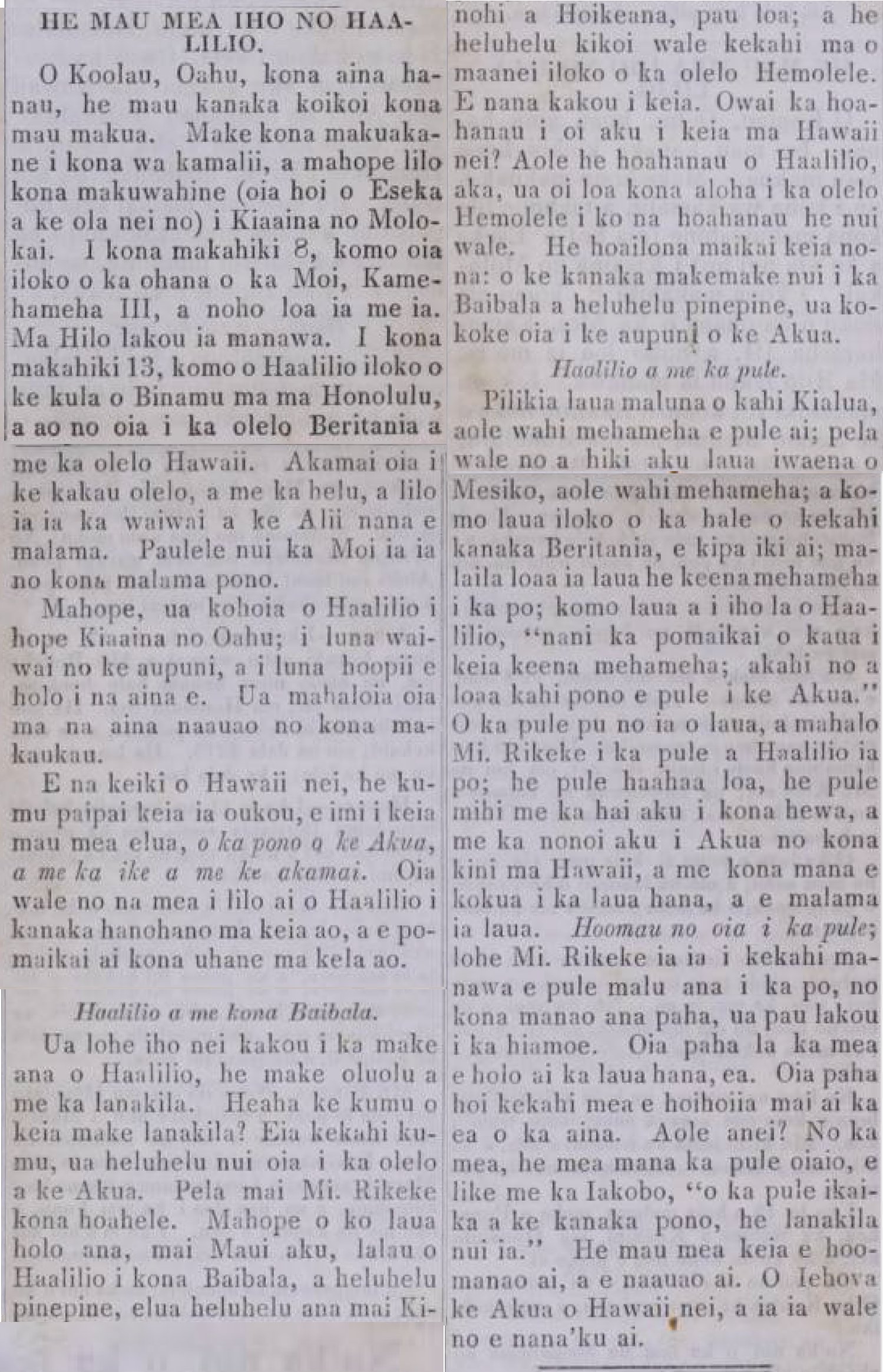
His land of birth was Koolau, Oahu; and his parents were important people. His father died when he was a child, and thereafter his mother (that is Eseka who is living) became Governor of Molokai. When he was 8 years old, he joined the family of the King, Kamehameha III, and lived permanently with them. They were in Hilo at that time. When he was 13 years old, Haalilio entered the school of Bingham folks in Honolulu, and he learned English and Hawaiian languages. He was skilled at composition and mathematics, and he became the keeper of the King’s wealth. The King had confidence that he would care for it well.
Thereafter, Haalilio was chosen as Governor of Oahu; as minister of finances for the government, and envoy to travel to foreign lands. He was respected in the enlightened lands for his competence.
O youth of Hawaii nei, this is encouragement for you. Seek out these two things, the righteousness of God, and knowledge and wisdom. It was just those things that made Haalilio an honored man in this world, and his soul will be blessed in the other world.
Haalilio and his Bible.
We heard of the death of Haalilio, and that it was a contented and victorious death. Why was it a victorious death? Here is one reason: he read much of the word of God. That according to his traveling companion, Mr. Richards. After they left Maui, Haalilio took his Bible and read of it frequently. He read twice from Genesis to Revelation in entirety; and he read randomly here and there or the Holy Words. Let us consider this. Who is the brethren in Hawaii nei that goes beyond this? Haalilio is not a brethren, but his aloha for the holy word is greater than the many of the brethren. This is a good sign for him: a man who has great desire for the Bible and who reads it frequently, he is near to the kingdom of God.
Haalilio and prayer.
The two of them had a difficult time aboard the double-masted ship; there was no secluded place to prayer. This continued until they reached Mexico, there was no secluded place. Then they entered the house of a British man to visit. There they were allowed a quiet room at night. They entered and Haalilio said, “We are so blessed to have this quiet room; it is the first time we have a proper place to pray to God.” They prayed together and Mr. Richards admired the prayer of Haalilio that night. It was a very humble prayer; it was a prayer of repentance, and he spoke of his sins, and asked God for his relatives in Hawaii, and his power to help the two of them in their duties and to watch over them.dhis prayer; Mr. Richards heard him once secretly praying at night, perhaps because he thought they were all asleep. That is perhaps why their work progressed, yes. That is probably one of the reasons the sovereignty of the land returned. Isn’t it so? For true prayer is powerful, like what Jacob said, “The effectual fervent prayer of a righteous man availeth much.” These are things to remember and to learn from. Jehovah is the God of Hawaii nei, and it is only to him we should pay attention.
When the editor [Edward L. Like] of this paper returned for a few short days to the famous rainy land of Hilo, Hanakahi after his being away, to witness the final breath of his cousin, Miss Emmeline Kaleionamoku Nawahi, which she released from this life in the land of their birth. There were many things he reported on pertaining to the fast advancement of that town which took place over the years he was away from the land of his birth.





 nupepa