Coconut grove of Kamehameha V at Kalamaula, Molokai, 1923.

[Found under: “NA ANOAI”]

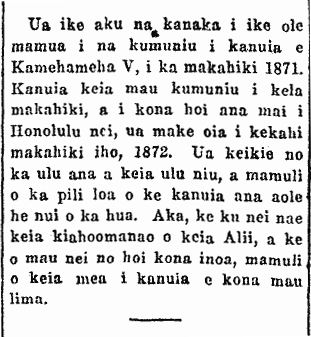
Those who did not know before of the coconut grove planted by Kamehameha V in 1871 now know. These coconut trees were planted that year, and when he returned here to Honolulu, he died a year later in 1872. This coconut grove has grown very tall, and because they were planted close together, there are not much fruit. But it stands as a monument to this Alii, and is called by his name because it was planted by his own hands.

[Check out Nanea Armstrong-Wassel’s post on more famous ulu niu!

It is also interesting to note that in the article “KA HUAKAI MAKAIKAI IA MOLOKAI” by W. J. Coelho, describing a trip around Molokai, found in Kuokoa, 7/6/1922, p. 3, it says:

I spoke of the coconut grove of Kamehameha V in Kalamaula. It is said that it was Kamehameha V who planted that coconut grove in 1864. The truth is that it was Meyer senior [Maea makua]—during the time of the King, Kamehameha IV who planted it. That was when Meyer married the mother of the Meyer family. When they were wed, they went upland of Kalae, and built a little house. It was a grass hut. Meyer began to work hard and peddled butter. After, Meyer was granted the care over the lands of Kamehameha IV, he planted coconuts by the beach, as a place to go for his lord the alii. It was Meyer who planted them, and not anyone else. Meyer himself told an important man of Honolulu, and it was from him I got this information.]

(Kuokoa, 4/26/1923, p. 2)

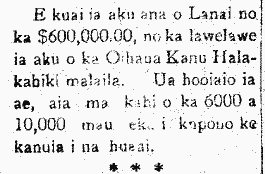
Ua ike aku na kanaka i ike ole mamua...

Ka Nupepa Kuokoa, Buke LXII, Helu 17, Aoao 2. Aperila 26, 1923.

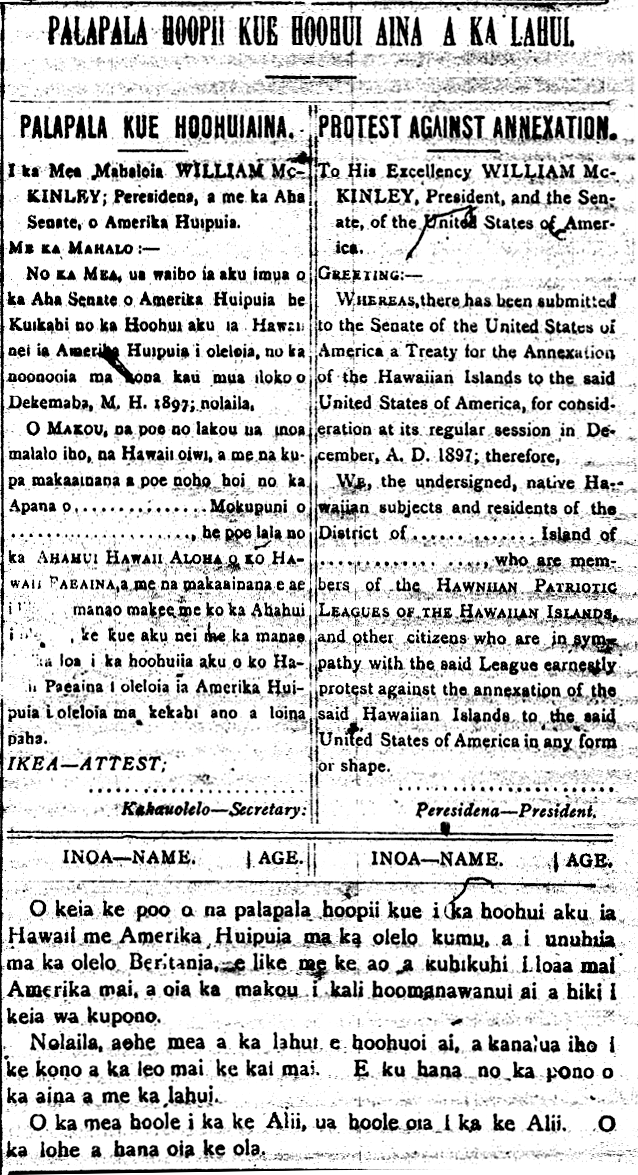
PETITION OF THE PEOPLE PROTESTING AGAINST ANNEXATION, 1897.

PALAPALA HOOPII KUE HOOHUI AINA A KA LAHUI.

PALAPALA KUE HOOHUIAINA.

I ka Mea Mahaloia WILLIAM McKINLEY; Peresidena, a me ka Aha Senate, o Amerika Huipuia.

Me ka Mahalo:—

No ka Mea, ua waiho ia aku imua o ka Aha Senate o Amerika Huipuia he Kuikahi no ka Hoohui aku ia Hawaii nei ia Amerika Huipuia i oleloia, no ka noonoooia ma kona kau mua iloko o Dekemaba, M. H. 1897; nolaila,

O Makou, na poe no lakou na inoa malalo iho, na Hawaii oiwi, a me na kupa makaainana a poe nooho hoi no ka Apana o …………………….Mokupuni o ……………………., he poe lala no ka Ahahui Hawaii Aloha o ko Hawaii Paeaina, a me na makaainana e ae i like ka manao makee me ko ka Ahahui i oleloia, ke kue aku nei me ka manao ikaika loa i ka hoohuiia aku o ko Hawaii Paeaina i oleloia ia Amerika Huipuia i oleloia ma kekahi ano a loina paha.

IKEA—ATTEST:

…………………….

Kakauolelo—Secretary:

INOA—NAME.     Ι AGE.

PROTEST AGAINST ANNEXATION.

To His Excellency WILLIAM McKINLEY, President, and the Senate, of the United States of America.

Greeting:—

Whereas, there has been submitted to the Senate of the United States of America a Treaty for the Annexation of the Hawaiian Islands to the said United States of America, for consideration at its regular session in December, A. D. 1897; therefore,

We, the undersigned, native Hawaiian subjects and residents of the District of …………………… Island of ……………………., who are members of the Hawaiian Patriotic Leagues of the Hawaiian Islands, and other citizens who are in sympathy with the said League earnestly protest against the annexation of the said Hawaiian Islands to the said United States of America in any form or shape.

…………………….

Presidena—President.

INOA—NAME.     Ι  AGE.

This is the heading of the petitions protesting the annexation of Hawaii to the United States of America in the original language, and translated into English, and as per the instruction and direction coming from America, we waited patiently until this proper time.

Therefore, there is nothing for the lahui to be suspicious about, or to be wary when the voice from the sea beckons. Stand up and do what is pono for the land and the people.

The person who denies that of the Alii denies that of the Alii [this is probably a typo that should have read, “O ka mea hoole i ka ke Alii, ua hoole oia i ka ke Akua,” The person who denies that of the Alii denies that of God]. Listening and acting is the way to survival.

[Check here for the images of the anti-annexation petitions put up by the University of Hawaii, Hamilton Library, Hawaiian Collection.]

(Aloha Aina, 9/18/1897, p. 5)

PALAPALA HOOPII KUE HOOHUI AINA A KA LAHUI.

Ke Aloha Aina, Buke III, Helu 38, Aoao 5. Sepatemaba 18, 1897.

Mauna a Kea, Moana a Kea: Hawaii nei is sacred in its entirety, from the sun above to the land and ocean below. 1866 / today and the future.

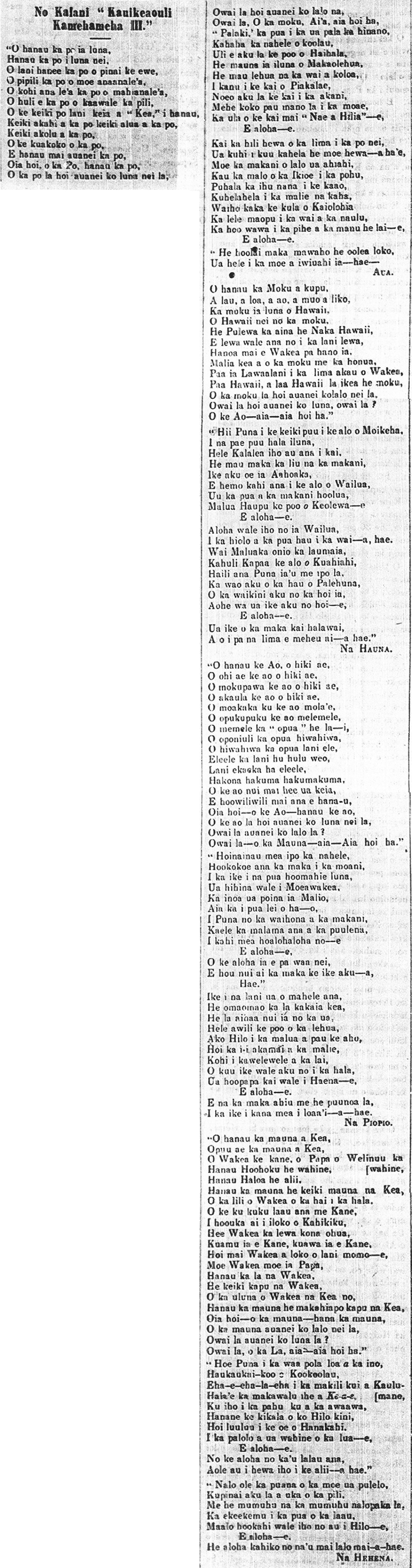
No Kalani “Kauikeaouli Kamehameha III.”

“O hanau ka po ia luna,
Hanau ka po i luna nei,
O lani hanee ka po o pinai ke ewe,
O pipili ka po o moe anaanale’a,
O kohi ana le’a ka po o mahianale’a,
O huli e ka po o kaawale ka pili,
O ke keiki po lani keia a “Kea,” i hanau,
Keiki akahi a ka po keiki alua a ka po,
Keiki akolu a ka po,
O ke kuakoko o ka po,
E hanau mai auanei ka po,
Oia hoi, o ka Po, hanau ka po,
O ka po la hoi auanei ko luna nei la,
Owai la hoi auanei ko lalo na,
Owai la, O ka moku, Ai’a, aia hoi ha,
“Palaki,” ka pua i ka ua pala ka hinano,
Kahaha ka nahele o koolau,
Uli e aku la ke poo o Haihala,
He mauna ia iluna o Makaolehua,
He mau lehua na ka wai a koloa,
I kanu i ke kai o Piakalae,
Noeo aku la ke kai i ka akani,
Mehe koko pau mano la i ka moae,
Ka ula o ke kai mai “Nae a Hilia”—e,
E aloha—e.

Kai ka hili hewa o ka lima i ka po nei,
Ua kuhi i kuu kahela he moe hewa—a ha’e,
Moe ka makani o lalo ua ahiahi,
Kau ka malo o ka Ikioe i ka pohu,
Puhala ka ihu nana i ke kaao,
Kuhelahela i ka malie na kaha,
Waiho kaka ke kula o Kaiolohia,
Ka lele maopu i ka wai a ka naulu,
Ka hoo wawa i ka piha a ka manu he lai—e,
E aloha—e.

[Na] AUA.

O hanau ka Moku a kupu,
A lau, a loa, a ao, a muo a lilo,
Ka moku ia luna o Hawaii,
O Hawaii nei no ka moku,
He Pulewa ka aina he Naka Hawaii,
E lewa wale ana no i ka lani lewa,
Hanoa mai e Wakea pa hano ia,
Malia kea a o ka moku me ka honua,
Paa ia lawaalani i ka lima akau o Wakea,
Paa Hawaii, a laa Hawaii la ikea he moku,
O ka moku la hoi auanei kolalo nei la,
Owai la hoi auanei ko luna, owai la?
O ke Ao—aia—aia hoi ha.”

“Hii Puna i ke keiki puu i ke alo o Moikeha,
I na pae puu hala iluna,
Hele Kalalea iho au ana i kai,
He mau maka ka liu na ka makani,
Ike akuu oe ia Aahoaka,
E hemo kahi ana i ke alo o Wailua,
Uu ka pua a ka makani hoolua,
Malua Haupu ke poo o Keolewa—e
E aloha—e.

Aloha wale iho no ia Wailua,
I ka hiolo a ka pua hau i ka wai—a, hae,
Wai Maluaka onio ka laumania,
Kahuli Kapaa ke alo o Kuahiahi,
Haili ana Puna ia’u me ipo la,
Ka wao aku o ka hau o Palehuna,
O ka waikini aku no ka hoi ia,
Aohe wa ua ike aku no hoi—e,
E aloha—e.
Ua ike o ka maka kai halawai,
A o i pa na lima e meheu ai—a hae.”

Na HAUNA.

“O hanau ke Ao, o hiki ae,
O ohi ae ke ao o hiki ae,
O mokupawa ke ao o hiki ae,
O akaula ke ao o hiki ae,
O moakaka ku ke ao mola’e,
O opukupuku ke ao melemele,
O memele ka “opua” he la—i,
O oponiuli ka opua hiwahiwa,
O hiwahiwa ka opua lani ele,
Eleele ka lani hu hulu weo,
Lani ekaeka ha eleele,
Hakona hakuma hakumakuma,
O ke ao nui mai hee ua keia,
E hoowiliwili mai ana e hana-u,
Oia hoi—o ke Ao—hanau ke ao,
O ke ao la hoi auanei ko luna nei la,
Owai la auanei ko lalo la?
Owai la—o ka Mauna—aia—Aia hoi ha.”

“Hoinainau mea ipo ka nahele,
Hookokoe ana ka maka i ka moani,
I ka ike i na pua hoomahie luna,
Ua hihina wale i Moeawakea,
Ka inoa ua poina ia Malio,
Aia ka i pua lei o ha—o,
I Puna no ka waihona a ka makani,
Kaele ka malama ana a ka puulena,
I kahi mea hoalohaloha no—e,
E aloha—e,
O ke aloha ia e pa waa nei,
E hou nui ai ka maka ke ike aku—a,
Hae.”

Ike i na lani ua o mahele ana,
He omaomao ka la kakaia kea,
He la aihaa nui ia no ka ua,
Hele awili ke poo o ka lehua,
Ako Hilo i ka malua a pau ke aho,
Hoi ka i-i akamai a ka malie,
Kohi i kawelewele a ka lai,
O kuu ike wale aku no i ka hala,
Ua hoopapa kai wale i Haena—e,
E aloha—e.
E na ka maka ahiu me he puunoa la,
I ka ike i kana mea i loaa’i—a—hae.

Na PIOPIO.

“O hanau ka mauna a Kea,
Opuu ae ka mauna a Kea,
O Wakea ke kane, o Papa o Welinuu ka wahine,
Hanau Hoohoku he wahine,
Hanau Haloa he alii,
Hanau ka mauna he keiki mauna na Kea,
O ka lili o Wakea o ka hai i ka hala,
O ke ku kuku laau ana me Kane,
I hoouka ai i iloko o Kahikiku,
Hee Wakea ka lewa kona ohua,
Kuamu ia e Kane, kuawa ia e Kane,
Hoi mai Wakea a loko o lani momo—e,
Moe Wakea moe ia Papa,
Hanau ka la na Wakea,
He keiki kapu na Wakea,
O ka uluna o Wakea na Kea no,
Hanau ka mauna he makahiapo kapu na Kea,
Oia hoi—o ka mauna—hana ka mauna,
O ka mauna auanei ko lalo nei la,
Owai la auanei ko luna la?
Owai la, o ka La, aia—aia hoi ha.”

“Hoe Puna i ka waa pola loa a ka ino,
Haukaukai—koo o Kookoolau,
Eha—e—eha—la—eha i ka makili kui a Kaulumano,
Hala’e ka makawalu ihe a Ko-a-e,
Ku iho i ka pahu ku a ka awaawa,
Hanane ke kikala o ko Hilo kini,
Hoi luuluu i ke oe o Hanakahi,
I ka palolo a ua wahine o ka lua—e,
E aloha—e.
No ke aloha no ka’u lalau ana,
Aole au i hewa iho i ke alii—a hae.”

“Nalo ole ka puana o ka moe ua pulelo,
Kupinai aku la a uka o ka pili,
Me he mumuhu na ka mumuhu nalopaka la,
Ka ekeekemu i ka pua o ka laau,
Maalo hookahi wale iho no au i Hilo—e,
E aloha—e.
He aloha kahiko no na’u mai lalo mai—a—hae.

Na HEHENA.

(Kuokoa, 3/24/1866, p. 4)

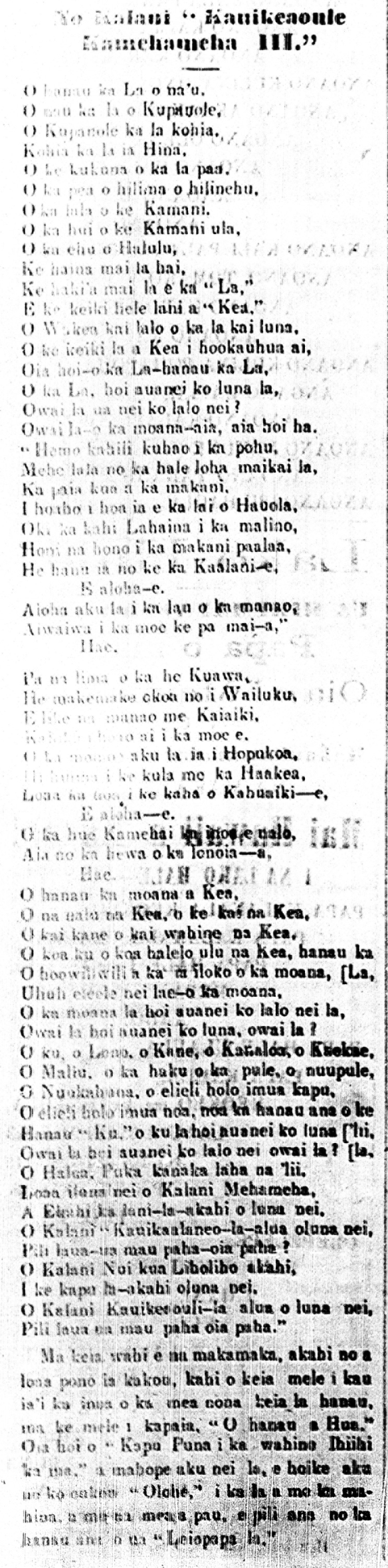
No Kalani "Kauikeaouli Kamehameha III."

Ka Nupepa Kuokoa, Buke V, Helu 12, Aoao 4. Maraki 24, 1866.

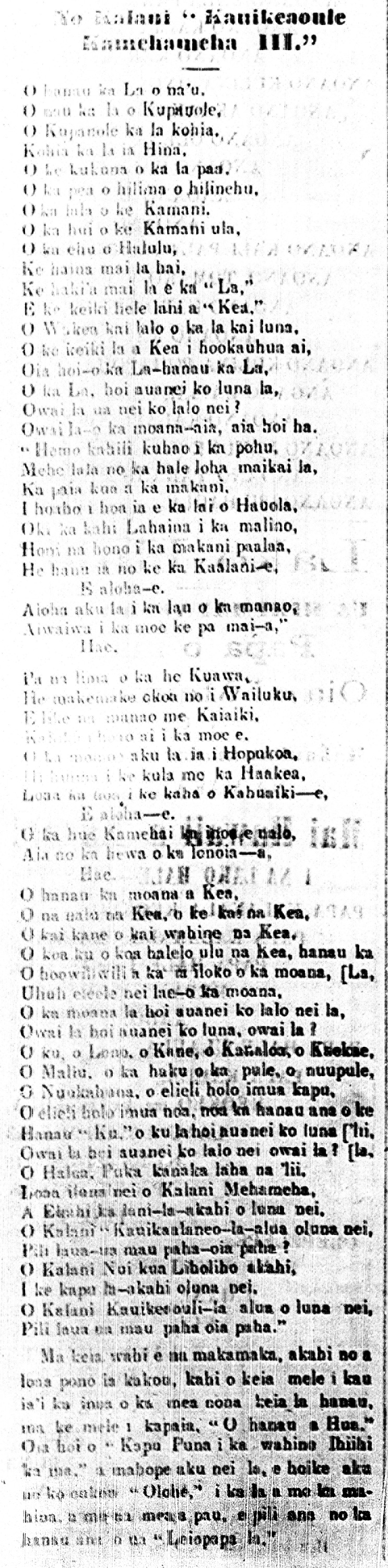
No Kalani “Kauikeaoule Kamehameha III.” [No Kalani “Kauikeaouli Kamehameha III.”]

O hanau ka La o na’u,
O nau ka la o Kupauole,
O Kupauole ka la kohia,
Kohia ka la ia Hina,
O ke kukuna o ka la paa,
O ka pea o hilima o hilinehu,
O ka lala o ke Kamani,
O ka hui o ke Kamani ula,
O ka ehu o Halulu,
Ke haina mai la hai,
Ke haki’a mai la e ka “La,”
E ke keiki hele lani a “Kea,”
O Wakea kai lalo o ka la kai luna,
O ke keiki la a Kea i hookauhua ai,
Oia hoi—o ka La—hanau ka La,
O ka La, hoi auanei ko luna la,
Owai la ua nei ko lalo nei?
Owai la—o ka moana—aia, aia hoi ha,
“Hemo kahili kuhao i ka pohu,
Mehe lala no ka hale loha maikai la,
Ka paia kua a ka makani,
I hoaho i hoa ia e ka lai o Hauola,
Oki ka kahi Lahaina i ka malino,
Honi na hono i ka makani paalaa,
He hanu ia no ke ka Kaalani—e,
E aloha—e.
Aloha aku la i ka lau o ka manao,
Aiwaiwa i ka moe ke pa mai—a,”
Hae.

Pa na lima o ka he Kuawa,
He makemake okoa no i Wailuku,
E like na manao me Kaiaiki,
Kahiko i hoao ai i ka moe e,
O ka momoe aku la ia i Hopukoa,
Hi hininu i ke kula me ka Haakea,
Loaa ka hoa i ke kaha o Kahuaiki—e,
E aloha—e.
O ka hue Kamehai ka inoa e nalo,
Aia no ka hewa o ka lonoia—a,
Hae.

O hanau ka moana a Kea,
O na nalu na Kea, o ke kai na Kea,
O kai kane o kai wahine na Kea,
O koa ku o koa halelo ulu na Kea, hanau ka La,
O hoowiliwili a ka ia iloko o ka moana,
Uliuli eleele nei lae—o ka moana,
O ka moana la hoi auanei ko lalo nei la,
Owai la hoi auanei ko luna, owai la?
O ku, o Lono, o Kane, o Kanalua, o Kaekae,
O Maliu, o ka haku o ka pule, o nuupule,
O Nuukahana, o elieli holo imua kapu,
O elieli holo imua noa, noa ka hanau ana o ke ‘lii,
Hanau “Ku” o ku la hoi auanei ko luna,
Owai la hoi auanei ko lalo nei owai la?
O Haloa, Puka kanaka laha na ‘liii,
Loaa iluna nei o Kalani Mehameha,
A Ekahi ka lani—la—akahi o luna nei,
O Kalani “Kauikaalaneo—la—alua oluna nei,
Pili laua—ua mau paha—oia paha?
O Kalani Nui kua Liholiho akahi,
I ke kapu la—akahi oluna nei,
O Kalani Kauikeaouli—la alua o luna nei,
Pili laua ua mau paha oia paha.”

Here O Friends is the first time we actually have the part of this mele in which is the name of the one whose birthday it is, in the mele called, “O hanau a Hua.” That being “Kapu Puna i ka wahine Ihiihi ka ma,” and after that, I, your “Expert,” will tell you of the day, and the months, and everything pertaining to the birthday of that “Leiopapa.”

[This genealogical mele for Kamehameha III was printed a number of times over the years in various Hawaiian-Language Newspapers. It was important enough back then, and it is just as important for us today, if not more so. The gods gave birth to all above and all below—it is all sacred. Let us treat all our land and ocean with that in mind.

Unfortunately much of the columns in which these appear are not digitized clearly, and are hard to read…]

(Kuokoa, 3/31/1866, p. 4)
No Kalani Kauikeaoule Kamehameha III."

Ka Nupepa Kuokoa, Buke V, Helu 13, Aoao 4. Maraki 31, 1866.


John Harbottle visits Hilo, 1943.

Just in Hilo.

This past week the kamaaina of the land renowned for the Apaapaa Wind, of Kohala with its hills that move along together, Kalahikiola and Pili, that is John Harbottle, and after some days he returned to his famous lands.

Looking at him, he is still in good health, he has not changed, as if it is still in the days of his youth, when I first met him 27 years ago, when I arrived in his famous aina.

He spent some days with his daughter and son-in-law, Mr. and Mrs. Eddie Nelson, of Keaukaha.

(Hoku o Hawaii, 9/8/1943, p. 1)

Ka Hoku o Hawaii, Volume XXXVIII, Number 20, Aoao 1. Sepatemaba 8, 1943.

Ka Hoku o Hawaii, Volume XXXVIII, Number 20, Aoao 1. Sepatemaba 8, 1943.

Walter McBryde purchases Kukuiolono, 1907.

[Found under: “COMMERCIAL NEWS By Daniel Logan”]

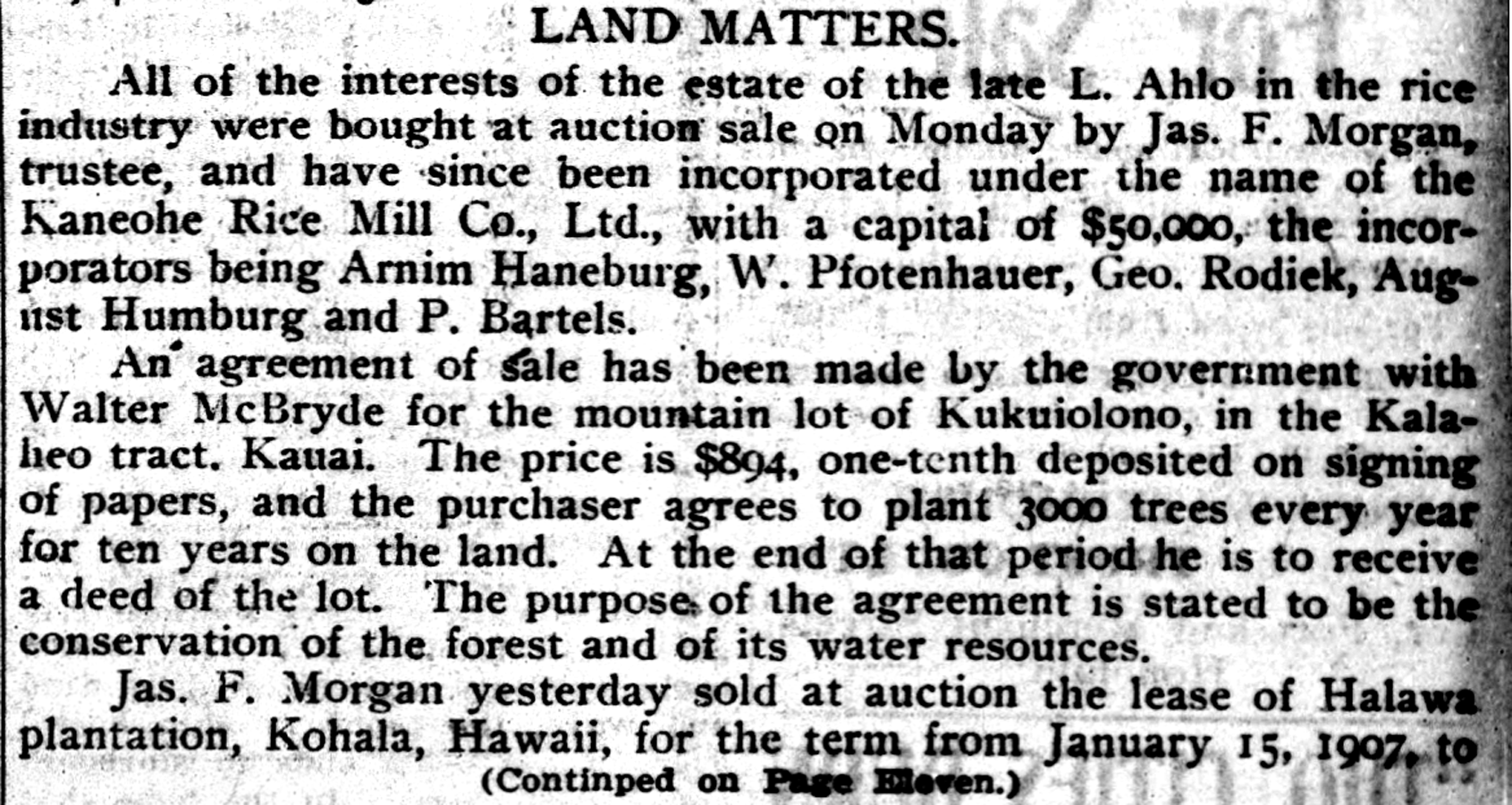
LAND MATTERS.

All of the interests of the estate of the late L. Ahlo in the rice industry were bought at auction sale on Monday by Jas. F. Morgan, trustee, and have since been incorporated under the name of Kaneohe Rice Mill Co., Ltd., with a capital of $50,000, the incorporators being Arnim Haneburg, W. Pfotenhauer, Geo. Rodiek, August Humburg and P. Bartels.

An agreement of sale has been made by the government with Walter McBryde for the mountain lot of Kukuiolono, in the Kalaheo tract, Kauai. The price is $894, one-tenth deposited on signing of papers, and the purchaser agrees to plant 3000 trees every year for ten years on the land. At the end of that period he is to receive a deed of the lot. The purpose of the agreement is stated to be conservation of the forest and of its water resources.

…..

(Sunday Advertiser, 1/13/1907, p. 4)

LAND MATTERS.

Sunday Advertiser, Volume V, Number 211, Page 4. January 13, 1907.

Government Proclamation, 1874.

[Found under: “BY AUTHORITY.”]

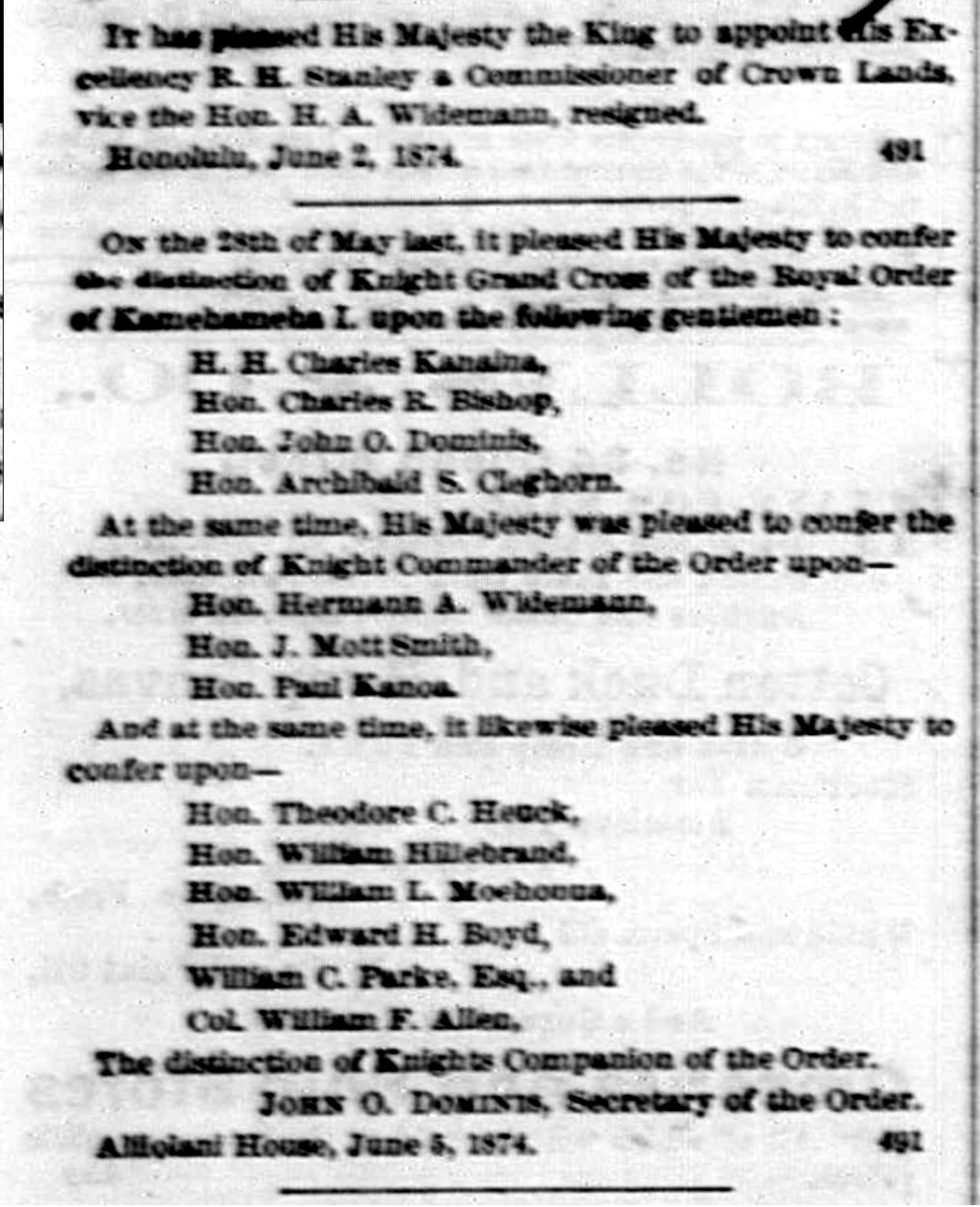
It has pleased His Majesty the King to appoint His Excellency R. H. Stanley a Commissioner of Crown Lands, vice the Hon. H. A. Widemann, resigned.

Honolulu, June 2, 1874.

On the 28th of May last, it pleased His Majesty to confer the distinction of Knight Grand Cross of the Royal Order of Kamehameha I. upon the following gentlemen:

H. H. Charles Kanaina,

Hon. Charles R. Bishop,

Hon. John O. Dominis,

Hon. Archibald S. Cleghorn.

At the same time, His Majesty was pleased to confer the distinction of Knight Commander of the Order upon—

Hon. Hermann A. Widemann,

Hon. J. Mott Smith,

Hon. Paul Kanoa.

And at the same time, it likewise pleased His Majesty to confer upon—

Hon. Theodore C. Heuck,

Hon. William Hillebrand,

Hon. William L. Moehonua,

Hon. Edward H. Boyd,

William C. Parke, Esq., and

Col. William F. Allen.

The distinction of Knights Companion of the Order.

John O. Dominis, Secretary of the Order.

Aliiolani House, June 5, 1874.

(Hawaiian Gazette, 6/10/1874, p. 2)

It has pleased His Majesty...

Hawaiian Gazette, Volume X, Number 23, Page 2. June 10, 1874.

Government Proclamation, 1874.

Na ke Aupuni.

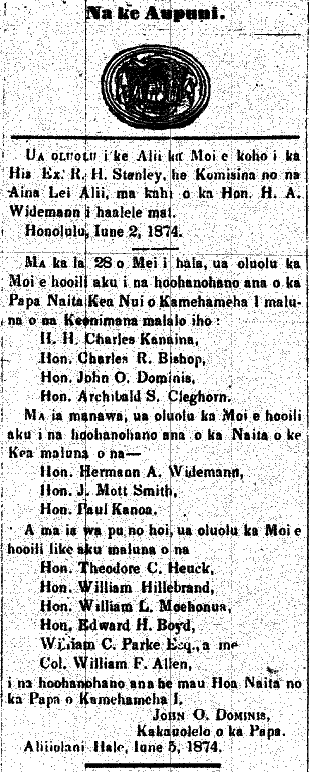
Ua oluolu i ke Alii ka Moi e koho i ka His Ex. R. H. Stanley, he Komisina no na Aina Lei Alii, ma kahi o ka Hon. H. A. Widemann i haalele mai.

Honolulu, Iune 2, 1874.

———

Ma ka la 28 o Mei i hala, ua oluolu ka Moi e hooili aku i na hoohanohano ana o ka Papa Naita Kea Nui o Kamehameha I maluna o na Keonimana malalo iho:

H. H. Charles Kanaina,

Hon. Charles R. Bishop,

Hon. John O. Dominis,

Hon. Archibald S. Cleghorn.

Ma ia manawa, ua oluolu ka Moi e hooili aklu i na hoohanohano ana o ka Naita o ke Kea maluna o na—

Hon. Hermann A. Widemann,

Hon. J. Mott Smith,

Hon. Paul Kanoa.

A ma ia wa pu no hoi, ua oluolu ka Moi e hooili like aku maluna o na

Hon. Theodore C. Heuck,

Hon. William Hillebrand,

Hon. William L. Moehonua,

Hon. Edward H. Boyd,

William C. Parke Esq., a me

Col. William F. Allen,

i na hoohanohano ana he mau Hoa Naita no ka Papa o Kamehameha I.

John O. Dominis,

Kakauolelo o ka Papa.

Aliiolani Hale, Iune 5, 1874.

(Ko Hawaii Ponoi, 6/10/1874, p. 3)

Na ke Aupuni.

Ko Hawaii Ponoi, Buke I, Helu 52, Aoao 3. Iune 10, 1874.

A description of Honokohau, Maui, 1872.

The Features of Honokohau.

O Nupepa Kuokoa; Aloha oe:

May it please you and your Editor to insert this bundle of aloha in some open space of your depository, and it will be for you to share it amongst our masses.

Looking at the lay of the land, it is a beautiful place indeed; there is a deep river, and there is much taro; the area planted with kalo is approximately 5 miles long.

Pertaining to the evenness of the land.—The flat lands here are on the east side of the river, that being the famous plains of Kalaulaolao, and a mele for this fame is written of by the people of old.

Pertaining to the crops.—Things that are planted grow stuntedly [kakanalii] because of aphids [Eleao]; talk of the Eleao is all over Hilo Paliku. Continue reading