Chinese New Year, 1911.

HAPPY NEW YEAR OF THE CHINESE

This coming Friday, February 7th, is the Happy New Year Day and Konohi of the Chinese. The Bow Wong Wui, the Chinese Reform Society is preparing to give on that day a great feast, and on that same day, some leaders of the group will give speeches on the reason for separating themselves from the leadership of China’s traditional government. However, it would seem that there will not be as grand a commemoration as the previous year because of the difficulty in obtaining funds now.

(Aloha Aina, 1/11/1907, p. 7)

LA HAPE NUIA O NA PAKE

Ke Aloha Aina, Buke VIII, Helu 2, Aoao 7. Ianuari 11, 1902.

More the celebrating the better? 1915.

[Found under: “Na Kuhinia o ka Manawa.”]

The celebration [hi’uwai] of the people of China [Aina Pua] is approaching, but perhaps there will only be a few because New Years was celebrated by some Chinese on this past New Years Day.

[Konohi is the lunar calendar new year. It probably comes from the Hawaiianization of the Chinese Kung Hei as in Kun Hei Fat Choi (恭喜發財).]

(Aloha Aina, 2/6/1915, p. 3

Ke hookokoke mai nei...

Ke Aloha Aina, Buke XIX, Helu 71, Aoao 3. Feberuari 6, 1915.

Hawaiian boys headed to China to play music, 1916.

[Found under: “LOCAL AND GENERAL”]

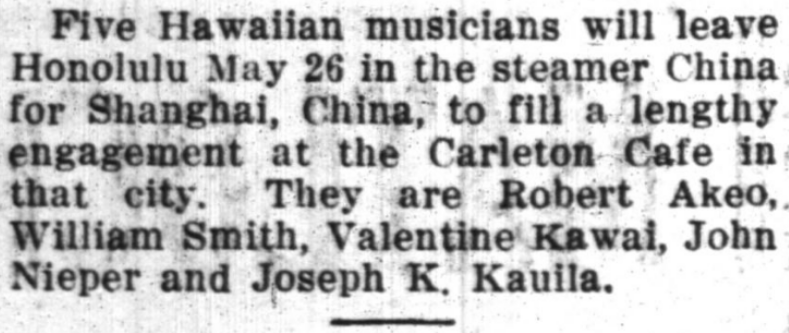
Five Hawaiian musicians will leave Honolulu May 26 in the steamer China for Shanghai, China, to fill a lengthy engagement at the Carleton Cafe in that city. They are Robert Akeo, William Smith, Valentine Kawai, John Nieper and Joseph K. Kauila.

(Honolulu Star-Bulletin, 5/9/1916, p. 3)

Five Hawaiian musicians...

Honolulu Star-Bulletin, Volume XXIII, Number 7511, Page 3. May 9, 1916.

Hawaiians singing in far away China, 1917.

THERE IS GREAT DELIGHT IN HAWAIIAN MUSIC IN CHINA.

In a letter written by Robert Akeo, a Hawaiian boy who travelled to Shanghai, China, with his companions to sing under contract, it is seen that there is much admiration for Hawaiian music in China, because their contract to play there was over long ago, and yet, they are constantly being asked to satisfy the desires of those people for Hawaiian music and hula.

It seems in order to fulfill the wishes of Shanghai’s people for hula, one of the boys was made into a woman by putting on women’s clothing, and he would dance with one of his fellow boys, while the rest of them play music, and they sing and dance at the same time.

There are some thousands of people in Shanghai who have no knowledge of Honolulu, but after hearing the singing voices, and seeing the act of those young ones, the desire to come visit Honolulu and see the Paradise of the Pacific grew within them.

(Kuokoa, 2/2/1917, p. 8)

NUI KA HIALAAIIA O NA MELE HAWAII MA KINA.

Ka Nupepa Kuokoa, Buke LV, Helu 5, Aoao 8. Feberuari 2, 1917.

Mary Mahiai, the original story, in English, 1901.

ROMANTIC HISTORY OF MARY MAHIAI

PROBABLY the most interesting woman in all Hawaii is the white-haired old wahine of four-score and ten, or thereabouts, who answers to the name of Mary Mahiai.

Last week an intricate land case came up in Judge Gear’s court and Mary Mahiai was summoned to appear as a witness, her testimony being relied upon to establish the validity of certain patents to extensive and valuable lands, the ancient boundaries of which were in dispute.

The old lady scorned the services of the interpreter on the witness stand and proceeded with her own story in good English astonishing the court and silencing the lawyers as, with Hawaiian freedom of gesture and animated features, she related the details of a most remarkable career.

It developed that she was born on the Island of Kauai before the coming of the first missionary, the arrival of Rev. Hiram Bingham being distinctly within her memory; at the age of seven years, little Mahiai, whose name (meaning “Working in the taro”) had been given her by her mother, went out in a rowboat with her uncle and five other men, starting for Molokai, to “go look see.” A storm came up and the boat was driven out of sight of land, its occupants having no food or drink with them, and suffering terribly from the pangs of hunger and thirst: for ten days and nights they drifted, becoming crazed and unable to cry out, and at last, when all hopes had been abandoned, and it was certain that the frail boat would go to pieces before the end of another day, a sail appeared upon the horizon and the faint outcries and feeble signals of the seven unfortunates attracted the attention of a sailor on board the ship, which was a sailing vessel bound for China. The six men and the little girl were taken on board and treated kindly. When the little girl was able to be about she was given the task of taking care of the captain’s little daughter, and the men were put to work on the ship; the vessel put in at Ladrone Islands, and by their own desire, the five men who had set out with little Mahiai and her uncle, were put ashore. It was afterwards learned that they were eaten by cannibals. Continue reading

Mrs. Akioka passes away, 1928.

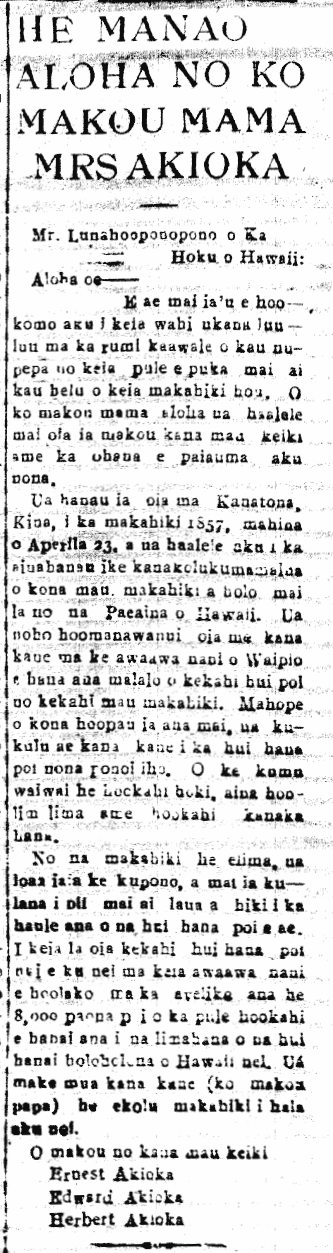
A LOVING SENTIMENT FOR OUR MAMA, MRS. AKIOKA

Mr. Editor of Ka Hoku o Hawaii:

Aloha oe—

Please allow to include this sad parcel in some space in your newspaper to be published this week, in the issue of this new year. Our beloved mother left us, her children and family to grieve for her.

She was born in Canton, China, in 1857, in the month of April 23, and left her homeland when she was thirty-two years old and came to the Hawaiian Islands. She lived patiently with her husband in the beautiful valley of Waipio working under a poi company for several years. After this, her husband started his very own poi company. His capital was a single mule, some leased land, and a hired hand.

He did well for five years, and at that point, the two of them grew until the other poi companies dropped off. Today, it is one of the big poi factories of this beautiful valley supplying on the average 8,000 pounds of poi every week, feeding the workers of the ranches of Hawaii nei. Her husband (our father) died three years ago.

We are her children

Ernest Akioka

Edward Akioka

Herbert Akioka

(Hoku o Hawaii, 1/17/1928, p. 3)

HE MANAO ALOHA NO KO MAKOU MAMA MRS AKIOKA

Ka Hoku o Hawaii, Buke XXI, Helu 33, Aoao 3. Ianuari 17, 1928.

Mr. Akioka, a Chinese taro farmer/poi maker, dies, 1922.

AKIOKA PASSES AWAY.

MR. AKIOKA (CHINESE)

Mr. Editor of the Kuokoa Newspaper, Aloha kaua:—Please kindly allow me an open space of your newspaper, for our loved one, our father has left us, his children and his wife; he has peacefully left for that realm we must all go to.

He had a swelling sickness, and the doctor was fetched, but he did not get any relief and died.

Our father was born in the “land of flowers,” China, on the 30th of November, 1851, and he left us on the 18th of May, 1922; he was over 71 years old. Continue reading

Sun Yat Sen arrives, 1903.

Doctor Sun Yet Sen [Sun Yat Sen].

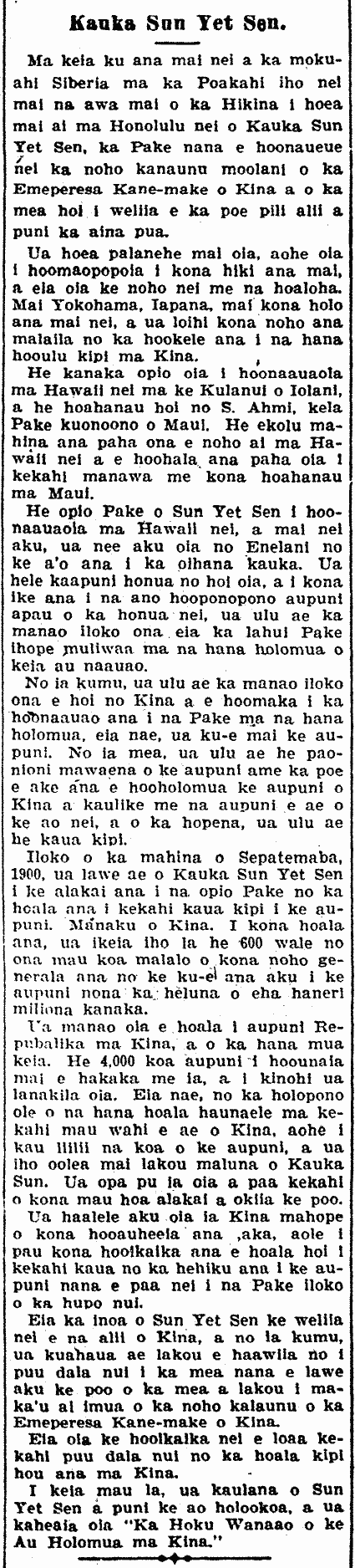
With the arrival of the steamship Siberia this past Monday from the ports of the East, Doctor Sun Yat Sen arrived in Honolulu, the Chinese man who is shaking the hereditary throne of the Empress Dowager of China, and the one who is feared by those  loyal to the throne all over China [aina pua].

He came quietly; it was not known that he was coming, and here he is staying with a friend. He came from Yokohama, Japan, where he was living for a long time to plan an uprising in China.

He is a young man educated in Hawaii nei at the College of Iolani, and he is a cousin of S. Ahmi, that wealthy Chinese man of Maui. He will perhaps be here for three months in Hawaii, and he will maybe spend some time with his cousin in Maui.

Sun Yat Sen is a young Chinese educated in Hawaii, and from here, he moved to England to study medicine. He travelled around the world, and after seeing the different governments of the world, he realized that here are the Chinese at the rear of progress in this age of enlightenment.

Because of this, within him grew the thought to return to China to start to educate the Chinese in things of progress, however, the government resisted. Therefore, there grew a struggle between the government and the people who want the nation of China to move forward and be equal to the other countries of the world; and this resulted in the start of a revolution.

In the month of September 1900, Sun Yat Sen took the leadership of young Chinese in starting a revolutionary war against the government. The Manchu [Manaku] of China. When he began the uprising, it was found that he only had 600 soldiers under his leadership for this revolution against the government with a population of four hundred million people

He decided to create a Republic in China, and this was his first act. 4,000 soldiers were sent to fight against him, and in the beginning, he was winning. However, because the inciting of uprisings in other places in China did not go well, the government soldiers were not dispersed, and so they came down in force upon Doctor Sun. He was crushed and some of his fellow leaders were captured and beheaded.

He fled from China after being routed, however, this did not end his efforts to incite a revolution to crush the government which holds the Chinese people in stupidity.

This name of Sun Yat Sen is feared by the royalty of China, and therefore, they proclaimed that a great sum of money will be given to the person who brings the head of that person who they fear before the throne of the Empress Dowager of China.

He is putting effort into raising substantial funds to start a new revolution in China.

These days, Sun Yat Sen is famous all over the world, and he is called the “Morning Star of the Progressive Era of China.”

(Kuokoa, 10/16/1903, p. 8)
Kauka Sun Yet Sen.

Ka Nupepa Kuokoa, Buke XLI, Helu 42, Aoao 8. Okatoba 16, 1903.

Ti ka char sow san nin fat choi? 1866.

Aloha La Konohi!

Is there anyone that knows what dialect the Chinese lines are from in the previous mele post?

Also, might there be someone that might offer an interpretation or translation for the Chinese lines?

1 La hauoli a pomaikai,
No ka lahui o Kina,
Ti ka char sow san nin fat choi
No ka makahiki hou,
Hape Nuia. Hape Nuia &co
E na makamaka nei.

2 Ke hui mai nei na kalepa
O ko Kina poe gentlemen,
Me ka lakou mau ladies no
A hauoli hoomaikai,
Ti ka kon hi. Ti ka kon hi, &co
And san nin Tat-i.

3 Na makua o keia hui
Me na keiki a lakou,
A pomaikai na mea a pau
Keia makahiki hou,
Choi tan qui sow. Choi tan qui sow
Hooili ia lakou.

4 Na ke Akua ma ka lani
Nana e hoomaikai mai
O keia hui ko Kina poe
E noho ma Hawaii nei,
Haleluia. Haleluia
No ka Haku ola mau.

5 Na Keonimana me na Lady
E aloha kakou a pau,
No ko kakou olioli,
Ka la nu Lahui o Kina,
Huro kakou! Huro kakou!!
A hauoli pu.

Chinese New Year song in Lahaina, 1866.

[Found under: “Ka Happy New Year o na Pake”]

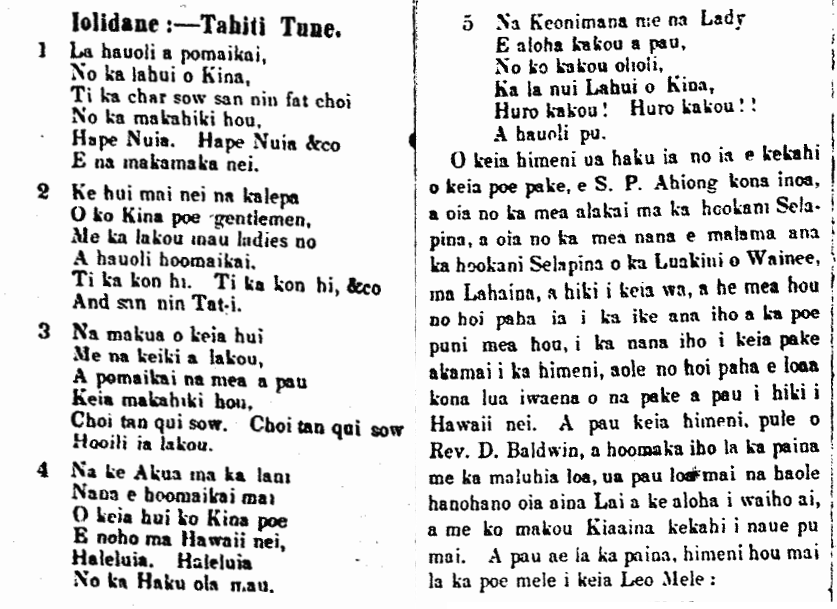
Iolidane:—Tahiti Tune.

1 La hauoli a pomaikai,
No ka lahui o Kina,
Ti ka char sow san nin fat choi
No ka makahiki hou,
Hape Nuia. Hape Nuia &co
E na makamaka nei.

2 Ke hui mai nei na kalepa
O ko Kina poe gentlemen,
Me ka lakou mau ladies no
A hauoli hoomaikai,
Ti ka kon hi. Ti ka kon hi, &co
And san nin Tat-i.

3 Na makua o keia hui
Me na keiki a lakou,
A pomaikai na mea a pau
Keia makahiki hou,
Choi tan qui sow. Choi tan qui sow
Hooili ia lakou.

4 Na ke Akua ma ka lani
Nana e hoomaikai mai
O keia hui ko Kina poe
E noho ma Hawaii nei,
Haleluia. Haleluia
No ka Haku ola mau.

5 Na Keonimana me na Lady
E aloha kakou a pau,
No ko kakou olioli,
Ka la nu Lahui o Kina,
Huro kakou! Huro kakou!!
A hauoli pu.

[Jordan [?]:—Tahiti Tune.
1 Joyous and blessed day,
For the Chinese people,
Ti ka char sow san nin fat choi
For the new year,
Happy New Year. Happy New Year &co
O Friends here.
2 The merchants have gathered
Of China’s gentlemen,
Along with their ladies
And blessed happiness
Ti ka kon hi. Ti ka kon hi, &co
And sun nin Tat-i.
3 The elders of this group
Along with their children,
Blessed is everyone
This new year,
Choi tan qui sow. Choi tan qui sow.
Onto them.
4 It is God in heaven
Who will bless them
This group of China’s people
Living in Hawaii nei,
Hallelujah, Hallelujah
For the eternal Lord.
5 The Gentlemen and Ladies
Aloha amongst all of us,
For our joy,
The holiday of the Chinese people,
Hurrah to us! Hurrah to us!!
And happiness too.]

This song was composed by one of these Chinese; S. P. Ahiong is his name, and he is the director in the playing of the Seraphim [Selapina], and he holds Seraphim concerts in the Wainee Church in Lahaina until today, and it may be something novel to see for those who are into new things; seeing this skilled Chinese singer, he probably has no match amongst all the Chinese who have come to Hawaii nei. After this song, Rev. D. Baldwin gave a prayer and the banquet started with much calm; all of the respected haole of that Calm land which aloha has put forth, along with our Governor [Paulo Nahaolelua] who came by….

[This is just a portion of a much larger article describing the new year celebration in Lahaina. There are more mele!]

(Kuokoa, 3/3/1866, p. 4)

Iolidane

Ka Nupepa Kuokoa, Buke V, Helu 9, Aoao 4. Maraki 3, 1866.