“The Value of Hawaiʻi 2,” 2014 and beyond.

The last post reminded me of this newly released must read, The Value of Hawaiʻi 2: Ancestral Roots, Oceanic Visions, edited by Aiko Yamashiro and Noelani Goodyear-Kaʻōpua. This is a book of essays all of us should sit down with, and let it allow us to ask of ourselves now what we think is important for our island community and what it is we want to leave behind for the future and what then we must do in order to achieve this…

How can more of us protect and create waiwai, value, for coming generations?

Culturally-rich education. Holistic health systems. Organic farming and aquaculture. Creative and conscious urban development. Caring for one another across difference. Telling our stories.

Continuing the conversation of The Value of Hawai‘i: Knowing the Past, Shaping the Future, this new collection offers passionate and poignant visions for our shared futures in these islands. The fresh voices gathered in this book share their inspiring work and ideas for creating value, addressing a wide range of topics: community health, agriculture, public education, local business, energy, gender, rural lifestyles, sacred community, activism, storytelling, mo‘olelo, migration, voyaging, visual art, music, and the ‘āina we continue to love and mālama. By exploring connections to those who have come before and those who will follow after, the contributors to this volume recenter Hawai‘i in our watery Pacific world. Their autobiographical essays will inspire readers to live consciously and lead as island people.

Essay contributors: Jeffrey Tangonan Acido, Kamana Beamer, Makena Coffman, Sean Connelly, Elise Leimomi Dela Cruz-Talbert, Noelani Goodyear-Ka‘ōpua, Consuelo Agarpao Gouveia, Tina Grandinetti, John “Prime” Hina, Sania Fa‘amaile Betty P. Ickes, Bonnie Kahapea-Tanner, Joseph Keawe‘aimoku Kaholokula, Kainani Kahaunaele, Hi‘ilei Kawelo, Keone Kealoha, Dawn Mahi, Ryan Oishi, Jamaica Heolimeleikalani Osorio, Eri Oura, Mark Kawika Patterson, Hawane Rios, Cheryse Julitta Kauikeolani Sana, Dean Itsuji Saranillio, Lyz Soto, Cade Watanabe, Aiko Yamashiro, Matt N. Yamashita, and Aubrey Morgan Yee.


The Value of Hawaiʻi 2

The Value of Hawaiʻi 2

G. W. Kahiolo is G. W. Poepoe, the father of Joseph Mokuohai Poepoe, 1861.

Death announcements are not only death announcements, they are often histories and genealogical records and more!

From the last post for instance, we discover G. W. Kahiolo, the mysterious writer who is known as the writer of a few newspaper articles and most widely known for the story of Kamapuaa, is G. W. Poepoe, and therefore the father of not only Ben Poepoe, but also the father of Joseph Mokuohai Poepoe, the great historian, translator, newspaper editor, lawyer, politician, &c., &c…

Hawaiian-language versus English historical documents, 2014 and beyond.

When researching anything relating to Hawaii nei, it goes without saying that it is imperative that we look at the Hawaiian-language documents left by the people of old. However, it is important to look at all the other documents available to us written in other languages as well.

The three different articles covering the 100th birthday celebration of Kauikeaouli recently posted is a simple case in point. Each of the three supply information not provided by the other two. Continue reading

Manoa Valley? 1914.

Portrait of Manoa Valley Presented to the Captain of the Steamship Manoa

[Most of this article including the image of the portrait is not recognizable. I can somewhat make out:

“In the afternoon of this past Tuesday, between the hours of three to five, …..  a great number of Honolulu’s people touring the Manoa, and during this tour, the captain of the Manoa, Henry F. Weeden, showed a portrait of the valley…”

Hopefully someday soon, there will be funding enough to rescan the Hawaiian-Language Newspapers so that they will be available as clear images.]

(Kuokoa, 4/3/1914, p. 3)

Ke Kii o ke Awawa o Manoa i Haawi Makanaia Aku i ke Kapena o ka Mokuahi Manoa

Ka Nupepa Kuokoa, Buke LII, Helu 14, Aoao 3. Aperila 3, 1914.

Corrections and Comments, 2014.

Because the time put in on the summaries of the articles vary, oftentimes there will be misreadings and misinterpretations. If you come across any, please do comment! I think it will not only benefit me, but the people that might read this blog as well.

Also, if you have other information to add or questions for the public in regard to the post, please do comment as well!

And if you are interested in a particular post, you can view followup comments by clicking on the title of the post, and scrolling down. Comments are found beneath the post itself and will not show up unless you click on the title of the post.

See for instance from the other day: Political prisoners released by the Provisional Government, 1895.

Ti ka char sow san nin fat choi? 1866.

Aloha La Konohi!

Is there anyone that knows what dialect the Chinese lines are from in the previous mele post?

Also, might there be someone that might offer an interpretation or translation for the Chinese lines?

1 La hauoli a pomaikai,
No ka lahui o Kina,
Ti ka char sow san nin fat choi
No ka makahiki hou,
Hape Nuia. Hape Nuia &co
E na makamaka nei.

2 Ke hui mai nei na kalepa
O ko Kina poe gentlemen,
Me ka lakou mau ladies no
A hauoli hoomaikai,
Ti ka kon hi. Ti ka kon hi, &co
And san nin Tat-i.

3 Na makua o keia hui
Me na keiki a lakou,
A pomaikai na mea a pau
Keia makahiki hou,
Choi tan qui sow. Choi tan qui sow
Hooili ia lakou.

4 Na ke Akua ma ka lani
Nana e hoomaikai mai
O keia hui ko Kina poe
E noho ma Hawaii nei,
Haleluia. Haleluia
No ka Haku ola mau.

5 Na Keonimana me na Lady
E aloha kakou a pau,
No ko kakou olioli,
Ka la nu Lahui o Kina,
Huro kakou! Huro kakou!!
A hauoli pu.

Kaipoleimanu, okolehao, place names, and such, 1895 / 2014.

KAIPOLEIMANU.

This Tuesday, Captain Kalei of the Schooner Rob Roy, which is a schooner travelling between Honolulu nei and Molokai, was arrested for having an Okolehao jug containing liquor; there were a great many officers sent to the seaside to arrest the Captain of the schooner.

There was much found in a dark room: four gin jugs, two Whiskey jugs, but the majority found were bottles that were empty with no whiff of Okolehao.

One of the sailors of this ship, distanced himself with a dismal look on his face, and another scratched his head while looking pale.

When it was clear to an officer that he saw alcohol was brought into Honolulu town to be sold, and because of orders received by the officers, should there be a person or persons that were confirmed to have alcohol, they were to be taken to Jail [Halewai], that indeed is what happened as per what was ordered; and the officers and some others went along to the Jailhouse while bringing in a Demijohn [“basketry filled with a bottle”] containing some Okolehao; there was the stench of Ipoleimanu, and this made us recall these lines of mele.

He manao he aloha,
No Kaipoleimanu,
He manu ku’u hoa,
Noho mai ka nahele,
Iiwi a o uka,
Polena i kaua,
Ua ao Hanalei,
Anu au maeele,
[Ua anu hoi au
I ka ua noe anu
Na hau o Maihi
Au ana i ke kai
Na ulu o Weli
Punohu mai ana
E mapu mai ana
Ke ala o ka Hala
Hala o Mapuana
Honi ana i ka ihu
Ke ala pua rose
Hooheno i kuu poli
Naue kuu kino
Ko hiki ana mai
Haina ia ka puana
No ka ipo leimanu.]

¹Kaipoleimanu was during this time a slang for okolehao.

[I took a step back from “Hawaii’s Story,” but not too far. This mele by Queen Kapiolani for her King Kalakaua, Kaipoleimanu, is still widely sung today. But who today still knows that along with Hanalei, Maihi, Weli, and Mapuana, that Kaipoleimanu is a place on Kauai. In a Hawaii where we are so used to places called Diamond Head, Pearl City, Bowls, Sunset, Yokohama, and the like, is there value in re-membering more traditional names?

On that note, before i take some time away from these posts, i thought i would try a little survey. If you have the time, please think about the question rationally, then choose an answer or add one of your own. And as always, do feel free to leave comments in the box all the way at the bottom.]

(Oiaio, 8/23/1894, p. 3)

KAIPOLEIMANU.

Nupepa Ka Oiaio, Buke VII, Helu 25, Aoao 3. Augate 23, 1895.

Contemporary reactions to “Hawaii’s Story by Hawaii’s Queen”? 1898.

There was a question posed as to what sort of reaction the Hawaiian-language translation of “Hawaii’s Story by Hawaii’s Queen” was getting. What indeed were the people saying about it and the book in general in the “Aloha Aina” and the other papers, both Hawaiian and English (as well as in the papers outside of Hawaii)?

Now that might be a nice Master’s thesis, or perhaps someone receiving funding might consider this as a project for which to do in-depth research! Any takers?

[In the new edition of “Hawaii’s Story,” see also David Forbes’ introduction for coverage on this topic.]

More on Queen Emma, Leleonalani, 1866.

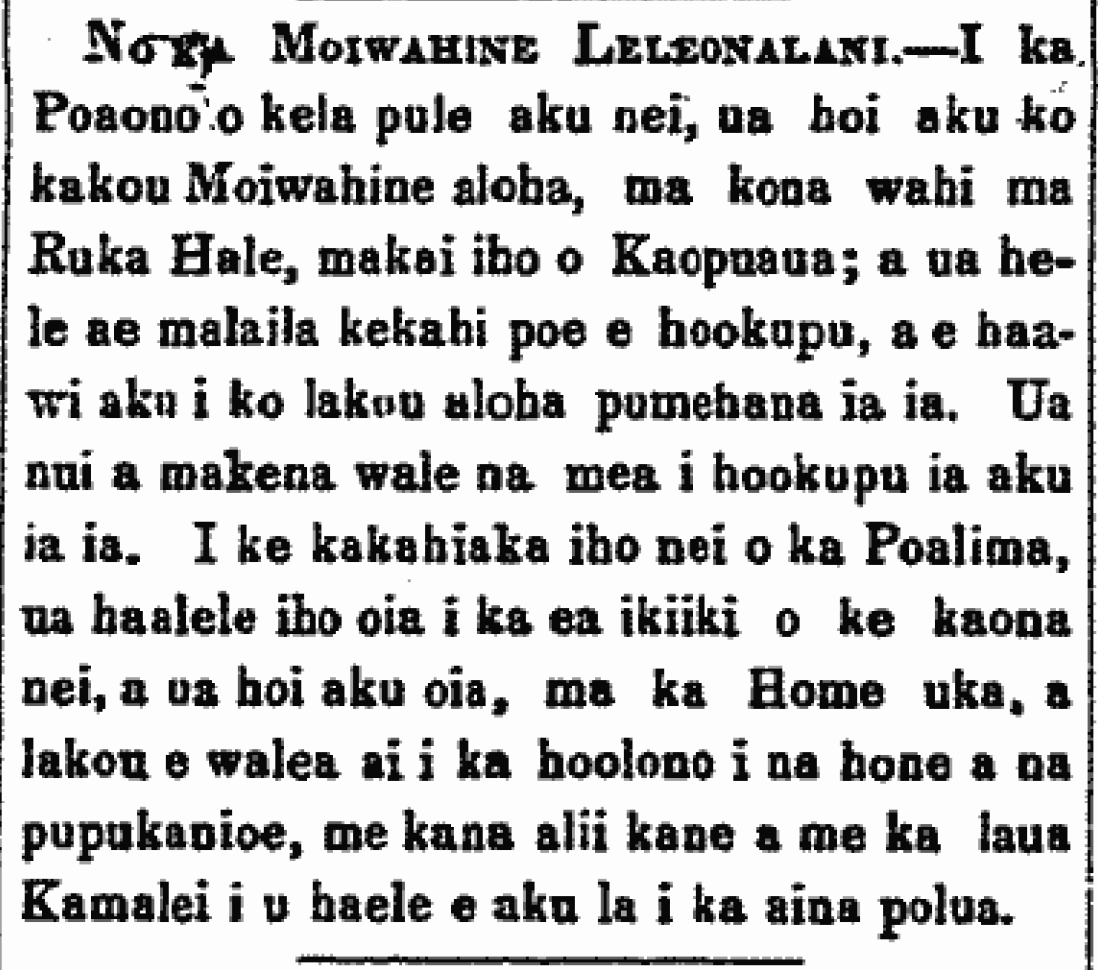
Pertaining to Queen Leleonalani.—This past Saturday, our beloved Queen returned to her residence Rooke House, seaside of Kaopuaua; and there many people went to give gifts [hookupu], and give their warm aloha to her. There was great and numerous hookupu given to her. This past Friday, she left the stifling air of town and returned to her Home in the uplands [Hanaiakamalama], where they relaxed to the sweet call of the singing snails [pupukanioe], and her royal husband and their beloved child who left for the dark lands.

[Here is another example where the initial “Ka” or “Ke” in a distinctive name is left off. Whereas Queen Emma is usually known as “Kaleleonalani,” here she is called “Leleonalani.” This works just as long as there is no confusion as to what or who is being referred to.

Kaumualii = Umualii, Kawaiahao = Waiahao, Kamoiliili = Moiliili, &c., &c., &c.]

(Au Okoa, 11/5/1866, p. 2)

No ka Moiwahine Leleonalani.

Ke Au Okoa, Buke II, Helu 29, Aoao 2. Novemaba 5, 1866.

Hauoli Makahiki Hou! 1906 / 2014.

Wishing you all a very happy 2014. This calendar is fashioned after the one given by the newspaper Aloha Aina in 1906 to its readers. It features a picture of the typesetters and the paperboys of the newspaper taken on December 30, 1905. Please feel free to save it onto your desktop and print it out and put it up on your wall or give it away to someone who you think will appreciate it!

I hope that with next year will come more exciting stories from the past which will encourage people to at least consider why the Hawaiian-Language Newspapers are important to us today and tomorrow. Perhaps it will encourage the individuals, agencies, and organizations who can benefit from the knowledge that the many, many kupuna thought important enough to entrust to the safekeeping of the pages of the Newspapers, to think about funding the rescanning as well as the conservation of the Newspapers, so that the information contained in them can be easily accessed by those of today and the generations to come…

2014 CALENDAR

2014 ALEMANAKA