Report on Jack Kaleiwahea, 1893.

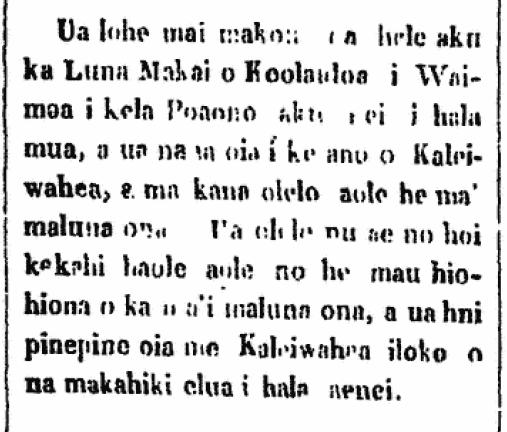
We’ve heard that the District Sheriff [Luna Makai] of Koolauloa went to Waimea this past Saturday, and saw the condition of Kaleiwahea, and according to him [the sheriff], he [Kaleiwahea] has no sickness. A haole also stated that he has no signs of the sickness upon him, and that he met with Kaleiwahea many times these past two years.

(Lei Momi: Oili Pule, 8/5/1893, p. 8)

Ua lohe mai makou...

Ka Lei Momi, He Nupepa Oili Pule, Buke I, Helu 1, Aoao 8. Augate 5, 1893.

Leprosy patients on the run, 1893.

The Heroes of Ewa.

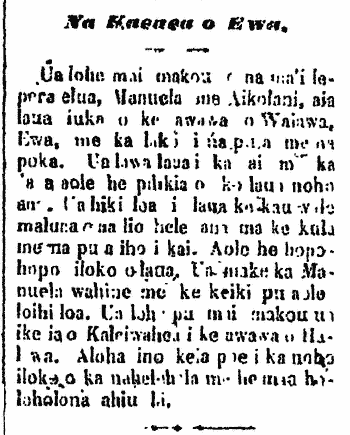
We have heard that the two leprosy patients, Manuela and Aikolani are in the uplands of Waiawa valley in Ewa, and that they are stocked with guns and bullets. The have enough fish and poi, and they have no difficulties with their living situation. They can just get on horses in the fields with their guns and go down to the sea. They have nothing to worry about. Manuel’s wife and child died long ago. We also hear that Kaleiwahea was seen in Halawa valley. How sad for these people living in the forests like wild animals.

[Here is yet another unclear digital image from a Hawaiian-Language Newspaper!]

(Lei Momi, 8/5/1893, p. 5)

Na Kaeaea o Ewa.

Ka Lei Momi (Oili Pule), Buke I, Helu 1, Aoao 5. Augate 5, 1893.

Queen Kapiolani’s visit to the leprosy colony, 1884.

While the entire report should be read because it is all so telling, I think many will find “Report of Her Majesty Queen Kapiolani’s visit to Molokai, by H. R. H. Princess Liliuokalani, July, 1884.” found in the Appendix to the Report on Leprosy of the President of the Board of Health to the Legislative Assembly of 1886, pp. iii–xvii, very interesting for many reasons.

More from Dr. Dwight Baldwin on the state of leprosy in Hawaii, 1865.

After reading the previous article in the Kuokoa signed D. Baldwin, read this statement from the same man dated just seven days after the article appeared, which is quoted on pp. 16–17 of “LEPROSY IN HAWAII: A Supplement to the Report of the President of the Board of Health,” 1886. Also, I just noticed that the original English of the Kuokoa article is shown, along with the places where portions were edited out (marked by asterisks) on pp. 15–16.

From Dr. D. Baldwin, Lahaina, April 20th, 1865.

“We have a foul and dangerous disease among us, and must, therefore, not quiet the fears of the public beyond what the truth will bear. The native population are not too much alarmed. In this region the healthy are often seen mingling with the leprous, which thing ought not so to be. In some of the extracts (of my letter in the Kuokoa) which you made, I have expressed myself strongly in favor of the curability of our Hawaiian leprosy, because I wished to turn the attention of natives from their ignorant and dangerous practitioners to foreign physicians. By extracting the paragraphs which utter this opinion, and omitting others, you make me seem to speak more confidently of future success in curing this disease than I intended to do; and therefore, I wish to add a few remarks by way of explanation; and,

“1. * * * The cases I was able to report are sufficient, I think, to encourage us to persevere in efforts to cure the frightful malady, and to banish it from the land. They should lead natives to look to those for help who alone can be supposed to have any means of combating so fearful a disease. They may be permanent cures, or the disease may break out more unmanageable than ever. Similar cures reported in other countries should encourage us.

“2. While I write thus hopefully, I am aware that men of the highest medical talent have studied the disease of leprosy, and they have sought for remedies, and many of them have pronounced it utterly incurable. It is certainly not a little staggering to our hopes in this matter, that while eminent physicians have bestowed so much attention, for many hundred years, and while the very remedies I have now been using have been used for ages in Asia and elsewhere, still there is a widespread belief that leprosy is an incurable disease. But there are authorities on the other side. An English medical dictionary has the finest descrip- I have ever met with of leprosy of the middle ages, which spread over Europe. The author says, recent cases may be cured. An eminent French physician says he has seen a multitude of cases of this disease treated without a single failure to cure. There is no way of accounting for such opposite opinions of great men, only by supposing that they are speaking of different species of the disease. * * * *

“As your China correspondent well observes (Feb. 25), we have now only a mild form of leprosy. But, it will, doubtless, in time assume more terrible features. Indeed, we have already had, in this place, some horrible cases. The disease has been considered in all countries, contagious. It has been so in Lahaina, though it does not appear in a new subject till a long time after exposure to its infection; and we have the proof of it in several families. We are beginning to have a crop of leprous young children.”

[It is important to read the information read by Hawaiians in the Hawaiian-Language Newspapers, but it is also important to read the English documents for a wider perspective on what happened historically.]

A cure for leprosy in Hawaii? 1865.

[For the Kuokoa]

Leprosy [“Chinese Disease”]

An Answer.

To you Doctor Gulick [Kauka Kulika]; Aloha oe:—

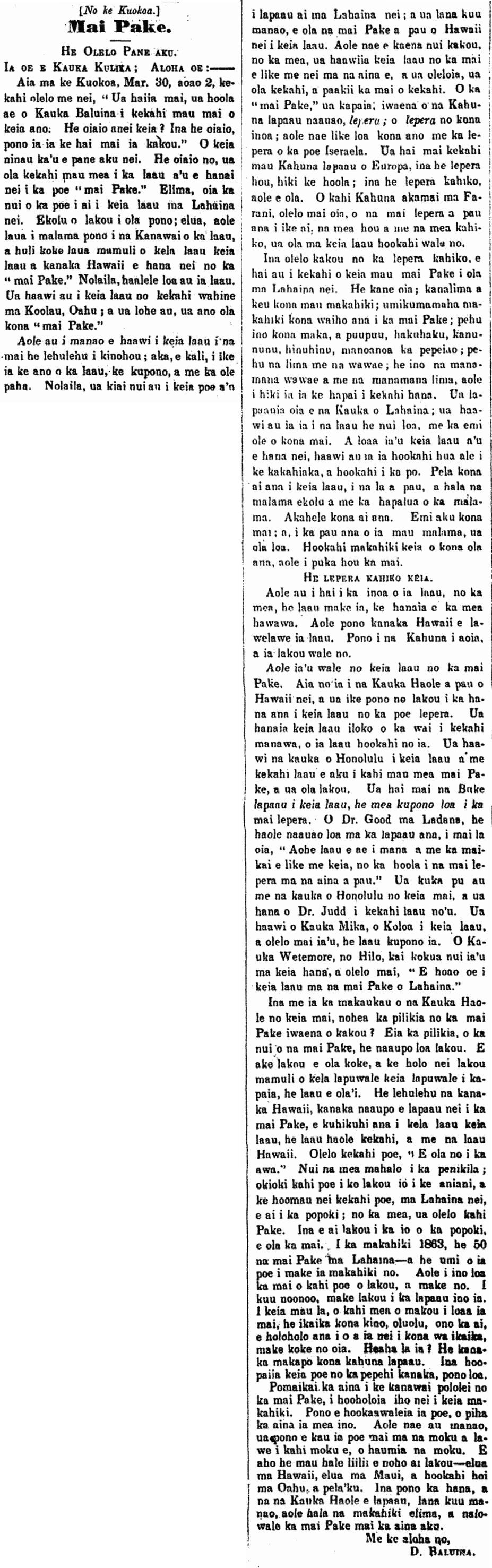
In the Mar. 30th issue of the Kuokoa, on page 2, there is a statement, “I have been told that Doctor Baldwin [Kauka Baluina] has cured some patients of this type. Is this true? If this is true, he should tell us.” It is to this question that I am responding to. It is indeed true, some people were cured with the medicine I am administering to those with the “Chinese disease.” Five are the number of those who ingested the medicine here in Lahaina. Three of them were totally cured; two, did not follow the instructions for the medicine and followed after this medicine and that medicine Hawaiians are taking for the “mai Pake.” Therefore, I’ve given up on that medicine [for those two]. I’ve given the medicine to a woman in Koolau, Oahu and I’ve heard that her “mai Pake” is somewhat better.

I did not consider prescribing this medicine to a great number of patients from the beginning; but instead to wait, and to see the affects of the medicine and if it was effective or not. Therefore, I watched carefully the people I cared after here in Lahaina; and I am hopeful that all the leprosy patients will be cured with this medicine. Let us not boast, for medicine like this has been given in other countries, and it is said that some have been cured while the illness of other has been persistent. The “Chinese disease” is referred to amongst enlightened Doctors [Kahuna lapaau] as leprosy [lepera]; leprosy is its name; however this is not the exact same thing as the leprosy of the Israelites. Some Doctors from Europe say that if this is a new leprosy, it is curable; if it is an ancient leprosy, it cannot be cured. A skilled Doctor from France, he says, all of the leprosy patients he has seen, both the new and ancient types, are curable only with this medicine.

If we are talking about ancient leprosy, I will mention one of these maii Pake cured in Lahaina. It is a man who is over fifty years of age; he was afflicted with mai Pake for fourteen years; his eyes were swollen, and his ears were knobby, lumpy, swollen, shiny, and thick; his feet and fingers were swollen, and he could do no work. He was treated by the Doctors of Lahaina; I gave him a lot of medicine, without his illness lessening. And I came upon this medicine I am working with, and gave him a pill in the morning and one at night. That is how he took this medicine every day, and three months and a half went by. He was careful in what he ate. His illness lessened; and after those months were over, his disease was entirely cured. This is now a year that he’s been cured, and the disease has not reappeared.

This is ancient leprosy.

I will not say what the name of this medicine is, for it is a poison if an unskilled one uses it. It would not be good if a Hawaiian prescribed this medicine. It is only for educated Doctors and just for them.

I am not the only one with this medicine for leprosy. All of the Haole Doctors in Hawaii have it, and they know well how to prescribe it for leprosy patients. This medicine is made into a liquid sometimes; it is the same medicine. The doctors of Honolulu have prescribed this medicine and other medicines to some leprosy patients, and they were cured. The medicine Book speaks of this medicine as good for leprosy. Dr. Good of London, a haole that is brilliant in doctoring says, “There is no other medicine that is as powerful and good for curing leprosy in all lands.” I spoke with the doctors of Honolulu about this illness, and Dr. Judd made some medicine for me. Doctor Smith [Mika] of Koloa prescribed this drug, and told me that it is a good medicine. Doctor Wetmore [Wetemore] of Hilo assisted me greatly in this effort, and said, “Try this medicine for the leprosy patients in Lahaina.”

If this is how prepared the Haole Doctors are for this disease, where does the problem lie with leprosy amongst us? Here is the problem; most of the leprosy patients are terribly simpleminded. They want to get cured quickly and follow after this or that foolishness called a medicine that works. There are many Hawaiians, uneducated people, who are treating leprosy, prescribing this medicine and that, haole medicine as well as Hawaiian medicine. One person says, “You will be cured with awa.” There are many who are fond of pain killers [penikila]; some cut their flesh with a piece of glass; and some here in Lahaina persist in eating cat, because some Chinese said, if they eat cat meat, they will be cured. In the year 1863, there were 50 leprosy patients in Lahaina—ten of them died that year. The illness of some of them was not that severe, but they died. In my opinion, they died because of bad medical treatment. These days, some of us who have this disease, they are strong and fine; they have an appetite, and go around here and there, but while they are strong, they die all of a sudden. What is tha about? His doctor is blind. It would be good to punish them for murder.

This land will be blessed by the good law for the leprosy patients that was passed this year. Those people must be segregated, or the land will be full of that horrible thing. I do not believe that it is right to put the patients on a ship and send them to another island, or the islands will become infested. It would be better that there be some small buildings where they are to live—two on Hawaii, two on Maui, and one on Oahu, and so forth. If it is done correctly, and if it is the Haole Doctor that does the treating, I am hopeful that in less than five years’ time, leprosy will be gone from the land.

With aloha,

D. Baldwin.

[Read this article, and then read the following post…]

(Kuokoa, 4/13/1865, p. 1)
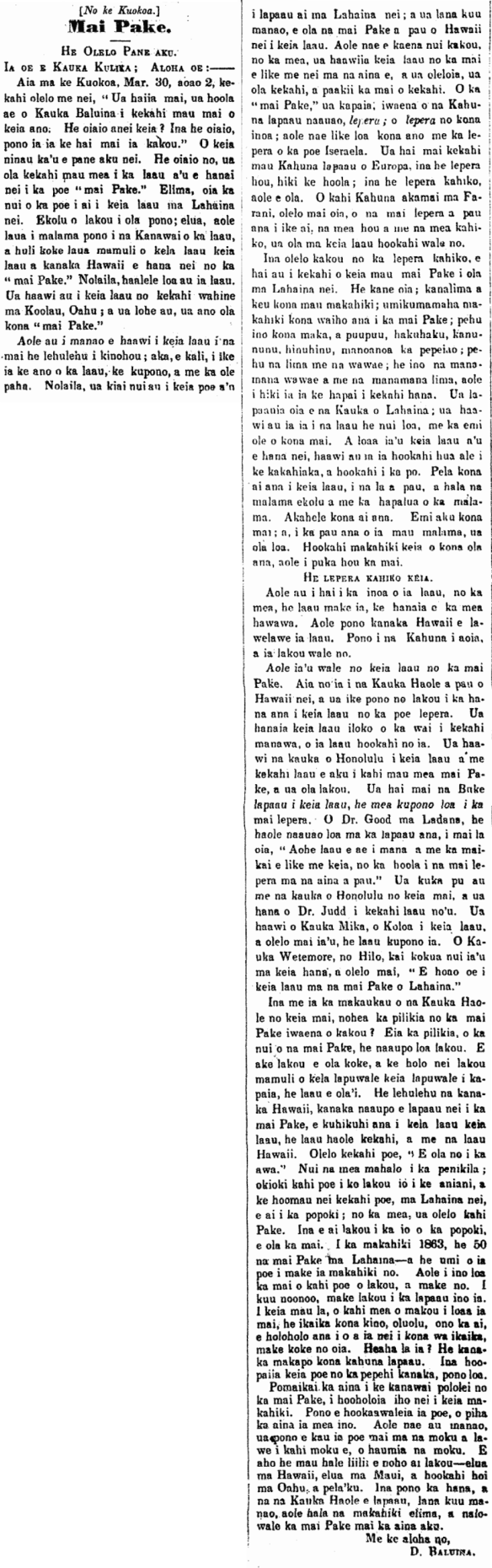
Mai Pake.

Ka Nupepa Kuokoa, Buke IV, Helu 15, Aoao 1. Aperila 13, 1865.
Vital Statistics Column, 1863.

BIRTHS.

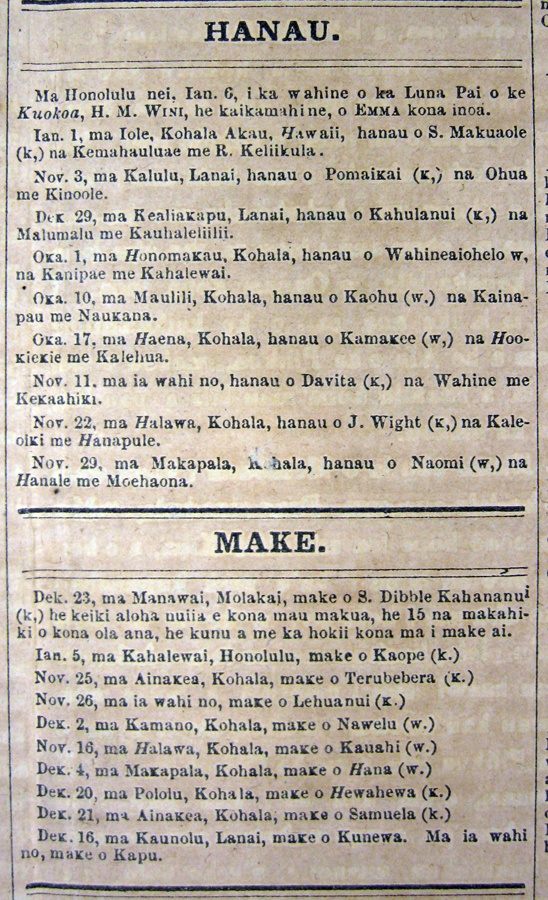
Here in Honolulu, Jan. 6, to the wife of the Head Printer of the Kuokoa, H. M. Whitney [Wini], a daughter by the name of Emma.
Jan. 1, at Iole, North Kona, Hawaii, born was S. Makuaole (m), of Kemahauluae and R. Keliikula.
Nov. 3, at Kalulu, Lanai, born was Pomaikai (m), of Ohua and Kinoole.
Dec. 29, at Kealiakapu, Lanai, born was Kahulanui (m), of Malumalu and Kauhaleliilii.
Oct. 1, at Honomakau, Kohala, born was Wahineaiohelo (f), of Kanipae and Kahalewai.
Oct. 10, at Maulili, Kohala, born was Kaohu (f), of Kainapau and Naukana.
Oct. 17, at Haena, Kohala, born was Kamakee (f), of Hookiekie and Kalehua.
Nov. 11, at the same place, born was Davita (m), of Wahine and Kekaahiki.
Nov. 22, at Halawa, Kohala, born was J. Wight (m), of Kaleoiki and Hanapule.
Nov. 29, at Makapala, Kohala, born was Naomi (f), of Hanale and Moehaona.

DEATHS.

Dec. 23, at Manawai, Molokai, S. Dibble Kahananui (m) died, a child greatly loved by his parents; he was 15 years old, and the illness he died of is coughing [kunu] and consumption [hokii].
Jan. 5, at Kahalewai, Honolulu, Kaope (m) died.
Nov. 25, at Ainakea, Kohala, Terubebera (m) died.
Nov. 26, at the same location, Lehuanui (m) died.
Dec. 2, at Kamano, Kohala, Nawelu (f) died.
Nov. 16, at Halawa, Kohala, Kauahi (f) died.
Dec. 4, at Makapala, Kohala, Hana (f) died.
Dec. 20, at Pololu, Kohala, Hewahewa (m) died.
Dec. 21, at Ainakea, Kohala, Samuela (m) died.
Dec. 16, at Kaunolu, Lanai, Kunewa died. At the same place, Kapu died.

(Kuokoa, 1/10/1863, p. 3)

HANAU. / MAKE.

Ka Nupepa Kuokoa, Buke II, Helu 2, Aoao 3. Ianuari 10, 1863.

Vital Statistics Column, 1863.

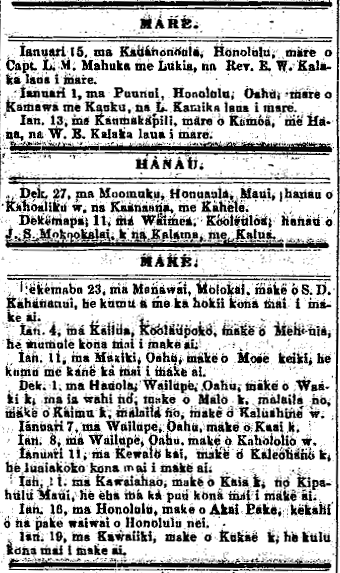
MARRIAGES.

January 15, at Kauanonoula, Honolulu, married were Capt. L. M. Mahuka and Lukia; they were wed by Rev. E. W. Clark.
January 1, at Puunui, Honolulu, Oahu, married were Kamawa and Kauku; they were wed by L. Smith.
Jan. 13, at Kaumakapili, married were Kamoa and Hana; they were wed by W. E. Clark.

BIRTHS.

Dec. 27, at Moomuku, Honuaula, Maui, born was Kahoaliku (f), of Kaanaana and Kahele.
December 11, at Waimea, Koolauloa, born was J. S. Mokookalai (m), of Kalama and Kalua.

DEATHS.

December 23, at Manawai, Molokai, S. D. Kahananui died; he died of kumu¹ and consumption [hokii].
Jan. 4, at Kailua, Koolaupoko, Meheula died; he died of muteness [mumule].
Jan. 11, at Makiki, Oahu, Mose child died; he died of kumu and tinea [kane].
Dec. 1, at Hauola, Wailupe, Oahu, Waaki (m) died; at the same location, Kaluahine (f) died.
January 7, at Wailupe, Oahu, Kaai (m) died.
Jan. 8, at Wailupe, Oahu, Kahololio (f) died.
January 11, at Kewalo kai, Kaleohano (m) died; he died of throwing up blood [luaikoko].
Jan. 11, at Kawaiahao, Kaia (m) died, of Kipahulu, Maui; he died of pains in the throat [he eha ma ka puu].
Jan. 18, at Honolulu, Akai Chinese died; he was one of the wealthy Chinese of Honolulu nei.
Jan. 19, at Kawaiiki, Kukae (m) died; he died of dysentery [kulu].

¹I could not find an ailment called “kumu”.

(Hoku o ka Pakipika, 1/22/1863, p. 3)

MARE. / HANAU. / MAKE.

Hoku o ka Pakipika, Buke 2, Helu 15, Aoao 3. Ianuari 22, 1863.

Man sent away from Queen’s Hospital, 1913.

REFUSED BY THE HOSPITAL AND DIED AT HIS HOME.

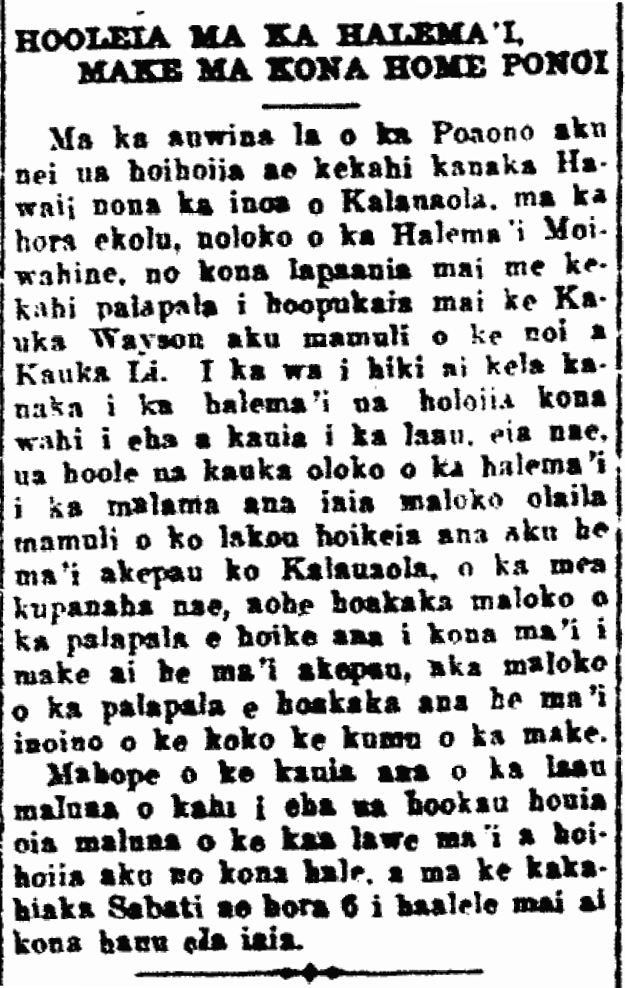
In the afternoon of this past Saturday, a Hawaiian named Kalanaola was brought back at three o’clock, to the Queen’s Hospital to be treated, with a document written by Dr. Wayson at the request of Dr. Li. When that man arrived at the hospital, his wound was cleaned and treated, but the doctors in the hospital refused to admit him there because they were told Kalanaola had diabetes [ma’i akepau]; the astonishing thing was that there was no indication in his death report that he died of diabetes, but in the report it said his death was caused by a sickness of the blood.

After treating his injury, he was placed back on the ambulance and taken back to his home, and on the following Sunday at 6 o’clock, his breath of life left him.

(Kuokoa, 1/31/1913, p. 4)

HOOLEIA MA KA HALEMA'I, MAKE MA KONA HOME PONOI

Ka Nupepa Kuokoa, Buke XLIX, Helu 5, Aoao 4. Ianuari 31, 1913.

Suicide in Kalawao, 1883.

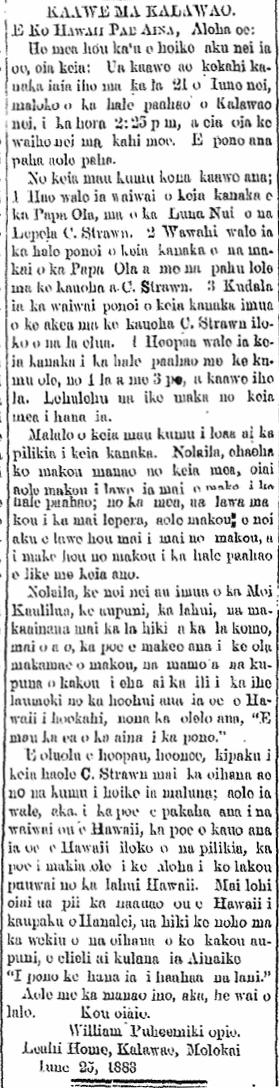
HANGING IN KALAWAO.

O Ko Hawaii Pae Aina, Aloha oe:

I have something to report to you, and that is this: A man hung himself on the 21st of this June, in the jail here in Kalawao, at 2:25 p. m., and he is now left to rest. Perhaps it will be set right, perhaps not.

Here is why he hung himself; 1. The estate of this man was confiscated by the Board of Health, the the superintendent of the Lepers, C. Strawn. 2. The residence of this man was torn down by the officers of the Board of health as well as his clothes trunk by the orders of C. Strawn. 3. The property of this man was auctioned off to the public by orders of C. Strawn over two days. 4. This man was imprisoned in the jail for no reason for 4 days and 3 nights, at which point he hung himself. There are many witnesses to what was done.

This is all why this man was troubled. And so we are pained by this, for we were not brought here to die in jail; because it is enough that we are inflicted with leprosy; we don’t wish for more sickness to befall us or for us to die again in jail like this.

Therefore I ask before King Kaulilua,¹ the nation, the lahui, the makaainana from where the sun rises to where it sets, from that side to this, those who care for our dear lives, the descendants of our kupuna who were wounded by the barbed spears to unify you O Hawaii as one, for whom is said, “E mau ke ea o ka aina i ka pono.”²

Please dismiss, transfer, and expell this haole C. Strawn from his job for the reasons shown above; and not just him, but those who plunder the wealth of you, O Hawaii; the people who drag you, O Hawaii into difficulties; and those who hold no aloha in their hearts for Hawaii. Don’t take your time, for your knowledge, O Hawaii, has climbed the heights of Hanalei, and you are qualified to occupy the highest positions of our government and be respected for your knowledge [e elieli ai kulana ia Ainaike.]

This is not said in spite, but for just cause [he wai o lalo]. Sincerely,

William Puheemiki, Jr.

Leahi Home, Kalawao, Molokai

June 25, 1883.

¹Kaulilua is another name for Kalakaua.

²”Ua mau ke ea o ka aina i ka pono,” is the famous proclamation of Kauikeaouli, Kamehameha III.

(Ko Hawaii Pae Aina, 7/7/1883, p. 4)

KAAWE MA KALAWAO.

Ko Hawaii Pae Aina, Buke VI, Helu 27, Aoao 4. Iulai 7, 1883.

Mistreatment of leprosy patients and why we need to reshoot the Hawaiian-Language Newspapers, 1886.

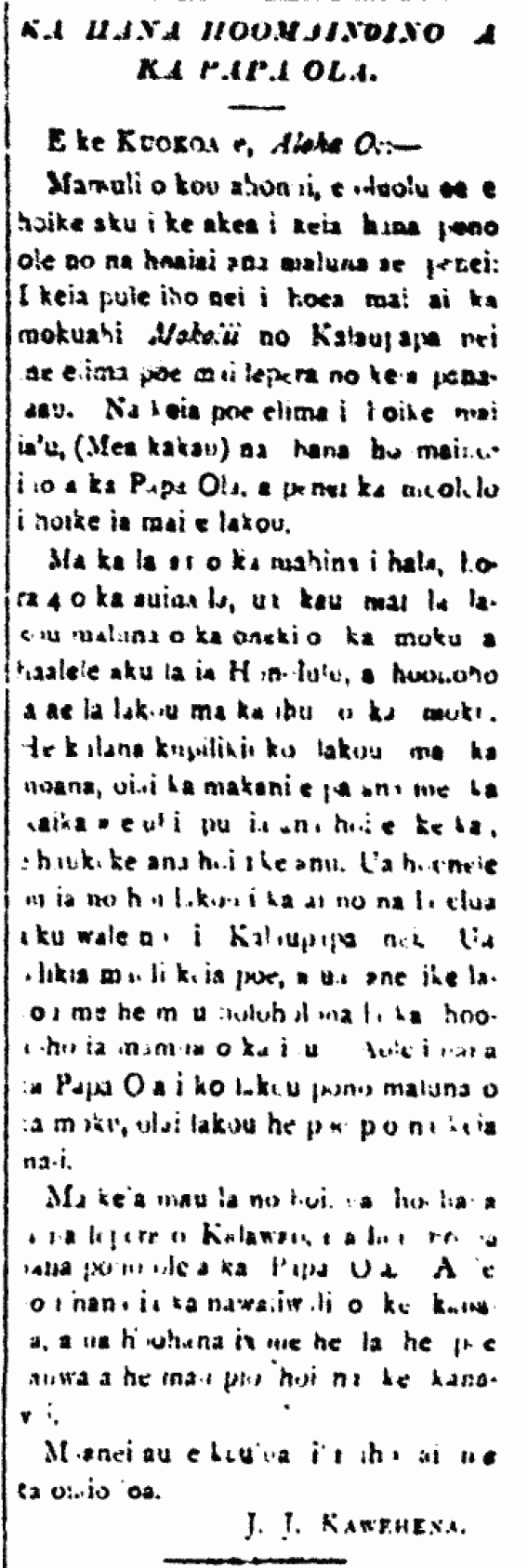
ABUSE BY THE BOARD OF HEALTH.

O Kuokoa, Aloha Oe:—

Please be so patient as to show this improper behavior to clarify the above, thus: This past week the steamship Makalii arrived here in Kalapapa with five leprosy patients for this colony. These five people told me (the Writer) about the cruelty done by the Board of Health, and this is the story told by them.

On the 21st of the past month, at 4 in the afternoon, stepped onto the deck of the ship and left Honolulu, and they were placed at the bow of the ship. They were in distress while at sea due to the winds that were blowing strongly and they were covered by the sea and shivered in the cold. They were not give food for two days and then landed here in Kalaupapa. They were in desperate shape, and were treated like animals being placed at the bow. The Board of Health did not look after their well-being even if they ?????

These days, the leprosy patients of Kalawao are made to work ?????? mistreated by the Board of Health. They don’t consider the weak state of the people and are worked like slaves and they are prisoners of the law.

Here, I ????? with sincerity.

J. J. Kawehena.

[I know i keep saying that the Hawaiian-Language Newspapers need to be reshot again so that we can have the clearest images possible, but i can’t help it. Here is a perfect example. I am guessing at a good deal of the content, and where i couldn’t, i left as “????” Once the papers deteriorate and crumble away, there is no way we can get these histories.]

(Kuokoa, 7/3/1886, p. 1)

KA HANA HOOMAINOINO A KA PAPA OLA.

Ka Nupepa Kuokoa, Buke XXV, Helu 27, Aoao 1. Iulai 3, 1886.