Halloween at Kamehameha, 1943.

[Found under: “News From Boys, Girls Kamehameha School”]

HALLOWE’EN PRIZES

By Thomas See

Hallowe’en parties were held at the Kamehameha Schools on Saturday, October 30. Three different places were chosen as rooms for the parties. The high eleventh an senior boys along with the junior and senior girls occupied the common room of Lunalilo Hall. The low-eleventh and tenth grade boys held their party in Iolani Hall together with the ninth and tenth grade girls. The choral room in the basement of the auditorium was the scene of the junior division’s party consisting of the eight and ninth grade boys with the seventh and eighth grade girls.

Prizes for the handsomest, the funniest, and the most original boy were awarded. The girls also received prizes for the prettiest girl, the funniest, and the most original.

In Lunalilo Hall prizes were awarded to Milton Beamer, Earl Fernandez, Phillip Eagles, Dawn Anahu, Illona Wiebke, Barbara Kekauoha, and Gladys Goo. Milton received the first prize for the handsomest boy, and Dawn, the prized for the most beautiful girl. Earl and Illona were the funniest boy and girl at the party. The most original winners were Phillip, Barbara, and Gladys. Continue reading

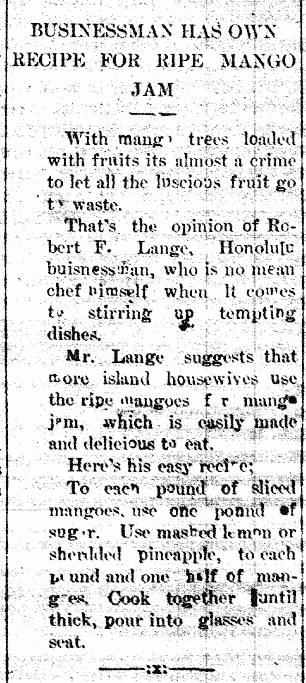
Mango jam? Sounds ono, 1936.

BUSINESSMAN HAS OWN RECIPE FOR RIPE MANGO JAM

With mango trees loaded with fruits its almost a crime to let all the luscious fruit go to waste.

That’s the opinion of Robert F. Lange, Honolulu businessman, who is no mean chef himself when it comes to stirring up tempting dishes.

Mr. Lange suggests that more island housewives use the ripe mangoes for making mango jam, which is easily made and delicious to eat.

Here’s his easy recipe.

To each pound of sliced mangoes, use one pound of sugar. Use mashed lemon or shredded pineapple, to each pound and one half of mangoes. Cook together until thick, pour into glases and seal.

(Hoku o Hawaii, 8/5/1936, p. 1)

HokuoHawaii_8_5_1936_1.png

Ka Hoku o Hawaii, Volume XXXI, Number 14, Aoao 1. August 5, 1936.

Hawaiian language not economical, 1939.

Unfair to Hawaiians

Territorial Secretary Charles M. Hite wants to have a bill put through the legislature eliminating the publication of the session laws in the Hawaiian language, claiming this is an “economy” measure.

Mr. Hite seems to be starting his so-called economy program in the wrong place. He probably doesn’t realize that there are still thousands of old time Hawaiians in the territory who cannot read English and who depend on the reports from the legislature through their own Hawaiian language newspaper, otherwise they won’t know what has been done by our law makers. Continue reading

Anna Lai Hipp transforms Hilo parks, 1937.

Hilo Parks Are Improved Under Woman’s Direction

What a woman park superintendent can do in three weeks is shown by the improvements in local parks accomplished by Mrs. Anna Lai Hipp, member of the park commission for four years, who has been substituting as park superintendent during the past three weeks during the vacation leave of the superintendent, Manuel Tavares. Mrs. Lai Hipp’s duties as acting superintendent end today.

An inspection tour of all the local parks Friday showed definite improvement during the three weeks’ period under Mrs. Lai Hipp.

And the best part of it all is that Mrs. Lai Hipp brought about the improvements with the same group of men who are always kept at work in the parks and with the same amount of money allotted for the work.

Perhaps the best piece of improvement work done by Mrs. Lai Hipp was Reeds bay park where in one day she had the men haul large rocks from Keaukaha which were placed on the boundary lines of the park area. Due to bad weather these stones had not been painted white, but when painted, they will be an added attraction on the park grounds as well as being practical.

“The park commission wants to protect the grass in this park, especially near the Yacht club. Many motorists have built roads on the grass by continually going over it,” Mrs. Lai Hipp said.

Plants in Bloom

At Liliuokalani park the tall weeds and bushes which had almost obstructed the view of the Japanese house from the main road were hauled away. Care has been given the azalea plants and now over 50 plants are in bloom.

On Coconut island scores of full-grown coconut palms have been planted in the places where trees were scarce. The planting was done entirely under Mrs. Lai Hipp’s supervision.

Mooheau park, parts of which were an eyesore, had been Mrs. Lai Hipp’s worry for sometime. Large stumps of trees at the Puna end of the park, which had rotted at the roots, were dug up by wedges and sledge hammers and the holes filled with dirt. Grass will be planted there are a nice lawn will be the result. Large stacks of pipes, rubbish and odds and ends clotted up the entire Puna end toward the beach, and these were hauled away. California grass, “honohono” grass and rubbish were hauled away by the truckloads.

The lovely palm trees lining Kamehameha Ave. in the Shinmachi district in front of the Royal theater were kept in good shape and old leaves trimmed under Mrs. Lai Hipp’s direction. The trees in the Puna end of this small park belong to the Hawaii Consolidated Railway and the Hilo Iron Works and should be taken care of by them, Mrs. Lai Hipp said.

Another piece of good work done by Mrs. Lai Hipp is at Rainbow Falls park where two trees which were too close to the Hilo Memorial hospital nurses’ cottage were cut down and truckloads of grass were taken away. Weeds had covered the lovely stone walks in the park and Mrs. Lai Hipp saw to it that they were pulled out.

For the past three weeks Mrs. Lai Hipp has visited and superintended the work in all the local parks at least twice a day. Hedges have been trimmed, grass pulled out, rubbish hauled away and new tree planted—all during the short space of three weeks along with the routine work the park workers do in lawnmowing the grass and picking up rubbish.

(Hoku o Hawaii, 3/24/1937, p. 1)

HokuoHawaii_3_24_1937_1.png

Ka Hoku o Hawaii, Volume XXXI, Number 48, Aoao 1. Maraki 24, 1937.

Kamehameha School for Boys’ 24th annual song contest, 1945.

[Found under: “News From Boys, Girls Kamehameha School”]

BOY’S SONG CONTEST

Kamehameha School for Boys will present its 24 annual song contest on March 4 at the school auditorium with the eighth and ninth graders competing in the junior division at the tenth, eleventh and twelfth grade boys in the senior division.

The eighth graders have as their choice song “Beautiful Kahana” and the ninth graders choice is “Ka Anoi.” The juniors have selected “Wai Lana” and the tenth grade boys a medley of “Kuu Lei Pikake,” “Lei Awapuhi” and “Roselani.” A medley of “Na Lei O Hawaii” and “Aloha Oe” is the seniors choice. Continue reading

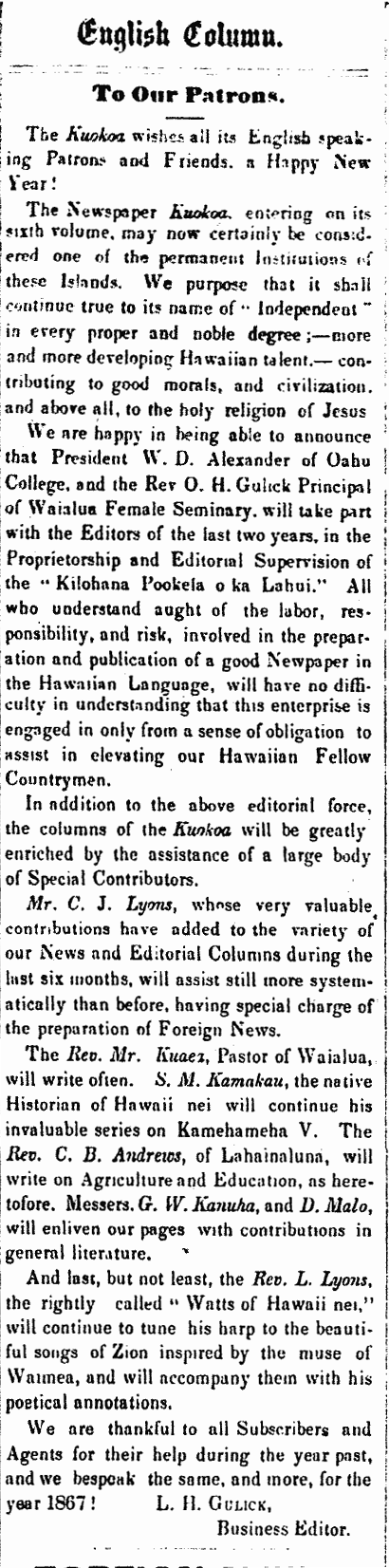
English announcement of officers and writers of the Kuokoa, 1867.

English Column.

To Our Patrons.

The Kuokoa wishes all its English speaking Patrons and Friends, a Happy New Year!

The Newspaper Kuokoa, entering on its sixth volume, may now certainly be considered one of the permanent Institutions of these Islands. We purpose that it shall continue true to its name of “Independent” in every proper and noble degree;—more and more developing Hawaiian talent—contributing to good morals, and civilization, and above all, to the holy religion of Jesus.

We are happy in being able to announce that President W. D. Alexander of Oahu College, and the Rev. O. H. Gulick Principal of Waialua Female Seminary, will take part with the Editors of the last two years, in the Proprietorship and Editorial Supervision of the “Kilohana Pookela o ka Lahui.” All who understand aught of the labor, responsibility, and risk, involved in the preparation and publication of a good Newpaper in the Hawaiian Language, will have no difficulty in understanding that this enterprise is engaged in only from a sense of obligation to assist in elevating our Hawaiian Fellow Countrymen.

In addition to the above editorial force, the columns of the Kuokoa will be greatly enriched by the assistance of a large body of Special Contributors.

Mr. C. J. Lyons, whose very valuable contributions have added to the variety of our News and editorial Columns during the last six months, will assist still more systematically than before, having special charge of the preparation of Foreign News.

The Rev. Mr. Kuaea, Pastor of Waialua will write often. S. M. Kamakau, the native Historian of Hawaii nei will continue his invaluable series on Kamehameha V. The Rev. C. B. Andrews, of Lahainaluna, will write on Agriculture and Education, as heretofore. Messers. G. W. Kanuha, and D. Malo, will enliven our pages with contributions in general literature.

And last, but not least, the Rev. L. Lyons, the rightly called “Watts of Hawaii nei,” will continue to tune his harp to the beautiful songs of Zion inspired by the muse of Waimea, and will accompany them with his poetical annotations.

We are thankful to all Subscribers and Agents for their help during the year past, and we bespeak the same, and more, for the year 1867!  L. H. Gulick,

Business Editor.

(Kuokoa, 1/5/1867, p. 3)

Kuokoa_1_5_1867_3.png

Ka Nupepa Kuokoa, Buke VI, Helu 1, Aoao 3. Ianuari 5, 1867.

79 years ago, Inter-Island Play Day for Women, 1937.

LOCAL GIRLS TO GO TO MOLOKAI

Under the leadership of Eliza K. Osorio and Irene K. Silva, directors of the Hilo Women’s Athletic association, 31 local girls will leave for Molokai this Sunday on the steamer to attend the fifth annual Inter-island Play Day of Women which will be held on Molokai on March 23, 24, and 25. The play festival was held two years in Hilo and a year ago on Maui.

Girls making the trip from Hilo are: Margaret Brown, Harriet Brown, Yok Lan Mehau, Christine Almeida, Pua Ho-a, Betty Watai, Elsie Watai, Mary Cootey, Virginia Asau, Margaret Kimi, [Napua] Harriet Stevens, Continue reading

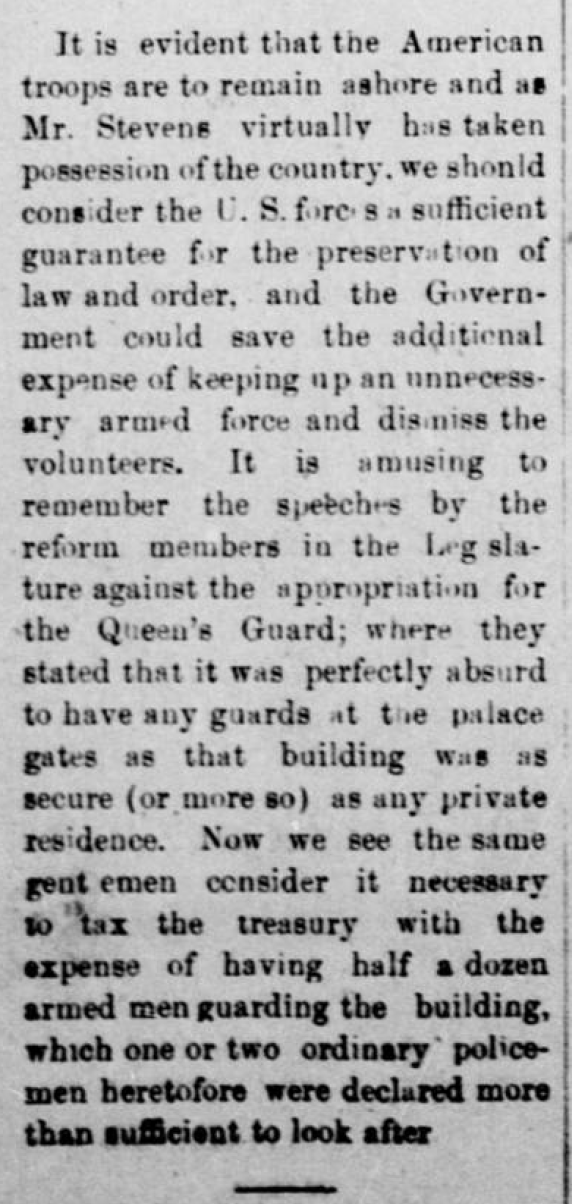
Hypocrites? 1893.

It is evident that the American troops are to remain ashore and as Mr. Stevens virtually has taken possession of the country, we should consider the U. S. forces a sufficient guarantee for the preservation of law and order, and the Government could save the additional expense of keeping up an unnecessary armed force and dismiss the volunteers. It is amusing to remember the speeches by the reform members in the Legislature against the appropriation for the Queen’s Guard; where they stated that it was perfectly absurd to have any guards at the palace gates as that building was as secure (or more so) as any private residence. Now we see the same gentlemen consider it necessary to tax the treasury with the expense of having half a dozen armed men guarding the building, which one or two ordinary policemen heretofore were declared more than sufficient to look after.

(Hawaii Holomua, 1/20/1893, p. 4)

HawaiiHolomua_1_20_1893_4

Hawaii Holomua, Buke III, Helu 143, Aoao 4. Ianuari 20, 1893.

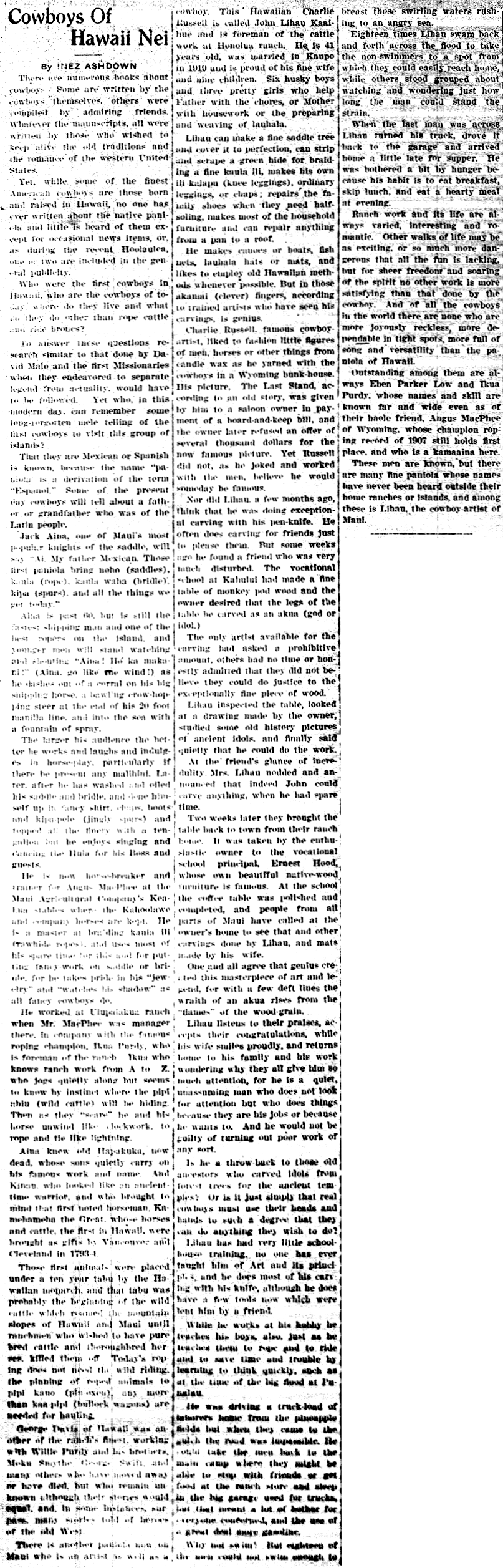
Inez Ashdown and the Paniolo, 1939.

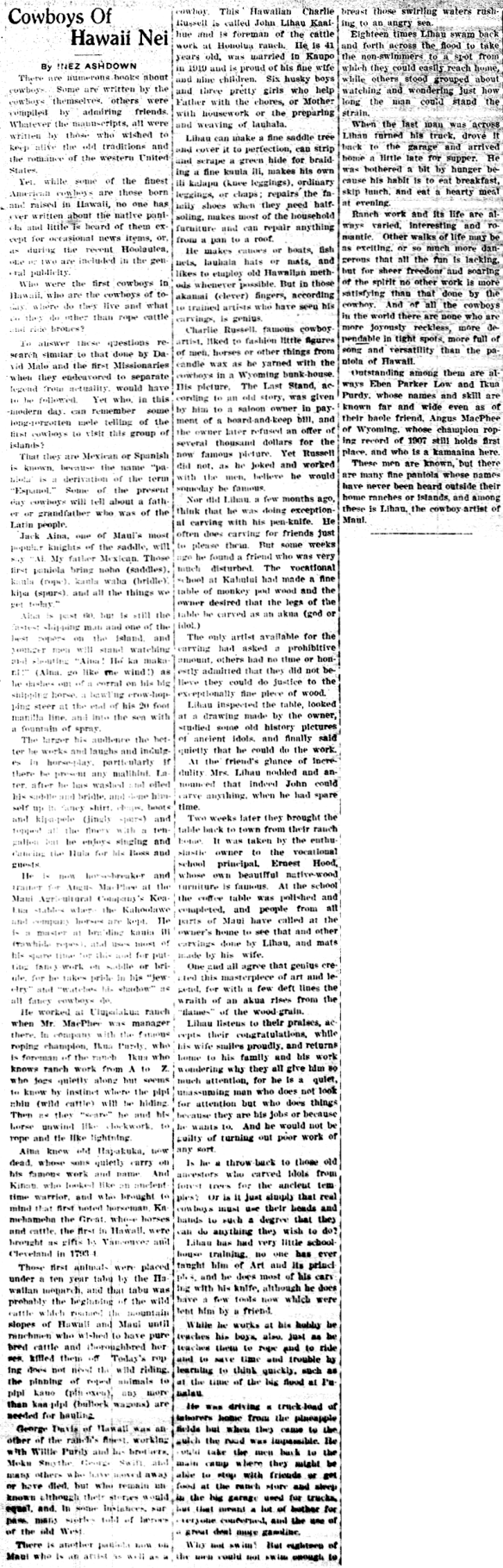
Cowboys of Hawaii Nei

By INEZ ASHDOWN

There are numerous books about cowboys. Some are written by the cowboys themselves, others were compiled by admiring friends. Whatever the manuscripts, all were written by those who wished to keep alive the old traditions and the romance of the western United States.

Yet while some of the finest American cowboys are those born and raised in Hawaii, no one has ever written about the native paniola and little is heard of them except for occasional news items, or, as during the recent Hoolaulea, one or tow are included in the general publicity.

Who were the first cowboys in Hawaii, who are the cowboys of today, where do they live and what do they do other than rope cattle and ride broncos?

To answer these questions research similar to that done by David Malo and the first missionaries when they endeavored to separate legend from actuality, would have to be followed. Yet who, in this modern day, can remember some long-forgotten mele telling of the first cowboys to visit this group of islands?

That they are Mexican or Spanish is known, because the name “paniola” is a derivation of the term “Espanol.” Some of the present day cowboys will tell about a father or grandfather who was of the Latin people.

Jack Aina, one of Maui’s most popular knights of the saddle, will say “Ai. My father Mexican. Those first paniola bring noho (saddles), kaula (rope), kaula waha (bridle), kipa (spurs), and all the things we get today.”

Aina is past 60, but is still the fastest shipping man and one of the best ropers on the island, and younger men will stand watching and shouting “Aina! Hu ka makani!” (Aina, go like the wind!) as he dashes out of a corral on his big shipping horse, a bawling crow-hopping steer at the end of his 20 foot manilla line, and into the sea with a fountain of spray.

The larger his audience the better he works and laughs and indulges in horse-play, particularly if there be present any malihini. Later, after he has washed and oiled his saddle and bridle, and done himself up in fancy shirt, chaps, boots and kipa pele (jingly spurs) and topped all the finery with a ten-gallon hat he enjoys singing and dancing the Hula for his Boss and guests.

He is now horsebreaker and trainer for Angus MacPhee at the Maui Agricultural Company’s Keahua stables where the Kahoolawe and company horses are kept. He is a master at braiding kaula ili (rawhide ropes) and uses most of his spare time for this and for putting fancy work on saddle or bridle, for he takes pride in his “jewelry” and “watches his shadow” as all fancy cowboys do.

He worked at Ulupalakua ranch when Mr. MacPhee was manager there, in company with the famous roping champion, Ikua Purdy, who is foreman of the ranch. Ikua who knows ranch work from A to Z, who jogs quietly along but seems to know by instict where the pipi ahiu (wild cattle) will be hiding. Then as they “scare” he and his horse unwind like clockwork, to rope and tie like lightning.

Aina knew old Hapakuka, now dead, whose sons quietly carry on his famous work and name. And Kinau, who looked like an ancient time warrior, and who brought to mind that first noted horseman, Kamehameha the Great, whose horses and cattle, the first in Hawaii, were brought as gifts by Vancouver and Cleveland in 1793–4.

Those first animals were placed under a ten year tabu by the Hawaiian monarch, and that tabu was probably the beginning of the wild cattle which roamed the mountain slopes of Hawaii and Maui until ranchmen who wished to have pure bred cattle and thoroughbred horsses, killed them off. Today’s roping does not need the wild riding, the pinning of roped animals to pipi kauo (pin oxen), any more than kaa pipi (bullock wagons) are needed for hauling.

George Davis of Hawaii was another of the ranch’s finest, working with Willie Purdy and his brothers, Moku Smythe, George Swift, and many others who have moved away or have died, but who remain unknown although their stories would equal, and, in some instances, surpass, many stories told of heroes of the old West.

There is another paniola man on Maui who is an artist as well as a cowboy. This Hawaiian Charlie Russel is called John Lihau Kaaihue and is foreman of the cattle work at Honolulu ranch. He is 41 years old, was married in Kaupo in 1919 and is proud of his fine wife and nine children. Six husky boys and three pretty girls who help Father with the chores, or Mother with housework or the preparing and weaving of lauhala.

Lihau can make a fine saddle tree and cover it to perfection, can strip and scrape a green hide for braiding a fine kaula ili, makes his own ili kalapu (knee leggings), ordinary leggings, or chaps; repairs the family shoes when they need half-soling, makes most of the household furniture, and can repair anything from a pan to a roof.

He makes canoes and boats, fish nets, lauhala hats or mats, and likes to employ old Hawaiian methods whenever possible. But in those akamai (clever) fingers, according to trained artists who have seen his carvings, is genius.

Charlie Russel, famous cowboy artist, liked to fashion little figures of men, horses or other things from candle wax as he yarned with the cowboys in a Wyoming bunk-house. His picture, The Last Stand, according to an old story, was given by him to a saloon owner in payment of a board-and-keep bill, and the owner later refused an offer of several thousand dollars for the now famous picture. Yet Russel did not, as he joked and worked with the men, believe he would someday be famous.

Nor did Lihau, a few months ago, think that he was doing exceptional carving with his pen-knife. He often does carving for friends just to please them. But some weeks ago he found a friend who was very much disturbed. The vocational school at Kahului had made a fine table of monkey pod wood and the owner desired that the legs of the table be carved as an akua (god or idol).

The only artist available for the carving had asked a prohibitive amount, others had no time or honestly admitted that they did not believe they could do justice to the exceptionally fine piece of wood.

Lihau inspected the table, looked at a drawing made by the owner, studied some old history pictures of ancient idols, and finally said quietly that he could do the work.

At the friend’s glance of incredulity Mrs. Lihau nodded and announced that indeed John could carve anything, when he had spare time.

Two weeks later they brought the table back to town from their ranch home. It was taken by the enthusiastic owner to the vocational school principal, Ernest Hood, whose own beautiful native-wood furniture is famous. At the school the coffee table was polished and completed, and people from all parts of Maui have called at the owner’s home to see that and other carvings done by Lihau, and mats made by his wife.

One and all agree that genius created this masterpiece of art and legend, for with a few deft lines the wraith of an akua rises from the “flames” of the wood-grain.

Lihau listens to their praises, accepts their congratulations, while his wife smiles proudly, and returns home to his family and his work wondering why they all give him so much attention, for he is a quiet unassuming man who does not look for attention but who does things because they are his jobs or because he wants to. And he would not be guilty of turning out poor work of any sort.

Is he a throw-back to those old ancestors who carved idols from forest trees for the ancient temples? Or is it just simply that real cowboys must use their heads and hands to such a degree that they can do anything they wish to do?

Lihau has had very little schoolhouse training, no one has ever taught him of Art and its principles, and he does most of his carving with his knife, although he does have a few tools now which were lent by a friend.

While he works at his hobby he teaches his boys also just as he teaches them to rope and to ride and to save time a trouble by learning to think quickly, such as at the time of the big flood at Punalau.

He was driving a truck-load of laborers home from the pineapple fields but when they came to the gulch the road was impassible. He could take the men back to the main camp where they might be able to stop with friends or get food at the ranch store and sleep in the big garage used for trucks, but that meant a lot of bother for everyone concerned, and the use of a great deal more gasoline.

Why not swim? But eighteen of the men could not swim enough to breast those swirling waters rushing to an angry sea.

Eighteen times Lihau swam back and forth across the flood to take the non-swimmers to a spot from which they could easily reach home, while others stood grouped about watching and wondering just how long the man could stand the strain.

When the last man was across Lihau turned his truck, drove it back to the garage and arrived home a little late for supper. He was bothered a bit by hunger because his habit is to eat breakfast, skip lunch, and eat a hearty meal at evening.

Ranch work and its life are always varied, interesting and romantic. Other walks of life may be as exciting, or so much more dangerous that all the fun is lacking, but for sheer freedom and soaring of the spirit no other work is more satisfying than that done by the cowboy. And of all the cowboys in the world there are none who are more joyously reckless, more dependable in tight spots, more full of song and versatility than the paniola of Hawaii.

Outstanding among them are always Eben Parker Low and Ikua Purdy, whose names and skill are known far and wide even as of their haole friend, Angus MacPhee of Wyoming, whose champion roping record of 1907 still holds first place, and who is a kamaaina here.

These men are known, but there are many fine paniola whose names have never been heard outside their home ranches or islands, and among these is Lihau, the cowboy-artist of Maui.

(Hoku o Hawaii, 4/26/1939, p. 6)
Cowboys Of Hawaii Nei

Ka Hoku o Hawaii, Volume XXXIII, Number 52, Page 6. Aperila 26, 1939.

Inez Ashdown and Queen Liliuokalani, 1939.

Was Friend of Liliuokalani

INEZ ASHDOWN

Ka Hoku’s Maui Corresponent.

This picture was taken at the time Mrs. Ashdown’s father Angus MacPhee was manager of the Ulupalakua ranch for Dr. Raymond. She had just returned from Dana Hall school at Wellesley and, as she says, “‘rarin’ to be a cowboy like him and all his Hawaiian paniola.”

“My people brought me here in 1907 when Dad was champion roper of the world and came to take part in Eben Low’s first wild west show,” writes Mrs. Ashdown. “Ikua went back to Cheyenne, our home town, the following year and took the title for that year, but no one has ever broken Dad’s time for that sort of roping. The first year we were here my parents were guests many times at the home of Queen Liliuokalani and I loved her very much. I was only a kid, but even then it made me boil because the people had taken her crown away.”

Mrs. Ashdown has lived on Maui most of the time since 1907, except for the years she was away at school. Her husband, C. W. Ashdown, is office manager for the Baldwin Packers at Lahaina. They have two sons and writing is Mrs. Ashdown’s hobby. She hopes some day to write some real good novels. She used to rope wild cattle, ride race horses and break colts, but says “that was a long time ago.”

(Hoku o Hawaii, 4/26/1939, p. 6)

Was Friend of Liliuokalani

Ka Hoku o Hawaii, Volume XXXIII, Number 52, Aoao 6. Aperila 26, 1939.