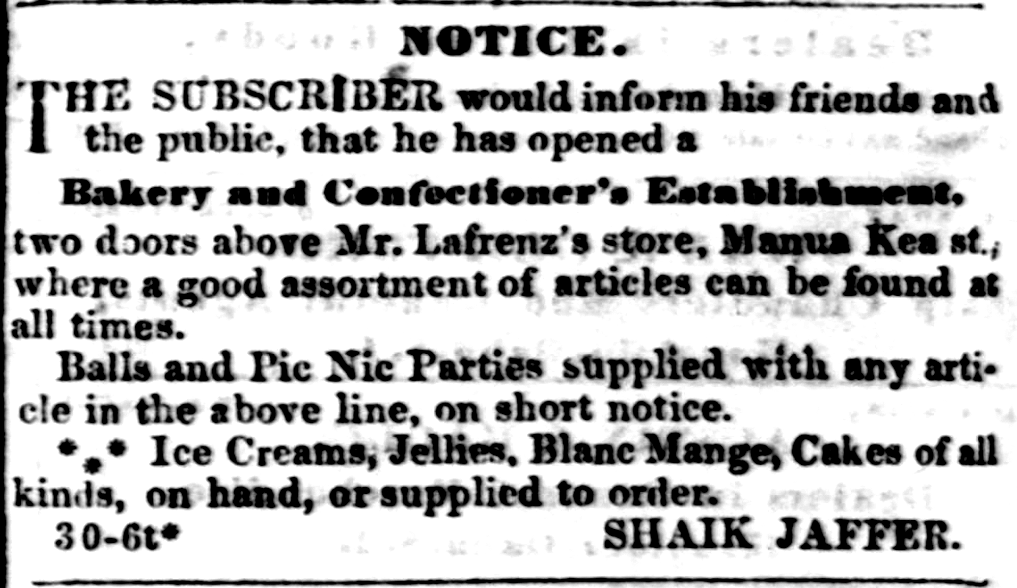
Ice Cream from a new Bakery, 1854.

NOTICE.

THE SUBSCRIBER would inform his friends and the public, that he has opened a

Bakery and Confectioner’s Establishment,

two doors above Mr. Lafrenz’s store, Mauna Kea st., where a good assortment of articles can be found at all times.

Balls and Pic Nic Parties supplied with any article in the above line, on short notice.

*** Ice Creams, Jellies, Blanc Mange, Cakes of all kinds, on hand, or supplied to order.

SHAIK JAFFER.

(Polynesian, 12/16/1854, p. 2)

NOTICE.

The Polynesian, Volume XI, Number 32, Page 2. December 16, 1854.

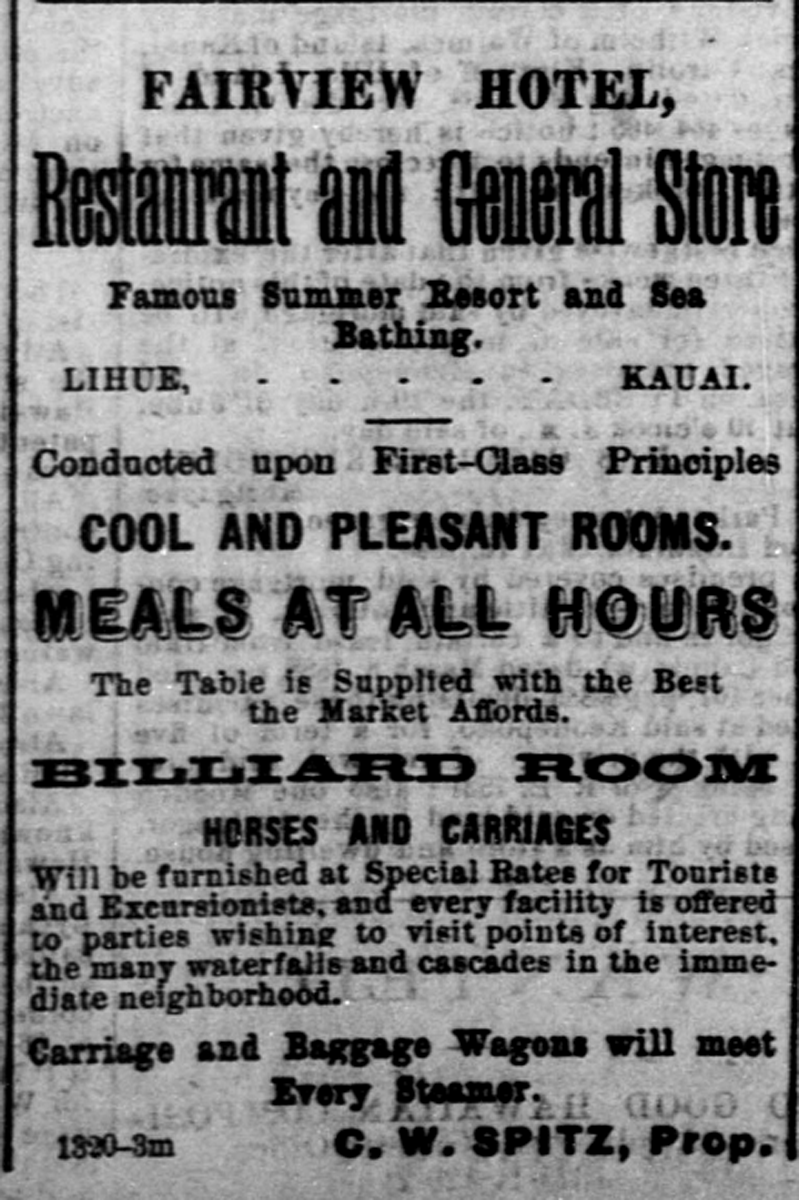
The Fairview Hotel, 1890.

FAIRVIEW HOTEL,

Restaurant and General Store

Famous Summer Resort, and Sea
Bathing.

LIHUE, – – – – – KAUAI.

Conducted upon First-Class Principles

COOL AND PLEASANT ROOMS.

MEALS AT ALL HOURS

The Table is Supplied with the Best the Market Affords.

BILLIARD ROOM

HORSES AND CARRIAGES

Will be furnished at Special Rates for Tourists and Excursionists, and every facility is offered to parties wishing to visit points of interest, the many waterfalls and cascades in the immediate neighborhood.

Carriage and Baggage Wagons will meet Every Steamer.

C. W. SPITZ, Prop.

(Hawaiian Gazette, 6/3/1890, p. 9)

FAIRVIEW HOTEL,

Hawaiian Gazette, Volume XXV, Number 22, Page 9. June 3, 1890.

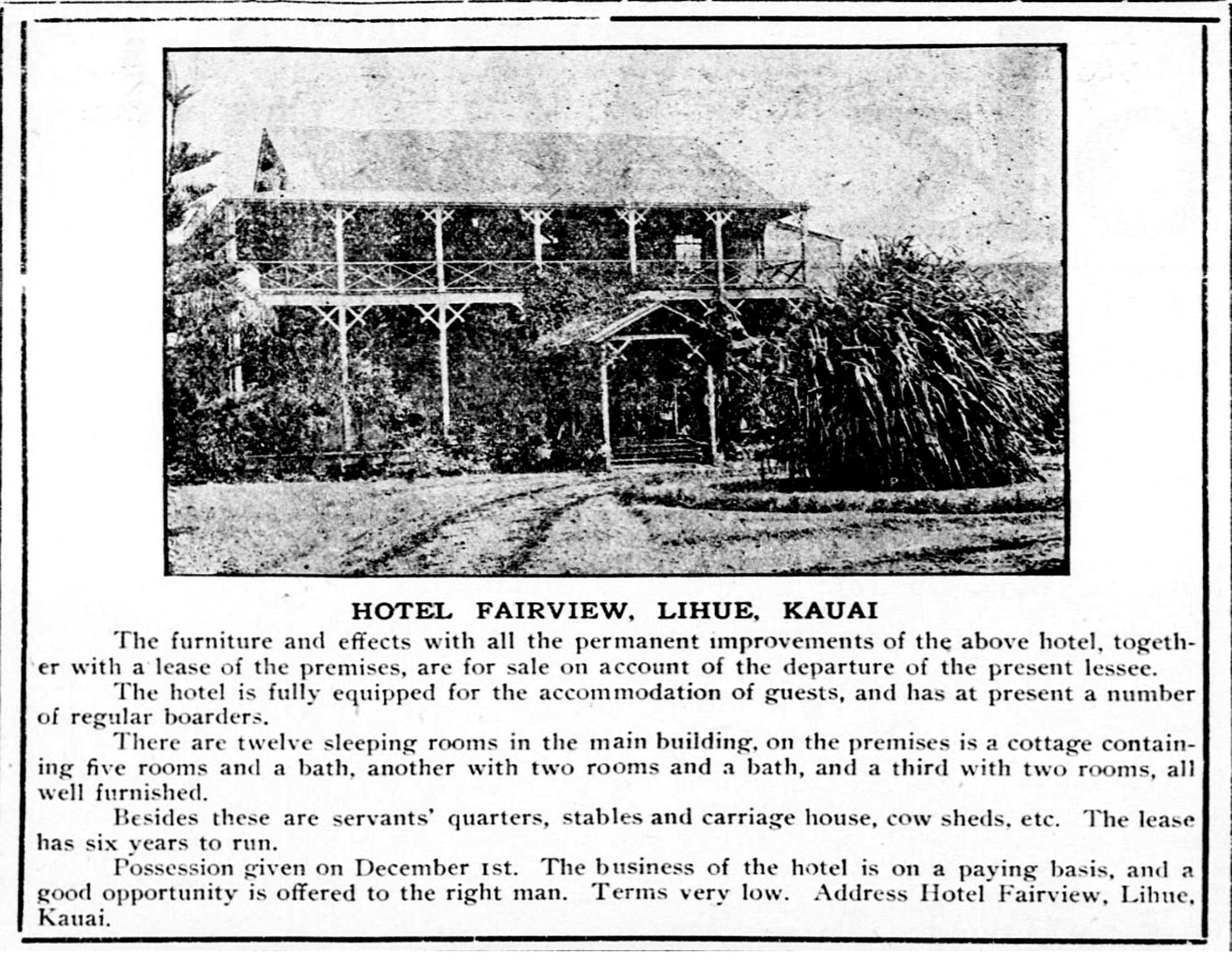
Hotel Fairview, Lihue, 1906.

HOTEL FAIRVIEW, LIHUE, KAUAI

The furniture and effects with all the permanent improvements of the above hotel, together with a lease of the premises, are for sale on account of the departure of the present lessee.

The hotel is fully equipped for the accommodation of guests, and has at the present a number of regular boarders.

There are twelve sleeping rooms in the main building, on the premises is a cottage containing five rooms and a bath, another with two rooms and a bath, and a third with two rooms, all well furnished.

Besides these are servants’ quarters, stables and carriage house, cow sheds, etc. The lease has six years to run.

Possession given on December 1st. The business of the hotel is on a paying basis, and a good opportunity is offered to the right man. Terms very low. Address Hotel Fairview, Lihue, Kauai.

(Pacific Commercial Advertiser, 11/15/1906, p. 6)

HOTEL FAIRVIEW, LIHUE, KAUAI

The Pacific Commercial Advertiser, Volume XLIV, Number 7573, Page 6. November 15, 1906.

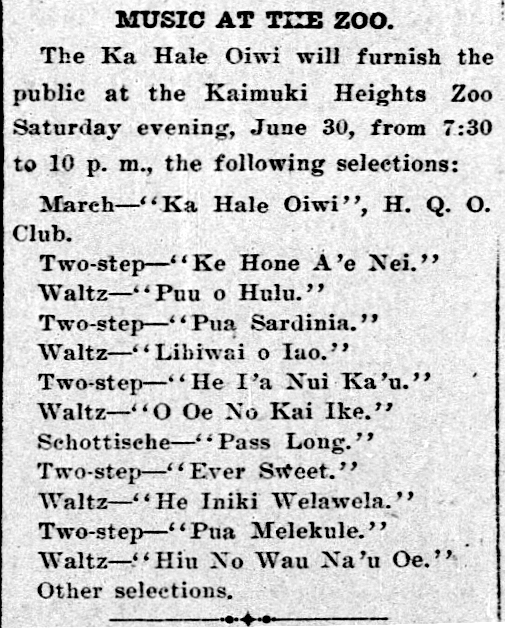
More music, 1906.

MUSIC AT THE ZOO.

The Ka Hale Oiwi will furnish the public at the Kaimuki Heights Zoo Saturday evening, June 30, from 7:30 to 10 p. m., the following selections:

March—”Ka Hale Oiwi”, H. Q. O. Club.

Two-step—”Ke Hone A’e Nei.”

Waltz—”Puu o Hulu.”

Two-step—”Pua Sardinia.”

Waltz—”Lihiwai o Iao.”

Two-step—”He I’a Nui Ka’u.”

Waltz—”O Oe No Kai Ike.”

Schottische—”Pass Long.”

Two-step—”Ever Sweet.”

Waltz—”He Iniki Welawela.”

Two-step—”Pua Melekule.”

Waltz—”Hiu No Wau Na’u Oe.”

Other selections.

[That must have been a fun time, a hundred and nine years ago!]

(Pacific Commercial Advertiser, 6/30/1906, p. 6)

MUSIC AT THE ZOO.

The Pacific Commercial Advertiser, Volume XLIII, Number 7455, Page 6. June 30, 1906.

“Makaloa ihi” hats, 1861.

Home Manufactures.

Our contemporary [Pacific Commercial Advertiser] talks very emphatically about Hawaiian made hats, worn much of late by the native women. It says they are made of a grass called “makaloa ihi,” which is very “abundant,” and it can’t explain why the women’s hats are so much dearer than the men’s hats. Had it asked the first native it saw, it would have been told that the mens’ hats are made of the makaloa grass, which is tolerably abundant, and the women’s hats of the Ihiihi grass, which is very scarce, short, and tiresome to braid. We and many other foreigners have patronised the manufacture by using hats of both kinds in our families. Why don’t the Advertiser do the same, instead of talking about it? And we think that what “is exceedingly neat and a most graceful article” for a pretty Hawaiian face, would not disgrace the looks of a foreign born lady, especially when she can have it made in “a style and variety” to correspond with the latest fashion plates. It is pleasant to see that several foreign ladies have already adopted the Ihiihi hats, and the demand is increasing.

(Polynesian, 11/30/1861, p. 2)

Home Manufactures.

The Polynesian, Volume XVIII, Number 31, Page 2. November 30, 1861.

Kamehameha Day proclaimed, 1871.

BY AUTHORITY.

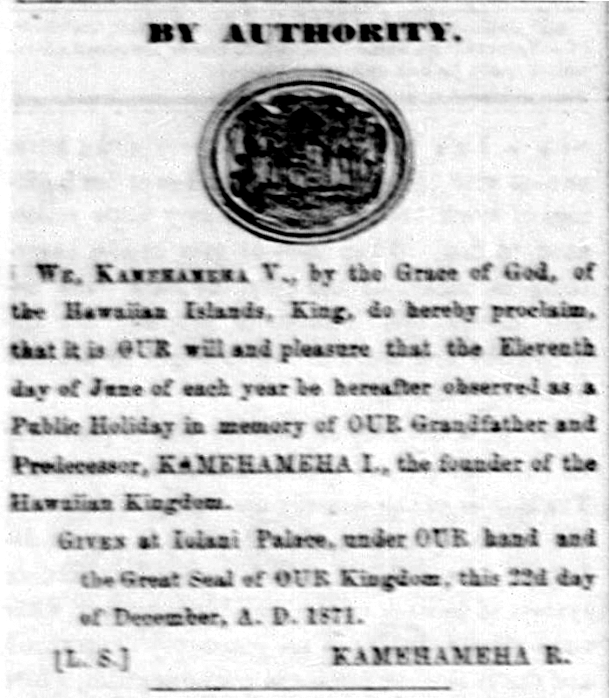
We, Kamehameha V., by the Grace of God, of the Hawaiian Islands, King, do hereby proclaim, that it is OUR will and pleasure that the Eleventh day of June of each year be hereafter observed as a Public Holiday in memory of OUR Grandfather and Predecessor, KAMEHAMEHA I, the founder of the Hawaiian Kingdom.

Given at Iolani Palace, under OUR hand and the Great Seal of OUR Kingdom, this 22nd day of December, A. D. 1871.

[Legal Seal] KAMEHAMEHA R.

(Hawaiian Gazette, 12/27/1871, p. 2)

BY AUTHORITY.

Hawaiian Gazette, Volume VII, Number 50, Page 2. December 27, 1871.

Maunaala, 1899.

ROYAL MAUSOLEUM

(THIS IMPOSING STRUCTURE STANDS ON AN ELEVATION PROMINENT IN THAT PORTION OF NUUANU CEMETERY ON THE WAIKIKI SIDE OF THE AVENUE. WITHIN WILL BE DEPOSITED THE REMAINS OF PRINCESS KAIULANI.)

WITHIN THE TOMB.

(This paper, February 16, 1891.)

On a beautiful lawn at the entrance of Nuuanu valley, overlooking this city, the harbor and ocean beyond, stands the Royal Mausoleum, erected by the Hawaiian Government, as the resting place of the remains of the Royal Family of Hawaii and a few of their greatest benefactors. It is built in the Gothic style of architecture, of concrete stone, with the lawn handsomely laid out with walks and studded with trees, the whole presenting from the avenue an attractive appearance. Continue reading

St. Andrew’s, the early days, 1909.

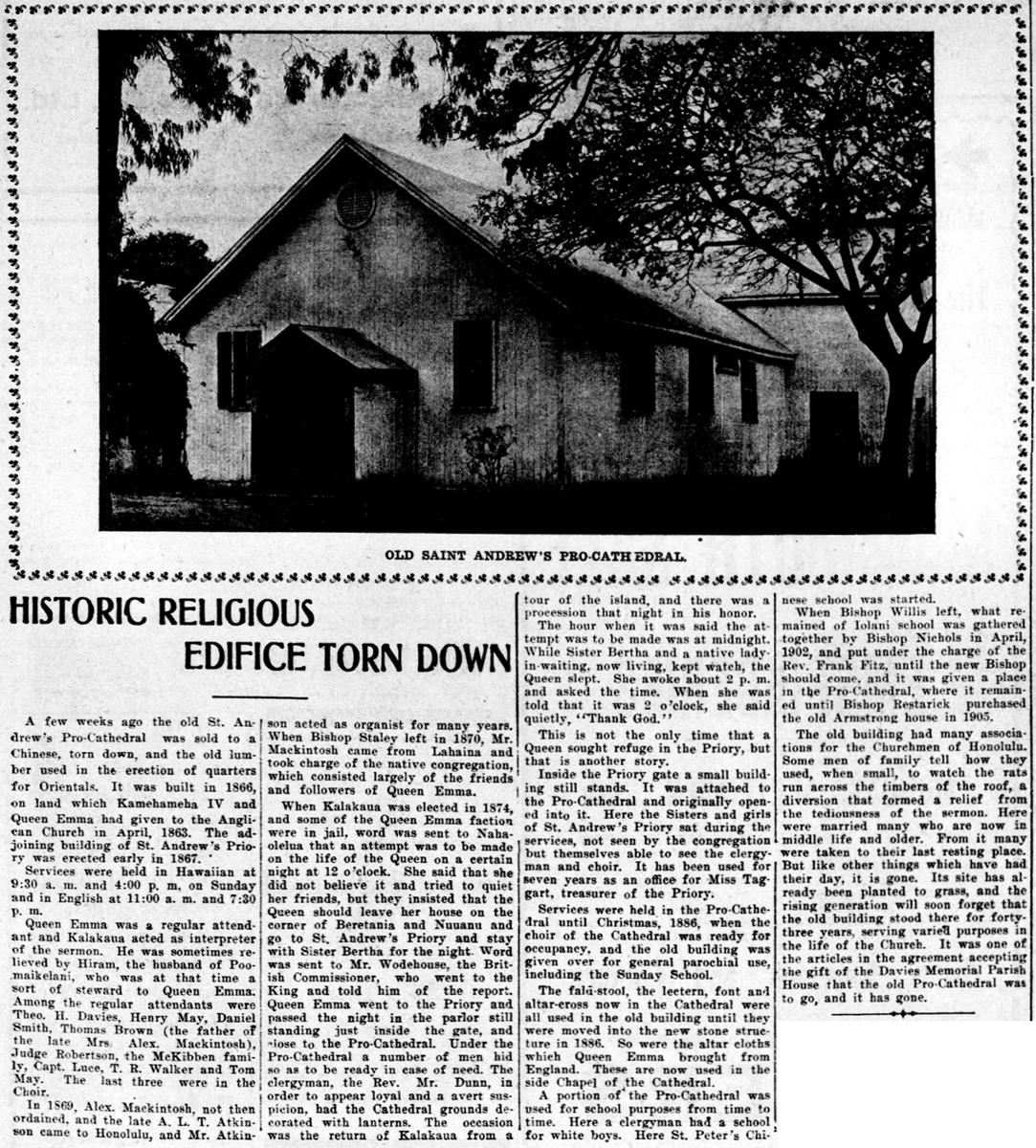
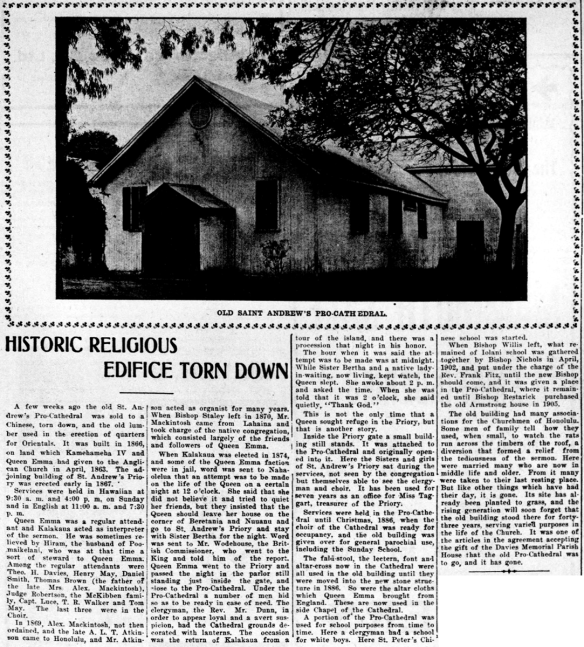
OLD SAINT ANDREW’S PRO-CATHEDRAL.

RELIGIOUS EDIFICE TORN DOWN

A few weeks ago the old St. Andrew’s Pro-Cathedral was sold to a Chinese, torn down, and the old lumber used in the erection of quarters for Orientals. It was built in 1866, on land which Kamehameha IV and Queen Emma had given to the Anglican Church in April 1863. The adjoining building of St. Andrew’s Priory was erected in 1867.

Services were held in Hawaiian at 9:30 a. m. and 4:00 p. m. on Sunday and in English at 11:00 a. m. and 7:30 p. m.

Queen Emma was a regular attendant and Kalakaua acted as interpreter of the sermon. He was sometimes relieved by Hiram, the husband of Poomaikelani, who was at that time a sort of steward to Queen Emma. Among the regular attendants were Theo. H. Davies, Henry May, Daniel Smith, Thomas Brown (the father of the late Mrs. Alex. McKintosh), Judge Robertson, the McKibben family, Capt. Luce, T. R. Walker and Tom May. The last three were in the Choir.

In 1869, Alex. Mackintosh, not then ordained, and the late A. L. T. Atkinson came to Honolulu, and Mr. Atkinson acted as organist for many years. When Bishop Staley left in 1870, Mr. Mackintosh came from Lahaina and took charge of the native congregation, which consisted largely of the friends and followers of Queen Emma.

When Kalakaua was elected in 1874, and some of the Queen Emma faction were in jail, word was sent to Nahaolelua that an attempt was to be made on the life of the Queen on a certain night at 12 o’clock. She said that she did not believe it and tried to quiet her friends, but they insisted that the Queen should leave her house on the corner of Beretania and Nuuanu and go to St. Andrew’s Priory and stay with Sister Bertha for the night. Word was sent to Mr. Wodehouse, the British Commissioner, who went to the King and told him of the report. Queen Emma went to the Priory and passed the night in the parlor still standing just inside the gate, and close to the Pro-Cathedral. Under the Pro-Cathedral a number of men hid so as to be ready in case of need. The clergyman, the Rev. Mr. Dunn, in order to appear loyal and a avert suspicion, had the Cathedral grounds decorated with lanterns. The occasion was the return of Kalakaua from a tour of the island, and there was a procession that night in his honor.

The hour when it was said the attempt was to be made was at midnight. While Sister Bertha and a native lady-in-waiting, now living, kept watch, the Queen slept. She awoke about 2 p. m. and asked the time. When she was told that it was 2 o’clock, she said quietly, “Thank God.”

This is not the only time that a Queen sought refuge in the Priory, but that is another story.

Inside the Priory gate a small building still stands. It was attached to the Pro-Cathedral and originally opened into it. Here the Sisters and girls of St. Andrew’s Priory sat during the services, not seen by the congregation but themselves able to see the clergyman and choir. It has been used for seven years as an office for Miss Taggart, treasurer of the Priory.

Services were held in the Pro-Cathedral until Christmas, 1886, when the choir of the Cathedral was ready for occupancy, and the old building was given over for general parochial use, including the Sunday School.

The fald-stool, the lectern, font and altar-cross now in the Cathedral were all used in the old building until they were moved into the new stone structure in 1886. So were the altar cloths which Queen Emma brought from England. These are now used in the side Chapel of the Cathedral.

A portion of the Pro-Cathedral was used for school purposes from time to time. Here a clergyman had a school for white boys. Here St. Peter’s Chinese school was started.

When Bishop Willis left, what remained of Iolani school was gathered together by Bishop Nichols in April, 1902, and put under the charge of the Rev. Frank Fitz, until the new Bishop should come, and it was given a place in the Pro-Cathedral, where it remained until Bishop Restarick purchased the old Armstrong house in 1905.

The old building had many associations for the Churchmen of Honolulu. Some men of family tell how they used, when small, to watch the rats run across the timbers of the roof, a diversion that formed a relief from the tediousness of the sermon. Here were married many who are now in middle life and older. From it many were taken to their last resting place. But like other things which have had their day, it is gone. Its site has already been planted to grass, and the rising generation will soon forget that the old building stood there for forty-three years, serving varied purposes in the life of the Church. It was one of the articles in the agreement accepting the gift of the Davies Memorial Parish House that the old Pro-Cathedral was to go, and it has gone.

(Pacific Commercial Advertiser, 9/18/1909, p. 3)
HISTORIC RELIGIOUS EDIFICE TORN DOWN

The Pacific Commercial Advertiser, Volume L, Number 8459, Page 3. September 18, 1909.

Papa holua found in Hookena by Napoleon Kalolii Pukui, 1905.

SLED OF A CHIEFESS

On the 6th of last month, N. K. Pukui, traveling agent of the Hawaiian Realty and Maturity Co., while on a tour of the Island of Hawaii, found the above illustrated sled in a cave at Hookena, Hawaii.

It is said that the oldest kamaainas of Hookena have heard from their parents and grandparents that sometime in the reign of King Keawenuiaumi, about two hundred and fifty years ago, a high chiefess named Kaneamuna [Kaneamama] was the living at Hookena. Her principal amusement was hee holua (coasting on a sled) and hee nalu (surfing).

She had her people make a sliding ground for her on a hill just back of the little village of Hookena, and ordered a sled, or land toboggan, called a papa holua, as well as a surfing board, or a papa hee nalu. When the slide was finished she passed many pleasant hours sliding down the steep hill. This slide was composed of smooth stones covered with rushes. After her death her sled and surf board disappeared, and the secred of their hiding place was never revealed.

It is believed the sled and board found in the cave belonged to the High Chiefess. They are made of the wood of the bread-fruit tree and at the present time are in very good condition. The cocoanut fiber ropes are still attached to the sled.

(Advertiser Photo.)

ANCIENT HAWAIIAN SLED FOUND IN A KONA, HAWAII, CAVE.

[See also the Hawaiian-Language article found in Ka Na’i Aupuni, 12/6/1905, p. 2.]

(Pacific Commercial Advertiser, 12/6/1905, p. 5)

SLED OF A CHIEFESS

The Pacific Commercial Advertiser, Volume XLII, Number 7279, Page 5. December 6, 1905.

Fishpond and fish and the court, 1915.

Court Holds Fish Don’t Go With Pond

Famous Molokai Fish Pond Case Passed on by Supreme Court—Decision Raises New Questions.

What’s fish pasture worth?

This is a question which Attorney Dan Case is trying to have answered, because on behalf of a client he will probably soon be putting in a bill against Attorney Eugene Murphy for a goodly sum for the care of Murphy’s finny property in a certain pond on Molokai. It is the famous fish pond case again.

The question has been brought up through a supreme court decision, rendered this week, in which the court apparently holds that when a man sells a fish pond he doesn’t necessarily sell the fish that may be in it. About six months ago a Japanese named Kanayama bought at sheriff’s sale the lease on the fish pond in question, only to be sued a little later for damages because he had taken fish from the pond. The suit was filed by Murphy, attorney for Akutogawa [Akutagawa], the Japanese who previously owned the lease, and who had given his attorney a bill of sale on the fish in the pond.

In the district magistrate’s court, judgement was rendered against Murphy, but on his appeal to the supreme court, this is reversed. The syllabus of the opinion of the higher court read:—”The judgement is reversed and the cause remanded to the district magistrate of Molokai with instructions to enter judgement in favor of the plaintiff for the sum of $75 and costs.”

The question is now what Murphy purposes doing to get his fish, which presumably are trespassing in the pond, and also what bill for pasture the owner of the pond can collect for caring for them all this time. And the end is not yet.

(Maui News, 7/24/1915, p. 6)

Court Holds Fish Don't Go With Pond

The Maui News, Volume XXII, Number 22, Page 6. July 24, 1915.