Wailuku and Lahaina get new marketplace, 1880.

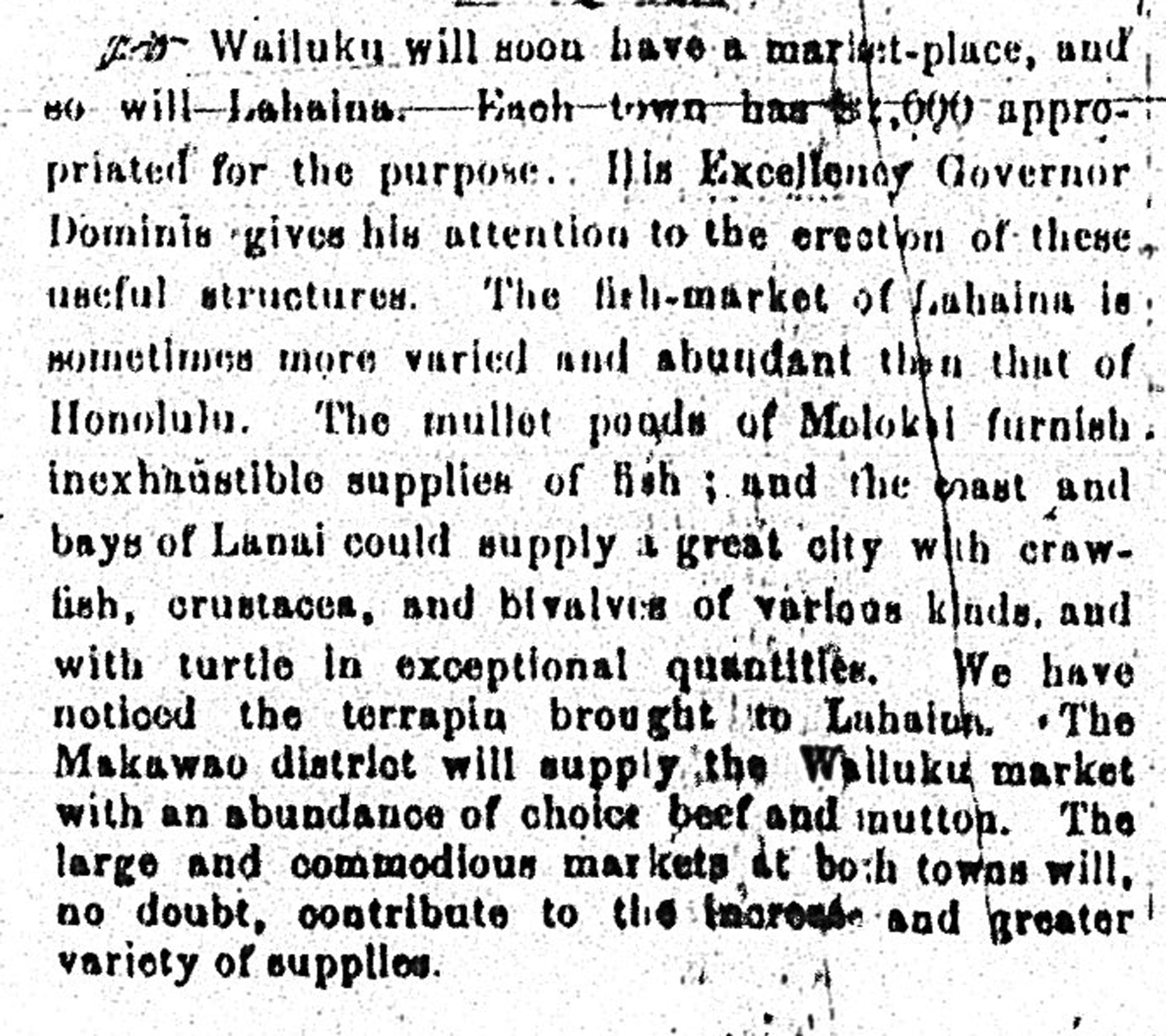
Wailuku will soon have a market-place, and so will Lahaina. Each town has $2,000 appropriated for the purpose. His Excellency Governor Dominis gives his attention to the erection of these useful structures. The fish-market of Lahaina is sometimes more varied and abundant than that of Honolulu. The mullet ponds of Molokai furnish inexhaustible supplies of fish; and the coast and bays of Lanai could supply a great city with crawfish, crustacea, and bivalves of various kinds, and with turtle in exceptional quantities. We have noticed the terrapin brought to Lahaina. The Makawao district will supply the Wailuku market with an abundance of choice beef and mutton. The large and commodious markets at both towns will, no doubt, contribute to the increase and greater variety of supplies.

[Wow, this article has so much varied information: on government spending, fish supply, fish ponds, ranching, &c., &c., &c.]

(Wednesday Express, 9/8/1880, p. 1)

Wailuku will soon have a market-place...

The Wednesday Express, Volume I, Number 1, Page 1. September 8, 1880.

Hawaiian-Language Newspapers, 1862.

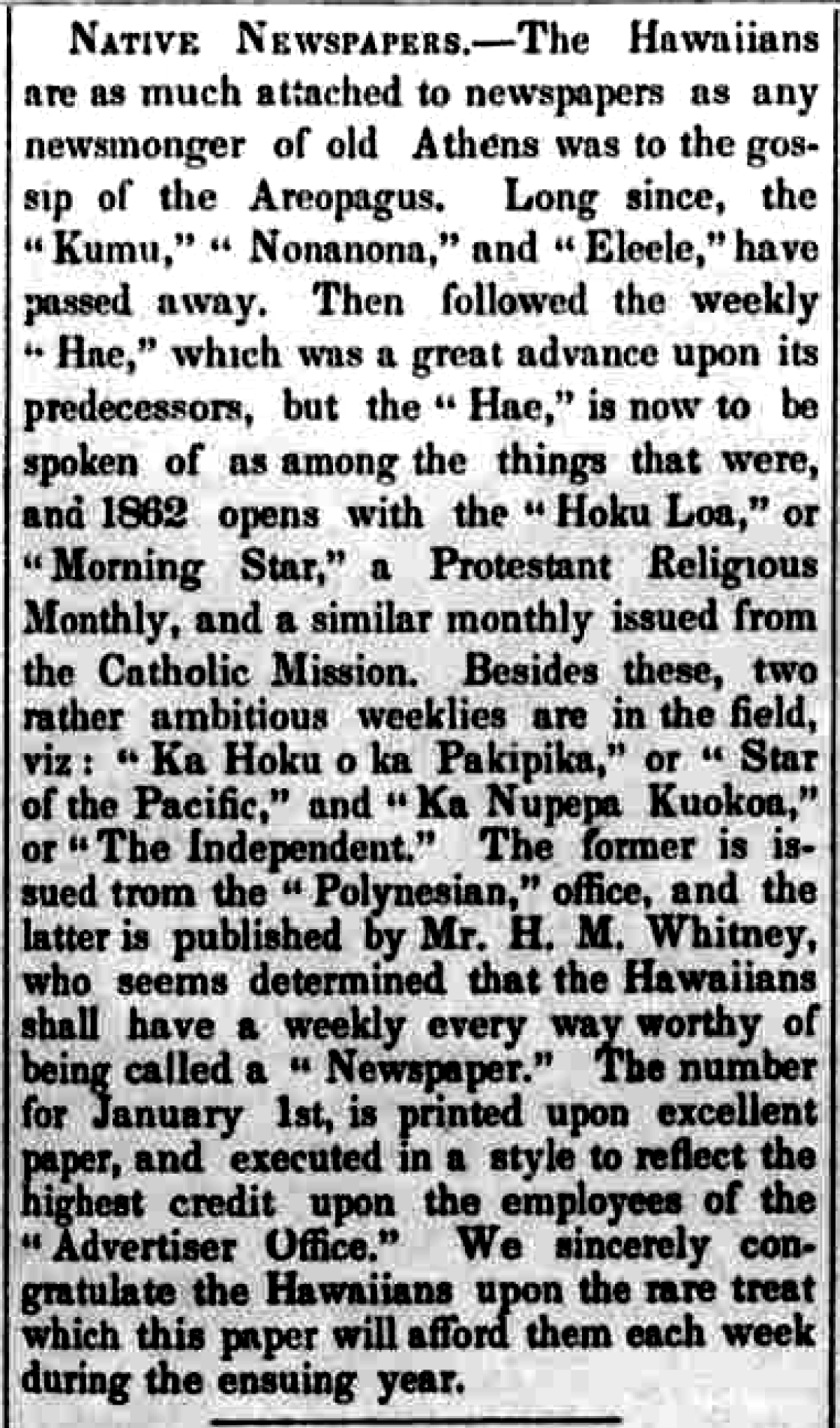
Native Newspapers.—The Hawaiians are as much attached to newspapers as any newsmonger of old Athens was to the gossip of the Areopagus. Long since, the “Kumu,” “Nonanona,” and “Eleele” [Elele], have passed away. Then followed the weekly “Hae,” which was a great advance upon its predecessors, but the “Hae,” is now to be spoken of as among the things that were, and 1862 opens with the “Hoku Loa,” or “Morning Star,” a Protestant Religious Monthly, and a similar monthly issued from the Catholic Mission [“Ka Hae Kiritiano”]. Besides these, two rather ambitious weeklies are in the field, viz: “Ka Hoku o ka Pakipika,” or “Star of the Pacific,” and “Ka Nupepa Kuokoa,” or “The Independent.” The former is issued from the “Polynesian,” office, and the latter is published by Mr. H. M. Whitney, who seems determined that the Hawaiians shall have a weekly every way worthy of being called a “Newspaper.” The number for January 1st, is printed upon excellent paper, and executed in a style to reflect the highest credit upon the employees of the “Advertiser Office.” We sincerely congratulate the Hawaiians upon the rare treat which this paper will afford them each week during the ensuing year.

[I am posting this after coming across it because of a post last week by Nanea Armstrong-Wassel, seen here. It is interesting to note that the Friend was obviously not supporting the Hoku o ka Pakipika…]

(Friend, 1/1/1862, p. 1)

Native Newspapers.

The Friend, New Series, Volume II, Number 1, Page 1. January 1, 1862.

Just because something appears in a newspaper doesn’t necessarily make it true, 1865.

[Found under: “NOTES OF THE WEEK.”]

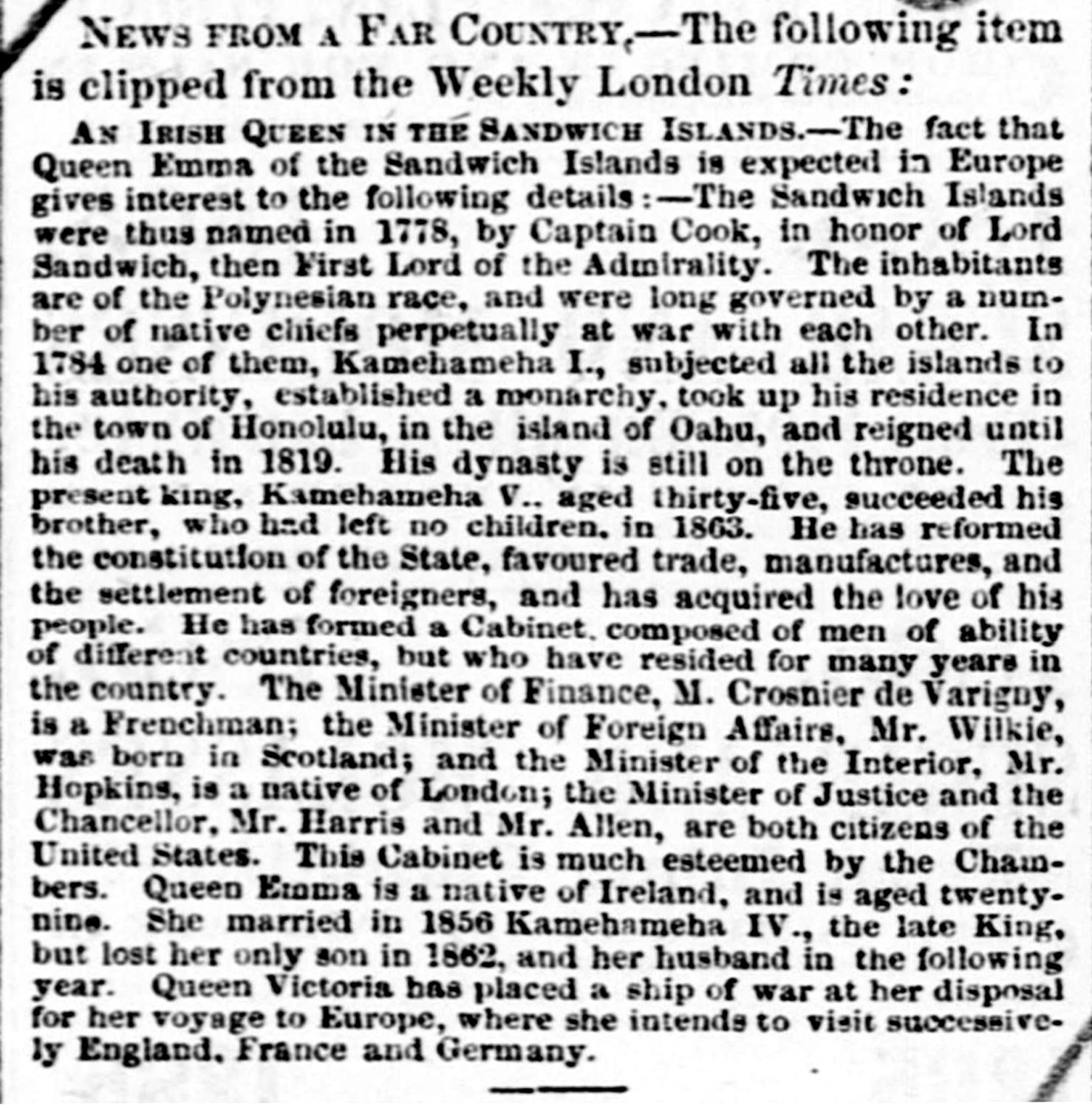
News from a Far Country.—The following item is clipped from the Weekly London Times:

An Irish Queen in the Sandwich Islands.—The fact that Queen Emma of the Sandwich Islands is expected in Europe gives interest to the following details:—The Sandwich Islands were thus named in 1778, by Captain Cook, in honor of Lord Sandwich, then First Lord of the Admirality. The inhabitants are of the Polynesian race, and were long governed by a number of native chiefs perpetually at war with each other. In 1784 one of them, Kamehameha I., subjected all the islands to his authority, established a monarchy, took up his residence in the town of Honolulu, in the island of Oahu, and reigned until his death in 1819. His dynasty is still on the throne. The present King, Kamehameha V., aged thirty-five, succeeded his brother, who had left no children, in 1863. He has reformed the constitution of the State, favoured trade, manufactures, and the settlement of foreigners, and has acquired the love of his people. The Minister of Finance, M. Crosnier de Varigny, is a Frenchman; the Minister of Foreign Affairs, Mr. Wilkie, was born in Scotland; and the Minister of Interior, Mr. Hopkins, is a native of London; the Minister of Justice and the Chancellor, Mr. Harris and Mr. Allen, are both citizens of the United States. This Cabinet is much esteemed by the Chambers. Queen Emma is a native of Ireland, and is aged twenty-nine. She married in 1856 Kamehameha IV., the late King, but lost her only son in 1862, and her husband in the following year. Queen Victoria has placed a ship of war at her disposal for her voyages to Europe, where she intends to visit successively England, France and Germany.

(Pacific Commercial Advertiser, 9/30/1865, p. 2)

News from a Far Country...

The Pacific Commercial Advertiser, Volume X, Number 13, Page 2. September 30, 1865.

Mortuary of Manuel E. Silva, 1910.

THE RESIDENCE UNDERTAKING PARLOR is the latest move in the undertaking line, where families can be accommodated with sleeping quarters, dining room, kitchen and bathroom. Call and inspect. 34 Chaplain Lane.

M. E. Silva’s Up-to-Date Funeral Parlors

M. E. Silva’s Embalming Room is the best; in fact, the only one of its kind in this city and county with modern ideas pertaining to the care of the dead.

M. E. Silva’s Res. Undertaking Parlors

24 CHAPLAIN LANE, OPP. CATHOLIC SISTERS

Phone 179—Night 1014

(Evening Bulletin, 7/2/1910, p. 16)

THE RESIDENCE UNDERTAKING PARLOR...

Evening Bulletin, Established 1882, Number 4660, Page 16. July 2, 1910.

The U. S. S. Boston, John L. Stevens, and the Hawaiian flag, 1893.

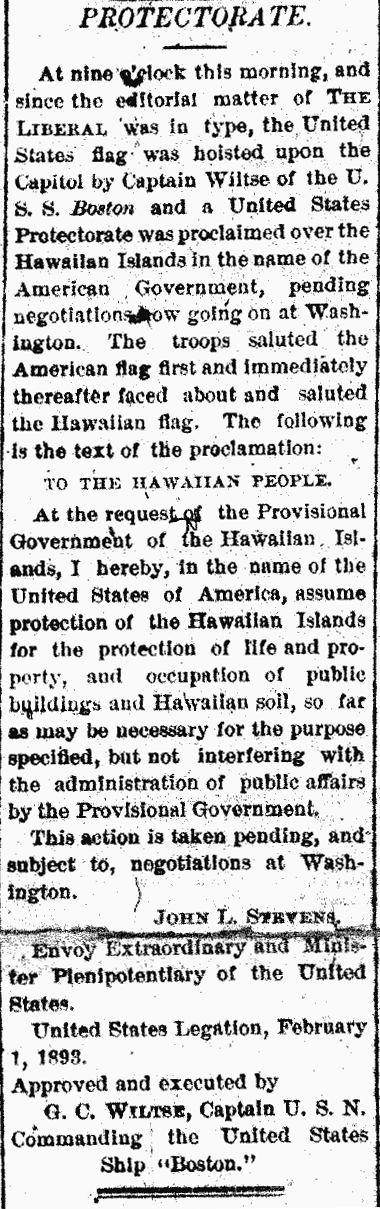
PROTECTORATE.

At nine o’clock this morning, and since the editorial matter of The Liberal was in type, the United States flag was hoisted upon the Capitol by Captain Wiltse of the U. S. S. Boston and a United States Protectorate was proclaimed over the Hawaiian Islands in the name of the American Government, pending negotiations now going on at Washington. The troops saluted the American flag first and immediately thereafter faced about and saluted the Hawaiian flag. The following is the text of the proclamation:

TO THE HAWAIIAN PEOPLE.

At the request of the Provisional Government of the Hawaiian Islands, I hereby, in the name of the United States of America, assume the protection of the Hawaiian Islands for the protection of life and property, and occupation of the public buildings and Hawaiian soil, so far as may be necessary for the purpose of specified, but not interfering with the administration of public affairs by the Provisional Government.

This action is taken pending, and subject to, negotiations at Washington.

John L. Stevens,

Envoy Extraordinary and Minister Plenipotentiary of the United States.

United States Legation, February 1, 1893.

Approved and executed by

G. C. Wiltse, Captain U. S. N.

Commanding the United States Ship “Boston.”

(Liberal, 2/1/1893, p. 2)

PROTECTORATE.

The Liberal, Volume I, Number 41, Page 2. February 1, 1893.

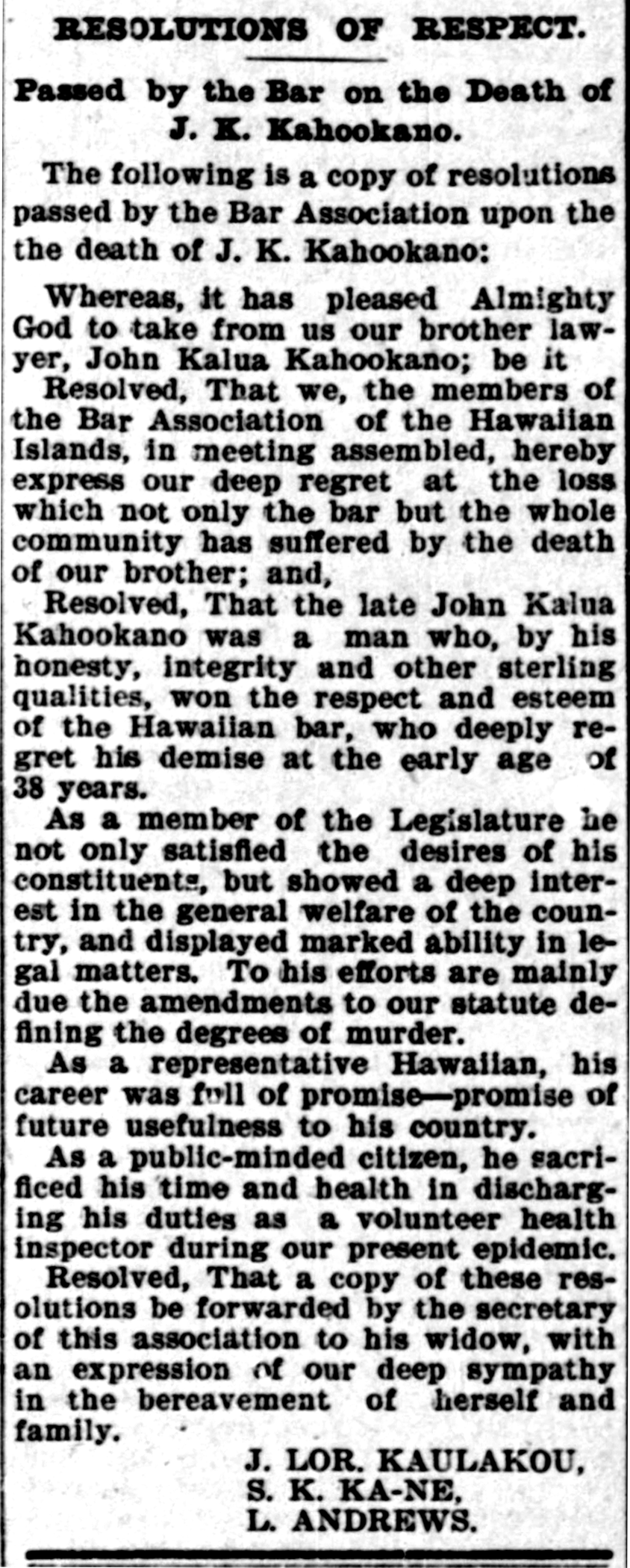
In memory of John Kalua Kahookano, 1900.

RESOLUTION OF RESPECT.

Passed by the Bar on the Death of J. K. Kahookano.

The following is a copy of resolutions passed by the Bar Association upon the death of J. K. Kahookano:

Whereas, it has pleased Almighty God to take from us our brother lawyer, John Kalua Kahookano; be it

Resolved, That we, the members of the Bar Association of the Hawaiian Islands, in meeting assembled, hereby express our deep regret at the loss which not only the bar but the whole community has suffered by the death of our brother; and,

Resolved, That the late John Kalua Kahookano was a man who, by his honesty, integrity and other sterling qualities, won the respect and the esteem of the Hawaiian bar, who deeply regret his demise at the early age of 38 years.

As a member of the Legislature he not only satisfied the desires of his constituents, but showed a deep interest in the general welfare of the country, and displayed marked ability in legal matters. To his efforts are mainly due the amendments to our statute defining the degrees of murder.

As a representative Hawaiian, his career was full of promise—promise of future usefulness to his country.

As a public-minded citizen, he sacrificed his time and health in discharging his duties as a volunteer health inspector during our present epidemic.

Resolved, That a copy of these resolutions be forwarded by the secretary of this association to his widow, with an expression of our deep sympathy in the bereavement of herself and family.

J. LOR. KAULAKOU [J. LOT KAULAKOU],

S. K. KA-NE,

L. ANDREWS.

(Pacific Commercial Advertiser, 3/2/1900, p. 7)

RESOLUTION OF RESPECT.

The Pacific Commercial Advertiser, Volume XXXI, Number 5482, Page 7. March 2, 1900.

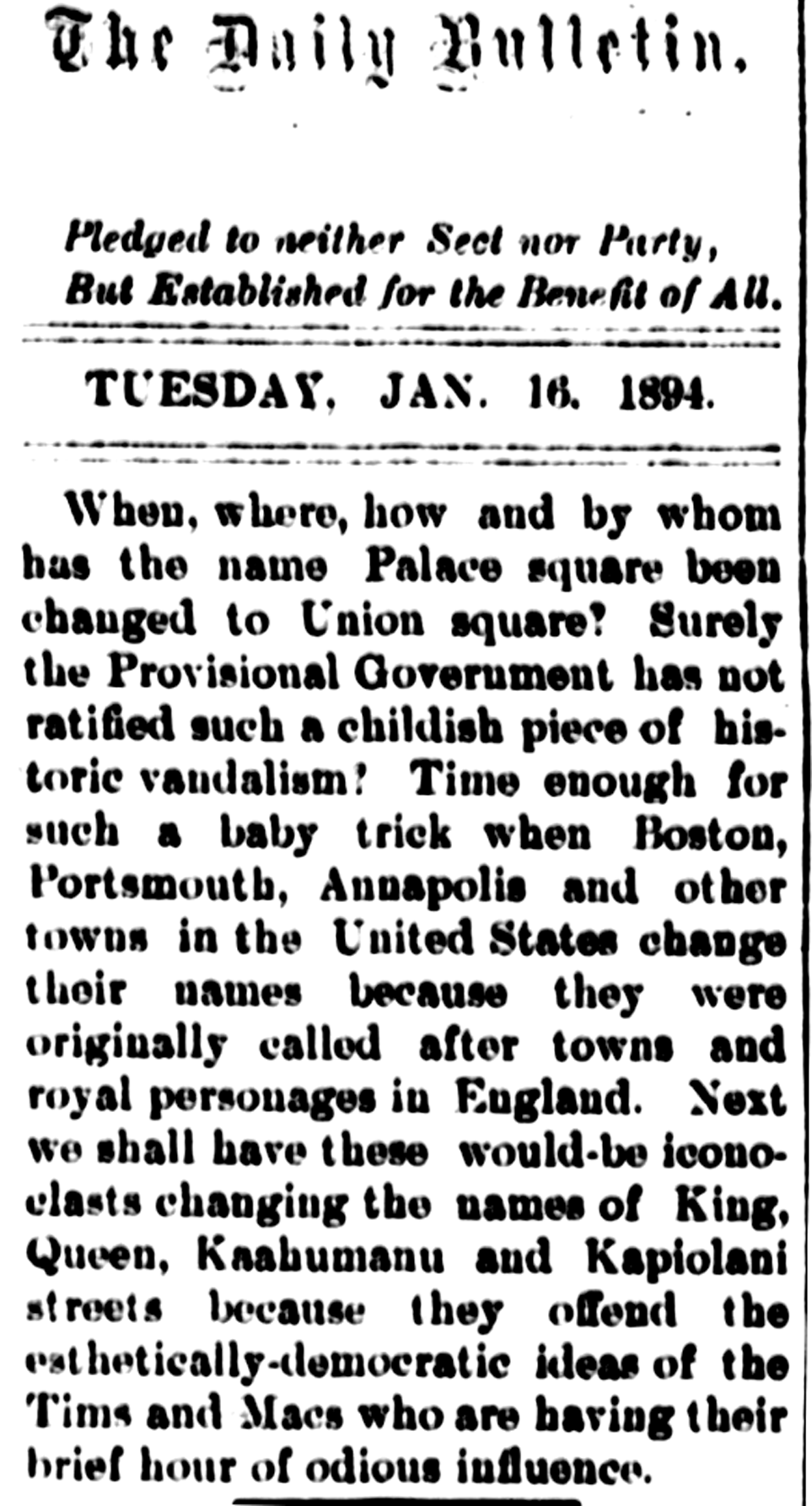
Change name, change history, 1894 / Timeless.

The Daily Bulletin.

Pledged to neither Sect nor Party,
But Established for the Benefit of All.

TUESDAY, JAN. 16, 1894.

When, where, how and by whom has the name Palace square been changed to Union square? Surely the Provisional Government has not ratified such a childish piece of historic vandalism? Time enough for such a baby trick when Boston, Portsmouth, Annapolis and other towns in the United States change their names because they were originally called after towns and royal personages in England. Next we shall have these would-be iconoclasts changing the names of King, Queen, Kaahumanu and Kapiolani streets because they offend the esthetically-democratic ideas of the Tims and Macs who are having their brief hour of odious influence.

(Daily Bulletin, 1/16/1894, p. 2)

When, where, how and by whom...

The Daily Bulletin, Volume VII, Number 932, Page 2. January 16, 1894.

Joseph Emerson interrupts meeting at the Kapuukolo Church, 1893.

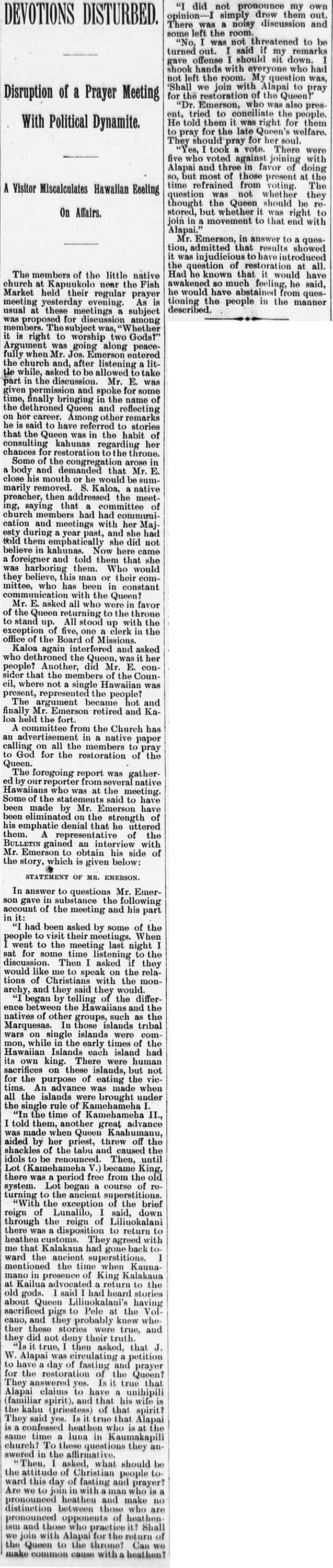
DEVOTIONS DISTURBED.

Disruption of a Prayer Meeting With Political Dynamite.

A Visitor Miscalculates Hawaiian Feeling On Affairs.

The members of the little native church at Kapuukolo near the Fish Market held their regular prayer meeting yesterday evening. As is usual at these meetings a subject was proposed for discussion among members. The subject was, “Whether it is right to worship two Gods?” Argument was going along peacefully when Mr. Jos. Emerson entered the church and, after listening a little while, asked to be allowed to take part in the discussion. Mr. E. was given permission and spoke for some time, finally bringing in the name of the dethroned Queen and reflecting on her career. Among other remarks he is said to have referred to stories that the Queen was in the habit of consulting kahunas regarding her chances for restoration to the throne.

 Some of the congregation arose in a body and demanded that Mr. E. close his mouth or he would be summarily removed. S. Kaloa, a native preacher, then addressed the meeting, saying that a committee of church members had had communication and meetings with her Majesty during a year past, and she had told them emphatically she did not believe in kahunas. Now here came a foreigner and told them that she was harboring them. Who would they believe, this man or their committee, who has been in constant communication with the Queen?

Mr. E. asked all who were in favor of the Queen returning to the throne to stand up. All stood up with the exception of five, one a clerk in the office of the Board of Missions.

Kaloa again interfered and asked who dethroned the Queen, was it her people? Another, did Mr. E. consider that the members of the Council, where not a single Hawaiian was present, represented the people?

The argument became hot and finally Mr. Emerson retired and Kaloa held the fort.

A committee from the Church has an advertisement in a native paper calling on all the members to pray to God for the restoration of the Queen.

The foregoing report was gathered by our reporter from several native Hawaiians who was at the meeting. Some of the statements said to have been made by Mr. Emerson have been eliminated on the strength of his emphatic denial that he uttered them. A representative of the Bulletin gained an interview with Mr. Emerson to obtain his side of the story, which is given below:

STATEMENT OF MR. EMERSON.

In answer to questions Mr. Emerson gave in substance the following account of the meeting and his part in it:

 “I had been asked by some of the people to visit their meetings. When I went to the meeting last night I sat for some time listening to the discussion. Then I asked if they would like me to speak on the relations of Christianity with the monarchy, and they said they would.

“I began by telling of the difference between the Hawaiians and the natives of other groups, such as the Marquesas. In those islands tribal wars on single islands were common, while in the early times of the Hawaiian Islands each island had its own king. There were human sacrifices on these islands, but not for the purpose of eating the victims. An advance was made when all the islands were brought under the single rule of Kamehameha I.

“In the time of Kamehameha II., I told them, another great advance was made when Queen Kaahumanu, aided by her priest, threw off the shackles of the tabu and caused the idols to be renounced. Then, until Lot (Kamehameha V.) became King, there was a period free from the old system. Lot began a course of returning to the ancient superstitions.

“With the exception of the brief reign of Lunalilo, I said, down through the reign of Liliuokalani there was a disposition to return to heathen customs. They agreed with me that Kalakaua had gone back toward the ancient superstitions. I mentioned the time when Kaunamano in the presence of King Kalakaua at Kailua advocated a return to the old gods. I said I had heard stories about Queen Liliuokalani’s having sacrificed pigs to Pele at the Volcano, and they probably knew whether these stories were true, and they did not deny their truth.

“Is it true, I then asked, that J. W. Alapai was circulating a petition to have a day of fasting and prayer for the restoration of the Queen? They answered yes. Is it true that Alapai claims to have a unihipili (familiar spirit), and that his wife is the kahu (priestess) of that spirit? They said yes. Is it tre that Alapai is a confessed heathen who is at the same time a luna in Kaumakapili church? To these questions they answered in the affirmative.

“Then, I asked, what should be the attitude of Christian people toward this day of fasting and prayer? Are we to join in with a man who is a pronounced heathen and make no distinction between those who are pronounced opponents of heathenism and those who practice it? Shall we join with Alapai for the return of the Queen to the throne? Can we make common cause with a heathen?

“I did not pronounce my own opinion—I simply drew them out. There was a noisy discussion and some left the room.

“No, I was not threatened to be turned out. I said if my remarks gave offense I should sit down. I shook hands with everyone who had not left the room. My question was, ‘Shall we join with Alapai to pray for the restoration of the Queen?’

“Dr. Emerson, who was also present, tried to conciliate the people. He told them it was right for them to pray for the late Queen’s welfare. They should pray for her soul.

“Yes, I took a vote. There were five who voted against joining with Alapai and three in favor of doing so, but most of those present at the time refrained from voting. The question was not whether they thought the Queen should be restored, but whether it was right to join in a movement to that end with Alapai.”

Mr. Emerson, in answer to a question, admitted that results showed it was injudicious to have introduced the question of restoration at all. Had he known that it would have awakened so much feeling, he said, he would have abstained from questioning the people in the manner described.

[This article was translated in Leo o ka Lahui, 2/9/1893, p. 2. It is interesting that there is a note appended to the end of the translated article that they did not have time to translate Emerson’s response.]

(Daily Bulletin, 2/7/1893, p. 3)

DEVOTIONS DISTURBED.

The Daily Bulletin, Volume V, Number 644, Page 3. February 7, 1893.

Why are some religions “real” while others are “superstitions,” “myths,” and “legends”? 1905 / today.

WAKEA THE POLYNESIAN

(By Rev. W. D. Westervelt in Paradise of the Pacific.)

The fountain source of the Mississippi has been discovered and re-discovered. The origin of the Polynesian race has been a subject for discovery and re-discovery. The older theory of Malay origin as set forth in the earlier encyclopædias is now recognized as untenable. The Malays followed the Polynesians rather than preceded them. The comparative study of Polynesian legends leads almost irresistibly to the conclusion that Polynesians were Aryans, coming at least from India to Malaysia and possibly coming from Arabia, as Fornander of Hawaii so earnestly argues. It is now accepted that the Polynesians did not originate from Malay parentage, and that they did occupy for an indefinite period the region around the Sunda Straits from Java to the Molucca Islands, and also that the greater portion of the Polynesians was driven out from this region and scattered over the Pacific in the early part of the Christian Era. The legends that cluster around Wakea have greatly aided in making plain some things concerning the disposition of the Polynesians. By sifting the legends of Hawaii-loa, we learn how the great voyager becomes one of the first Vikings of the Pacific. His home at last is found to be Gilolo of the Molucca Islands. From the legends we become acquainted with Wakea (possibly meaning “noonday” or “the white time” and his wife Papa (“earth”), the most widely remembered of all the ancestors of the Polynesian race. Their names are found in the legends of the most prominent island groups, and the highest places are granted them among the chief dieties. Their deeds belong to the most ancient times—the creation or discovery of the various islands of the Pacific world. Those who worshipped Wakea and Papa are found in such widely separated localities that it must be considered impossible for even a demi-god to have had so many homes. Atea or Wakea was one of the highest gods of the Marquesas islands. Here his name means “light.” The Marquesans evidently look back of all their present history and locate Atea in the ancient home land. Va-tea, in the Society Islands, Wakea in Hawaii and New Zealand, Makea-Vakea and Akea are phonetic variations of the one name when written down by the students who made a written form for words repeated from generation to generation by word of mouth alone. Even under the name Wakea this ancient chief is known by most widely separated islands. The only reasonable explanation for this widespread reference to Wakea is that he was an ancestor belonging in common to all the scattered Polynesians. It seems as if there must have been a period when Wakea was king of chief of a united people. He must have been of great ability and probably was the great king of the United Polynesians. If this were the fact it would naturally result that his memory would be carried wherever the dispersed race might go.

In the myths and legends of the Hervey Islands, Vatea is located near the beginning of their national existence.” Then there came upon the ancient world Te Vaerua, “the breath” or “the life.” Then came the god time—Te Manawa roa, “the long ago.” Then their creation legends locate Vari, a woman whose name means “the beginning,” a name curiously similar to the Hebrew word bara, to create, as in Gen. 1:1. Her children were torn out of her breasts and given homes in the ancient mist land, with which without any preparation or introduction, Hawa-iki is confused in a part of the legend. One of the children of Vari dwelt in a “sacred tabu island” and became the god of the fish. Another sought a home “where the red parrots’ feathers were gathered”—the royal feathers for the high chief’s garments. Another became the echo-god and lived in the “hollow grey rocks.” Another as the gods of the winds went far out “on the deep ocean.” Another, a girl, found a home, “the silent land,” with her mother. Wakea, or Vatea, the eldest of this family remained in Avaiki (Hawaii) the ancestral home—”the bright land of Vatea.” Here he married Papa. This Ava-iki was to the Herveyites of later generations the fiery volcanic under-world. When the long sea voyages ceased after some centuries, the islanders realized that Ava-iki was very closely connected with their history. They had but a misty idea of far off lands, and they did know of earthquakes and lava caves and volcanic fires—so they located Ava-iki as the secret world under their islands. This underworld with legendary inconsistency was located on the ocean’s surface, when it became necessary to have their islands discovered by the descendants of Vatea. According to the Hervey legends, Vatea is the father of Lono and Kanaloa, two of the great gods of the Polynesians. They are twins. Lono has three sons, whom he sends away. They sail out through many heavens and from Ava-iki “pull up” out of the deep ocean two of the Hervey islands. The natives of the Hervey group supposed that the horizon around their group inclosed the world. Beyond this world were heaves after heavens. A daring voyager by sailing through the sky line would break out from this world into an unknown world or a heaven bounded by new horizons. Strangers thus “broke through” from heaven to heaven, sometimes making use of the path of the sun. Thus about twenty-five generations ago Raa (possibly Laa, the Hawaiian), broke down the horizon’s bars and established a line of kings in Raiatea. So also when Captain Cook came to the Hervey Islands the natives said: “Whence comes this strange thing? It has climbed up (come up forcibly) from the thin land the home of Wakea.” He had pierced the western heavens from which their ancestors had come. Continue reading