Fashion setting, 1901.

[Found in an advertisement for Hale’s Good Goods store in San Francisco]

In ready-to-wear hats

We are showing now a splendid variety of chic, nobby styles. This imitation of the Hawaiian hat, bound with silk and trimmed with silk and gold scarf, for $1.25 is a splendid illustration of the money’s worth we can give you Two or three others:…

(San Francisco Call, 3/24/1901, p. 32)

In ready-to-wear hats

The San Francisco Call, Volume LXXXIX, Number 114, Page 32, March 24, 1901.

Hawaiian influence in music and fashion, 1917.

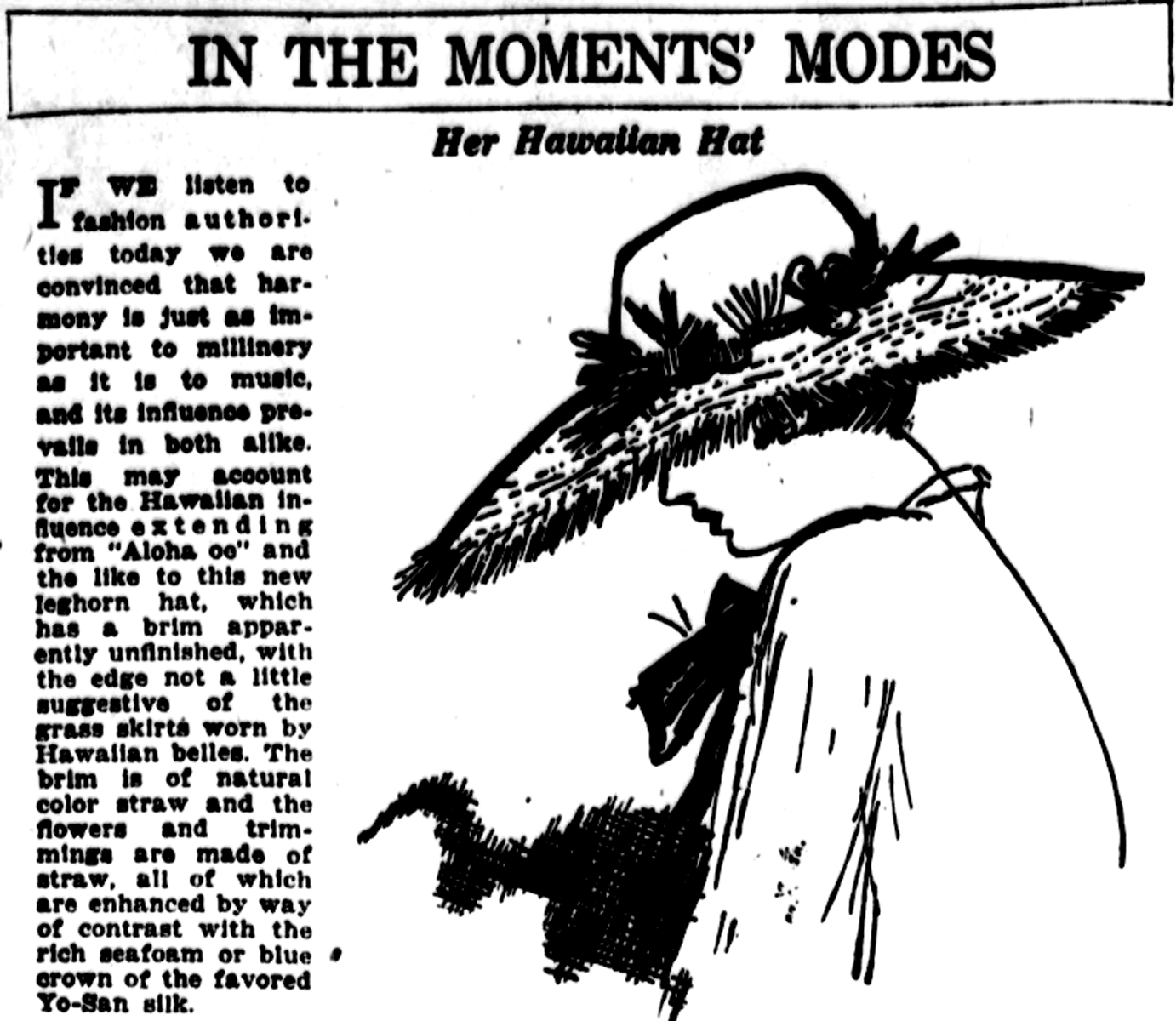
IN THE MOMENTS’ MODES

Her Hawaiian Hat

IF WE listen to fashion authorities today we are convinced that harmony is just important to millinery as it is to music, and its influence prevails in both alike. This may account for the Hawaiian influence extending from “Aloha oe” and the like to this new leghorn hat, which has a brim apparently unfinished, with the edge not a little suggestive of the grass skirts worn by Hawaiian belles. The brim is of natural color straw and the flowers and trimmings are made of straw, all of which are enhanced by way of contrast with the rich seafoam or blue crown of the favored Yo-San silk.

(Evening Ledger, 4/5/1917, p. 12)

IN THE MOMENTS' MODES

Evening Ledger, Volume III, Number 174, Page 12. April 5, 1917.

Stanford University Hawaii Club, 1905.

LEIS AT STANFORD

AN INTERESTING SOCIETY FORMED AT THE UNIVERSITY AT PALO ALTO—LEIS OF ROSES AND SCORE CARDS OF LAUHALA AT A CARD PARTY OF THOSE WHO HAVE LIVED IN THE ISLANDS.

STANFORD UNIVERSITY, April 13, 1905.—A number of Island people met on the evening of April 7, at the home of Mr. and Mrs. A. D. Larnach, and formed what was named the “Hui Hawaii” which is intended to bring together the Hawaiians about Stanford University in a social way. It was decided to have this a most informal affair and not to choose any regular officer, but simply to have it made known at one meeting who is to entertain at the next one. Anyone who has been in the Islands is to be eligible to membership. Continue reading

Papale fame to reach New York, 1906.

Hawaiian Hats for New York.

A question which has long puzzled the friends of the Hawaiian people has been how to provide, for the ones who wish to work, suitable occupations. Critics of the Hawaiian race have been free in their statements to the effect that the Hawaii is lazy and unprogressive, in utter forgetfulness of the fact that it takes more than a generation or two to outlive the old customs more especially when the vitality of a once healthy people has been sapped by the vices and evil productions of socalled civilizasion.

This attitude on the part of many whites and the importation of foreign goods has very nearly doomed to extinction many industries distinctively Hawaiian, but a determined effort is being made to revive at least some of them before they are forgotten entirely.

Perhaps among the most interesting of these is that of making Hawaiian hats and in this a fine start towards establishing a truely native industry has already been made.

The prices commanded by Panama and Filipino hats is such as to encourage those who are looking after the present attempt as there is no doubt that as good hats can be made by the Hawaiian women as any that come from the places mentioned. For these expensive hats however there is of course a limited demand and it is towards the production of grades for ordinary wear that attention has been directed.

First attempts to enlist Hawaiian women in the work were discouraging but after some time Theodore Richards and the Atherton Estate, recognizing the importance of the work, took it up in order to assist the lady who had the matter in hand.

“When Mr. Richards heard of the work he became interested and at once offered a work room at the Kauluwela lodgings, on Vineyard street,” she said this morning, “with out that we could have done nothing. There the women work on the hats and on the braids. Some of the original Hawaiian patterns for braids had disappeared entirely. Others were recalled by native women who remembered them from the early days. Others we managed to get from the other islands and one or two I designed. We have now thirty patterns in all.”
Continue reading

Far reaching influence of Hawaiian lauhala, 1911.

[Found in: M. McInerny, Ltd. advertisement]

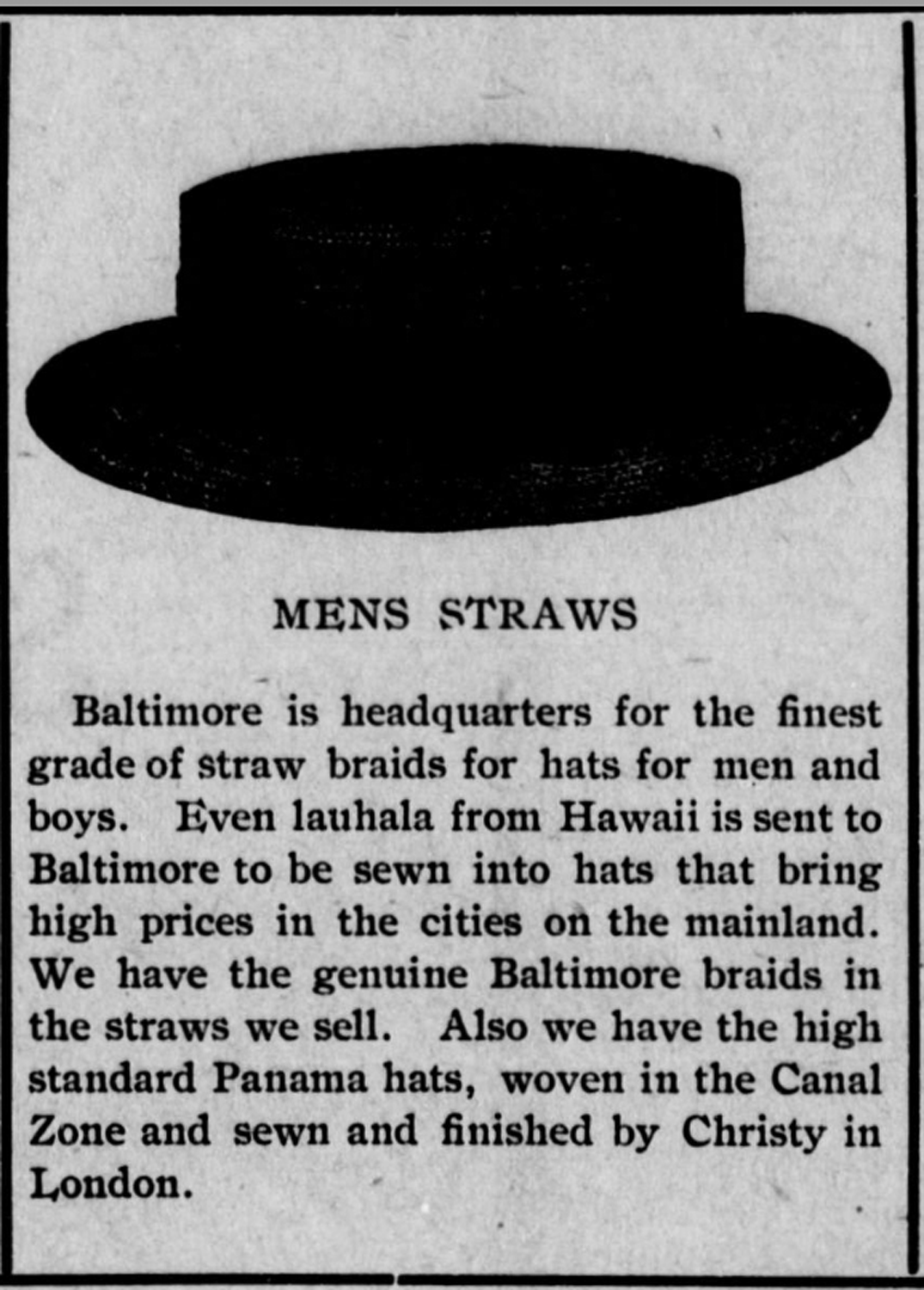
MENS STRAWS

Baltimore is headquarters for the finest grade of straw braids for hats for men and boys. Even lauhala from Hawaii is sent to Baltimore to be sewn into hats that bring high prices in the cities on the mainland. We have the genuine Baltimore braids in the straws we sell. Also we have the gigh standard Panama hats, woven in the Canal Zone and sewn and finished by Christy in London.

(Maui News, 12/2/1911, p. 7)

MENS STAWS

Maui News, Volume XVIII, Number 41, Page 7. December 2, 1911.

Carl Nakuina’s shark attack news spreads far to Utah, 1917.

SHARK IN AUTO BITES CAPTOR

HONOLULU, T. H., Aug. 30 (by mail).—Honolulu has probably the only man who was ever bitten by a shark in an automobile. If the sentence appears confused, it is nevertheless correct, for both the man and the shark were in the automobile at the time.

Carl Nakuina, an employee of a local poi factory, went to Nanakuli, on the shores of this island, last Sunday to fish. He had bigger luck than he anticipated in, for he hooked a twelve-foot shark. Continue reading

English and education, 1903.

The Problem Of Language

Some interesting comments of the solution of the language difficulty in the public schools of the islands are contained in the reports of Normal Inspectors to Superintendent Atkinson. There are few, if any, countries in the world where so much diversity of language confronts the teachers as in Hawaii, and two of the inspectors express the opinion that in quick solution of the problem of speech Hawaii leads the world.

Inspector J. K. Burkett, of the First and Fourth Circuits, says:

“When we  consider how mixed is the population, from how many nationalities our teaching force is recruited, and how the whole is mixed as it were in the crucible of English, bringing forth not a garbled and provincial English speech, but one based upon  the best models, the outcome is truly marvelous. There is probably no country on the face of the globe which has succeeded in solving this difficult problem of speech, so quickly as this has. The work of the schools in my districts has been directed to the thorough instilling of English, colloquial English. But though English is the foundation and the study most carefully and thoroughly instilled, it is not the final end of our effort. The course of study is carefully followed, and we have every branch given its full due. Some schools may be more successful than others, some teachers command better results than others, but the whole school system of these two districts stands at a very high average. I would like before closing to register my unqualified sentiments of satisfaction with the teaching force of the districts, and would say that few places in the Union can show as able and as energetic teachers as we have. Especial credit must be given to those who have had no other advantage than the education of our own schools, completed in the Honolulu Normal. These young men and young women have proved what local work can and will do, if properly guided and earnestly carried out.

“I look for a great future for education in these Islands. With much toil and much careful thought, many most difficult problems have been solved and a most valuable foundation has been laid. Upon this a magnificent super-structure will be raised which will do honor to the Territory and its people.”

Charles W. Baldwin, Inspector for the Third Circuit says:

“In conclusion I may say, though the Inspector feels that he has failed in much, that failure has been due to the facts already set forth in this report—the need of methods more in harmony with those of our Normal school has been so great that almost his entire attention has been towards the accomplishment of that object. While there is yet much to criticize, of the schools as a whole it is certain that they are a decided step in advance of the work that was being done when the Inspector first undertook his new duties. Of the future it may be said that, if our present educational system is allowed to remain untrammelled, that we will excel all schools in methods for teaching English; and nowhere on earth will teachers be found better fitted to handle non-English speaking children.”

(Hawaiian Star, 3/5/1903, p. 7)

The Problem Of Language

The Hawaiian Star, Volume X, Number 3419, Page 7. March 5, 1903.

Hawaiian language in an English paper, 1884.

$25 REWARD.

FOR the Conviction of the person or persons that entered my premises on the 9th of Jan. 1884, and robbed the house, and destroyed several bags of feed.

———

NO KA HOPU ANA i ka mea a mau mea paha i hele ai ma ku’u aina ma ka la 9 o Ianuari, 1884, a komo iloko o ka hale a hoopoinoia he lehulehu o na Eke Ai (a ka holoholona).

R. GERKE.

Jan. 15th, 1884.

(Daily Bulletin, 2/5/1884, p. 4)

$25 REWARD.

The Daily Bulletin, Volume III, Number 628, Page 4. February 5, 1884.

The death of Prince Albert Kunuiakea, 1903.

PRINCE ALBERT KUNUIAKEA’S BODY BORNE IN STATE TO THE CAPITOL

Kamehameha III.  Prince Albert.  Queen Kalama.

PRINCE ALBERT AS AN INFANT.

From a picture hanging on the walls of the home of the late Prince Albert Kunuiakea. Made about 1853.

The Program of the Ceremonies Today.

In the old throne room of the Capitol Building, where royalty once held sway, the remains of Prince Albert Kunuiakea were laid in state yesterday afternoon. At 6 o’clock to the accompaniment of muffled drums and the solemn tread of soldiery the casket containing the body of the last heir presumptive of the Kamehamehas was brought from his late residence in Palama to the old royal estate where the Prince as a boy had been raised in the family of Kamehameha III. The procession from the residence was headed by a drum corps followed by four companies of the First Regiment of the National Guard of Hawaii. Behind the troops came the hearse bearing the royal casket, flanked by young Hawaiian chiefs bearing large and small feather kahilis. These were novel in the startling array of beautiful colored feathers and in the adaptation of ancient funeral customs. Behind the hearse came the mourners, the chiefs and chiefesses according to rank as recognized among the Hawaiians. When the military filed into the Capitol grounds they divided on each side of the driveway allowing the hearse to pass between serried lines of soldiers standing at present arms. Col. Soper and Capt. Hawes of the Governor’s staff, in full uniform, met the remains at the front entrance of the Capitol.

The casket was carried into the throne room and deposited upon a bier overspread with a beautiful pall of heavy black velvet faced with yellow silk. At the head was a magnificent feather kahili of black and yellow and candelabra authorized by the Roman Catholic church. Four huge kahilis, the tabu marks of the royal presence, designated the sacred enclosure and within this, six chiefs, three on each side of the bier, were placed upon watch, waving small kahilis in unison over the casket. From the old throne of the Kalakauas the crown flag of Hawaii was suspended and over the entrances the Hawaiian colors were draped. A beautiful array of palms upon the dais, together with the picturesque old throne room chairs, formed a pleasing picture. When the beautiful crystal candelabra were illuminated the scene beneath was spectacular.

The main staircase from the hallway was lined with palms. The waving of the kahilis, and the chanting of the genealogy of the Prince were continued through the night and will be a part of the weird ceremony until the casket is borne from the palace.

The committee on decorations was as follows: Mrs. Carrie Robinson, Mrs. Helen Holt, Mrs. Mary Beckley, Mrs. Ena, Mrs. A. P. Taylor, Mrs. Emmeline Magoon, Mrs. Alice Hutchinson, Miss Hilda Burgess, Miss May Low, Harry Davison, J. McGuire.

From 11 a. m. to 1 p. m. today the body will lie in state in the old throne room of the Capitol. From 1 to 1:20 p. m. the Roman Catholic service will be said, Pro Vicar Libert officiating. A detail of the National Guard was assigned as a guard of honor yesterday afternoon and will remain under arms until the procession moves this afternoon.

The order of procession today appears elsewhere in a By Authority notice.

[Might anyone know where this portrait is today?]

(Pacific Commercial Advertiser, 3/15/1903, p. 1)
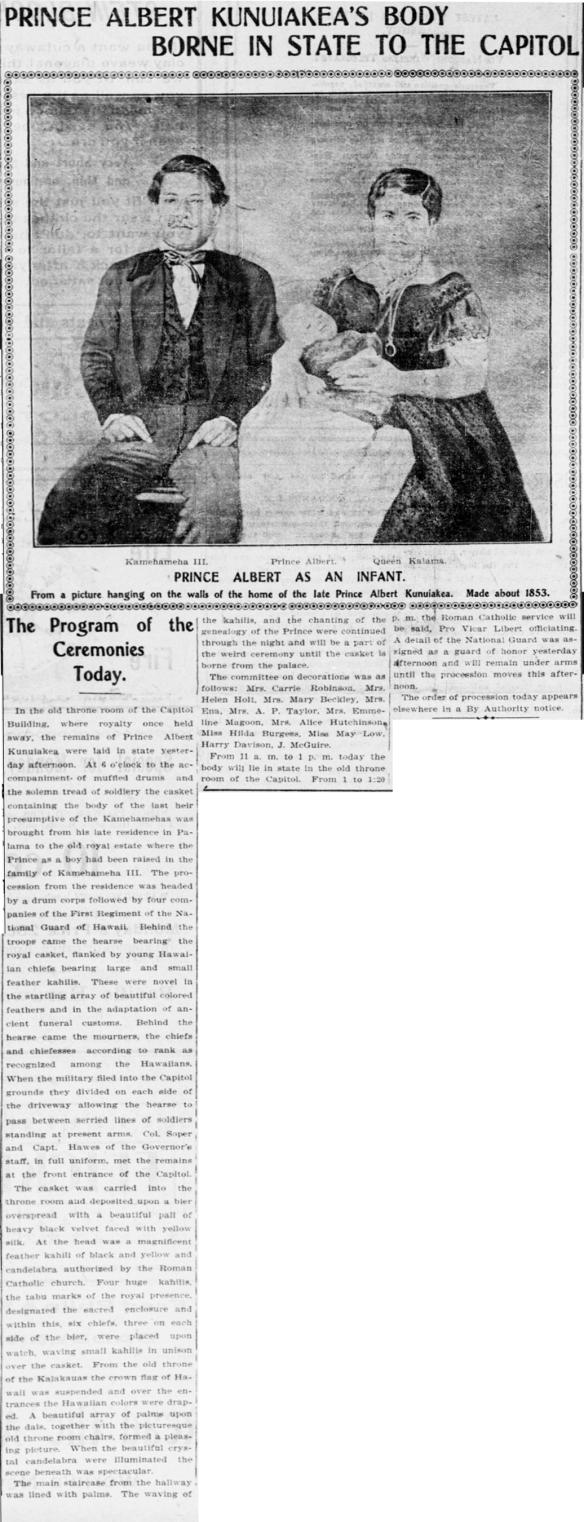
PRINCE ALBERT KUNUIAKEA'S BODY BORNE IN STATE TO THE CAPITOL

Sunday Advertiser, Volume I, Number 11, Page 1. March 15, 1903.

Edgar Henriques weds Lucy Kalanikiekie Davis, 1898.

[Found under: “LOCAL BREVITIES.”]

Edgar Henriques and Miss Kalani Davis were quietly married at the home of Miss Lucy Peabody, Vineyard street, last evening [June 10, 1898], the Rev. Alex. Mackintosh officiating. Only the relatives were present. The newly married couple have gone to Waikiki for their honeymoon.

(Pacific Commercial Advertiser, 6/24/1898, p. 7)

Edgar Henriques...

The Pacific Commercial Advertiser, Volume XXVII, Number 4954, Page 7. June 24, 1898.