John G. M. Sheldon passes away, 1914.

SUDDEN DEATH OF J. G. M. SHELDON

John G. M. Sheldon, brother of Henry Sheldon, of Lihue, and Wm. J. Sheldon, formerly of Waimea, died in Honolulu of hemorrhage last Friday morning. He had been in rather poor health for several years. Henry Sheldon left by the Kinau Saturday for Honolulu to attend the funeral, which took place Sunday afternoon.

Mr. Sheldon was one of the oldest printers in the Islands, having begun work as such when quite young. Being proficient in both the English and Hawaiian languages, he was frequently employed as interpreter in the courts and elsewhere. He had many friends by whom he was well liked.

(Garden Island, 3/31/1914, p. 1)

SUDDEN DEATH OF J. G. M. SHELDON

The Garden Island, Volume 10, Number 12, Page 1. March 31, 1914.

Kahikina Kelekona, John G. M. Sheldon, editor of the Hawaii Holomua, arrested for speaking, 1893.

LIBERTY OF THE SUBJECT.

Has Anybody Any Rights Under the Provisional Government?

Argument of the Question in the Circuit Court.

John G. M. Sheldon, editor of the Holomua, who is deprived of his liberty under a warrant issued by the President of the Provisional Government, was produced in the First Circuit Court before Judge Frear, at 11 o’clock this forenoon, under a writ of habeas corpus. Attorney-General Smith and F. M. Hatch appeared for the Government, and C. W. Ashford, C. Creighton, A. Rosa and J. L. Kaulukou for the prisoner.

Mr. C. W. Ashford argued for the discharge of the prisoner, speaking to the following effect: There was no authority vested in the Executive and Advisory Councils to issue warrants of arrest. President Dole had no right in the Proclamation of the Provisional Government to issue a warrant of arrest. The Government could not go behind that proclamation, he presumed. “We the People of the Hawaiian Islands” gave him no such power. If “We the People of the Hawaiian Islands” had intended to exercise that power they would have given it to him. The Proclamation stated that the President’s duties were to preside over the meetings of the Executive Council. Mr. Dole now holds no judicial position in these islands. He did hold such position before, but resigned it to become President of the Provisional Government. If that warrant, of President Dole was valid, then there was no security of liberty for any man, woman or child under these tropic skies. There was then nothing to prevent any resident of this country being consigned to a dungeon or bound in irons. It should be known whether the Provisional Government had such tremendous powers. He was not making a covert attack on the late revolution. He believed in the sacred right of revolution, and he considered the late revolution was a good thing. But it might not be good if the Provisional Government introduced anarchy and despotism. Some persons were led by their philosophy to believe that a beneficent despotism was the best form of government, and he believed that members of this school of philosophy had seats in the Advisory Council. Continue reading

Bilingual law announcements in English-language newspapers, 1902.

BY AUTHORITY.

REGULATIONS
FOR
HACK AND FOR PASSENGER VEHICLES
AND
RATES OF FARE.

By virtue of the authority in me vested and under the provisions of Section 794 of Chapter 55, of the Penal Laws of 1897, I, James H. Boyd, Superintendent of Public Works of the Territory of Hawaii, do make and declare the following Rules and Regulations to be observed by Licensed Carriers of Passenger Vehicles, in the District of Honolulu:

1st. Every licensed carriage, dray or vehicle must be numbered, and this number must be placed on a conspicuous part of the carriage, dray or vehicle.

2d. Every licensed carriage running at night must exhibit two lights, and the number of such carriage plainly shown on the glass of each lantern, in black figures, not less than one and one-half (1½) inches in height.

3d. Drivers of licensed vehicles must obey the orders of the Police.

4th. On all stands set apart for licensed carriages the horses must be headed parallel to the street, and close to the sidewalk.

5th. No horse harnessed to a licensed vehicle must be left on any stand unless properly secured by a hitching rope to an iron hitching weight.

6th. No licensed carriage will be allowed to be left on the street over night. Continue reading

Farming in Hawaii, 1913.

ENCOURAGING SMALL FARMER.

Beginning January 5, The Advertiser will publish a weekly list of wholesale prices for Island produce in Honolulu markets while A. T. Longley, superintendent of the home markets division of the Hawaii Experiment Station will also supply a weekly market letter for publication. The marketing division was authorized by the last legislature, an appropriation having been made for the purpose.

Dr. E. V. Wilcox has been a close student of cooperative marketing organizations for the last twenty years. He stated to The Advertiser Saturday that there are ten times as many cooperative marketing organizations in the United States as in England and Germany combined, although there is very little American literature on the subject. One Southern farmer’s organization that both sells produce and purchases machinery, fertilizers, seed and supplies for its members includes over three million farmers and planters. California, Oregon, Idaho, Washington, Utah and Colorado have their fruit marketing organizations. In the Central States the farmers have to together on their corn, wheat and oat crops as well on the scores of minor products usually associated in the Hawaiian public mind with “small farming.” There are cooperative societies in New York and New England; in Kentucky, Tennessee and the Carolinas they united in the marketing of tobacco, early truck crops, peach and berry crops; and in the Gulf States they are almost a controlling factor in cotton.

The prime objects of farmer’s cooperative unions are, continuity of supply, an honest and uniform pack, and standardization of grades. The idea is to put the growing, packing and marketing of farm produce on a business basis.

Continue reading

Beginnings of the Bernice Pauahi Bishop Museum, 1886.

Museum of Antiquities.

A special meeting of the Board of Trustees of the Queen’s Hospital was held yesterday. It was called to consider the question of conveying the Hawaiian antiquities and curios, devised to the Trustees by the will of the late Queen Emma, to the Hon. C. R. Bishop for a projected public museum. Mr. Bishop had sometime ago formed the purpose of founding a museum of Hawaiian antiquities, with the collection of his late consort, Princess Bernice Pauahi Bishop, as the nucleus. Continue reading

Mary Mahiai passes away, 1913.

AGED HAWAIIAN PASSES BEYOND

Believed by many of the Hawaiians to be at least 110 years old, and having figured in a history which has been recounted from the Atlantic coast to the far east, Mary Mahiai died at her home on Vineyard street last Monday night, and was buried yesterday afternoon in the cemetery back of the asylum.

The aged Hawaiian was born on the island of Kauai during the period the reign of Kamehameha the Great, long before the first missionaries from New England arrived here, and at the age of seven years went out in a canoe with her uncle and five other men for the island of Molokai. A storm came up and the canoe was driven out of sight of land, and for ten days they drifted at the mercy of the elements without food or water. When nearly dead from hunger and thirst, a sail was sighted, and two boats appeared, the larger of which sent a boat out to take the occupants of the canoe aboard. They were treated kindly by the captain and soon learned that the vessel was bound for China. The little Hawaiian girl was given the task of caring for the captain’s daughter and the men put to work on the vessel. At one of the islands of the Ladrones the five men of the little party were put ashore at their request, and it was afterward earned that they were devoured by cannibals who were known to infest those islands. Mary Mahiai, with her uncle, remained on the vessel and were taken to China, where they were turned over to missionaries there. They remained there several years, during which time Mary’s uncle died. Mary was made nurse to one of the missionary’s children and soon after traveled to New York with her mistress. At the time of the gold rush to California Mary was in the employ of a missionary family named Bates, and in 1848 they set sail for the gold fields, via Cape Horn. They were many months reaching their destination on account of the fierce storms which swept that coast, finally reaching Monterey.

The party sailed for the Hawaiian islands a few years later, arriving in Honolulu in 1850, and Mary at once sent a letter to her friends, who had many years previous mourned her death, thinking that she had been drowned or eaten by sharks. Her friends came to Honolulu and her return was celebrated with a luau which lasted many days. Mary did not accompany her relatives back to Kauai, but remained in the employ of the Bates family, to whom she had become very much attached. Later, she married, her husband dying a few months later. Her second husband died of the smallpox and her third lived only a year after their marriage. She married for the fourth time and she and her husband lived happily for twenty years, he dying in the early part of the present century.

The interesting story of her life was told by her when she appeared before the United States senatorial commission on its visit to Honolulu in 1902. As she became old, Mary Mahiai lapsed into the easy Hawaiian life in her humble home on Vineyard street, where she would be often seen barefooted and clad in a holoku.

(Star-Bulletin, 1/8/1913, p. 4)

AGED HAWAIIAN PASSES BEYOND

Honolulu Star-Bulletin, Volume XX, Number 6479, Page 4. January 8, 1913.

More on Kamehameha III 100th birthday memorial, 1914.

CENTENARY OF KAMEHAMEHA III IS MARKED WITH IMPRESSIVE SERVICE

Handsome Tablet Is Unveiled Accompanied by Sacred Chant of Loved King

The unveiling of a handsome tablet of Hawaiian lava granite, to the accompaniment of sacred chants composed a century ago, marked the 100th anniversary of the birth of Kauikeaouli, the third of the Kamehamehas, which yesterday afternoon was observed at old Kawaiahao church by the Daughters of Hawaii. It was a fitting memorial to that ruler who, known to his subjects as the beneficent king, gave to the inhabitants of these islands their first written constitution, and, to make the observance further complete, the tablet will be taken to Keauhou, Kona, where it will mark the birthplace of ka moi lokomaikai.

The historical structure of Kawaiahao, around which is woven innumerable tales dear to the heart of the kamaaina, was occupied by more than 2600 persons, the majority of whom were Hawaiian. The memorial tablet occupied the center of the platform, hidden from view by the royal standard of Liliuokalani and High Chiefess Elizabeth Kekaaniau Pratt, both lineal descendants of the Hawaiian King who was the founder of the Kamehameha dynasty. Feathered cloaks of almost priceless value draped the chairs in which they sat.

The strange, yet beautiful, setting doubtless was a perfect replica of a court scene in the days of the old regime when the Kamehameha held sway. The costuming of the participants was perfect, and there was presented a spectacle in which was brought out many ancient and rare relics which today are treasured by Honolulu families and which are seldom seen other than in private homes, where they are held almost sacred.

Attired in feather cloaks and helmets, High Chief Fred Kahapula Beckley and High Chief Albert Kalaninoanoa Hoapili, the spear and kahili bearers respectively, occupied places just back of the queen and High Chiefess Pratt, representing the figures which are seen on the royal Hawaiian coat-of-arms. Both are lineal descendants of chiefs of the court of Kamehameha I, High Chief Beckley being a descendant of Kameeiamoku, and High Chief Hoapili a descendant of Kamanawa, the royal kahili bearer. Boys from the Kamehameha school, to the number of 16, acted as court attendants and kahili bearers, and occupied places on either side of the court representatives. They were attired in feather capes and other accessories adopted by the Hawaiian warriors of other days. Above this gathering was suspended the royal standard of Kalakaua, as well as other Hawaiian flags, their colors blending in perfect harmony with the vivid green of the palms and ferns with which the nave was banked.

Continue reading

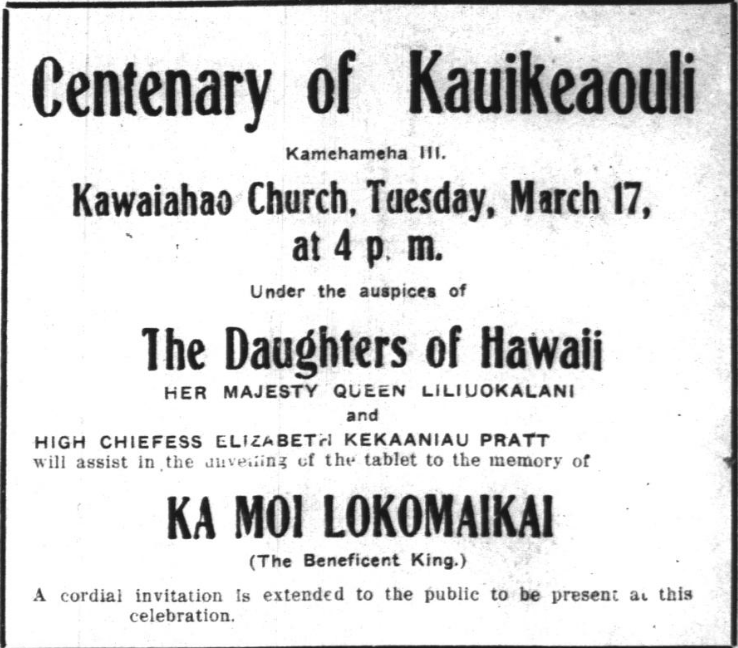
Public invitation to celebration of Centenary of Kauikeaouli, 1914.

Centenary of Kauikeaouli

Kamehameha III.

Kawaiahao Church, Tuesday, March 17,

at 4 p. m.

Under the auspices of

The Daughters of Hawaii

HER MAJESTY QUEEN LILIUOKALANI

and

HIGH CHIEFESS ELIZABETH KEKAANIAU PRATT

will assist in the unveiling of the tablet to the memory of

KA MOI LOKOMAIKAI

(The Beneficent King.)

A cordial invitation is extended to the public to be present at this celebration.

(Star Bulletin, 3/11/1914, p. 8)

Centenary of Kauikeaouli

Honolulu Star-Bulletin, Volume XXI, Number 6840, Page 8. March 11, 1914.

Kauikeaouli’s 100th birthday at Kawaiahao Church, 1914.

TRIBUTE PAID TO MEMORY OF KING

Hawaiians Celebrate Centenary of Kamehameha III with Impressive Ceremony—Queen Liliuokalani Unveils Tablet to Mark Birthplace of Beloved Monarch

(From Wednesday Advertiser.)

The centenary of Kauikeaouli, Kamehameha III, was celebrated yesterday at Kawaiahao Church under the auspices of the Daughters of Hawaii. This old church, that has witnessed so many of the royal ceremonials of the Hawaiian people, was taxed to the utmost of its seating capacity. More than twenty-six hundred persons viewed the unveilling of the memorial tablet which had been prepared by the Daughters of Hawaii to mark the birthplace of “The Generous King” at Keauhou, in Kai-malino, Hawaii.

The tablet was hidden from view by the Royal Standard of Liliuokalani and a Hawaiian flag, both the property of and loaned by Hawaii’s venerable ex-queen for the sacred ceremonial.

The Queen and High Chiefess Elizabeth Kekaaniau Pratt, both of whom are lineal descendants of Keawe, the ancient king of Hawaii, and founder of the Kamehameha dynasty, were seated on either side of the memorial stone in the nave of the church. The palace chairs in which they sat were draped with ancient Hawaiian feather capes of priceless value.

Oldtime Dignitaries Attend.

Back of the Queen and High Chiefess Pratt were High Chiefs Beckley and Hoapili, clad in the ceremonial feather cloaks and helmets of the Royal Courtiers. High Chief Fred Kahapula Beckley, the spear-bearer, is a direct descendant through his father’s side from Kameeiamoku. High Chief Albert Kalaninoanoa Hoapili, the kahili bearer, is a lineal descendant of Kamanawa, the royal kahili bearer. These two therefore, in yesterday’s ceremony represented the spear-bearer and kahili bearer who are shown on the Hawaiian coat of arms and are descendants of the two chief court alii of Kamehameha I.

On either side of the royal court representatives were the kahili bearers in ordinary, sixteen young men from the Kamehameha School for Boys, robed in feather capes and the costumes of the warrior of old, representative of the court attendants.

The chancel and pulpit were tastefully decorated with beautiful ferns and palms while above was the Royal Standard of Kalakaua and the Hawaiian flags, both now the property of and loaned by the Kapiolani Estate.

Continue reading