Bonine brings movies to Kalawao and Kalaupapa, 1909.

FIRST MOVING PICTURE SHOW TAKES SETTLEMENT BY STORM

On Thursday evening last a new miracle happened at Kalaupapa. On that evening R. K. Bonine, the moving-picture expert, threw his first picture on the screen before an audience of a thousand lepers, and there was a great gasp of awed astonishment and keen delight when the pictures really moved and did things. Cheers, tears, gasps and soul-satisfying laughter greeted the pictures in turn, and when the reels put aside for the first entertainment had been exhausted, the people of Kalaupapa and Kalawao, in a body, cheered their thanks to the man who had brought these wonders to them and to those in Honolulu who had through their contributions made these miracles possible.

It was a great day for the people of the Molokai Settlement, and it was a great day for Bonine. To the lepers had come a new marvel, greater far than the sight of the mighty White Fleet, which maneuvered past their shores last summer, greater than anything that had come to them. No place the world over have motion pictures made such a hit. Continue reading

Hawaiian Language information from English-language newspapers! 1887.

“The Lightning Detective.”

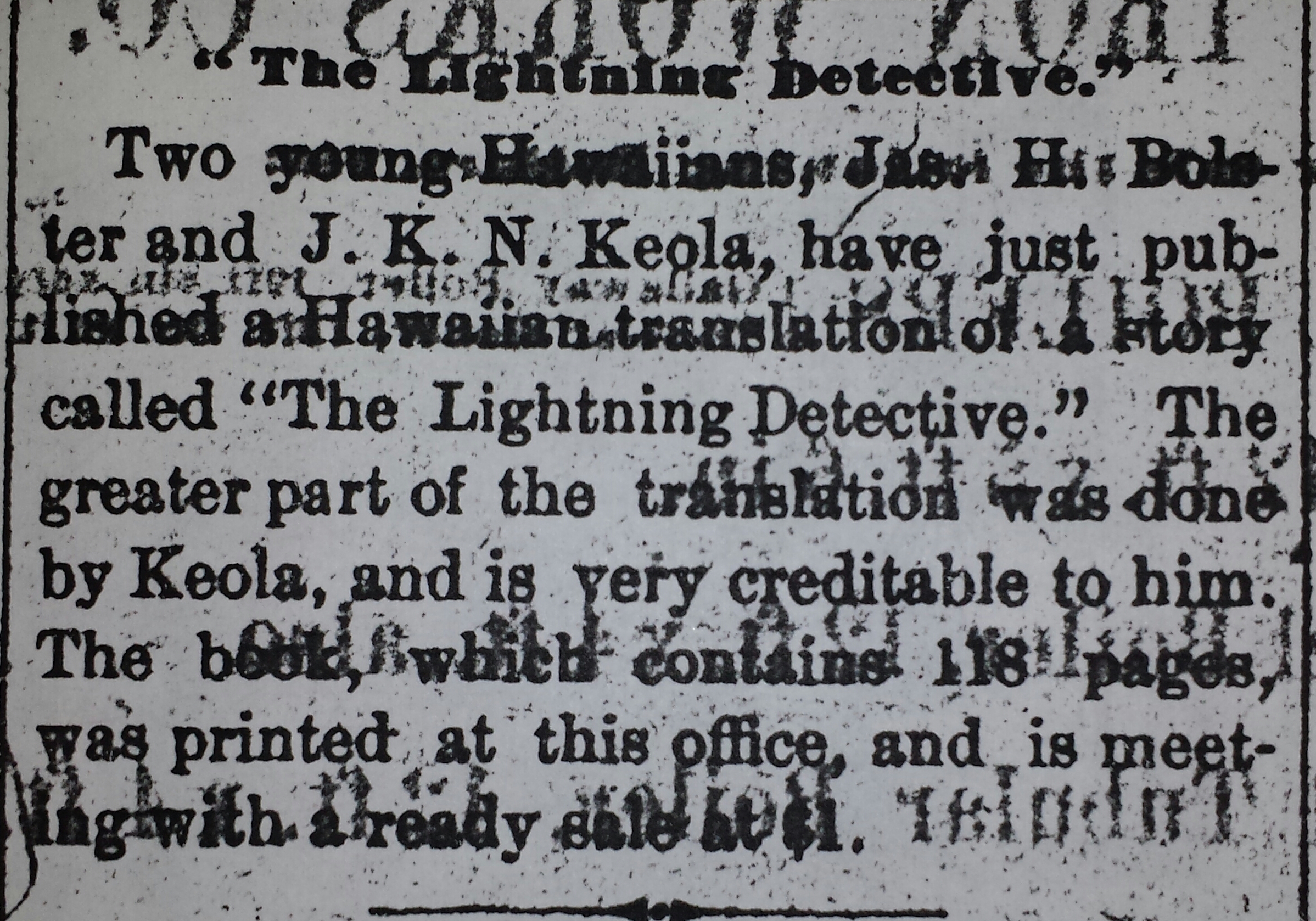
Two young Hawaiians, Jas. H. Boster and J. K. N. Keola, have just published a Hawaiian translation of a story called “The Lightning Detective.” The greater part of the translation was done by Keola, and is very creditable to him. The book, which contains 118 pages, was printed at this office, and is meeting with a ready sale at $1.

[There doesn’t seem to be a translator credited on the actual book, “He Buke Moolelo no Ka Makai Kiu Uila” published in 1887 by the P. C. Advertiser.¹ Who would have thought that translators of a Hawaiian book would be mentioned in an English newspaper (even if it was a newspaper printed by the company that did the publishing). This goes to show you that it is important to look at all sources available, whatever language it may be in, to find information!

Copies of this book are available at the Hawaiian Historical Society and Mission Children Society, photocopies are available at Hamilton Library at UHM.]

¹See David Forbes’ Hawaiian National Bibliography, vol. 4.

(Pacific Commercial Advertiser, 5/3/1887, p. 3)

"The Lightning Detective."

Pacific Commercial Advertiser, Volume VI, Number 104, Page 3. May 3, 1887.

Stopping by at Washington, D. C. on the way to see the Queen, 1887.

KING KALAKAUA’S WIFE.

QUEEN KAPIOLANI ARRIVES AT OUR NATIONAL CAPITAL.

Arrangements Made for the Queen to Call on the President and Mrs. Cleveland—A Benevolent Creature on Her Way to Visit Victoria—Queen Emma.

QUEEN KAPIOLANI.

Washington, May 4.—Queen Kapiolani, of the Hawaiian Islands, who arrived in San Francisco on April 20, arrived in Washington to-day and immediately went to the Arlington Hotel. Arrangements have been made for the queen to call on the president and Mrs. Cleveland at noon on Wednesday. The queen and suite will arrive here early Tuesday evening and go at once to the Arlington. A time will be appointed by the queen during her stay here for the diplomatic corps to call on her, and she will also probably receive calls from the naval officers who have been stationed at Honolulu, all of whom have met her majesty, and many of whom have danced with her.

After spending a few days here sight-seeing she will go to New York. From there she goes to England to be present at the Queen’s jubilee. She has never been out of her own country before, and is quite anxious to see the “greatest woman on the face of the earth,” as she calls Queen Victoria. Queen Kapiolani is not of what is known as royal blood in Honolulu. Strictly speaking neither is King Kalakaua of royal blood, as he was elected to the throne and did not inherit it. Continue reading

Nipper and Hawaiian Music, 1917.

Victor
“HIS MASTER’S VOICE”
REG. U.S. PAT OFF

To insure Victor quality, always look for the famous trademark, “His Master’s Voice.” It is on every Victrola and every Victor Record. It is the identifying label on all genuine Victrolas and Victor Records.

All the fascination of Hawaiian music is in these Victor Records

There is a quaint and dreamy beauty to the music of Hawaii as it comes like the whispering breeze from the mid-Pacific. It breathes the lightsome spirit of this land of sunshine. Its laguorous rhythm is typical of Hawaiian life, of the swaying trees, the beating surf, of the joys and sorrow of this interesting music-loving people.

And all the enchantment of Hawaiian music, all the charms of their quaint instruments, all the peculiar beauties of their light voices are brought to you on Victor Records. You are in fancy transported to these far-off islands.

18132 10 in. 75c
On the Beach at Waikiki—Medley Hula (with Ukulele and Guitar by Louise and Ferera) Horace Wright-Rene Dietrich
My Luau Girl (with Ukulele and Guitar by Louise and Ferera) Horace Wright-Rene Dietrich

17701 10 in. 75c
Hawaiian Waltz Medley (Guitar Duet) Lua and Kaili
Kilima Waltz (Guitar Duet) Lua and Kaili

65344 10 in. 75c
My Honolulu Hula Girl In English and Hawaiian (with Quintette) E. K. Rose
One—Two—Three—Four In English Hawaiian Quintette

65348 10 in. 75c
Aloha Oe (Farewell to Thee) (Liliuokalani) Hawaiian Quintette
Kuu Home—Native Plantation Song (with Quintette) S. M. Kaiawe

17710 10 in. 75c
Honolulu March (Guitar Duet) Pale K. Lua-David Kaili
Kohala March (Guitar Duet) Pale K. Lua-David Kaili

17767 10 in. 75c
Hilo—Hawaiian March Irene West Royal Hawaiians
Wailana Waltz Irene West Royal Hawaiians

Hear this fascinating Hawaiian music today at any Victor dealer’s. He will gladly give you a copy of the special Victor catalog of Hawaiian Records, and play any music you wish to hear. And he will demonstrate the various styles of Victor and Victrola—$10 to $400.

Victor Talking Machine Co., Camden, N. J.

Important Notice. All Victor Talking Machines are patented and are only licensed, and with right of use with Victor Records only. All Victor Records are patented and are only licensed, and with right of use on Victor Talking Machines only. Victor Records and Victor Machines are scientifically coordinated and synchronized by our special process of manufacture; and their use except with each other, is not only unauthorized, but damaging and unsatisfactory.

New Victor Records demonstrated at all dealers on the 28th of each month.

Victrola

“Victrola” is the Registered Trade-mark of the Victor Talking Machine Company designating the products of this Company only.

Warning: The use of the word Victrola upon or in the promotion or sale of any other Talking Machine or Phonograph products is misleading and illegal.

[It is interesting to note that many of these records can still be heard today (although well worn) on Youtube!]

(Bismarck Tribune, 2/20/1917, p. 2)

Victor

The Bismarck Tribune, Twenty-Seventh Year, Number 43, Page 2. February 20, 1917.

The Hypnotists at the Savoy, 1911.

Savoy Theatre

POSITIVELY THE LAST WEEK

of

AYESHA

and

BARNETT

THE WORLD’S GREATEST

HYPNOTISTS.

Packed to the Doors Last Night.

NEW SENSATIONS NIGHTLY.

Rightly Termed the Funniest Show

on Earth.

If You Want to Laugh, Don’t Miss It.

POPULAR PRICES.

(Hawaiian Star, 9/12/1911, p. 6)

Savoy Theatre

The Hawaiian Star, Volume XIX, Number 6070, Page 6. September 12, 1911.

Sleeping in a window front, 1911.

FATHER WANTS SON IN HYPNOTIC SLEEP WAKED

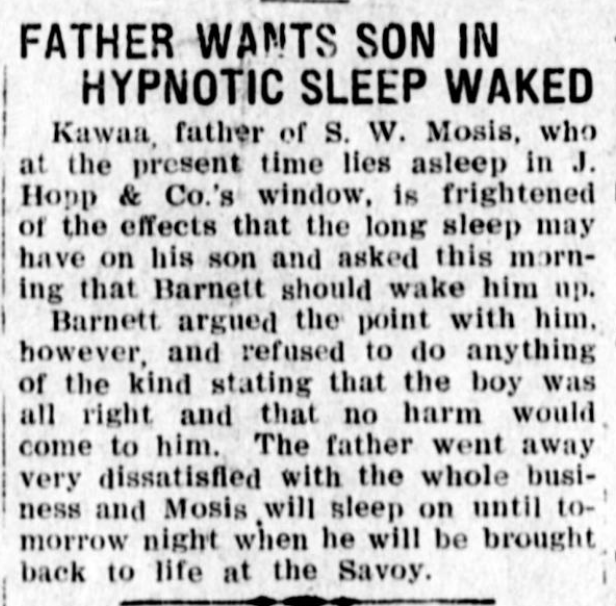
Kawaa, father of S. W. Mosis, who at the present time lies asleep in J. Hopp & Co.’s window, is frightened of the effects that the long sleep may have on his son and asked this morning that Barnett should wake him up.

Barnett argued the point with him however, and refused to do anything of the kind stating that the boy was all right and that no harm would come to him. The father went away very dissatisfied with the whole business and Mosis will sleep on until tomorrow night when he will be brought back to life at the Savoy.

(Evening Bulletin, 9/12/1911, p. 6)

FATHER WANTS SON IN HYPNOTIC SLEEP WAKED

Evening Bulletin, Number 5029, Page 6. September 12, 1911.

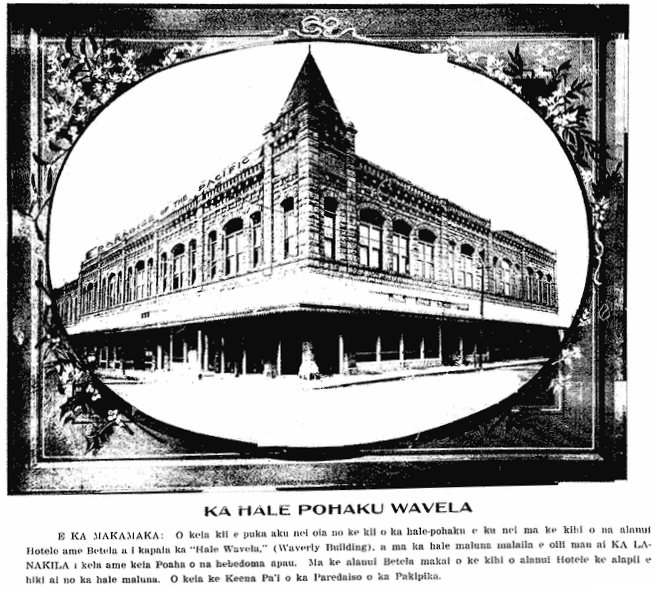
Waverly Building at the corner of Hotel and Bethel, 1909.

THE WAVERLY [WAVELA] STONE BUILDING

O FRIENDS: This picture that is being printed is an image of the stone building standing at the corner of Hotel [Hotele] and Bethel [Betela] Streets, called the Waverly Building [Hale Wavela], and on the second story is where the LANAKILA appears every Thursday of every week. It is on Bethel Street, makai of the Hotel Street corner where the stairs are to get to the second story. This is the Printing Office of the Paradise of the Pacific [Paredaiso o ka Pakipika].

[This “Paradise of the Pacific” magazine is the precursor to the magazine on the shelves today, “Honolulu Magazine”…]

(Lanakila, 7/15/1909, p. 4)

KA HALE POHAKU WAVELA

Ka Lanakila, Buke I, Helu 3, Aoao 4. Iulai 15, 1909.

Lahaina, and Hawaii through history, 1941.

OLD LAHAINA PRISON
and
ANCIENT LAHAINA

By INEZ ASHDOWN

According to information gleaned from the Bishop Museum records and the Archives of Mr. E. Bryan Jr., curator at the Museum, the old Lahaina Prison was built in 1851 and completed in April 1852. This was during the reign of Kamehameha III, who ruled until 1854.

For “local color” at that time I have talked with old Hawaiians who are from 70 to 80 years of age, and have also spent many hours at the Wailuku library reading old volumes supplied by Mrs. Juliette Davis, Librarian. Continue reading

Interesting translation, 1908.

HOW DIPHTHERIA IS CONTRACTED.

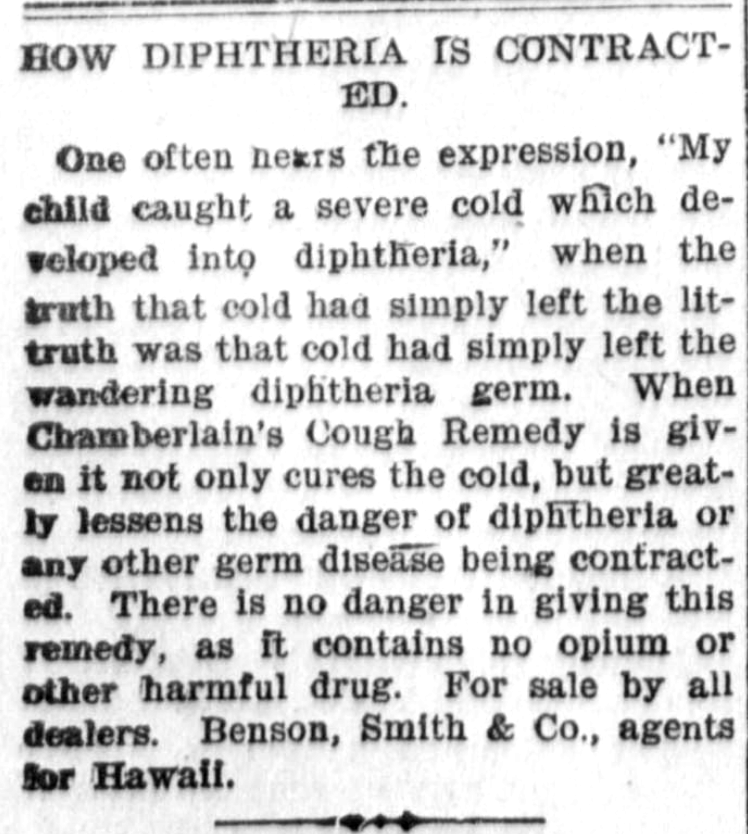
One often hears the expression, “My child caught a severe cold which developed into diphtheria,” when the truth that cold had simply left the lit- truth was that cold had simply left the wandering diphtheria germ. When Chamberlain’s Cough Remedy is given it not only cures the cold, but greatly lessens the danger of diphtheria or any other germ disease being contracted. There is no danger in giving this remedy, as it contains no opium or other harmful drug. For sale by all dealers. Benson, Smith & Co., agents for Hawaii.

(Hawaiian Star, 3/13/1908, p. 6)

HOWA DIPHTHERIA IS CONTRACTED.

The Hawaiian Star, Volume XV, Number 4978, Page 6. March 13, 1908.

KE ANO I HOOPAUIA AI O KA MA’I O KA PUU.

Ua lohe pinepineia keia olelo i ke kamailioia, “Ua loaa ka’u keiki i ke anu, a ku a puu maoli ae ma ka a-i,” a o ka mea oiaio no ea, mai ke anu mai i loaa mai ai ka anoano liilii a hiki i ke ku a puu maoli ana o ka a-i. I ka manawa i haawiia aku ai o ka Laau Kumu a Chamberlain, aole wale no o ke anu kana i hoola ai, aka ua hoopauia a hoemiia mai ka ma’i puu o ka a-i, a mau anoano e ae paha o kekahi ano ma’i. Aole loa he pilikia iki o ka haawi ana aku i keia laau oiai aole he opiuma iloko olaila, a laau hoopilikia e ae paha. Eia ke kuaiia nei e Benson, Smith & Co., Ltd., na akena no ka Paeaina Hawaii.

(Kuokoa, 3/13/1908, p. 4)

KE ANO I HOOPAUIA AI O KA MA'I O KA PUU.

Ka Nupepa Kuokoa, Buke XLIII, Helu 11, Aoao 4. Maraki 13, 1908.