More on the 11th of June in Kalaupapa, 1904.

11th of June

Sports at Kalaupapa

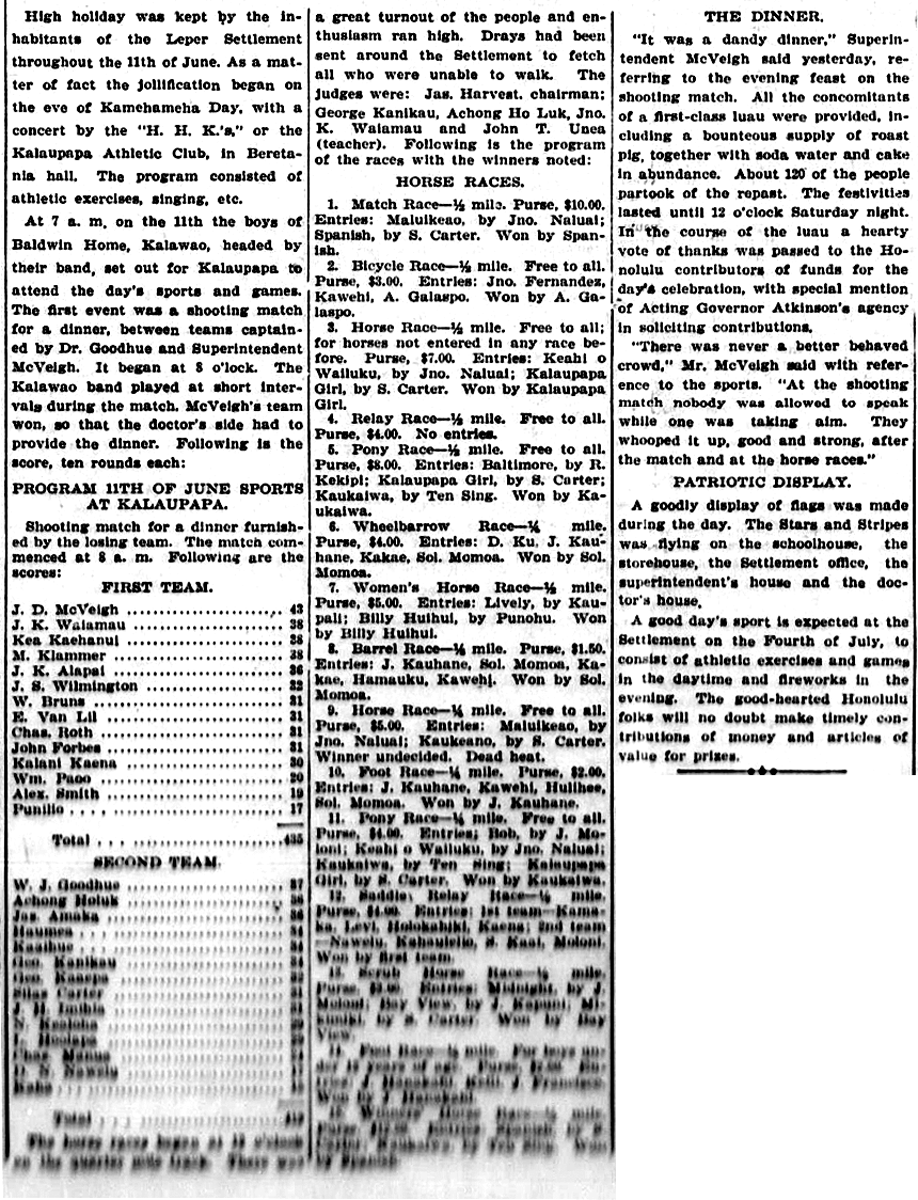
High holiday [Kamehameha Day] was kept by the inhabitants of the Leper Settlement throughout the 11th of June. As a matter of fact the jollification began on the eve of Kamehameha Day, with a concert by the “H. H. K.’s” [Hui Hooikaika Kino] or the Kalaupapa Athletic Club, in Beretania hall. The program consisted of athletic exercises, singing, etc.

At 7 a. m., on the 11th the boys of Baldwin Home, Kalawao, headed by their band, set out for Kalaupapa to attend the day’s sports and games. The first event was a shooting match for a dinner, between teams captained by Dr. Goodhue and Superintendent McVeigh. It began at 8 o’clock. The Kalawao band played at short intervals during the match. McVeigh’s team won, so that the doctor’s side had to provide the dinner. Following is the score, ten rounds each:

PROGRAM 11TH OF JUNE SPORTS AT KALAUPAPA.

Shooting match for a dinner furnished by the losing team. The match commenced at 8 a. m. Following are the scores:

FIRST TEAM.

J. D. McVeigh ….. 43
J. K. Waiamau ….. 38
Kea Kaehanui ….. 38
M. Klammer ….. 38
J. K. Alapai ….. 36
J. S. Wilmington ….. 32
W. Bruns ….. 31
E. Van Lil ….. 31
Chas. Roth ….. 31
John Forbes ….. 31
Kalani Kaena ….. 30
Wm. Paoo ….. 20
Alex. Smith ….. 19
Punilio ….. 17
Total ….. 435

SECOND TEAM.

W. J. Goodhue …. 37
Achong Holuk ….. 36
Jas. Amaka ….. 36
Haumea ….. 34
Kaaihue ….. 34
Geo. Kanikau ….. 34
Geo. Kaaepa ….. 32
Silas Carter ….. 31
J. H. Imihia ….. 31
N. Kealoha ….. 29
I. Hoolapa ….. 29
Chas. Manua ….. 24
D. N. Nawelu ….. 17
Kaha ….. 15
Total ….. 119

The horse races began at 12 o’clock on the quarter mile track. There was a great turnout of the people and enthusiasm ran high. Drays had been sent around the Settlement to fetch all who were unable to walk. The judges were: Jas. Harvest, chairman; George Kanikau, Achong Ho Luk, Jno. K. Waiamau and John T. Unea (teacher). Following is the program of the races with the winners noted:

HORSE RACES.

1. Match Race—½ mile. Purse, $10.00. Entries: Maluikeao, by Jno. Naluai; Spanish, by S. Carter. Won by Spanish.
2. Bicycle Race—½ mile. Free to all. Purse, $3.00. Entries: Jno. Fernandez, Kawehi, A. Galaspo. Won by A. Galespo.
3. Horse Race—½ mile. Free to all; for horses not entered in any race before. Purse, $7.00. Entries: Keahi o Wailuku, by Jno. Naluai; Kalaupapa Girl, by S. Carter. Won by Kalaupapa Girl.
4. Relay Race—½ mile. Free to all. Purse, $4.00. No entries.
5. Pony Race—½ mile. Free to all. Purse, $8.00. Entries: Baltimore, by R. Kekipi; Kalaupapa Girl, by S. Carter; Kaukaiwa, by Ten Sing. Won by Kaukaiwa.
6. Wheelbarrow Race—¼ mile. Purse, $4.00. Entries: D. Ku, J. Kauhane, Kakae, Sol. Momoa. Won by Sol. Momoa.
7. Women’s Horse Race—½ mile. Purse, $5.00. Entries: Lively, by Kaupali; Billy Huihui, by Punohu. Won by Billy Huihui.
8. Barrel Race—¼ mile. Purse, $1.50. Entries: J. Kauhane, Sol. Momoa, Kakae, Hamauku, Kawehi. Won by Sol. Momoa.
9. Horse Race—¼ mile. Free to all. Purse, $5.00. Entries: Maluikeao, by Jno. Naluai; Kaukeano, by S. Carter. Winner undecided. Dead heat.
10. Foot Race—¼ mile. Purse, $2.00. Entries: J. Kauhane, Kawehi, Hulihee, Sol. Momoa. Won by J. Kauhane.
11. Pony Race—¼ mile. Free to all. Purse, $4.00. Entries: Bob, by J. Moloni; Keahi o Wailuku, by Jno. Naluai; Kaukaiwa, by Ten Sing; Kalaupapa Girl, by S. Carter. Won by Kaukaiwa.
12. Saddle Relay Race—½ mile. Purse, $4.00. Entries: 1st team—Kamaka, Levi, Holokahiki, Kaena; 2nd team—Nawelu, Kahaulelio, S. Kaai, Moloni. Won by first team.
13. Scrub Horse Race—½ mile. Purse, $3.00. Entries: Midnight, by J. Moloni; Bay View, by J. Kapuni; Mikimiki, by S. Carter. Won by Bay View.
14. Foot Race—½ mile. For boys under 13 years of age. Purse, $2.00. Entries: J. Hanakahi, Kelii, J. Francisco. Won by J. Hanakahi.
15. Winners’ Horse Race—½ mile. Purse, $12.00. Entries: Spanish, by S. Carter; Kaukaiwa, by Ten Sing. Won by Spanish.

THE DINNER.

“It was a dandy dinner,” Superintendent McVeigh said yesterday, referring to the evening feast on the shooting match. All the concomitants of a first-class luau were provided, including a bounteous supply of roast pig, together with soda water and cake in abundance. About 120 of the people partook of the repast. The festivities lasted until 12 o’clock Saturday night. In the course of the luau a hearty vote of thanks was passed to the Honolulu contributors of funds for the day’s celebration, with special mention of Acting Governor Atkinson’s agency in soliciting contributions.

“There was never a better behaved crowd,” Mr. McVeigh said with reference to the sports. “At the shooting match nobody was allowed to speak while one was taking aim. They whooped it up, good and strong, after the match and at the horse races.”

PATRIOTIC DISPLAY.

A goodly display of flags was made during the day. The Stars and Stripes was flying on the schoolhouse, the storehouse, the Settlement office, the superintendent’s house and the doctor’s house.

A good day’s sport is expected at the Settlement on the Fourth of July, to consist of athletic exercises and games in the daytime and fireworks in the evening. The good-hearted Honolulu folks will no doubt make timely contributions of money and articles of values for prizes.

[This article followed the illustration by John K. Waiamau posted earlier today.]

(Hawaiian Gazette, 6/17/1904, p. 5)
11th of June

Hawaiian Gazette, Volume XXXIX, Number 49, Page 5. June 17,

John K. Waiamau, the artist, 1904.

11th of June

Sports in Kalaupapa

KRG

The Butts

Bull’s Eye.

The Losers.

Scorer.

Bicycle Race.

Horse Race.

DRAWN BY JOHN K. WAIAMAU.

(Hawaiian Gazette, 6/17/1904, p. 5)

11th of June

Hawaiian Gazette, Volume XXXIX, Number 49, Page 5. June 17, 1904.

I hewa no ia oe la, i kou awihi maka ana mai! 1911.

FAULTED FOR WINKING.

Because the Hawaiian musicians who are in Denver continuously wink at the haole women who frequently dine in the hotel which hired the boys to sing regularly, and most of the women are smitten and are truly entranced by some of the boys, therefore there have been many a complaint to the police about them, to the point where the hotel was ordered to immediately stop contracting those musicians.

When the women and their companions arrive at the hotel, the musicians are always singing songs about women, and therefore some of the women are delighted at this, and the boys are constantly winking.

As they are always seen doing this, there has been numerous complaints to the police department demanding that the hotel throw out the band; the hotel agreed, but only after their contract to sing and play music there was over.

The kinds of songs were not complained about, nor how they sang; only one thing was the cause of the complaints, that being the constant winking of the boys to the women, for by doing this, there have been singers who have married girls of high-class families.

[…pii e ke kai i kumu pali!]

(Kuokoa, 2/17/1911, p. 6)

HOOHALAHALAIA NO KA AWIHI MAKA.

Ka Nupepa Kuokoa, Buke XLVII, Helu 7, Aoao 6. Feberuari 17, 1911.

Hawaiian boys headed to China to play music, 1916.

[Found under: “LOCAL AND GENERAL”]

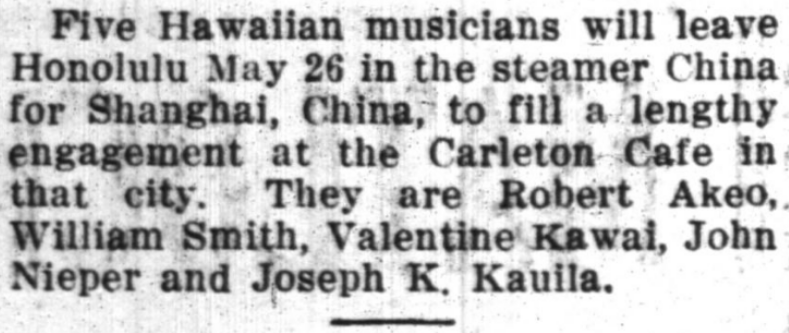
Five Hawaiian musicians will leave Honolulu May 26 in the steamer China for Shanghai, China, to fill a lengthy engagement at the Carleton Cafe in that city. They are Robert Akeo, William Smith, Valentine Kawai, John Nieper and Joseph K. Kauila.

(Honolulu Star-Bulletin, 5/9/1916, p. 3)

Five Hawaiian musicians...

Honolulu Star-Bulletin, Volume XXIII, Number 7511, Page 3. May 9, 1916.

Hawaiians singing in far away China, 1917.

THERE IS GREAT DELIGHT IN HAWAIIAN MUSIC IN CHINA.

In a letter written by Robert Akeo, a Hawaiian boy who travelled to Shanghai, China, with his companions to sing under contract, it is seen that there is much admiration for Hawaiian music in China, because their contract to play there was over long ago, and yet, they are constantly being asked to satisfy the desires of those people for Hawaiian music and hula.

It seems in order to fulfill the wishes of Shanghai’s people for hula, one of the boys was made into a woman by putting on women’s clothing, and he would dance with one of his fellow boys, while the rest of them play music, and they sing and dance at the same time.

There are some thousands of people in Shanghai who have no knowledge of Honolulu, but after hearing the singing voices, and seeing the act of those young ones, the desire to come visit Honolulu and see the Paradise of the Pacific grew within them.

(Kuokoa, 2/2/1917, p. 8)

NUI KA HIALAAIIA O NA MELE HAWAII MA KINA.

Ka Nupepa Kuokoa, Buke LV, Helu 5, Aoao 8. Feberuari 2, 1917.

University of Hawaii Lei Day Queen, 1936.

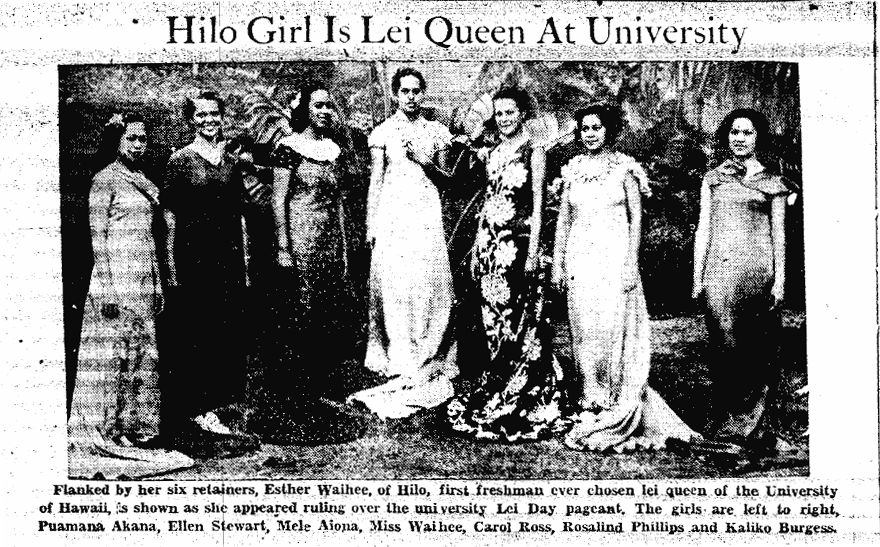
Hilo Girl Is Lei Queen At University

Flanked by her six retainers, Esther Waihee, of Hilo, first freshman ever chosen lei queen of the University of Hawaii, is shown as she appeared ruling over the university Lei Day pageant. The girls are left to right, Puamana Akana, Ellen Stewart, Mele Aiona, Miss Waihee, Carol Ross, Rosalind Phillips and Kaliko Burgess.

(Hoku o Hawaii, 5/13/1936, p. 1)

Hilo Girl Is Lei Queen At University

Ka Hoku o Hawaii, Volume XXXI, Number 3, Aoao 1. Mei 13, 1936.

Bella Luana and Annie Lana Bohling, 1940.

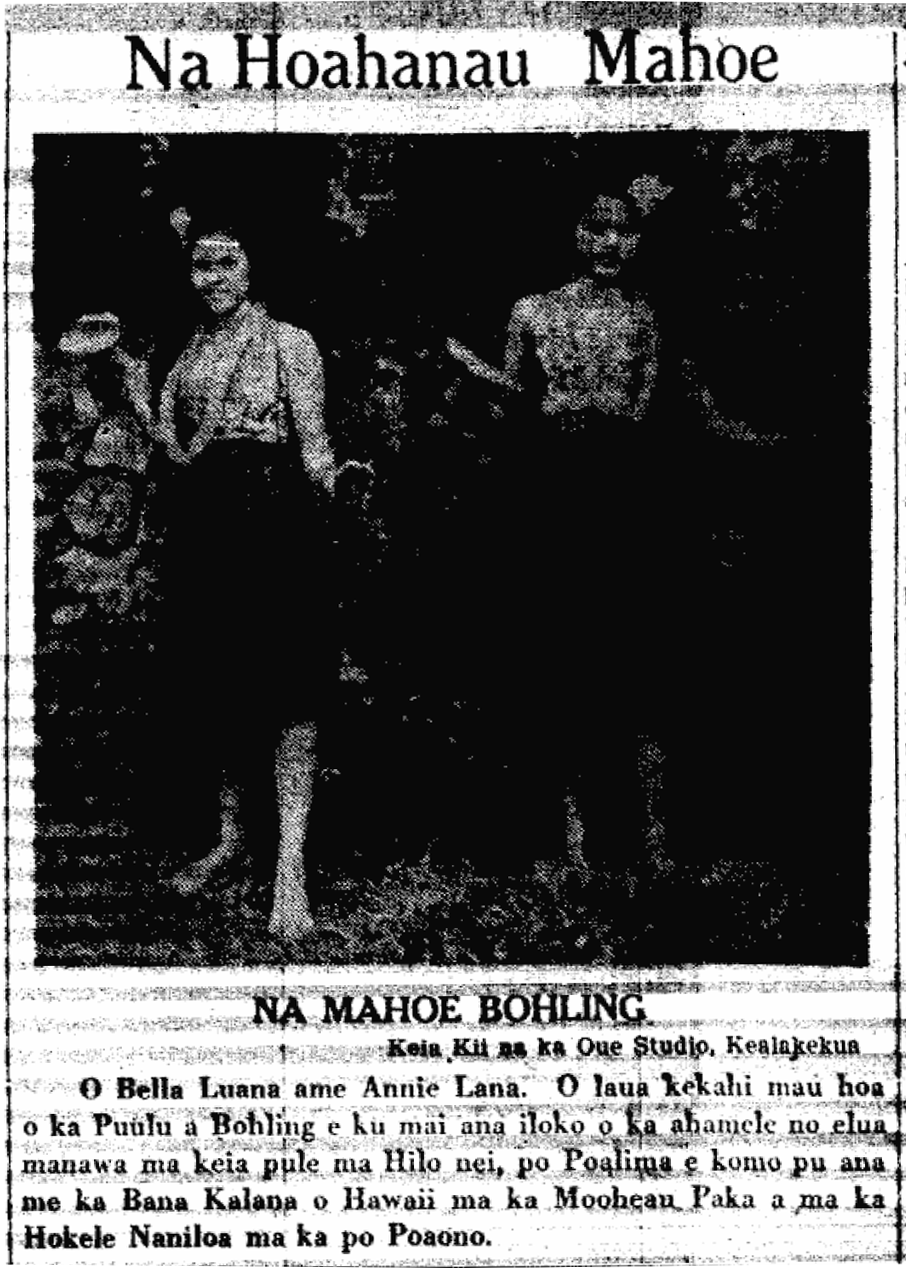
The Bohling Sisters

THE BOHLING TWINS

This Picture is by Oue Studio, Kealakekua

Bella Luana and Annie Lana. They are some of the members of the Bohling Group who will perform twice in the concert this week here in Hilo, on Friday night, along with the Hawaii County Band [ka Bana Kalana o Hawaii] at Mooheau Park and at the Naniloa Hotel on Saturday night.

(Hoku o Hawaii, 12/18/1940, p. 1)

Na Hoahanau Mahoe

Ka Hoku o Hawaii, Volume XXXV, Number 34, Aoao 1. Dekemaba 18, 1940.


William S. Ellis, leader of the glee club accompanying the Royal Hawaiian Band on tour, 1906.

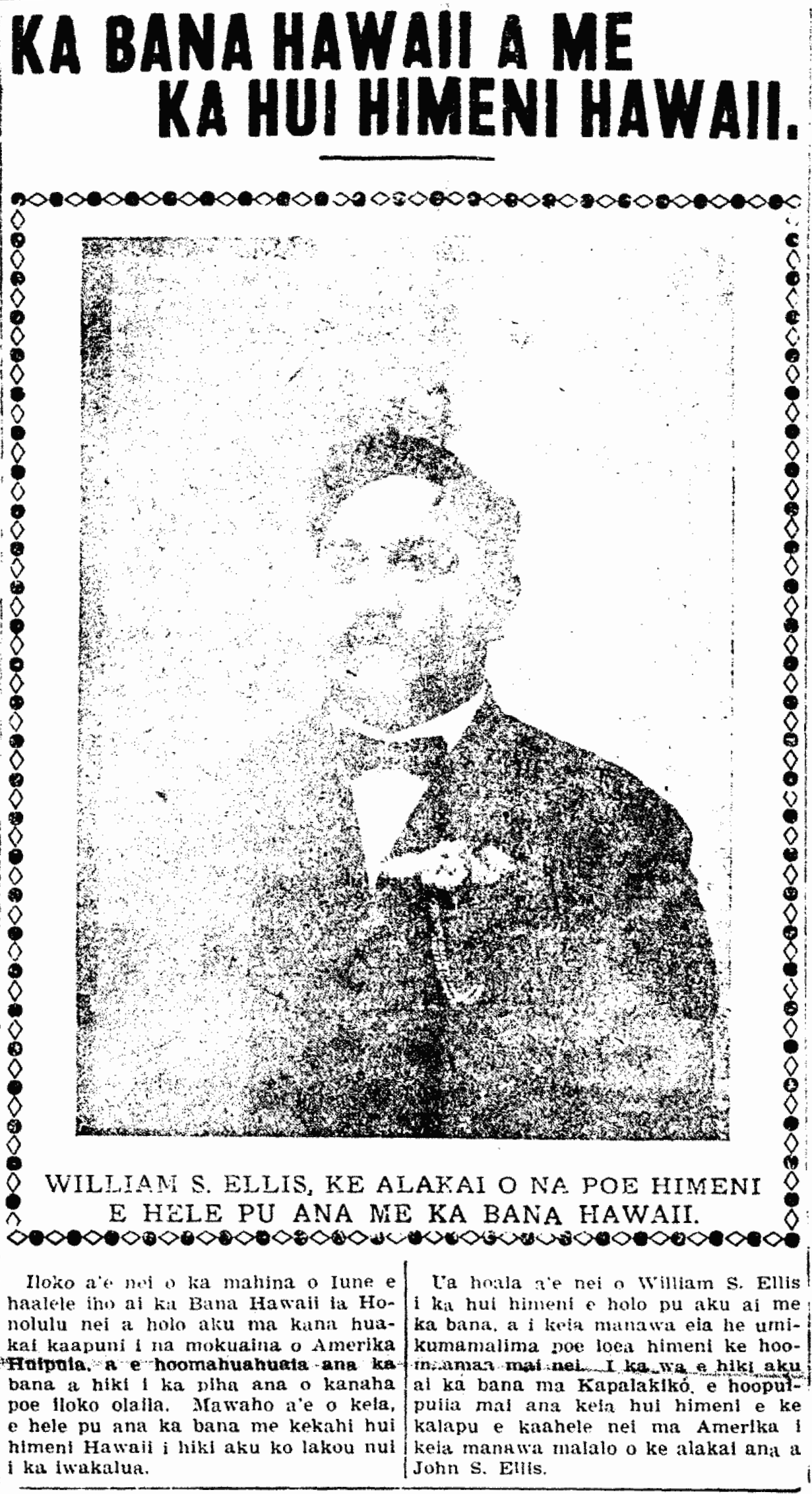
THE ROYAL HAWAIIAN BAND AND THE HAWAIIAN GLEE CLUB.

WILLIAM S. ELLIS, THE LEADER OF THE SINGERS THAT ARE TRAVELLING WITH THE ROYAL HAWAIIAN BAND.

In the month of June, the Royal Hawaiian Band is leaving Honolulu and going on their tour of the states of the United States of America, and their number will increase until it includes forty people. Other than that, the band will go with a Hawaiian glee club that is made up of twenty people.

William S. Ellis formed the glee club going along with the band, and currently there are fifteen skilled singers who are practicing. When the band arrives in San Francisco, this glee club will be increased by the club that is touring America under the leadership of John S. Ellis.

(Kuokoa, 3/9/1906, p. 1)

KA BANA HAWAII A ME KA HUI HIMENI HAWAII.

Ka Nupepa Kuokoa, Buke XLIV, Helu 10, Aoao 1. Maraki 9, 1906.

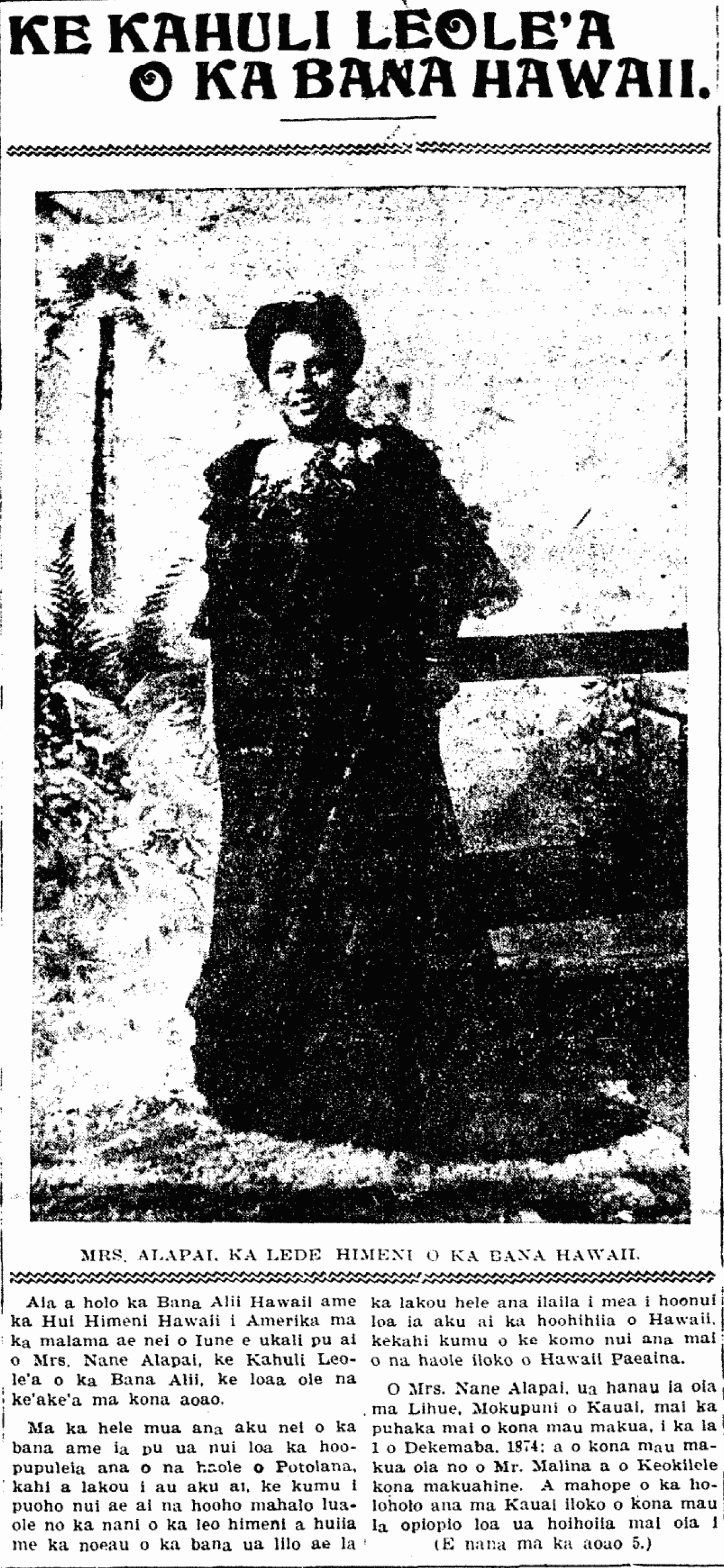
Nane Alapai, 1906.

THE HAPPY-VOICED KAHULI OF THE HAWAIIAN BAND

When the Royal Hawaiian Band and the Hawaiian Glee Club leaves for America in the next month of June, Mrs. Nane Alapai [Nani Alapai], the Beautiful-Voiced Kahuli of the Hawaiian Band will accompany them, should there be no obstructions in her way.

When the band first went with her along, the haole of Portland, where they travelled to, were driven crazy, and that is the reason that there was unequaled exclaim for the beauty of of the singing along with the skill of the band; and their travelling there caused a great interest in Hawaii, which is why there is a great influx in the number of haole coming to the Hawaiian Islands.

Mrs. Nane Alapai [Nani Alapai], was born in Lihue, on the island of Kauai, from the loins of her parents, on the 1st of December, 1874; her parents are Mr. Malina and Keokilele is her mother. And after going around Kauai during her youth, she was taken…

(Kuokoa, 3/16/1906, p. 1)

KE KAHULI LEOLE'A O KA BANA HAWAII.

Ka Nupepa Kuokoa, Buke XLIV, Helu 11, Aoao 1. Maraki 16, 1906.

to Honolulu, where she was educated at the Catholic Boarding School for Girls. She married her husband, Mr. W. J. Alapai almost eleven years ago. She has some siblings other than her; five brothers and eight sisters.

When she joined the Royal Hawaiian Band until today, she spent nine years singing before an audience, and during that whole time, her singing has brought much delight in Hawaii’s people and more so in the malihini who come to Hawaii and then go to America; they are so much more delighted; and this is very valuable to Hawaii and to her herself, and this advertises Hawaii’s beauty; the beauty of her ridges, the beauty of her mountains, and the beauty of the songs of her people; it seems there will be a lot of Hawaiian singer born as a result.

(Kuokoa, 3/16/1906, p. 5)

KE KAHULI LEOLE'A O KA BANA HAWAII.

Ka Nupepa Kuokoa, Buke XLIV, Helu 11, Aoao 5. Maraki 16, 1906.

Bonine brings movies to Kalawao and Kalaupapa, 1909.

FIRST MOVING PICTURE SHOW TAKES SETTLEMENT BY STORM

On Thursday evening last a new miracle happened at Kalaupapa. On that evening R. K. Bonine, the moving-picture expert, threw his first picture on the screen before an audience of a thousand lepers, and there was a great gasp of awed astonishment and keen delight when the pictures really moved and did things. Cheers, tears, gasps and soul-satisfying laughter greeted the pictures in turn, and when the reels put aside for the first entertainment had been exhausted, the people of Kalaupapa and Kalawao, in a body, cheered their thanks to the man who had brought these wonders to them and to those in Honolulu who had through their contributions made these miracles possible.

It was a great day for the people of the Molokai Settlement, and it was a great day for Bonine. To the lepers had come a new marvel, greater far than the sight of the mighty White Fleet, which maneuvered past their shores last summer, greater than anything that had come to them. No place the world over have motion pictures made such a hit. Continue reading