Peleioholani’s response to the Queen? 1902.

COMPANION OF A PRINCE

A Hawaiian Chief Who Fought in Africa.

HE TELLS A ROMANTIC TALE

Decapitated Morrocan of High Rank—Was Owner of Famous Feather Cloak.

WITHIN THREE months a stalwart Hawaiian will leave Honolulu and journey to London to attend the reunion of the survivors of one of England’s wars of conquest fought more than thirty years ago. Upon the Hawaiian’s body are the scars inflicted by sword, spear and bullets, received while he was fighting under the flag of St. George in the service of Queen Victoria upon the battlefields of Southern Africa. According to a romantic story which the Hawaiian tells, few amongst the veterans who will gather in the capital of the British nation will have more honorable records for bravery and conspicuous gallantry in the face of a dark-skinned enemy than he, and few will there be whose entire lives are so wrapped in a halo of romance. Linked with this Hawaiian’s life are those of Kings and Queens, Dukes and Admirals, Generals and Captains, and yet today he is an humble resident of the Hawaiian Islands. Continue reading

Keeaumoku ahuula destroyed in Peleioholani house fire, 1901.

Couple of years ago, I posted two articles on an insurance claim by Peleioholani after a priceless ahuula was destroyed in the great Chinatown fire of 1900. I just ran across this just now:

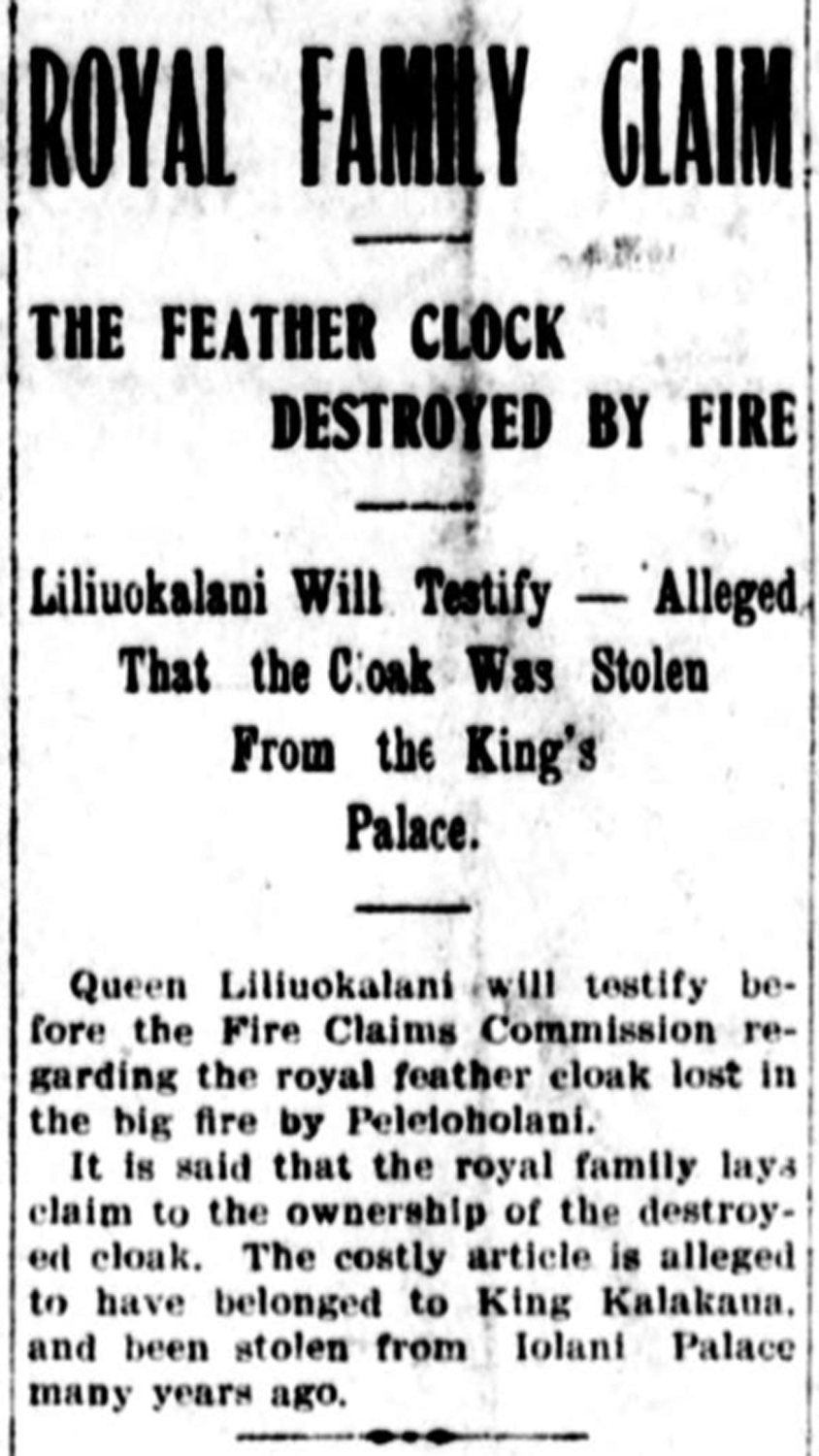
ROYAL FAMILY CLAIM

THE FEATHER CLOAK DESTROYED BY FIRE

Liliuokalani Will Testify—Alleged That the Cloak Was Stolen From the King’s Palace.

Queen Liliuokalani will testify before the Fire Claims Commission regarding the royal feather cloak lost in the big fire by Peleioholani.

It is said that the royal family lays claim to the ownership of the destroyed cloak. The costly article is alleged to have belonged to King Kalakaua, and been stolen from Iolani Palace many years ago.

[See: Ancient Relics Were Destroyed & Pau ka Ahuula i ke Ahi]

(Evening Bulletin, 11/2/1901, p. 1)

ROYAL FAMILY CLAIM

Evening Bulletin, Volume XI, Number 1984, Page 1. November 2, 1901.

Fred Malulani Beckley Kahea passing on traditional knowledge, 1922.

[Found under: “Nuhou Kuloko”]

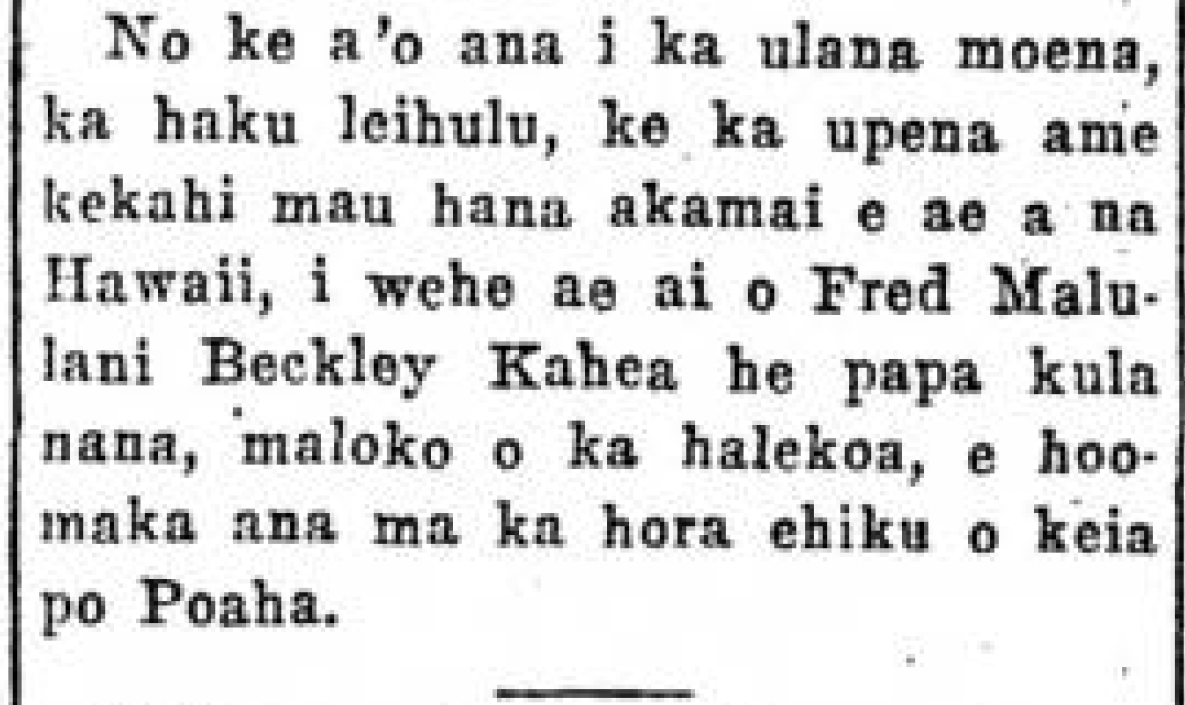
In order to teach mat weaving [ulana moena], feather lei making [haku lei hulu], net tying [ka upena], and other Hawaiian skills, Fred Malulani Beckley Kahea initiated himself a class in the armory, beginning at seven o’clock this Thursday night.

[I was reminded of this article by the recent post by Nanea Armstrong-Wassel about Fred Malulani Beckley Kahea and traditional featherworkers.

F. M. B. Kahea not only taught his class at the armory, but he also was the sharing his knowledge in the construction of kahili when they were made for Governor Farrington in 1928.]

(Kuokoa, 12/7/1922, p. 8)

No ke a'o ana...

Ka Nupepa Kuokoa, Buke LXI, Helu 49, Aoao 8. Dekemaba 7, 1922.

“Kearny cloak” aboard the Malolo, 1927.

[Found under: “Nuhou Kuwaho”]

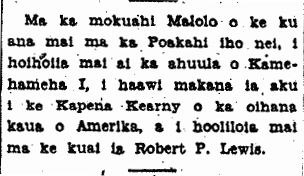
By way of the steamship Malolo which arrived this past Monday, returned was the feather cape of Kamehameha I that was presented to Captain Kearny of the armed forces of America, and which was obtained through purchase by Robert P. Lewis.

(Kuokoa, 11/24/1927, p. 4)

Ma ka mokuahi Malolo...

Ka Nupepa Kuokoa, Buke LXVI, Helu 52, Aoao 4. Novemaba 24, 1927.

Pueo found in Kalihi, 1902.

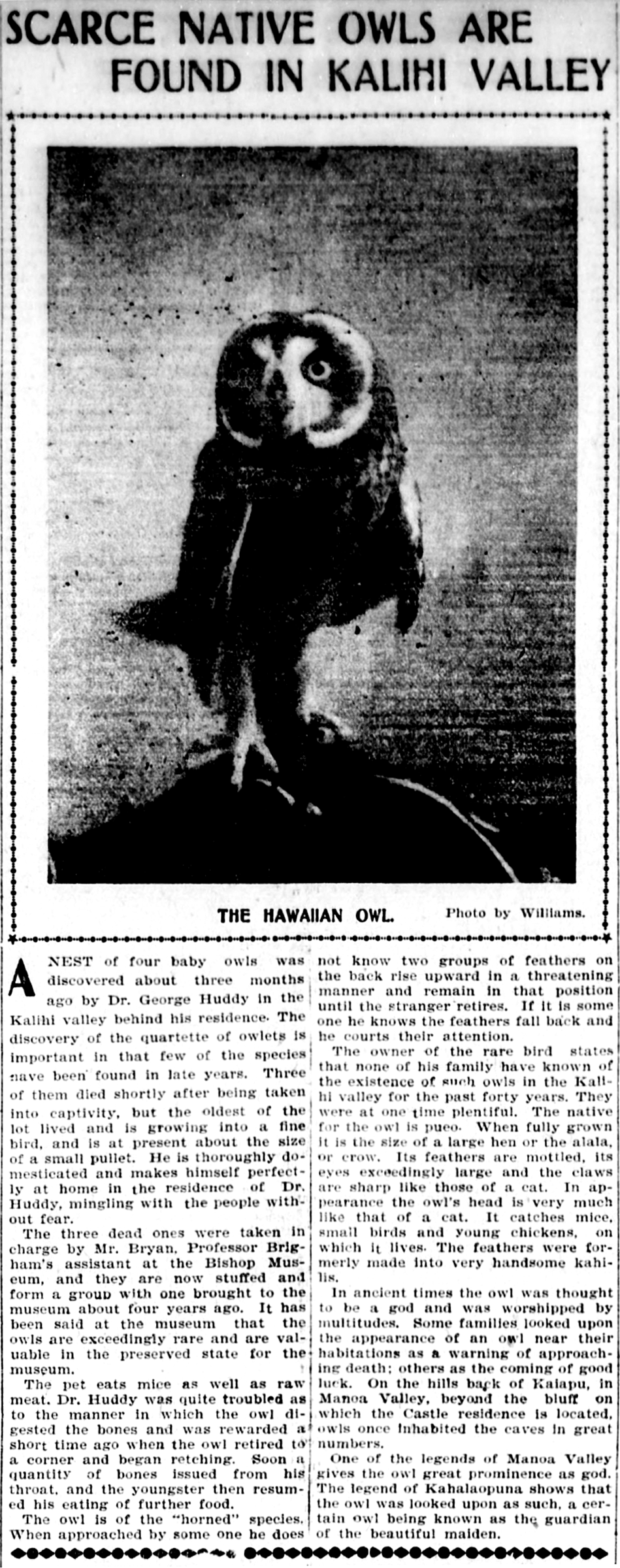
SCARCE NATIVE OWLS ARE FOUND IN KALIHI VALLEY

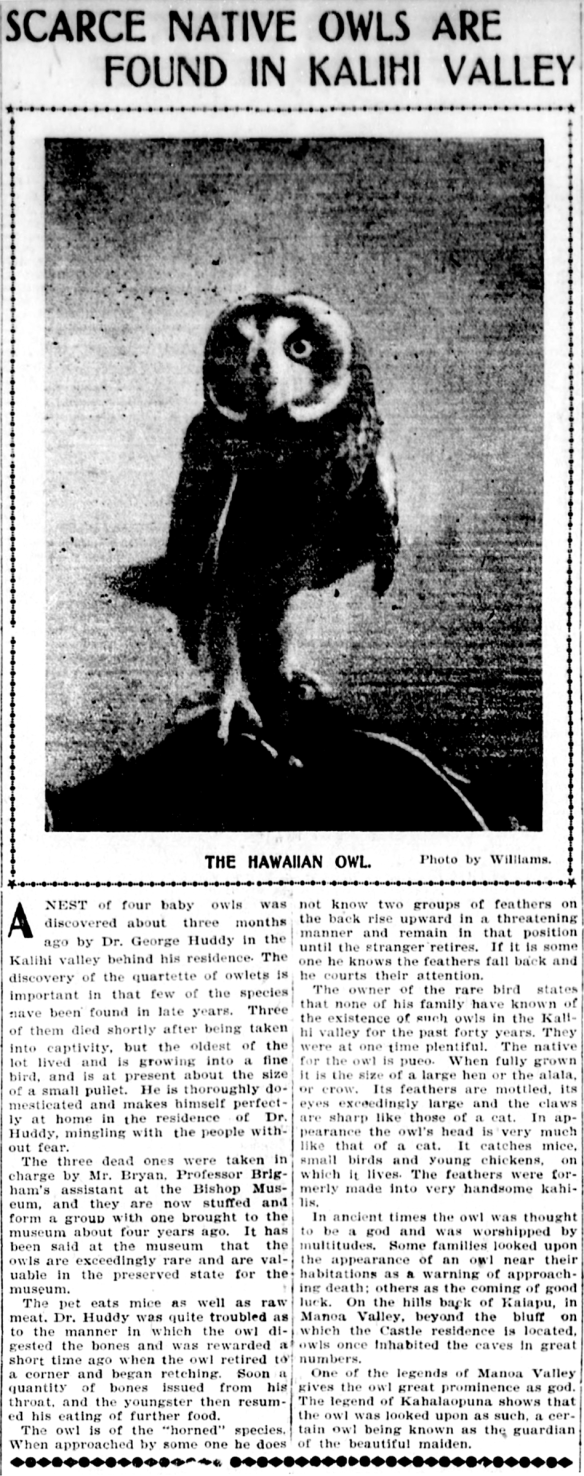
THE HAWAIIAN OWL.  Photo by Williams.

A NEST of four baby owls was discovered about three months ago by Dr. George Huddy in the Kalihi valley behind his residence. The discovery of the quartette of owlets is important in that few of the species have been found in late years. Three of them died shortly after being taken into captivity, but the oldest of the lot lived and is growing into a fine bird, and is at present about the size of a small pullet. He is thoroughly domesticated and makes himself perfectly at home in the residence of Dr. Huddy, mingling with the people without fear.

The three dead ones were taken in charge by Mr. Bryan, Professor Brigham’s assistant at the Bishop Museum, and they are now stuffed and form a group with one brought to the museum about four years ago. It has been said at the museum that the owls are exceedingly rare and are valuable in the preserved state for the museum.

The pet eats mice as well as raw meat. Dr. Huddy was quite troubled as to the manner in which the owl digested the bones and was rewarded a short time ago when the owl retired to a corner and began retching. Soon a quantity of bones issued from his throat, and the youngster then resumed his eating of further food.

The owl is of the “horned” species. When approached by some one he does not know two groups of feathers on the back rise upward in a threatening manner and remain in that position until the stranger retires. If it is some one he knows the feathers fall back and he courts their attention.

The owner of the rare bird states that none of his family have known of the existence of such owls in the Kalihi valley for the past forty years. They were at one time plentiful. The native for the owl is pueo. When fully grown it is the size of a large hen or the alala, or crow. Its feathers are mottled, its eyes exceedingly large and the claws are sharp like those of a cat. In appearance the owl’s head is very much like that of a cat. It catches mice, small birds and young chickens, on which it lives. The feathers were formerly made into very handsome kahilis.

In ancient times the owl was thought to be a god and was worshipped by multitudes. Some families looked upon the appearance of an owl near their habitation as a warning of approaching death; others as the coming of good luck. On the hills back of Kalapu, in Manoa Valley, beyond the bluff on which the Castle residence is located, owls once inhabited the caves in great numbers.

One of the legends of Manoa Valley gives the owl great prominence as god. The legend of Kahalaopuna shows that the owl was looked upon as such, a certain owl being known as the guardian of the beautiful maiden.

[Does anyone know of kahili made with pueo feathers?]

(Hawaiian Gazette, 2/11/1902, p. 5)
SCARCE NATIVE OWLS ARE FOUND IN KALIHI VALLEY

Hawaiian Gazette, Volume XXXVII, Number 12, Page 5. February 11, 1902.


Select committee to decide whether to protect birds, 1876.

[Found under: “Ke Kau Ahaolelo o M. H. 1876: La Hana 88—Poakolu, Augate 16.”]

Order of the Day.

The bill to protect the oo, iiwi, mamo, and akakane birds for the king, so that they are not killed, was read for the third time. It was left to the select committee [komite wae], Kaai, Aholo, Kahanu, Nahaku, and Wana.

[This is found in the minutes of the 1876 Session of the Legislature.]

(Kuokoa, 9/2/1876, p. 1)

Na Hana o ka La.

Ka Nupepa Kuokoa, Buke XV, Helu 36, Aoao 1. Sepatemaba 2, 1876.

Hawaiian-based? fashion in New York, 1921.

[Found under: “Maison Fashion Offers These Eight Appealing Suggestions For Miss Manhattan’s Everyday Wardrobe For the Coming Spring and Summer”]

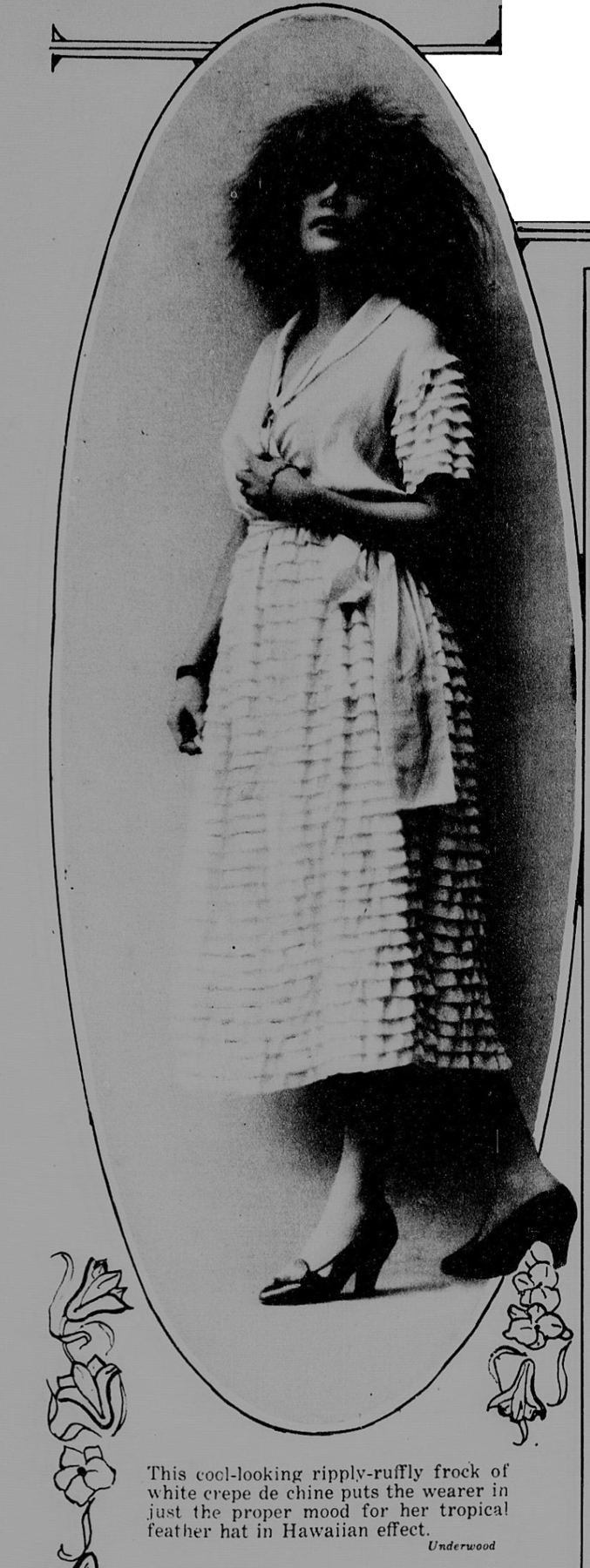
This cool-looking ripply-ruffly frock of white crepe de chine puts the wearer in just the proper mood for her tropical feather hat in Hawaiian effect.

Underwood

(New York Tribune, 3/13/1921, pt. 6, p. 12)

This cool-looking...

New York Tribune, Volume LXXX, Number 27,146, Part 6, Page 12. March 13, 1921.

Amazing story about the capes given by Kalaniopuu to Cook, 1908.

The Ahuula Garments of Kalaniopuu!

Given by the Chief to Captain Cook!

It is understood in Hawaii’s ancient history, before Captain Cook [Kapena Kuke] left Hawaii, on the 3rd of February, 1779, King Kalaniopuu gave a gift to Captain Cook some Ahuula and Ahu Mamo and feather mahiole headgear of Hawaii. After the ships of Captain Cook left Hawaii Island shortly after the death of that British Captain, the ships went and landed at Kamchatka, on the eastern shores of Siberia.
Continue reading

The “Kearny Cloak” at Tiffany & Co., 1893.

THE WAR CLOAK OF KAMEHAMEHA I.

AN INTERESTING HAWAIIAN RELIC TO BE SEEN IN THIS CITY.

The recent proposed annexation of the Sandwich Islands has revived much forgotten lore concerning the people of Hawaii and their history, and nothing perhaps is more interesting than specimens of the handiwork of this semi-barbarous people who possessed certain arts for ingenuity and patient labor that cannot be equalled by the boasted civilization of the nineteenth century. In Tiffany & Co.’s window, in Union Square, there is on exhibition for a few days a feather war cloak or namo, once the property of Hawaii’s giant King, Kamehameha I (The Lonely One), which tradition says cost the labor of several generations of skilled workers. The body consists of a fine network of homespun cord, make from the native hemp or olona, the meshes of which vary from an eight to a thirty-second of an inch; over this is laid the feather-work in small bunches of three or four feathers each, tied with a minute thread highly twisted, made from the same fibre. The cloak is almost semicircular in shape, and cut to fit in at the neck. The meshwork being made in sections of various shapes, allows it, when placed on a tall man’s shoulders, to fall in graceful lines about his body. Continue reading

Hawaii at the Great London Exposition, 1862.

The Sandwich Islands.—During the last few days a stall has been fitted up near the department of the Ionian Islands which represents the latest and most distant echo in response to the invitation given to all nations and peoples to exhibit their natural and artificial products under the domes of South Kensington. The Hawaiian, or, as they are better known, the Sandwich Islands, were unrepresented in 1851, owing to the collection made there not reaching England till the Exhibition had finally closed, the voyage by a sailing vessel occupying five or six months. This year a similar fate threatened this remote group in the Pacific, and it seemed likely that the name of Hawaii would only be known in connexion with the International Exhibition of 1862 by a pair of silk banners in the nave, and a foreign commissioner with nothing to do. Continue reading