Curious report, 1868.

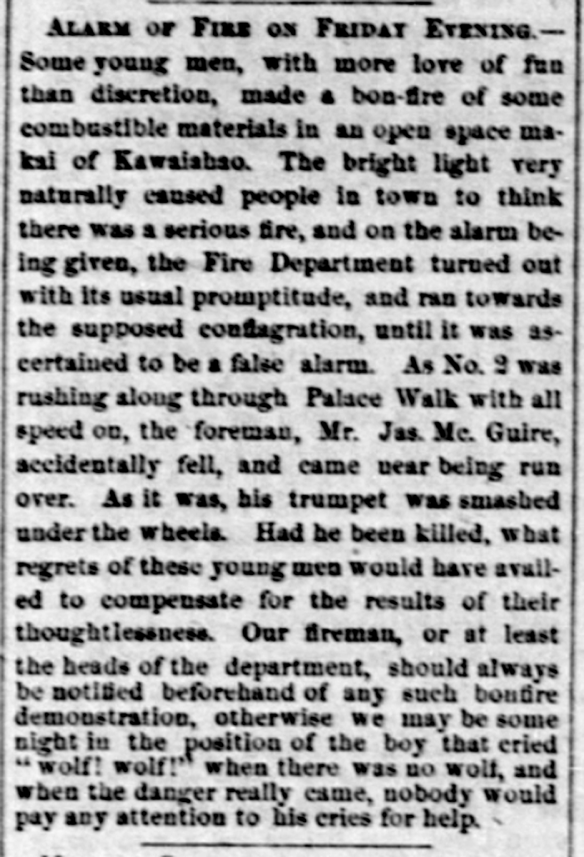
Alarm of Fire on Friday Evening.—Some young men, with more love of fun than discretion, made a bon-fire of some combustible materials in an open space makai of Kawaiahao. The bright light very naturally caused people in town to think there was a serious fire, and on the alarm being given, the Fire Department turned out with its usual promptitude, and ran towards the supposed conflagration, until it was ascertained to be a false alarm. As No. 2 was rushing along through Palace Walk with all speed on, the foreman, Mr. James McGuire, accidentally fell, and came near being run over. As it was, his trumpet was smashed under the wheels. Had he been killed, what regrets of these young men would have availed to compensate for the results of their thoughtlessness. Our fireman, or at least the heads of the department, should always be notified beforehand of any such bonfire demonstration, otherwise we may be some night in the position of the boy that cried “wolf! wolf!” when there was no wolf, and when the danger really came, nobody would pay any attention to his cries for help.

(Hawaiian Gazette, 12/16/1868, p. 3)
HawaiianGazette_12_16_1868_3.png

Hawaiian Gazette, Volume IV, Number 48, Page 3. December 16, 1868.

Kalakaua, the firemen’s king! 1875.

Burning of the Ship Emerald.—At half-past two o’clock on Monday morning an alarm of fire was sounded by the watchmen in the bell-tower, which proved to be for the ship Emerald, at anchor in the roadstead. Fire brigades, about two hundred officers and men, were immediately dispatched from the Pensacola in port, which took off two or three of the patent fire extinguishers. The city firemen also turned out promptly, with their machines, hose carts and ladders, ready to assist whenever ordered. At early dawn, the ship was towed into the harbor alongside the steamboat wharf, where the firemen and engines could get access to her. The fire was first discovered soon after midnight, but when the naval force reached the ship the hole was so full of smoke that the fire extinguishers could could not be successfully applied, and little could be done towards checking the fire until the engines could be brought to bear on it. From six oʻclock, the firemen, mariners and citizens worked faithfully till after noon, when the fire was apparently subdued, and the firemen returned home. Continue reading

The latest from Hilo, 1898.

THE NEWS FROM NORTH HILO.

Mr. Editor of the Greatest Prize of the Hawaiian People:

Aloha oe:—Please include this bit of news from here in North Hilo.

On the first of this month, Pakele, Iaukea, Laika, Kalei, and Lahapa went to go pick opihi on the shore of Waipunalei, and upon their return, they climbed up the pali. Lahapa was the first to climb up and the rest followed. When they reached the midpoint up the pali, a rocked dislodged and hit Lapaha square on the chest and he rolled down the pali, and because of the love of God, he was caught on a pandanus tree that was burned earlier in a fire. It was 40 feet high from where he tumbled from to where he was caught. Therefore, O my sisters and brothers and younger siblings, don’t go pick opihi again and return upland of the pali, lest you end up dying. Continue reading

Kalihi fire, 1889.

The glowing fire on the Kalihi mountains Thursday night Feb. 21, was caused by workmen burning off the grass on the site of the new reservoir in the upper Nuuanu Valley. The fire could easily have been controlled in the first instance. As it was, it was allowed to run up a narrow ridge, and thence to spread along the flanks of the mountain until it became an extensive conflagration, destroying many vigorous young koa trees and persistently working itself down into the valley. On Friday morning, two teachers and about twenty of the largest boys in the Kamehameha School went up to the fire and after a vigorous battling with the dense smoke succeeded in hemming in the fire, and finally subdued it. The utmost care in such a dry season should be used in preventing the setting, much more the spreading, of fire in the grass and bushes above Honolulu. A few such fires would make it unnecessary to build extra reservoirs.

(Handicraft, 2/1889, p. 3)

Handicraft_2_1889_3.png

Handicraft, Volume I, Number 2, Page 3. February 1889.

The perils of fire in old Hawaii, 1848.

CONSUMED IN FIRE.

Kapalama, July 7, 1848.

O Elele Hawaii, aloha oe. Tell the people and the other Islands of this Nation of the great devastation that happened here in Honolulu last night.

On the 6th of July, at perhaps 1 o’clock at night, three houses went up in flames at the North East corner of town, near the North side of Kaumakapili Church [not where it is located now]. One adobe house and two pili grass houses. The adobe house belonged to Kahehenanui, a member of the church and a widower. One of the pili houses belonged to Kauhema, a church member, and that new pili house was only completed some months ago. The other pili house belonged to Lio and was about three years old.

The fire started at the new pili house of Kauhema on the south side of the structure in the lanai. A candle was burning there and the flame caught on to the wall of the lanai. The fire leaped from the house of Kauhema and caught the adobe house of Kahehenanui on fire, and then the fire jumped to the house of Lio, and those houses were all consumed leaving the house of Uilani located makai of those houses to escape from being burned down; the Church escaped the fire as well. Continue reading

Keeaumoku ahuula destroyed in Peleioholani house fire, 1901.

Couple of years ago, I posted two articles on an insurance claim by Peleioholani after a priceless ahuula was destroyed in the great Chinatown fire of 1900. I just ran across this just now:

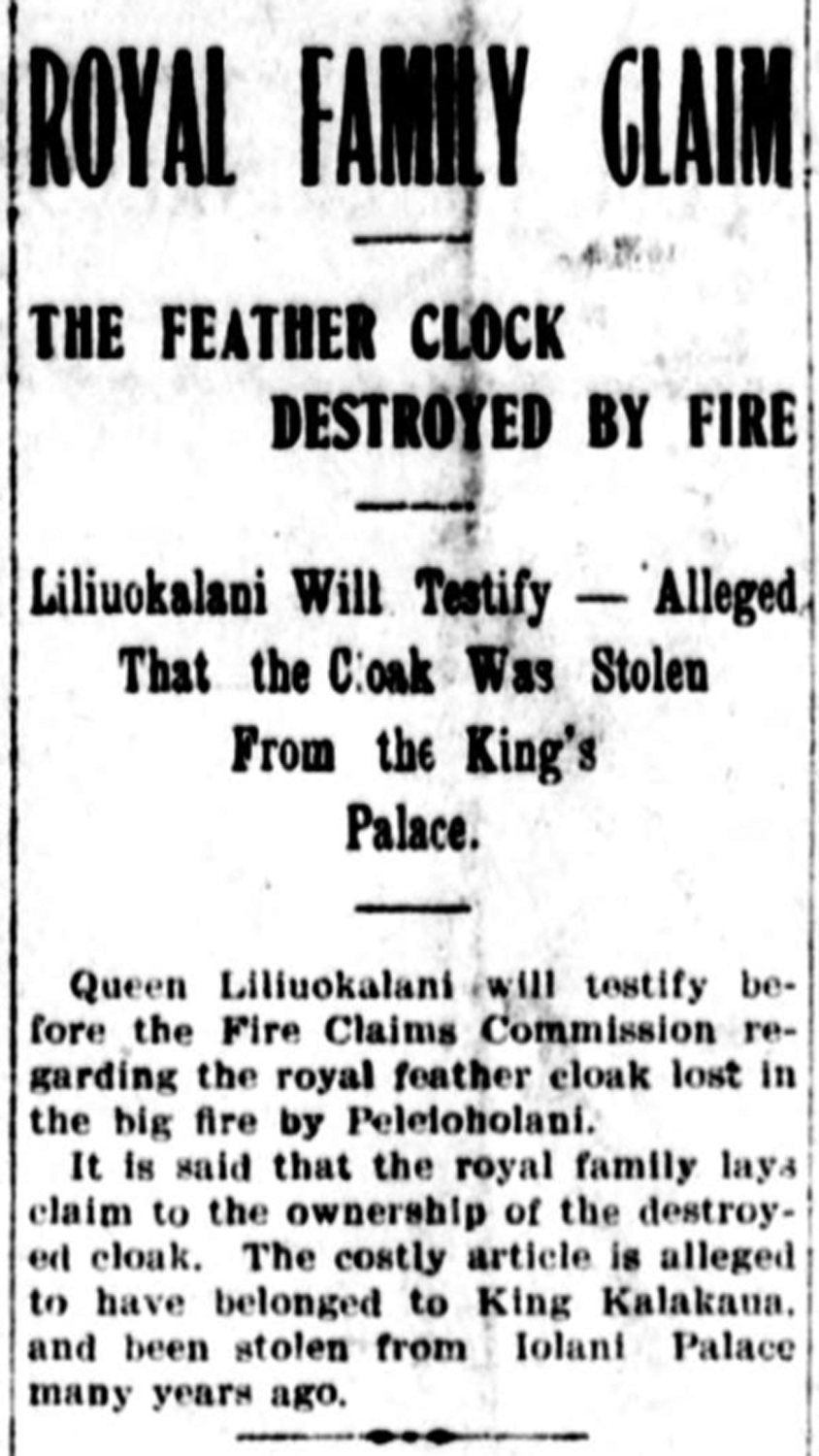
ROYAL FAMILY CLAIM

THE FEATHER CLOAK DESTROYED BY FIRE

Liliuokalani Will Testify—Alleged That the Cloak Was Stolen From the King’s Palace.

Queen Liliuokalani will testify before the Fire Claims Commission regarding the royal feather cloak lost in the big fire by Peleioholani.

It is said that the royal family lays claim to the ownership of the destroyed cloak. The costly article is alleged to have belonged to King Kalakaua, and been stolen from Iolani Palace many years ago.

[See: Ancient Relics Were Destroyed & Pau ka Ahuula i ke Ahi]

(Evening Bulletin, 11/2/1901, p. 1)

ROYAL FAMILY CLAIM

Evening Bulletin, Volume XI, Number 1984, Page 1. November 2, 1901.

The latest from Kohala, 1879.

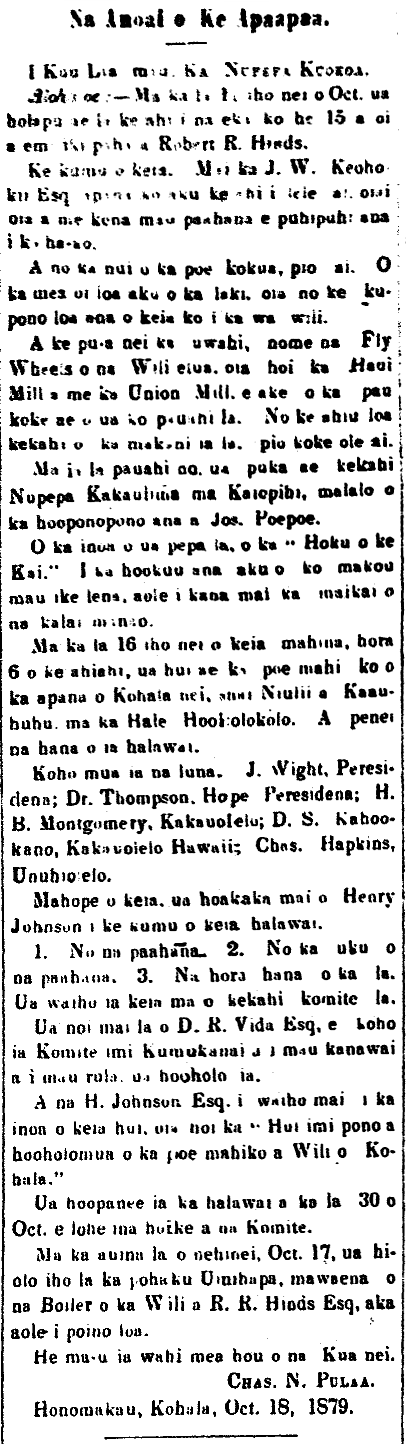
News of the Apaapaa Winds.

To My Constant Desire, Ka Nupepa Kuokoa.

Aloha oe:—On this past 11th of Oct., fire engulfed more or less 15 acres of Robert R. Hind’s.

This is the cause. The fire jumped from the property of J. W. Keohokii, Esq., while he and his workers were burning the leaves of the sugarcane.

And it was extinguished because of all of those assisting. The luckiest thing was that the cane was all ready to be milled.

While the smoke was billowing, the Fly Wheels of the two Mills spun, that being Haui Mill [Hawi Mill] and Union Mill,  hoping to quickly take care of that burning cane. Because of the terribly wild winds that day, it was not put out quickly.

On that very day of the fire, a Handwritten Newspaper at Kaiopihi under the editing of Joseph Poepoe was issued.

The name of that paper is “Hoku o ke Kai.” When we examined it, the discussions were outstanding.

On the past 16th of this month, at 6 o’clock in the evening, the sugar plantation people of the district of Kohala, from Niulii to Kaauhuhu, met at the Court House. And this is what happened at that meeting.

The officers were chosen first. J. Wight, President; Dr. Thompson, Vice President; H. B. Montgomery, Secretary; D. S. Kahookano, Hawaiian Secretary; Charles Hapkins [Charles Hopkins], Translator.

After this, Henry Johnson explained the purpose of this meeting.

1. Pertaining to the laborers. 2. Pertaining to the wages of the laborers. 3. The work hours per day. This was left to a committee.

D. R. Vida, Esq., asked that a Committee be selected to  form a constitution, laws, and rules; the motion was passed.

H. Johnson, Esq. put forth the name of this organization, that being “Hui imi pono a hooholomua o ka poe mahiko a Wili o Kohala” [Association seeking rights and progress for the workers of the plantations and Mills of Kohala].

The meeting was adjourned until the 30th of Oct. to hear the report of the Committee.

Yesterday afternoon, Oct. 17, a brick fell between the Boilers of the Mill of R. R. Hind, Esq., but there were no serious injuries.

Those were a few news items from here in the Back areas.

Charlse N. Pulaa.

Honomakua, Kohala, Oct. 18, 1879.

(Kuokoa, 10/25/1879, p. 3)

Na Anoai o Ke Apaapaa.

Ka Nupepa Kuokoa, Buke XVIII, Helu 43, Aoao 3. Okatoba 25, 1879.

Peleioholani’s home is destroyed by fire, 1901.

ANCIENT RELICS

WERE DESTROYED

Valuable Feather Cloak In Peleioholani’s Fire Claim.

BELONGED TO KEEAUMOKU

THE CLAIMANT’S ANCESTOR

While Husband and Wife Were Shut Out By Quarantine the Flames Swept Away Their Home.

Claims of native Hawaiians were resumed before the Fire Claims Commission yesterday morning. Two of these were called this morning, one of which is of more than ordinary interest.

S. L. Peleioholani presents a claim for $2000 and it appears to be a perfectly straight one. The claimant is a lineal descendant of high chiefs and among his household possessions were heirlooms of great value. Indeed, it is scarcely practicable to measure their value in money, the articles having both historical and ethnological—it might be added without joking, ornithological—interest.

Of the last-named class was a feather cloak, the only one existing of its class except the famous garment of Kamehameha treasured in the British Museum. This cloak descended to Peleioholani from his great-great-grandfather, Keeaumoku, a high chief whose name is given to one of the streets of Honolulu. Evidence was presented before the Commission showing that the claimant refused $500 from Mrs. Marry Ailau, the well-known dealer and connoisseur in Hawaiian relics, several years ago. Yes, and when she sent a relative to further sound the owner on his selling figure an offer of $700 for the cloak was declined by him.

Peleioholani had also a few calabashes of high value, besides other ancient objects of native art.

Why did not Mr. Peleoholani or his wife rescue all this archaeological wealth from the advancing flames? It is an easy question and its answer is not mysterious. The husband was working at his trade of a carpenter on the Castle house, while his wife was away from home on some errand, when the rigid quarantine came down suddenly as a Pali cloud. In consequence the couple could not gain access to their home and the tempest of flame came and swept it away.

Peleioholani lost sundry articles of latter day manufacture and utility, which went to make up his claim. An item was sixty fathoms of inch and a half rope at $47, this being the price he paid for it at an auction sale. He explained that he used the hawser in connection with building and house-moving operations. Scion of a noble house as he is, Peleioholani gave the Commissioners the impression of an honorable man.

[See what was said in an article from one of the Hawaiian-Language Newspapers here.]

(Evening Bulletin, 10/15/1901, p. 1)

ANCIENT RELICS WERE DESTROYED

Evening Bulletin, Volume XI, Number 1968, Page 1. October 15, 1901.

Keelikolani’s house and valuables destroyed by fire, 1873.

Destruction by Fire of the Residence of the Governess of Hawaii.

The tedium of this dull town, was relieved a little on last Wednesday night by a rousing fire. About one quarter to eight o’clock, the dwellers on Emma street, and in the immediate neighborhood, were suddenly aroused by the shouts and cries of kanakas, the screams of wahines, and the barking of dogs; and were first led to suppose that a big fight was on hand,—that perhaps the police had mutinied and the rifles were called out; but as each anxious individual peered into the street, they soon discovered by the column of flame that was leaping up into the dark sky, that a conflagration was on hand, and farther observation showed that it was taking place at the town mansion of Her Excellency, R. Keelikolani, the Governess of Hawaii.

The fire evidently had a good start, and as soon as discovered, was beyond the control of blankets or buckets of water; but not beyond the control of a good head of water from a fire plug, if spouting on it there and then. But the hydrant for public safety was not ready till the roaring devourer was licking the roof tree of Ruth. And when it was ready, the quenching stream served only to raise an impotent fizzle of stream. And oh! had the wind been up, and this fire had been in the close built part of the town, then we would have had a dance of destruction, that would have been equal to the cost of forty reservoirs.

But we must not complain, as the Ministers were out to see the fire burn, and lend a hand if needed. Emma street was lively with the jostling of Ministers and milkmen, diplomats and deacons, judges and jews, and editors and elderly ladies. Everybody turned out,—even some of the churches turned out. These were in the midst of the regular Wednesday evening service, when the uproar began. One pastor affected by the outside outcry, and the evident anxiety of his people, “sung it short,” and he and his flock, joined the throng in the street, to see the sight; but another one, while addressing his faithful, although he saw them speak out one by one, until he was left with only two to listen, yet he stood firm like the Roman sentinel at Pompeii, while the sparks of the conflagration were falling in his vestibule, and gave the two faithful witnesses the full benefit without halt or abbreviation of good orthodox sermon.

The cause of the fire is unknown, but as there had been on hand lately, a fierce litigation about this and other property, the circumstances afford occasion for a good deal of suspicion. Much that was curious and valuable in relation to ancient Hawaiian habits and costumes were unfortunately destroyed. There was some of the famed featherwork, worn by the old chiefs, many of the old feather insignia of office, the great kahilis of Hawaiian pageants, shell and hair ornaments, tappas and fine mats, and some royal bones—all of which were a considerable loss, excepting the bones.

The residence as a property, will not be much of a loss to the wealthy Governess of Hawaii. If the trades had been blowing fresh, several houses makai of this building, would have gone with it but as it was dead calm, and a light shower had fallen a few minutes before the fire broke out, it was easy to defend the roofs of neighboring houses.

On account of the absence of mail, we give this long report of an ordinary fire.

(Hoku o Hawaii, 1o/17/1873, p. 3)

Destruction by Fire of the Residence of the Governess of Hawaii.

Nuhou, Volume II, Number 24, Page 3. October 17, 1873.

Kauai court records saved …by prisoners? 1911.

RECORDS OF THE KAUAI DISTRICT COURT SAVED ONLY BECAUSE OF SOME PRISONERS.

In some news received from Kauai, it told of the saving of the records of the court of Kauai from being destroyed by fire on the night of the 14th, that being this past Friday, through the quick action of a prisoner sentenced for attempted murder.

At 11 o’clock that night, the desk of Judge C. S. Dole in the courthouse of Lihue was on fire; the cause of the fire is unknown. The courthouse and the court records within it were saved because of the quick action taken by some of the prisoners in the jail; if the jail was located far away, there would have just been a pile of ashes. The prisoner who noticed it and went to go save it was Jona Davis, a prisoner sentenced a day earlier for attempted murder; he was assisted by some other prisoners.

(Kuokoa, 7/21/1911, p. 6)

E OLE KEKAHI MAU PAAHAO PAKELE AI KA BUKE MOOLELO O KA AHA O KAUAI.

Ka Nupepa Kuokoa, Buke XLVII, Helu 29, Aoao 6. Iulai 21, 1911.