This is an independent blog. Please note that I am nowhere near fluent, and that these are not translations, but merely works in progress. Please do comment if you come across misreads or anything else you think is important.
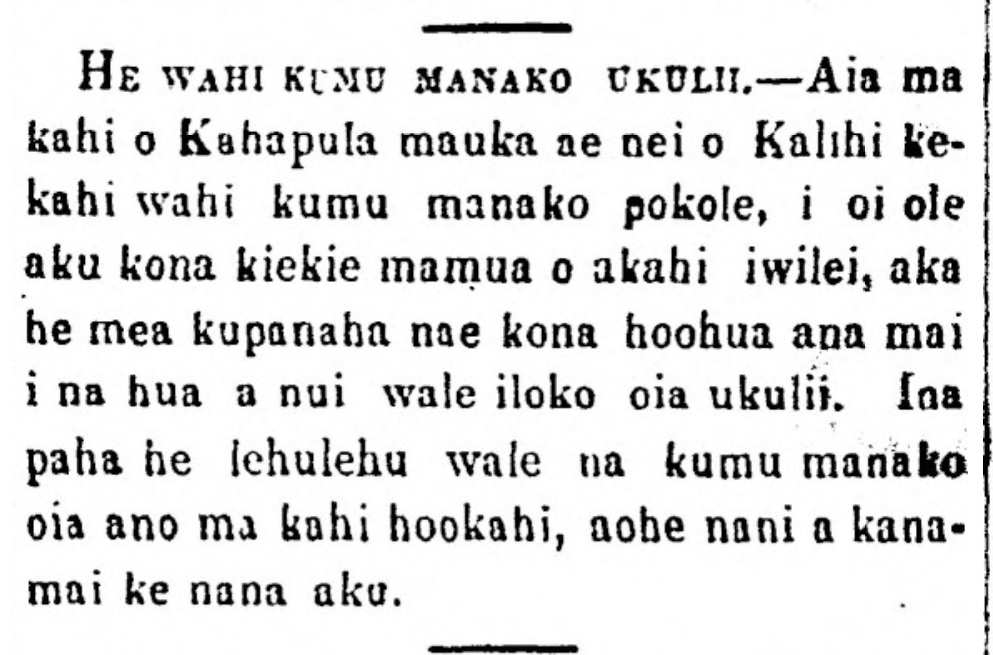
A tiny mango tree.–At Kahapula’s1 place in the uplands of Kalihi, there is a short mango tree, its height not more than an iwilei.2 But it is amazing that while it is so tiny, it produces so much fruit. Should there be many of those mango trees in one place, there would be nothing more beautiful to see.
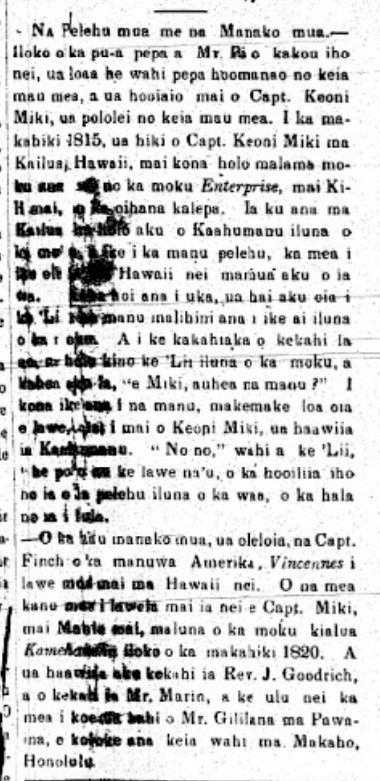
The first Turkeys and the first Mangoes.–In the sheaves of paper belonging to our Mr. ???, there was a memo pertaining to these things, and Captain John Meek [Capt. Keoni Miki] confirmed the information. In 1815, Capt. John Meek arrived in Kailua, Hawaii, as a mate of the ship Enterprise, from Chili, on a trading voyage. When he landed in Kailua, Kaahumanu boarded the ship and saw the turkeys, which were not seen here in Hawaii before that. She went back to shore and told the King about the unfamiliar birds she saw on the ship. In the morning of some following day, the King boarded the ship in person and called out, “O Miki, where are the birds?” When he saw the birds, he very much wanted to take them, but John Meek said that they were given to Kaahumanu. “No, no,” said the King, “I should take them for myself.[“] They were placed upon a canoe and taken ashore.
The first mango tree, it is said that it was Capt. Finch of the American warship Vincennes who first brought it to Hawaii nei. The first plants imported by Capt. Meek from Manila [Mania], were aboard the double-masted Kamehameha in 1820. Some were given to Rev. J. Goodrich, and some to Mr. Marin, and the others are growing at Mr. Gilliland’s place at Vineyard; this place is near Makaho, Honolulu.
(Ko Hawaii Ponoi, 6/18/1873, p. 2)
Ko Hawaii Pae Aina, Buke I, Helu 1, Aoao 2. Iune 18, 1873.
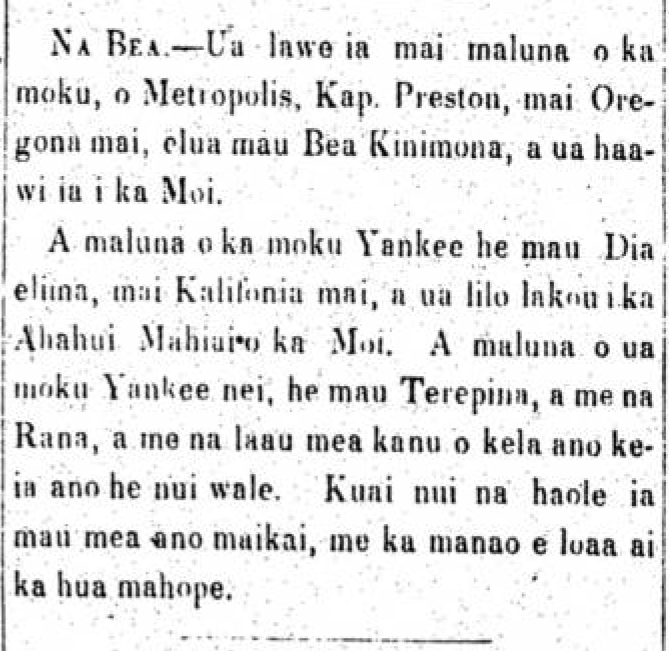
Aboard the ship the Yankee were five Deer, from California, and they went to the Royal Hawaiian Agriculture Society, of the King. And aboard that ship the Yankee, were some Terrapin and Frogs, and many types of plants. Haole buy those fine things with the thought they would have fruit in the future.
Bears.–Brought aboard the ship the Metropolis, Capt. Preston, from Oregon, were two Cinnamon Bears, and they were given to the King.
(Hae Hawaii, 12/2/1857, p. 142)
Ka Hae Hawaii, Buke 2, Ano Hou—Helu 2, Aoao 2. Dekemaba 2, 1857.
Rice is planted much here in this place. The rice just newly planted here in some paddies is growing and it is green when looking at it. Continue reading →
A general meeting of the Society was held at the Court House on Saturday last, April 1st, 1865, pursuant to a call published by his Ex. R. C. Wyllie.
Mr. Montgomery was called to the Chair, and stated that the objects of the meeting were, first, to consider the amalgamation of the Planters’ Society with the Royal Hawaiian Agricultural Society.
Hon. G. M. Robertson, appointed at a former meeting to report on the proposed step, stated that the simplest way for attaining the object was for the members of the Planters’ Society to unite individually with the R. H. A. Society. Continue reading →
Mr. Editor:—The eminent success which has attended Dr. Hillebrand’s first consignment of plants and birds per Alberto for the Royal Hawaiian Agricultural Society, ought certainly to operate as a stimulus to all who feel interested in the material progress of these islands, to lend a helping hand to enable him to avail freely of the facilities and opportunities he now possesses of procuring and forwarding here the vast number of plants, &c., suitable to our climate, Continue reading →
New plants.—Aboard the trade ship of the Chinese laborers which Dr. Hillebrand sent for, arrived some plants which were never seen before in Hawaii, Continue reading →
Pertaining to Punaluu.—This is rice farming lands for Chulan & Co. There is much rice in this land; there is much rice as well amongst the Hawaiians in Waiono, Makana, Puheemiki, Kapano, and Papaakoko; Continue reading →

 nupepa