Labor Day, 1920.

LABOR DAY HOLIDAY IN HONOLULU NEI.

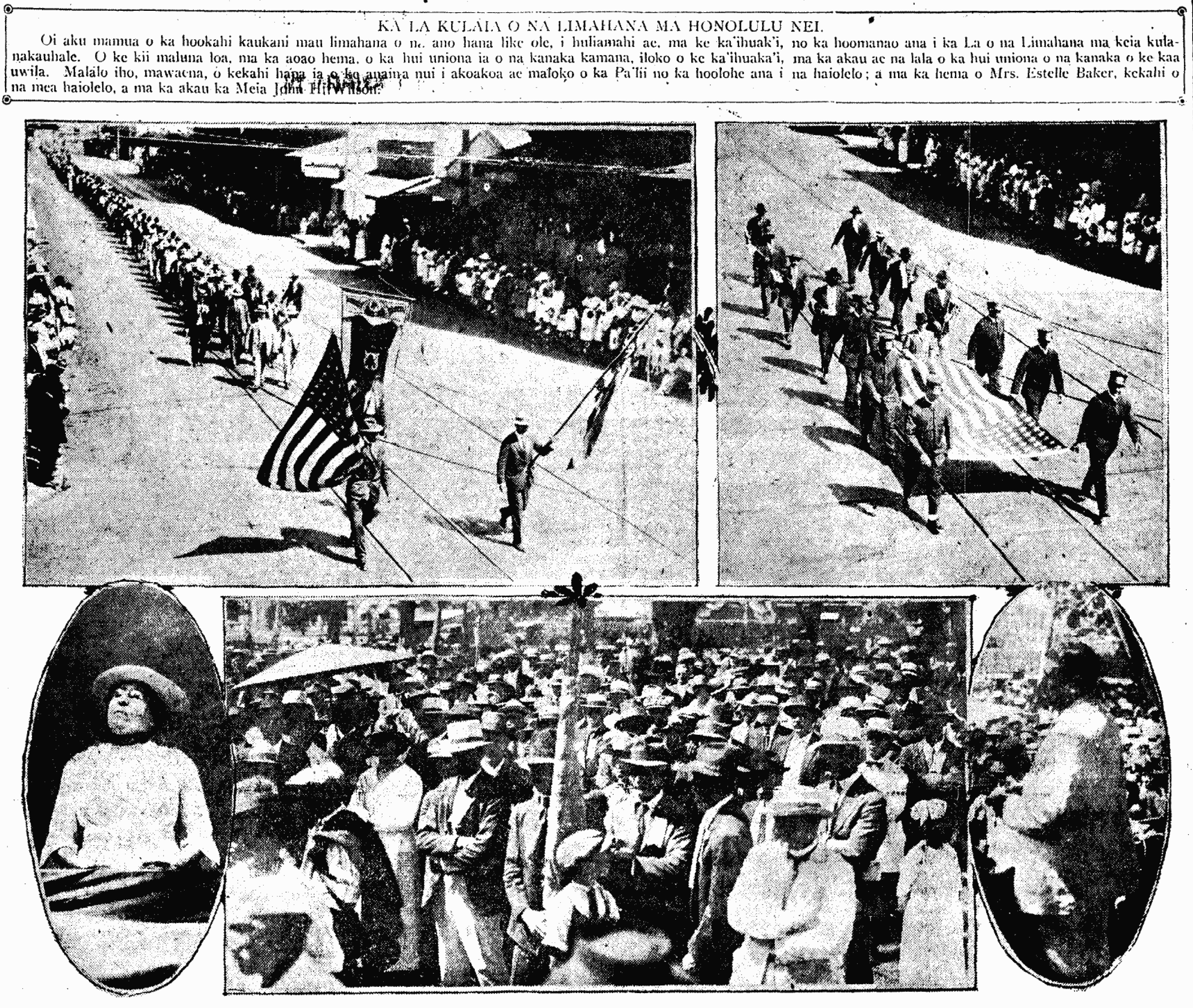
More than a thousand laborers of all trades all came together in the parade to celebrate Labor Day [La o na Limahana] in this town. The picture on the top left, are the men of the carpenter’s union in the parade; to the right are the men of the streetcar union. Below, in the center, is some of the crowd gathered on the Palace Grounds to listen to the speeches; on the left is Mrs. Estelle Baker, one of the speakers; and on the right is Mayor John H. Wilson.

(Kuokoa, 9/10/1920, p. 1)

KA LA KULAIA O NA LIMAHANA MA HONOLULU NEI.

Ka Nupepa Kuokoa, Buke LVIII, Helu 37, Aoao 1. Sepatemaba 10, 1920.

Restoration Day celebration by true patriots, 1894.

LA HOIHOI EA.

Fitting Remembrances for that Great Day.

This past Tuesday, July 31, was the day that the independence and the beloved flag of this land was restored after being seized and forcefully taken by Lord George Paulet [Lo Keoki Pauleti] on February 25, 1843, without orders from his Nation, and Rear-Admiral Thomas [Hope-Adimerala Kamaki] was the one who restored it on this day in that very year, five months and some days after it was stolen. This day is celebrated by all true patriots with many feasts all over the place.

In the early morning, the Royal Hawaiian Band [Puali Puhiohe Lahui] went to entertain the Alii, the Monarch, at Washington Place. When they entered the yard after marching from Emma Square [Ema Kuea], the door was swung open and they marched to the Ewa corner of the house and began to play. The Alii came out and sat on the lanai on that side. The songs that were played were full of reverence, awe, and joy. Outside before the front yard were the masses, and children climbed the fence and went inside. From what we saw, the crowd was looking intensely to try and maybe get a glimpse of the Alii, showing that the songs by the band wasn’t what they desired, but it was the sight of the face and the appearance of the Ruler that they were after, as it is sung: “Our desire is but for our Alii, The one we care for.” [“O ke Alii wale no ka makou makemake, O ka luhi o maua me ia nei.”]

After the music was over, the Alii stood and spoke briefly before these people who stood steadfast behind her, with words of encouragement. She stressed that the lahui keep the peace, like her statement of January 14, 1893, for the welfare of her people, and that it would be but a few more days before, according to assurances she received, that she will once again have them [? e kikoo hou mai ai oia ia lakou] go back to their lives just as before. The Alii had as well some words filled with aloha, and there was not one from amongst the members of the band who did not shed tears; some shed great many tears while blowing their noses into handkerchiefs.

That night, on the grounds of the Hawaiian Hotel [Hotele Hawaii], they gave an open concert to entertain the public, and just as was seen at the performance they put on earlier, so too was this one, and it was very well attended. Those who attended were very happy, there being perhaps 3000, from men to women, from the old to they young, and from those of high stature to low. They played without electric lights, but were illuminated by Japanese lanterns and their pewter lanterns. It would appear as if they were totally thwarted by the Government [P. G.], but in fact it was the deceitful ones who were disappointed, because they were all the more delighted. There was a single wealth-seeking haole [kolea kauahua] that we saw sitting on the lanai of the Hotel, on the Waikiki side, with his mouth wide open, maybe because he witnessed the unmatched beauty of that great night of entertainment, that person was the one with a maimed hand from Boston.

[Let the story never be forgotten. Ua mau ke ea o ka aina i ka pono!]

(Makaainana, 8/6/1894, p. 1)

LA HOIHOI EA.

Ka Makaainana, Buke II—-Ano Hou, Helu 6, Aoao 1. Augate 6, 1894.

W. D. Alexander on Restoration Day, 1896.

A MEMORABLE DAY

Admiral Thomas Declines the Provisional Cession of the Islands.

Professor Alexander’ Brief But Graphic Description of the Important Events of 1843

On the 10th of February 1843, the British frigate Carysfort, commanded by Lord George Paulet, arrived at Honolulu, and showed displeasure by withholding the usual salutes. The commander seems to have placed himself completely under the direction of Mr Alexander Simpson. The United States sloop-of-war Boston, Captain Long, arrived on the 13th.

The king who had been sent for at Lord Paulet’s request, arrived from Lahaiua on the 16th. Lord Paulet refused to treat with him through Dr. Judd, his agent, and late in the evening of the 17th sent him a peremptory letter, inclosing six demands with the threat that if they were not complied with by four o’clock p. m. the next day, “immediate coercive steps would be taken.” The substance of these demands was as follows:

1st. That an attachment laid on Charlton’s property, at the suit of an English firm for an old debt, be removed, that the land claimed by him be “restored,” and reparation to his representatives for the losses which they had suffered through the alleged injustice of the government.

2d. The immediate recognition of Mr. Simpson as British Consul, and a salute of twenty-one guns to the British flag.

3d. A guarantee that no British subject should be put in irons, unless for a felony.

4th. That a new trial should be held in the case of Skinner vs. Dominis.

5th. That all disputes between British subjects and others be referred to mixed juries, one half of whom should be British subjects approved by the consul.

6th. A direct communication between the king and the Acting British Consul for the immediate settlement of all complaints on the part of British subjects. Continue reading

Restoration Day, 1896.

The Independent recalls the fact that to-day is Restoration day. It reprints on its first page Professor Alexander’s description of the incidents attaching to it. If inaccurate in detail, it is worth reading and is suggestive to thoughtful persons at the present time. The government in control forgets the day, but Hawaiians remember and respect it, and in a few years time will again observe and honor it.

[Tomorrow will be the 171st anniversary of the restoration of the Kingdom.]

(Independent, 7/31/1896, p. 2)


The Independent recalls...

The Independent, Volume III, Number 340, Page 2. July 31, 1896.

Tahitian mele for La Kuokoa, 1861.

Songs of Polapola

Aue oe tau hoa hele e,
E fiteri tou e,
Tai ta pea ta te fa tu,
O Iesu ta haa maitai.

Eau ia oe te oa oa,
Eau ia oe te haa maitai,
Ia oe nae te fei a haa wale,
I loto i te au ahi oia nae.

Aue oe e ta Moi e,
He aroha to oe,
Mai horoa i te hau ia Mareta,
E ta pea maitai.

Iaorana oe e ta Hatu o Hawaii,
Tai haapao ia tai haapao hia,
E mono i tooe toloa.

Iaorana oe e Ema,
Te Alii Vahine e,
Faatere maitai to otou haue,
E mau te ora o te Alii e amuri no atu.

Auwe oe tou hoa he re e,
Pi te ri tou e tei ta pea i ta te fatu,
Oietu te parau maitai,
eau ia oe te oaoa,
Eau ia oe te haa maitai,
Ia oto nae te feia faa vare,
I roto o te au ahi oia nae.

Auwe oe e ta Moi e,
E aroha to oe e,
Mai ho roa i te hau,
Ia Amerita,
E ta pea maitai mai,
Iaorana oe e ta Hatu Hawaii e,
Tei haa pao hia i mano to oe to roa,
Iaorana oe e Ema te Rii vahine e,
Faa te re maitai to otou hau,
E mau te aroha o te Rii e,
Ea muri noatu.

Himeni 27.

1 Te ra, te aoae, te fetia,
Maramarama ai te ao,
Maitai atoa ai te po,
Na te Atua i faaue iho,

2 Ia ara, e ia moe tatou,
Te merahi maitai tei mau,
To ratou tiai ia tatou,
Aore e ino i roohia mai.

3 Te rai anaana i nia ae,
Te aihere rii i raro nei,
Te miti atoa e ati ae,
Na te Atua i hamani.

4 Te puapua, noanoa,
Unauna ai te raau nei,
Te raau maa na tatou a,
Na te Atua i horoa mai.

5 Te ata i pee, te ua i pou,
Te matai farara e oraʻi,
Te manu, i rere nei,
Te mau puaa nana anae,

6. Te ia e tere i te tai,
Tei nee i raro i te repo,
Tatiou atoa te taata nei,
Ohipa na te Atua mau.

7 Ia hamanihia ra tatou
Ia hau tu teie i te maitai,
E ia ra oe ta te Arii parau,
Ma te aau au i a rue ai.

[These are some of the mele performed on the 28th of November, 1861, at Kawaiahao Church in celebration of Independence Day.

For more Tahitian mele, see this composition of Ninito and Manaiula Sumner for Victoria Kaahumanu from 1862.]

(Kuokoa, 12/2/1861, p. 2)

He Mele Polapola.

Ka Nupepa Kuokoa, Buke I, Helu 4, Aoao 2. Dekemaba 2, 1861.

Scenes from the Kamehameha Day celebration, 1919.

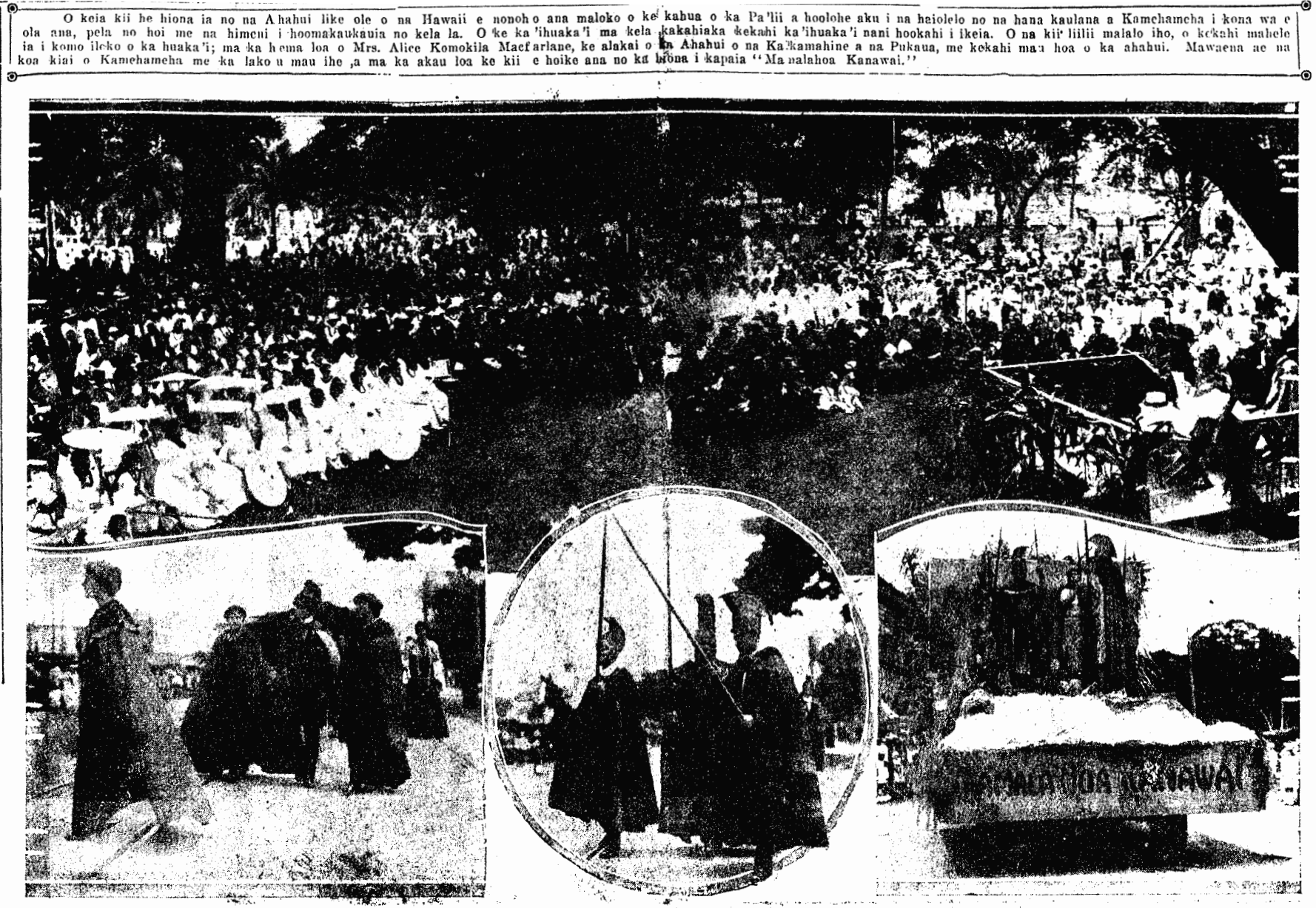
The picture [on the top] shows the various Hawaiian Societies seated on the Palace Grounds and listening to the speeches of the famous deeds of Kamehameha in his lifetime, and also the songs prepared for the day. The parade of the morning was one of the most beautiful parades seen. The small pictures below show parts of the parade; on the far left is Mrs. Alice Kamokila Macfarlane, the head of the Daughters of Hawaiian Warriors [Ahahui o na Kaikamahine a na Pukaua], along with some of the members. In the middle are the guards of Kamehameha armed with their spears, and on the far right is a picture showing the scene called “Mamalahoa Kanawai.”

[Don’t forget to turn out for or tune into the Kamehameha Parade of 2014!]

(Kuokoa, 6/13/1919, p. 1)

O keia kii he hiona...

Ka Nupepa Kuokoa, Buke LVII, Helu 24, Aoao 1. Iune 13, 1919.

Song for Ka Na’i Aupuni, Kamehameha Paiea, 1909.

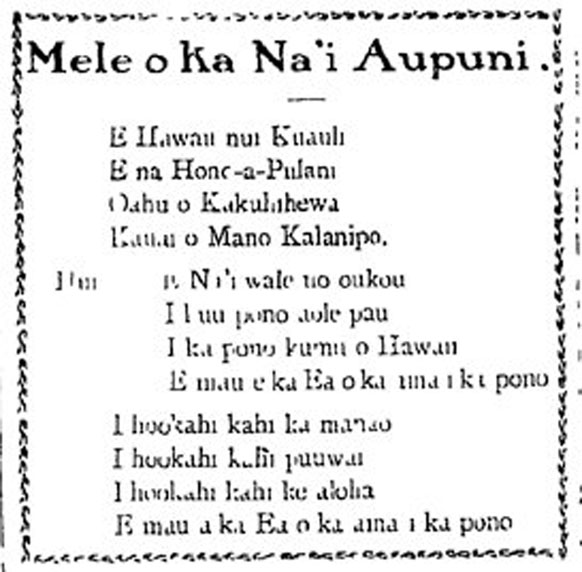
Mele o Ka Na’i Aupuni.

E Hawaii nui Kuauli
E na Hono-a-Piilani
Oahu o Kakuhihewa
Kauai o Mano Kalanipo.

Hui:  E Na’i wale no oukou
I kuu pono aole pau
I ka pono kumu o Hawaii
E mau e ka Ea o ka aina i ka pono.

I hookahi kahi ka manao
I hookahi kahi puuwai
I hookahi kahi ke aloha
E mau a ka Ea o ka aina i ka pono

[This was printed for Kamehameha Day 105 years ago! See also an earlier publication of a variant of this mele from Aloha Aina, 8/21/1897.]

(Kuokoa Home Rula, 6/11/1909, p. 1)

Mele o Ka Na'i Aupuni.

Kuokoa Home Rula, Buke VII, Helu 24, Aoao 1. Iune 11, 1909.


Decoration Day, 1909.

“DAY TO STREW FLOWERS”

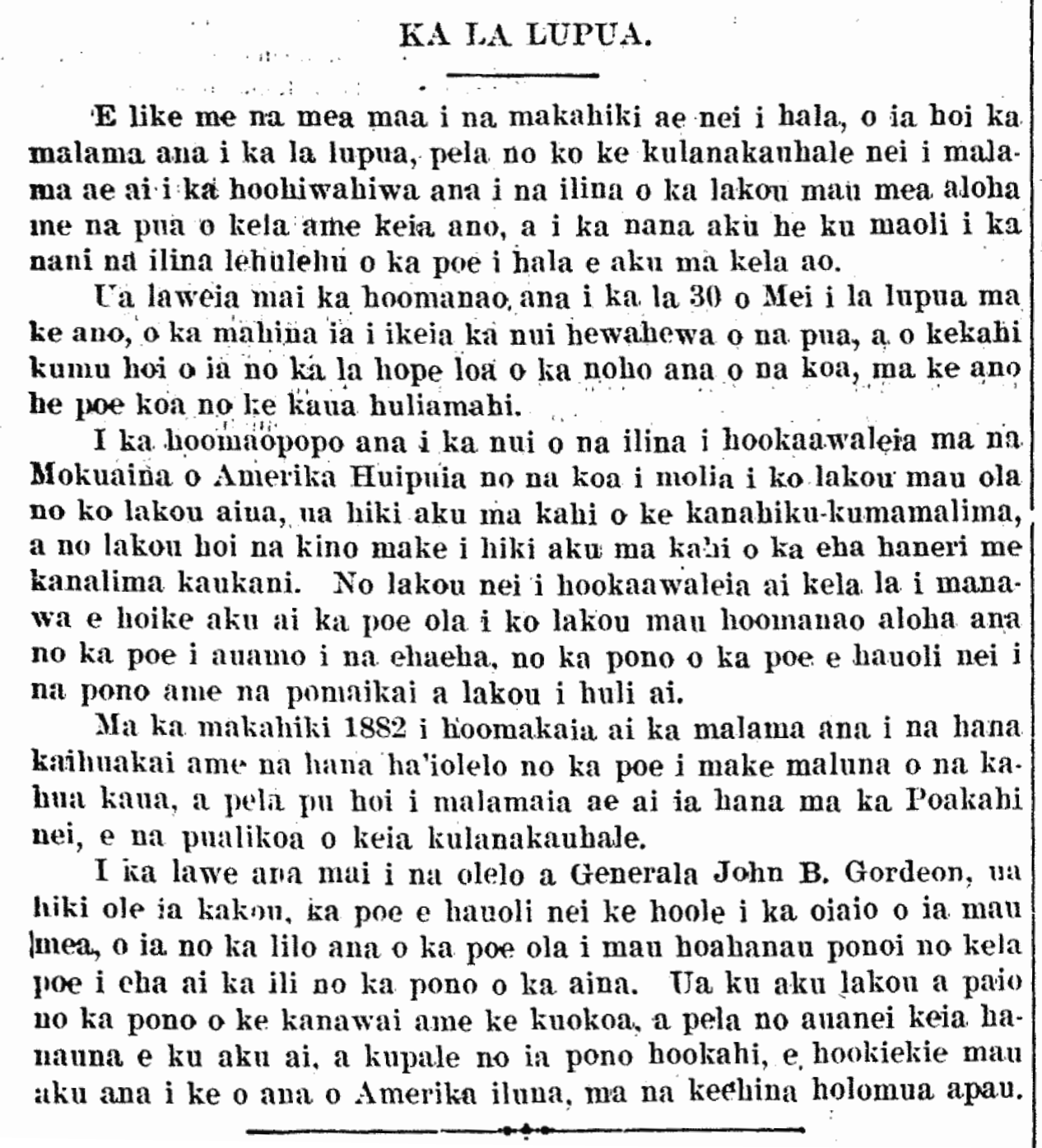
As has been the custom in previous years, that is the observation of memorial day [la lupua], the town is similarly decorating the graves of their loved ones with flowers of every type, and the cemeteries of the many who have passed are truly beautiful to see.

The 30th of May has been taken as a day to “strew flowers,” being that it is the month in which many flowers are seen, and also it is the final day the soldiers served as soldiers in the great war [kaua huliamahi].

The number of the [national] cemeteries in the different States of the United States, for the soldiers who sacrificed their lives for their land, is about seventy-seven, and within them they hold about four-hundred fifty thousand bodies. It is for them that the day is set aside; it is a time for the living to show their loving remembrances for those who bore suffering for the welfare of the people who enjoy the rights and blessings for which they sought after.

In the year 1882, the parades and speeches for those who died on the battlefields were initiated, and that is what happened this past Monday by the soldiers of this town.

Taking the words of General John B. Gordon, “It is impossible for us who are today joyful, to deny the truth of these things, that being, those who are living should be as true brothers of those people who suffered injuries for the blessings of this land. They stood and fought for the righteousness of the law and for independence, and that is how this generation then should remain and defend the very same right, continually pushing America on higher in all areas of progress.”

(Kuokoa, 6/9/1909, p. 4)

KA LA LUPUA.

Ka Nupepa Kuokoa, Buke XLVI, Helu 23, Aoao 4. Iune 9, 1909.

A day to remember, 1924.

THE “DAY TO PLACE FLOWERS” WAS OBSERVED HERE IN HONOLULU

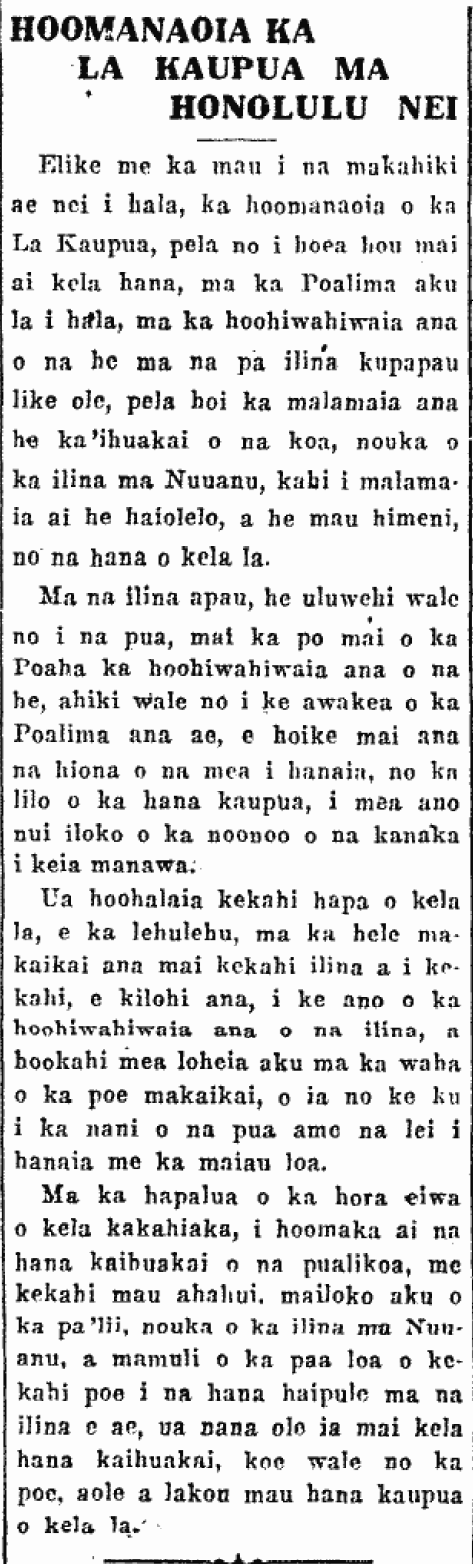
Just as in years past where Decoration Day [La Kaupua] was observed, so too has it come again on this past Friday, as the graves in the different cemeteries were decorated, and also a parade of soldiers was held upland of the cemetery of Nuuanu, where speeches were given as well as songs, for the observances on that day.

All of the cemeteries were decorated with flowers; from Thursday night the graves were being decorated until noon of the following Friday, showing that the observation of Decoration Day is given much thought to by the people these days.

A majority of the day was spent by the people going around from graveyard to graveyard looking at the adornments of the graves, and one thing heard amongst the people making their rounds was that the flowers and lei done with great care were beautiful.

At nine thirty in the morning, the parade of the soldiers and some organizations began from within the palace grounds up to the cemetery in Nuuanu, and being that some people were occupied with prayers at other cemeteries, this parade was not given any thought to, except by those who were not participating in decorating flowers on that day.

[Memorial Day (Decoration Day), which was held on the 30th of May and is now held on the last Monday of May, can be found in the Hawaiian-Language Newspapers as La Kaupua (“day to place flowers”) or La Lupua (“day to strew flowers”).]

(Kuokoa, 6/5/1924, p. 1)

HOOMANAOIA KA LA KAUPUA MA HONOLULU NEI

Ka Nupepa Kuokoa, Buke LXIII, Helu 23, Aoao 1. Iune 5, 1924.

Restoration Anthem, 1843.

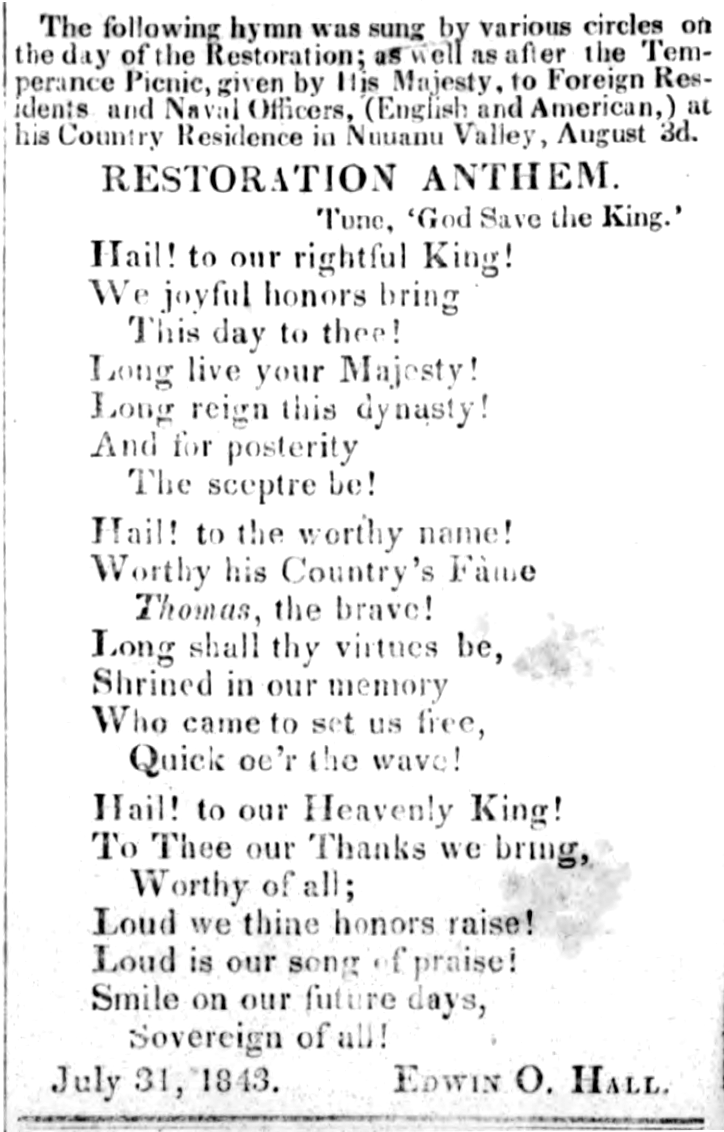
The following hymn was sung by various circles on the day of the Restoration; as well as after the Temperance Picnic, given by His Majesty, to Foreign Residents and Naval Officers, (English and American,) at his Country Residence in Nuuanu Valley, August 3d.

RESTORATION ANTHEM.

Tune, ‘God Save the King.’

Hail! to our rightful King!
We joyful honors bring
This day to thee!
Long live your Majesty!
Long reign this dynasty!
And for posterity
The sceptre be!

Hail! to the worthy name!
Worthy his Country’s Fame
Thomas, the brave!
Long shall they virtues be,
Shrined in our memory
Who came to set us free,
Quick oe’r the wave!

Hail! to our Heavenly King!
To Thee our Thanks we bring,
Worthy of all;
Loud we thine honors raise!
Loud is our song of praise!
Smile on our future days,
Sovereign of all!

July 31, 1843.  Edwin O. Hall.

[This post may be just a little early this year, but it is good to not just remember momentous events like Ka La Hoihoi Ea just one day of the year. Last year, the Hawaiian Historical Society put up handwritten lyrics of this mele on their Facebook page on the 27th of July. Here we find it in print, just a few days following its being penned by Edwin O. Hall!]

(Temperance Advocate and Seamen’s Friend, 8/11/1843, p. 42)

RESTORATION ANTHEM.

Temperance Advocate and Seamen’s Friend, Volume I, Number VIII, Page 42. August 11, 1843.