Kamehameha graduating class, 1926.

The Students of Kamehameha Schools Who Graduated This Year 1926.

1. Juliette Blake, 2. Alice Leialoha, 3. Edwin Stone, 4. Harry Chang, 5. Arthur Ahulii, 6. Samuel Vida, 7. Charles Buchanan, 8. Daniel Lansing, 9. Daniel McGregor, 10. Florence Smith, 11. Thurza Drake (class president Girls’ school), 12. George Groves, 13. Charles Travis, 14. George Naumu, 15. Evelyn Cooper, 16. Piilani Yates, 17. Helen Lani, 18. Evelyn Clark, 19. Dinah Dunn, 20. Paul Keaka, 21. Charles Aiden, 22. Henry Reinhardt, 23. Emma Woodward, 24. Elizabeth Leal, 25. Henry Kaahea, 26. Henry Young (class president Boys’ school), 27. Rogers Whitmarsh, 28. Edward Chang, 29. William Poka, 30. Walter Ahulii, 31. George Cummings, 32. Daisy Pa, 33. Bertha Mahikoa.

(Kuokoa, 6/17/1926, p. 2)

Na Haumana o na Kula Kamehameha i Puka i Keia Makahiki 1926

Ka Nupepa Kuokoa, Buke LXV, Helu 24, Aoao 2. Iune 17, 1926.

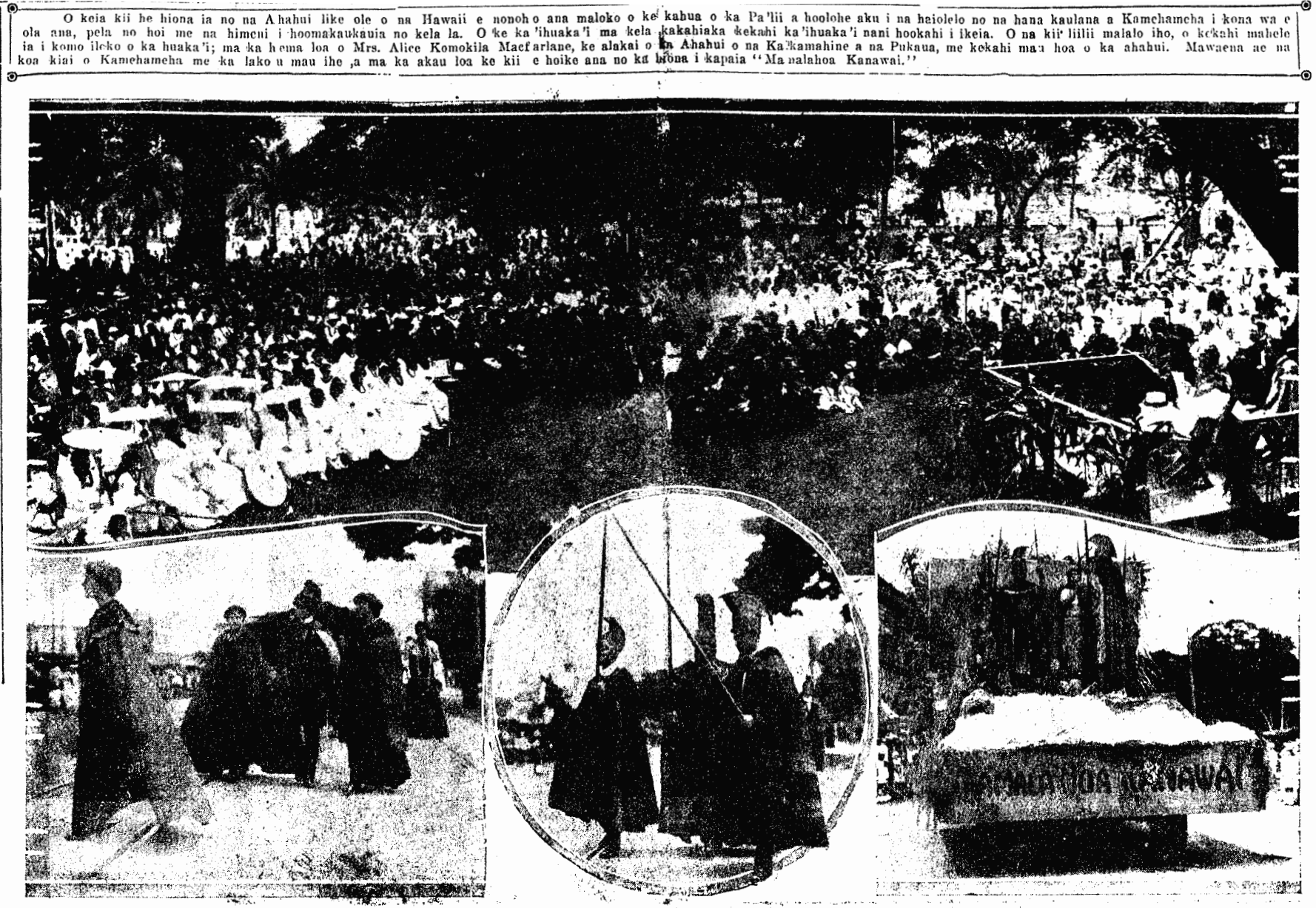
Scenes from the Kamehameha Day celebration, 1919.

The picture [on the top] shows the various Hawaiian Societies seated on the Palace Grounds and listening to the speeches of the famous deeds of Kamehameha in his lifetime, and also the songs prepared for the day. The parade of the morning was one of the most beautiful parades seen. The small pictures below show parts of the parade; on the far left is Mrs. Alice Kamokila Macfarlane, the head of the Daughters of Hawaiian Warriors [Ahahui o na Kaikamahine a na Pukaua], along with some of the members. In the middle are the guards of Kamehameha armed with their spears, and on the far right is a picture showing the scene called “Mamalahoa Kanawai.”

[Don’t forget to turn out for or tune into the Kamehameha Parade of 2014!]

(Kuokoa, 6/13/1919, p. 1)

O keia kii he hiona...

Ka Nupepa Kuokoa, Buke LVII, Helu 24, Aoao 1. Iune 13, 1919.

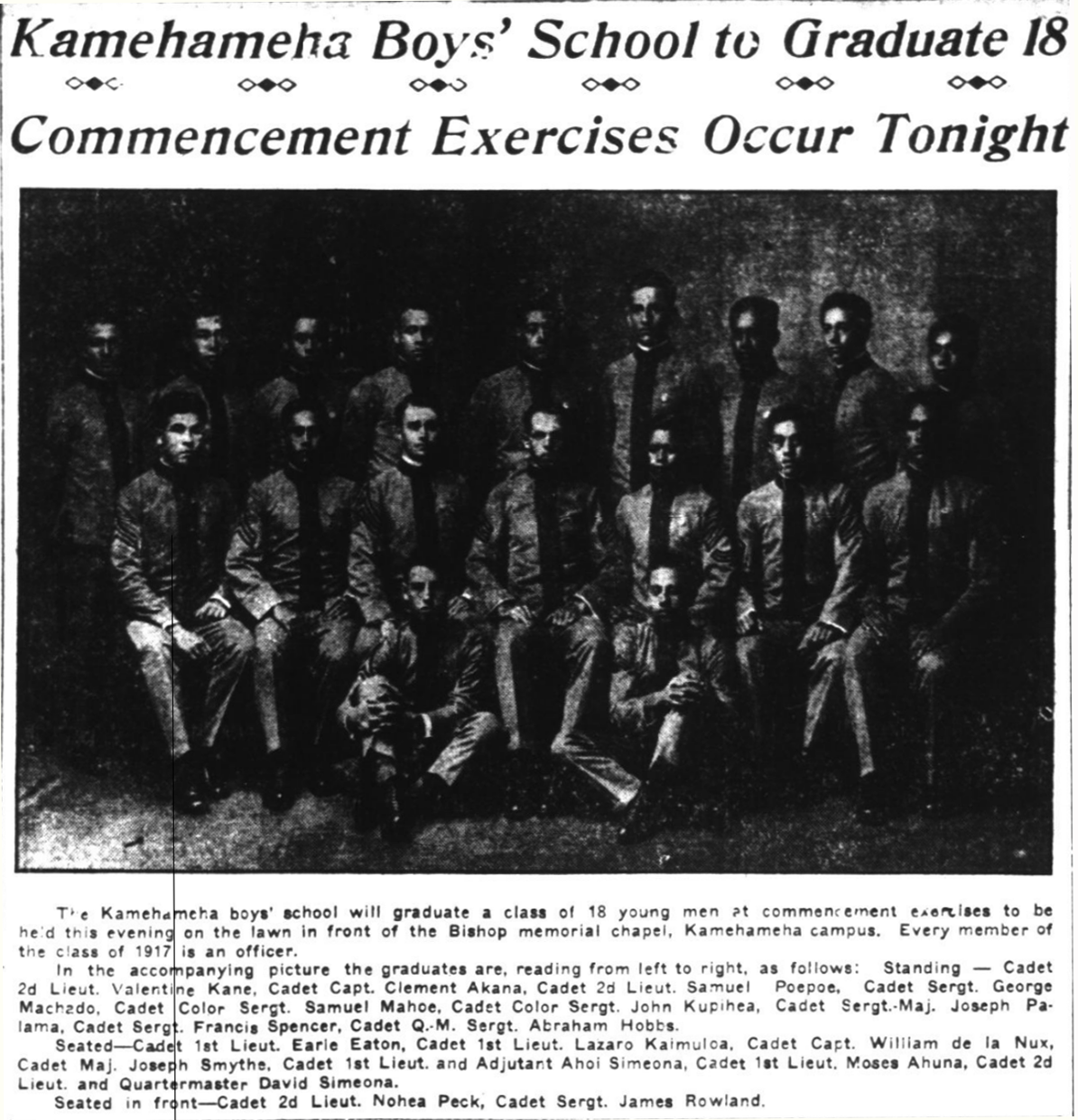
Kamehameha boys graduate, 1917.

Kamehameha Boys’ School to Graduate 18 Commencement Exercises Occur Tonight

The Kamehameha boys’ school will graduate a class of 18 young men at commencement exercises to be held this evening on the lawn in front of the Bishop memorial chapel, Kamehameha campus. Every member of the class of 1917 is an officer.

In the accompanying picture the graduates are, reading from left to right, as follows: Standing—Cadet 2d Lieut. Valentine Kane, Cadet Capt. Clement Akana, Cadet 2d Lieut. Samuel Poepoe, Cadet Sergt. George Machado, Cadet Color Sergt. Samuel Mahoe, Cadet Color Sergt. John Kupihea, Cadet Sergt.-Maj. Joseph Palama, Cadet Sergt. Francis Spencer, Cadet Q. M. Sergt. Abraham Hobbs.

Seated—Cadet 1st Lieut. Earle Eaton, Cadet 1st Lieut. Lazaro Kaimuloa, Cadet Capt. William de la Nux, Cadet Maj. Joseph Smythe, Cadet 1st Lieut. and Adjutant Ahoi Simeona, Cadet 1st Lieut. Moses Ahuna, Cadet 2d Lieut. and Quartermaster David Simeona.

Seated in front—Cadet 2d Lieut. Nohea Peck, Cadet Sergt. James Rowland.

(Honolulu Star-Bulletin, 6/7/1917, p. 5)

Kamehameha Boys' School to Graduate 18...

Honolulu Star-Bulletin, Volume XXIV, Number 7847, Page 5. June 7, 1917.

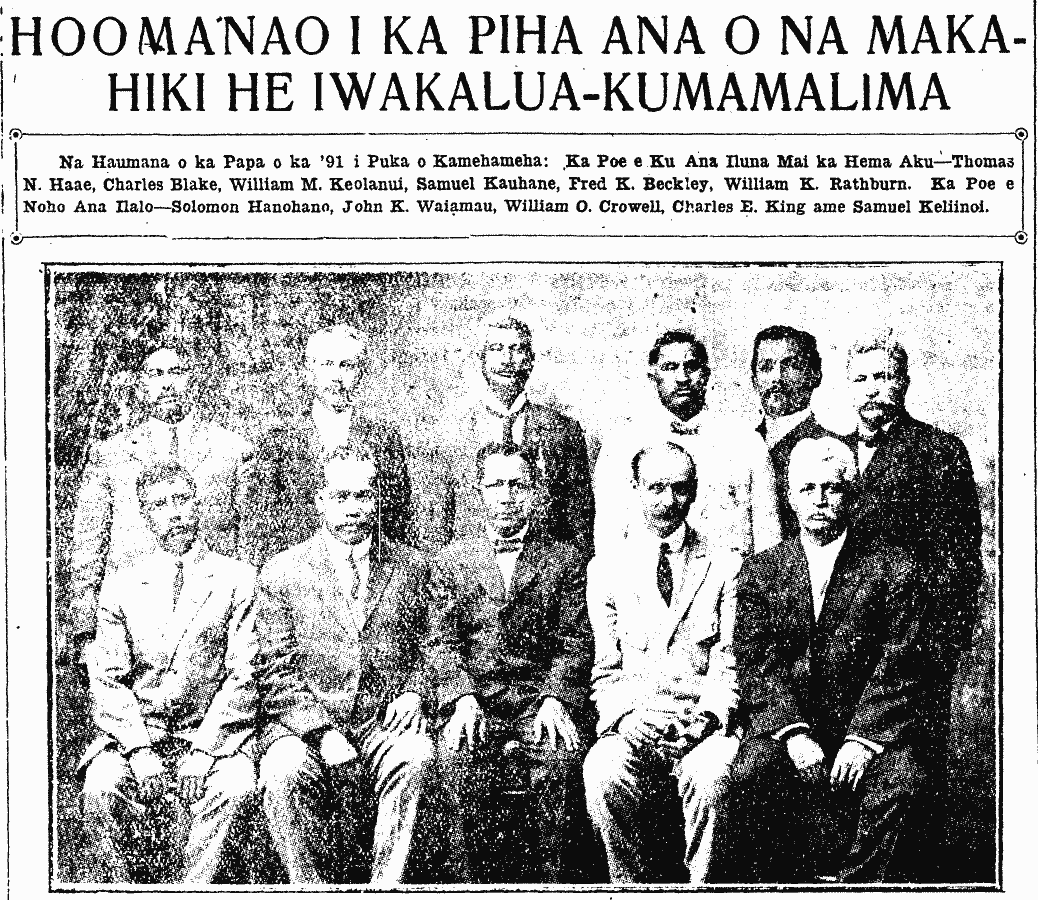
First Kamehameha class reunites, 1916.

TWENTY-FIFTH ANNIVERSARY CELEBRATION

Students of the ’91 Graduate Class of Kamehameha: Those standing from the Left—Thomas N. Haae, Charles Blake, William M. Keolanui, Samuel Kauhane, Fred K. Beckley, William K. Rathburn. Those seated—Solomon Hanohano, John K. Waiamau, William O. Crowell, Charles E. King, and Samuel Keliinoi.

[There are many priceless articles on this reunion; this includes the one that accompanies the picture which can be found here from pages 1 & 3.

It is pretty awesome that we can compare the graduation portrait of the class of 1891 which is on the Kamehameha Schools Archives page with this picture from 25 years later!]

(Kuokoa, 6/16/1916, p. 3)

HOOMANAO I KA PIHA ANA O NA MAKAHIKI HE IWAKALUA-KUMAMALIMA

Ka Nupepa Kuokoa, Buke LIV, Helu 24, Aoao 3. Iune 16, 1916.


Charles Nakao, survivor of the Aztec, writes home to Hawaii, 1917.

HAWAIIAN SURVIVOR OF AZTEC TELLS HIS STORY IN LETTER TO THE STAR-BULLETIN

A MESSAGE from a Hawaiian survivor of the steamship Aztec, sunk by a German submarine, came to the Star-Bulletin in yesterday’s mail from Brooklyn, New York.

Charles Nakao in a letter to this paper tells how some of his comrades were lost in trying to launch a lifeboat, and of the suffering of those on the wintry sea. Five Hawaiians were among those who perished, and a few weeks ago the legislature held a public memorial in their honor.

The letter says:

“Brooklyn, New York, April 26, 1917.

“Dear Sir: I, Chas. Nakao, was one of the members of the crew of the S. S. Aztec which was the first American vessel armed with two three-inch guns. Number of crew was 49, including 12 navy gunners and an officer of the U. S. S. Dolphin. We sailed from New York March 18, 1917, and were torpedoed by a submarine April 1, 1917, Sunday night, at 9:30 o’clock, off the coast of France. It was very stormy weather, the seas were about 30 feet in height and the current from English channel was running about 7 miles an hour. It were dark hail storm and were impossible to launch any lifeboat over the weather side. Seven of the crew got excited and try to launch the boat No. 2, which were on the weather side they were all smashed between the life boat and the ship side one of the boys were from Honolulu, Ekela Kaohi, the other were Chinese boy from Puna Pahoa Henry Look. No. 3 boat there were Hail Rice of Honolulu, Chas. Pumoku, Julian Makama of Honolulu, one from Tahiti Islands, John Davis. I were on board the No. 1 boat which I suppose to be the gunners’ boat. There were 19 of the crew on board. The vessel had sunk within 15 minutes it took 9 minutes because we were away from the ship side. After we were probably about 100 yards away some one gave four long blasts. Nobody knows how it happened. After four hours and a half in lifeboats on the high seas and hail storms and rain and darkness we were sighted by a French patrol boat. We had signaled to the boat with flashlights. They got full speed away from us. The second one had passed by and we lighted a torch and they came and picked us up. The temperature of the water was 40 degrees and I didn’t have any shoes or hat on. I was frozen and could hardly speak for about two hours after we got picked up. It was 1:30 o’clock in the early Monday…

Charles Nakao, survivor of the torpedoed Aztec

…morning and we had looked around for about 18 hours for the other boat. There were know sign whatsoever. So we landed at Brest, France, the American consul came and met us at the dock and over 6 hundred Frenchmen were treated fine. I got warm and were send to Brest hospital. From Brest we were send to Bourdeaux, France, about 48 hours ride train.

“We got on board the S. S. La Tourine, the French passenger boat from Bourdeaux, and we got back to New York safe.

“I remain yours truly,

CHAS. NAKAO,

Waiakea, Hilo, Hawaii.

“If any of boys’ family wants to get any information about the clothes or anything else please sent me your address and I will try my best to send it over. This is my address: Chas. Nakao, 324-32th street, Brooklyn, New York.

“P. S.—Thinking our Queen for her kindly remembrance to us boys off the ill-fated S. S. Aztec.

“Yours sincerely,

“C. N.”

[This article seems to be summarized in the Kuokoa of Iune 1, 1917, p. 5]

(Honolulu Star-Bulletin, 5/9/1917, p. 1)

HAWAIIAN SURVIVOR OF AZTEC TELLS HIS STORY IN LETTER TO THE STAR-BULLETIN

Honolulu Star-Bulletin, Volume XXIV, Number 7822, Page 1. May 9, 1917.

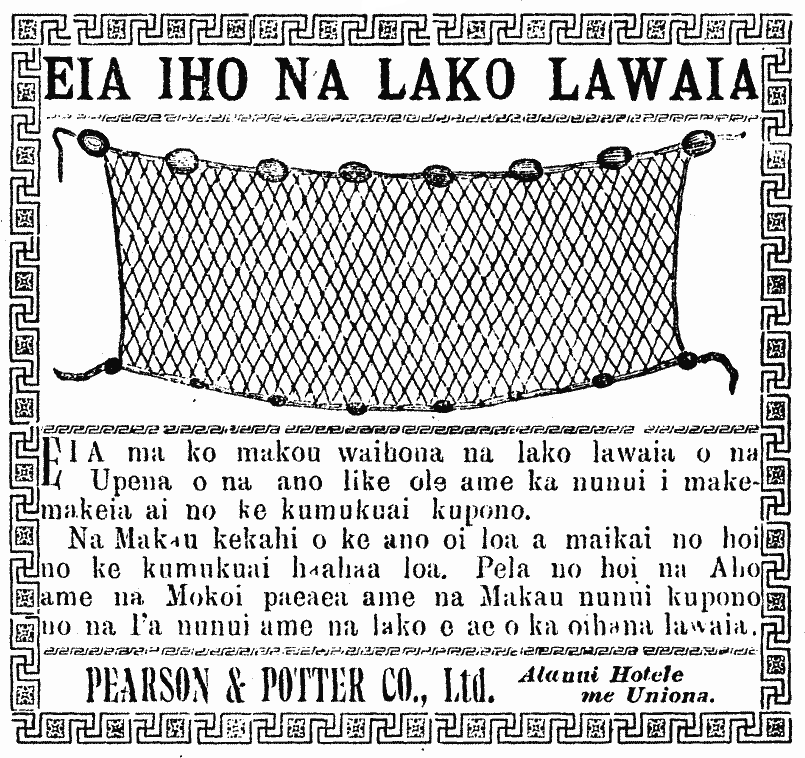
Nice advertisement for fishing nets and other equipment! 1902.

WE HAVE FISHING SUPPLIES

Here within our stock of fishing equipment are Nets [Upena] of all sorts and sizes as per your desires priced right.

We also have Hooks [Makau] which are very sharp and fine at very low prices. We also have Line [Aho] and Rods [Mokoi paeaea] and large Hooks good for large Fish as well as other fishing accessories.

PEARSON & POTTER CO., LTD.   Hotel and Union Streets.

(Kuokoa, 8/15/1902, p. 5)

EIA IHO NA LAKO LAWAIA

Ka Nupepa Kuokoa, Buke XL, Helu 33, Aoao 5. Augate 15, 1902.


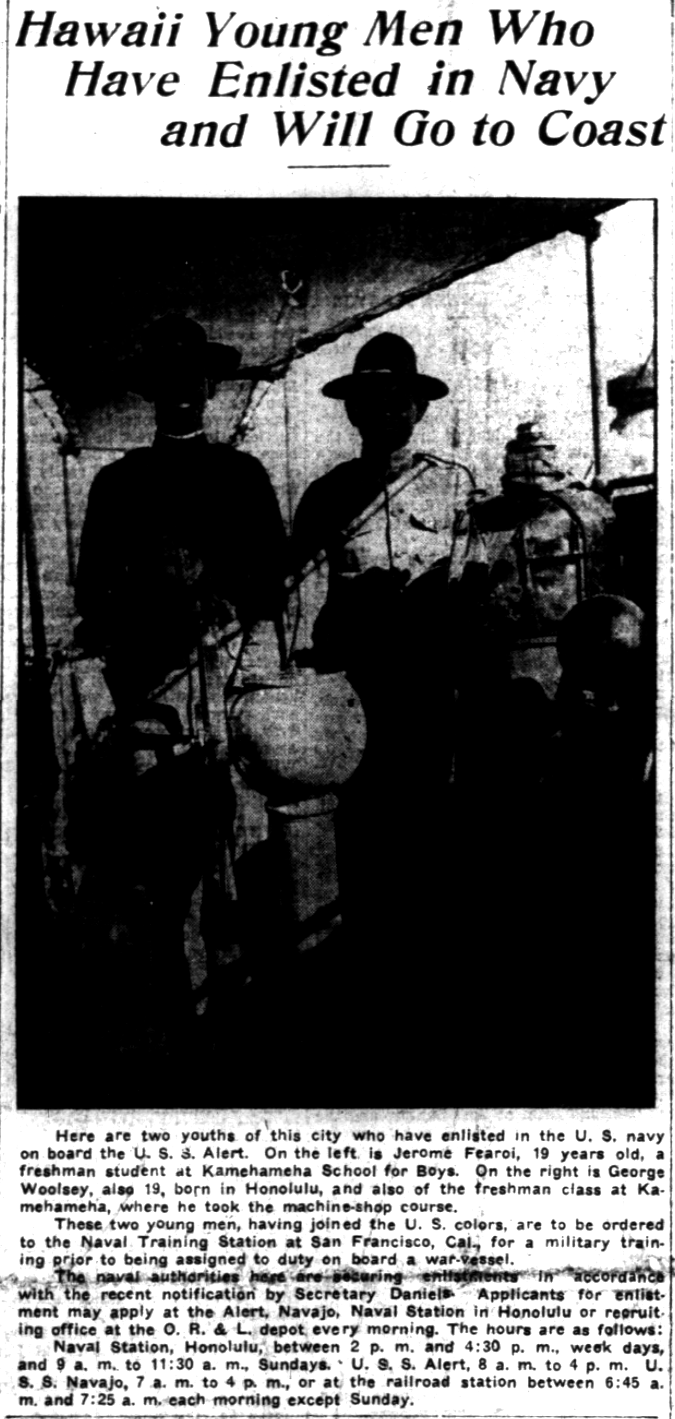
Kamehameha boys off to war, 1917.

Hawaii Young Men Who Have Enlisted in Navy and Will Go to Coast

Here are two youths of this city who have enlisted in the U. S. navy on board the U. S. S. Alert. On the left is Jerome Fearoi, 19 years old, a freshman student at Kamehameha School for Boys. On the right is George Woolsey, also 19, born in Honolulu, and also of the freshman class at Kamehameha, where he took the machine-shop course.

These two young men, having joined the U. S. colors, are to be ordered to the Naval Training Station at San Francisco, Cal., for a military training prior to being assigned to duty on board a war vessel.

The naval authorities here are securing enlistments in accordance with the recent notification by Secretary Daniels. Applicants for enlistment may apply at the Alert, Navajo, Naval Station in Honolulu or recruiting office at the O. R. & L. depot every morning. The hours are as follows:

Naval Station, Honolulu, between 2 p. m. and 4:30 p. m., week days, and 9 a. m. to 11:30 a. m., Sundays. U. S. S. Alert, 8 a. m. to 4 p. m. U. S. S. Navajo, 7 a. m. to 4 p. m., or at the railroad station between 6:45 a. m. and 7:25 a. m. each morning except Sunday.

(Honolulu Star-Bulletin, 4/17/1917, p. 9)

Hawaii Young Men Who Have Enlisted in Navy and Will Go to Coast

Honolulu Star-Bulletin, Volume XXIV, Number 7803, p. 9. April 17, 1917.


The beginnings of Punahou School, 1841.

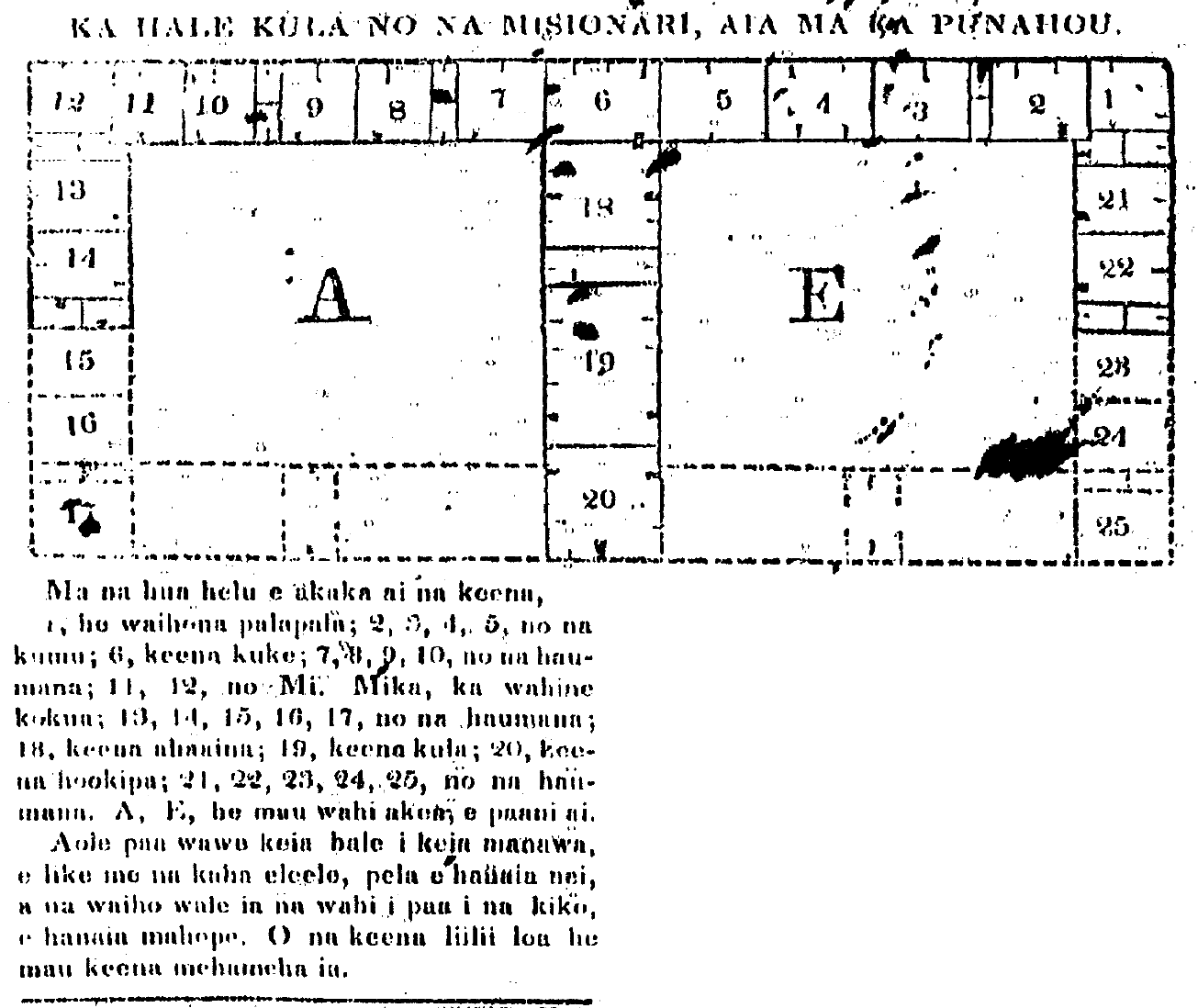
SCHOOLHOUSE FOR THE MISSIONARIES, AT KA PUNAHOU.

The rooms are explained by the numbers,

1, a library; 2, 3, 4, 5, for the teachers; 6, kitchen; 7, 8, 9, 10, for the students; 11, 12, for Mi. Mika [?] the woman helper; 13, 14, 15, 16, 17, for the students; 18, cafeteria; 19, school room; 20, room for entertaining guests; 21, 22, 23, 24, 25 for the students. A, E, wide areas to play.

This will not be completed quickly at this time; the places with solid lines are being constructed, and the areas surrounded by dashes are left to complete at a later date. The most tiny rooms are solitary rooms.

[Earlier, i posted a diagram of the layout of the Chiefs’ Children’s School. Here from about the same time is the school for missionary children at Kapunahou, the precursor to today’s Punahou School.

The school began instruction on July 11, 1842, with 5 boarders and 12 day schoolers.]

(Nonanona, 11/23/1841, p. 44)

KA HALE KULA NO NA MISIONARI, AIA MA KA PUNAHOU.

Ka Nonanona, Buke 1, Pepa 11, Aoao 44. Novemaba 23, 1841.

Kau ka pea, holo ka waa, 1980.

HOKULEʻA SAILS AGAIN

Hold on to the course! Hold on to the course! Continue On!

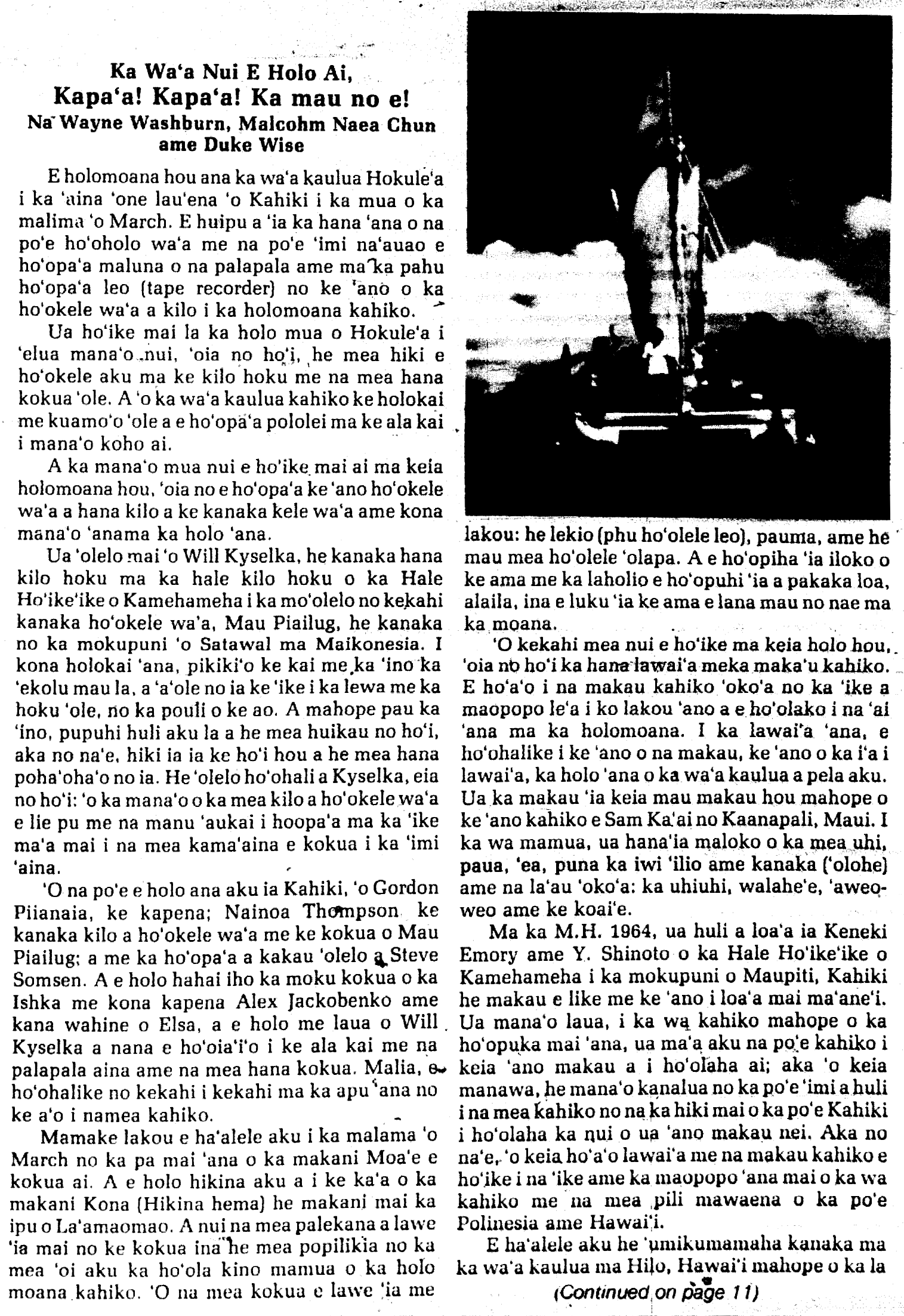
by Wayne Washburn, Malcolm Naea Chun and Duke Wise

In early March the Hokuleʻa will again set sail in hopes of reaching first landfall somewhere near Tahiti. Crewmen and scientists will concentrate efforts on documenting the thinking process, and methods, which may have been used by the ancient Polynesian navigators.

Without first voyage demonstration to the modern world two important findings. First, was that navigation by the stars without use of modern navigational instruments can be successfully used when travelling between Tahiti and Hawaii. Second, a Polynesian double-hulled canoe without keels or deep centerboards is able to sail to windward, and thus maintain planned course. For the present voyage celestial navigation will once again be of primary importance. Where the first voyage showed that celestial navigation was possible, the presēnt will pay particular attention to the recording of the thought process of the navigator.

Dr. Will Kyselka of the Bishop Museum Planetarium, and an assistant to the project, cited an incident involving a highly skilled non-instrument navigator from Satawal, Mau Piailug. Once caught in a storm for three days, Mau was unable to sail or use celestial markers for assistance. After the storm, though his course direction had been turned around many times, Mau miraculously found his way home to his tiny atoll of Satawal. Dr. Kyselka suggested that maybe there are maps within some of the more skilled navigators’ minds. He mentioned that pigeons are said to find their bearings in flight by being able to sense the difference magnetic fields given off by certain structures. Using the changes in magnetic fields the pigeons are able to draw a mental map and find their way home. Did the Polynesians possess this ability or something which would enable them to find Tahiti and Hawaii with regularity?

Captaining the voyage down will be Gordon Piianaia. Navigating for the trip will be Nainoa Thompson. There to assist Thompson will be Mau Piailug, the navigator from the 1976 voyage. Crew member Steve Somsen will be documenting the navigation process. This will be done by conferring with Nainoa and Mau and then orally recording it through the use of a tape recorder. Hopefully this will shed more light on the Polynesians’ navigational thought process.

The Ishka, a sailing vessel captained by Alex Jackobenko with assistance from his wife Elsa will follow some distance behind Hokuleʻa. Dr. Kyselka will be on board to study and document the route of the Hokuleʻa using modern navigational instruments and charts. On completion of the voyage the two styles of navigation will be compared for scientific value.

March has been designed for departure because it is the season that tends to favor the northeast tradewinds which are important for the first half of the voyage. Like the 1976 voyage the canoe will travel southeasterly for about 1000 miles. Once “easting” is accomplished winds blowing from the southeast will be used to rēach first landfall or Tahiti from a windward approach. This “easting” is important in that not enough movement in that direction might cause them to sail west of Tahiti and miss the islands completely. Certain safety features have been added to the canoe in order to avoid swamping problems encountered in previous inter-island trips. The gunwales and hatches have been raised to help prevent water seepage into the hulls. Also on board will be six hand pumps, a radio and flares. The radio will be used to notify the Hokuleʻa’s escort boat in case of an emergency. Certain sections of the hulls will contain inflated rubber. In the event that the hulls are accidentally smashed these will enable the canoe to remain afloat. Although non-instrumental navigation is the paramount research project of this voyage, other projects are being encouraged on a smaller scale. One of these is to fish using traditional types of fishhooks to learn how they were used. This hopefully will also provide a supplement to the crew’s diet by adding fresh fish. While conducting the fishing experiments crew members will record how the differences of fishhooks: design, material and size; the speed of the canoe; the types of fish caught and other factors affect fishing in the deep sea. These fishhooks are being faithfully copied from authentic fishhooks under the supervision of Sam Ka’ai of Kaanapali, Maui. Ancient fishhooks were made from materials such as shell, coral, turtle shell, dog and human bones and even hard woods.

In 1964, Drs. Kenneth Emory and Y. Sinoto of the Bernice Pauahi Bishop Museum, found a Tahitian one-piece fishhook at Maupiti in the Society Islands. They proposed a theory that this type of fishhook is the same as found in various sites in Hawaii. After its initial introduction they believe it became a major type used by the ancient Hawaiians, Today, other anthropologists are not as certain if Tahitian migrations caused the popularity of this fishhook, but nonetheless, the experiments conducted by crew members of the Hokuleʻa should provide some information that may help the on going research in finding common links between the ancient Hawaiian society and the Southern Polynesians.

With a crew of fourteen, the Hokuleʻa is scheduled to depart from Hilo on…

(Ke Alahou, 2-3/1980, p. 1)

Ka Waʻa Nui E Holo Ai...

Ke Alahou, Helu 4, Aoao 1. February/March 1980.

…the first favorable day after March 2.

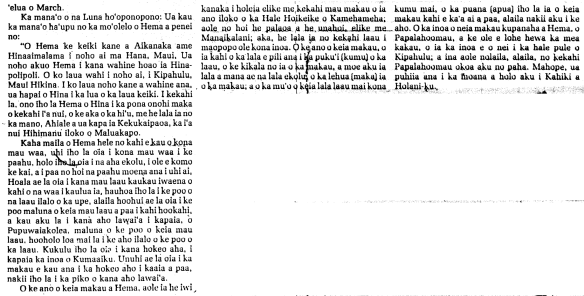
Editor’s comment: The projects conducted by the crew of the Hokuleʻa remind us of the legend of Hema, a pan-Polynesian legend about a great super chief.

Hema was the son of Aikanaka and his wife Hinaaimalama of Hana, Maui. Hema’s wife was called Hina-polipoli and they lived at Kipahulu, East Maui. When she was pregnant with their second child, Hina craved for the eyeball of a large fish of the open, deep sea. This fish had a tail like that of the shark, Ahiale and was called Kekukaipaoa.

Hema prepared all his fishing gear and made ready the double-hulled canoe by loading enough food and water for several days. He covered his canoes with many mats, lashing them down with cords so that sea water could not seep in. When the canoe was covered securely, he hung his fishing line, Pupuwaiakolea, above the top of the poles that were between the hulls of the canoes. He put the end of the line through a knot he had tied and then he set up his cord calabash, which was called Kumaaiku. He took out the fishhook and tied the end of the fish line tightly around it fastening it to the pole.

Hema’s fishhook was not made of human bone like some of those found in the Bishop Museum, nor was it made of whale bone or turtle shell like Manaiakalani. It was made of a branch of wood whose name is not known today. The kikala or the intersection of the barbs, is found at the branch closest to the trunk of the tree. When this branch is laid flat, three other branches project from it. These branches are broken so they are short and sharp. This joint is called lehua, perhaps after the flower. The shank knob of the fishhook is called muʻo and this is where the fish line is tied. The name of Hema’s fishhook is Papalahoʻomau and still survives today as the name of the Congregational Church in Kipahulu.

It was later on in the story that Hema was blown off course and his voyage to Kahiki or Holani-ku began.

(Alahou, 2-3/1980, p. 11)
ʻelua o March.

Ke Alahou, Helu 4, Aoao 11. February/March 1980.

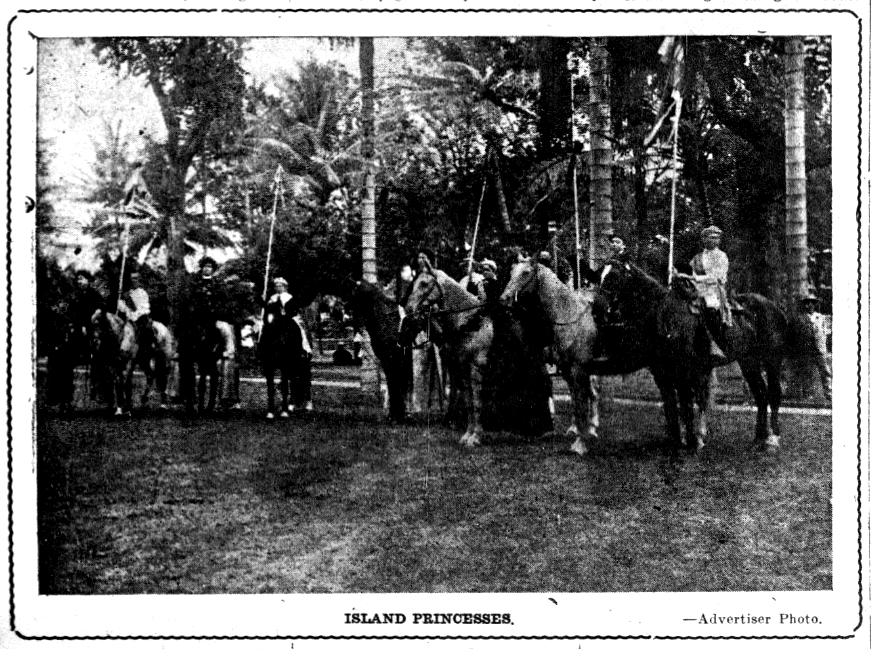
Island Princesses, 1908.

ISLAND PRINCESSES.

ISLAND PRINCESSES.

Pacific Commercial Advertiser, Volume VI, Number 269, Page 2. February 23, 1908.

THE PA-U RIDERS.

Thirty-four pa-u riders came cantering along in four sections of color: yellow, red, orange and pink, led by Judge Andrade and Mrs. Puahi. The Kaonohiokala Club sent fifteen horse women and the Wakinekona Club eighteen equestiennes. A brave sight they made with their long pa-us fluttering in the breeze and their garlands showing bright in the sunshine.

Several of the older riders were in the parade, ladies who wore the pa-u in the pleasure-loving days of the monarchy. Very dignified were these elderly dames and very well they rode. The younger women were out for fun and they certainly had it, galloping wherever there was room to and urging their steeds on with merry shouts. The riders included the following from the Kaonohiokala Club: Mrs. Puahi, Mrs. Kaumaka, Mrs. Dias, Mrs. Kaluapapakini, Mrs. Kailianu, Mrs. Nakapaahu, Mrs. Irene Silva, Mrs. Kauwa, Mrs. Haalou, Miss Lucy Woodward, Mrs. M. Hoonani, Mrs. Maluae, Mrs. Anehilo Keama, Mrs. Stahle, Mrs. Johnson; and the following members of the Wakinekona Club: Mrs. Horn, Mrs. Kapio, Mrs. Liau, Mrs. Aiwohi, Mrs. Jackson, Mrs. Pumehia, Mrs. Mahi, Mrs. Isaac, Mrs. Fairman, Mrs. Kekuewa, Mrs. Kapulani, Mrs. Tuck Williams, Miss Kekua, Miss M. Hao, Mrs. Emakai, Miss Marie Hiram, Miss Julia Lui, Miss Mary Wood. Continue reading