THIS IS A PICTURE OF THE NEW HOME OF THE KUOKOA ON KING STREET.
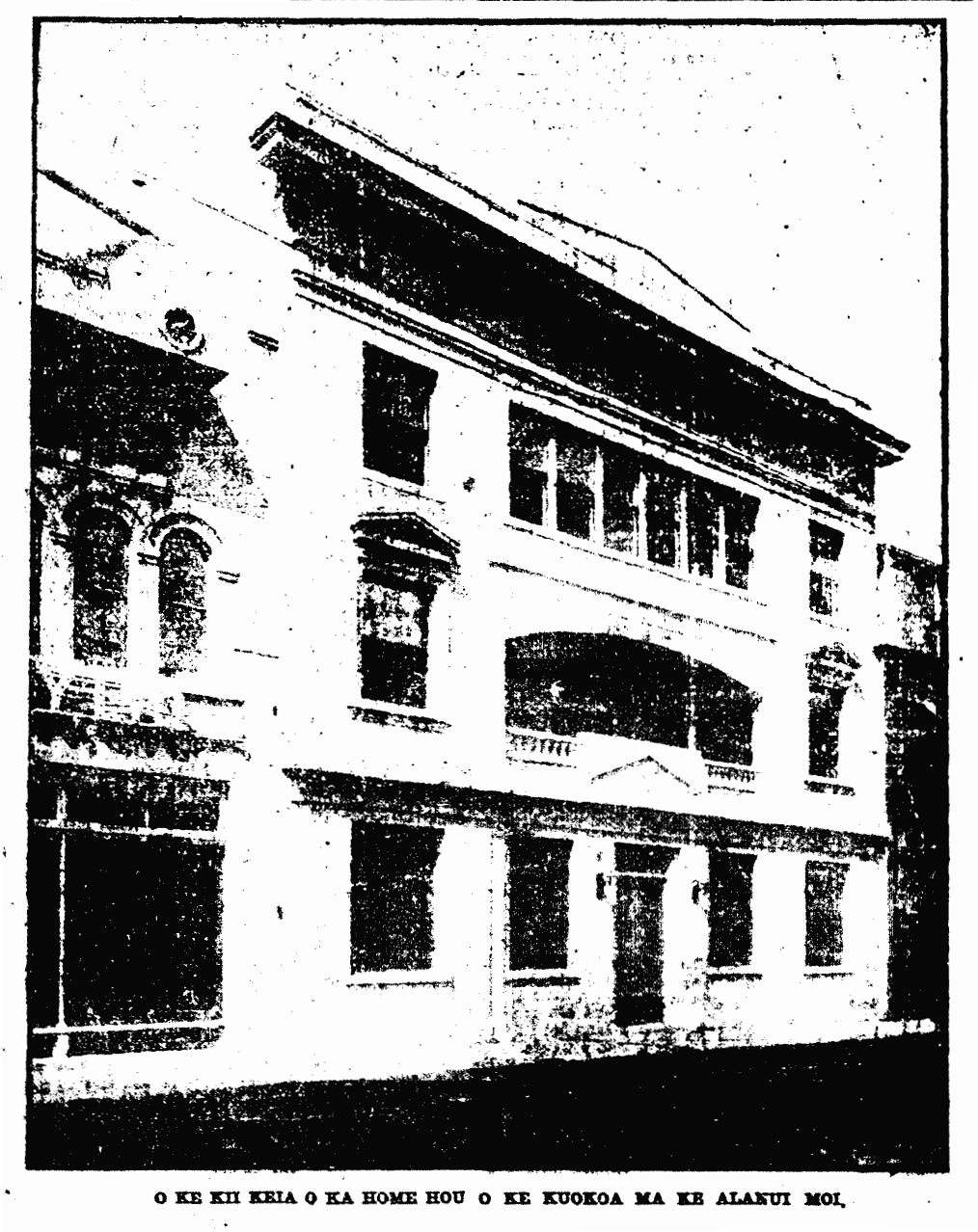
Ka Nupepa Kuokoa, Buke LI, Helu 14, Aoao 2. Aperila 11, 1913.
Ka Nupepa Kuokoa, Buke LI, Helu 14, Aoao 2. Aperila 11, 1913.
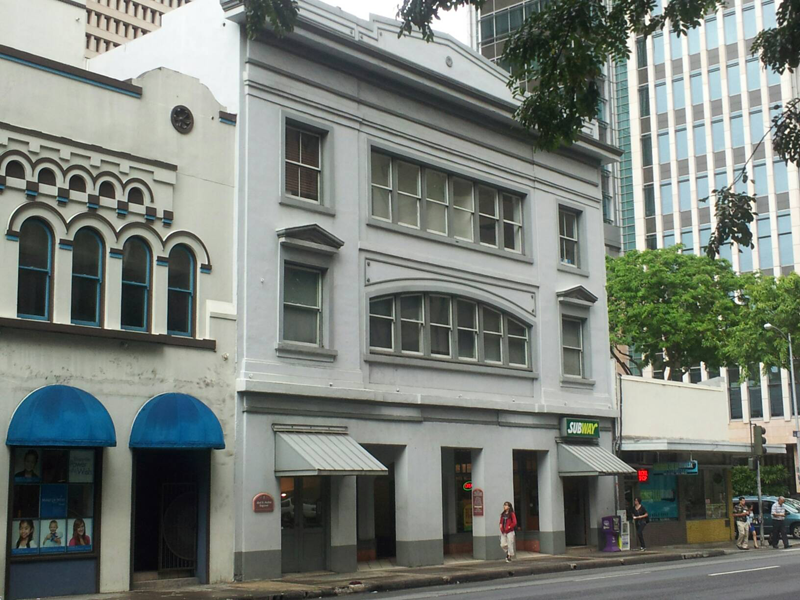
Kuokoa Building Aperila 15, 2013
…duced in London, and he has his own publishing house and an intsruments factory. The combination has been touring the world since 1906. There are nine men and six women in the company, and there is every possibility that Queenie and David Kaili, who are we know here, will join them for the Adelaide season. Tuavivi, who is a member of the company, is a noted hula dancer.
[This comes from an Adelaide, South Australia newspaper, found on the National Library of Australia webside, TROVE. It seems unclear newspaper images is not something limited to Hawaii nei. However, at least the text on that site is correctable.]
(Advertiser, 2/23/1923, p. 11)
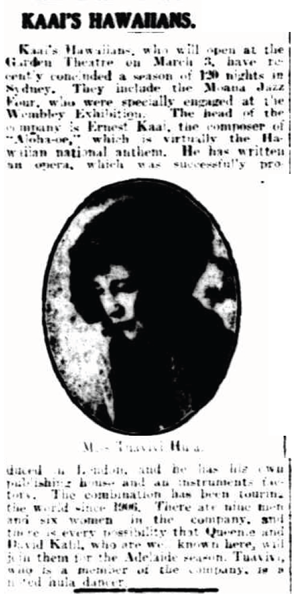
The Advertiser, Volume LXX, Number 21645, Page 11. February 23, 1928.
Last month, we posted articles about buttons produced for the funeral of Princess Kaiulani. JR kindly responded with an image of an example of one of these buttons! Here is the image sent, with the description: 3 15/16″ in diameter. Printed on the backside: “pin lock, patd. May 31, 98”
For the previous posts, click here:
Mourning of Princess Kaiulani, 1899.
and
More on Kaiulani buttons, 1899.
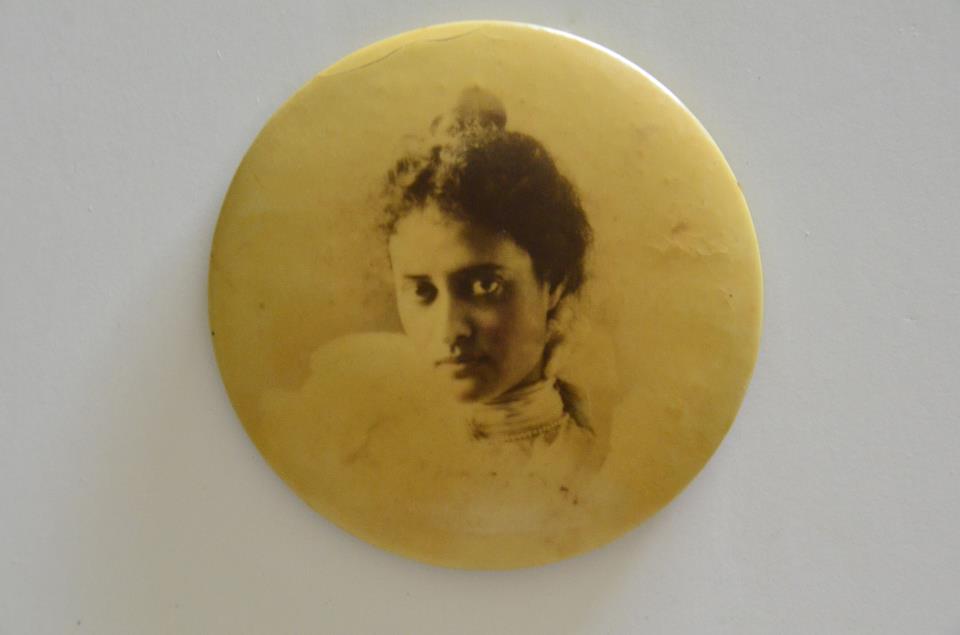
Kaiulani funerary button
This is from an issue of “The Friend,” which includes a short biography in English of the ruling monarchs of Hawaii nei, written by S. C. Damon. As for this page of illustrations, they say:
The illustrations accompanying this number of the Friend we could wish were better executed. The plate was made in New York, from the best photographs we could procure in Honolulu. The original of Kamehameha 1st was executed in 1817 by a Russian artist, who accompanied Kotzebue in his voyage, and may be seen by referring to the third volume of his voyage. The original of Kamehameha 2d was executed in England in 1824, in the style of the dress of George 4th’s reign. We think those of Kamehameha 3d, 4th and 5th are very good, but not quite so good those of Lunalilo or His Majesty Kalakaua.
[For the biographies, find them here: The Friend, February 1, 1876.
Although it is clunky to maneuver, most of this series of news letters is available from the Mission Houses Museum here: The Friend.]
(Friend, 2/1/1876, pp. 9–13)
![[Monarchs]](https://nupepa-hawaii.com/wp-content/uploads/2013/04/friend_1_2_1876_13.png)
The Friend, New Series, Volume 25, Number 2, Page unnumbered. February 1, 1876.
There are many people studying the history of Hawaii nei and the lifestyle of its people, like what has been done with America, Europe and Asia. And through this studying of history, there has not been a lack of new information which brings benefits by its study. However Judge [Lyle Alexander] Dickey has come up with a new path to this study, not utilized before in Hawaii nei. He is learning string figures, and is collecting the old names and the mele that go with these string figures. He now has about a hundred or more of them.
String figures is something done all over the world. And most people know one or two. From what is known, there is not much of them in Europe and Asia; there are a bit more in Africa; and there is a lot with the Indians of America and the people of the islands of the Pacific. There are two books on string figures of the islands of Britain, the Indians of the Arctic, the Indians, and a few from the islands to the south of us. There is nothing written on the hei of Hawaii nei, even if Hawaii’s figures are most wonderful for the mele which accompany them. Some are not difficult, however some are very problematic because of the many transformations, with different lines of mele going along with each change. Some are very humorous without value, while some are for wooing, while others are riddles. Knowing the way of life of the people, its tales, its history, and the lay of its lands—this is the means of understanding the meanings and kaona (underlying meanings) of these hei. Perhaps the most widely memorized figure is called Hale Kumukaaha. However to this day, Judge Dickey has not gained clarity as to the true meaning and kaona of this hei.
Some figures done by the school children of Hawaii are perhaps not originating in Hawaii nei. The hei called “six eyes” is probably not from here [the first image]. Not a single old Hawaiian can make this figure. Maybe it is a new figure or maybe one from outside of Hawaii.
Some of the hei are associated with daily life, like the canoe, the net, the hammock, the imu, and the water gourd. Some are associated with animals and fish, like the turtle, the mo’o, the manini, the aweoweo, the hapuu, and the bird. Some hei are associated with the house like the kumukaaha structure, the loulu structure, and the paakai structure. There are a very little hei pertaining to body parts, like the piko of Kahoalii and the breasts of Ne. There are many dealing with land and famous fishing shrines as well as men with god-like bodies. Kauiki, for probably a good reason is the most widely known figure. One hei is for Wailua and it is seen in the attached illustration.
There is one famous hei, but it is only known by the oldsters of Hawaii nei, of which is accompanied by the chant starting with: “O Kuhaupio ka la, ka la i ke kula o Ahuena.”
A majority of the people who have the song or chant memorized along with the figures, have died without teaching them to their children. There are so many other things that entertain the new generation, but this entertainment of times long ago is something that the Hawaiian people are proud of. This skill shows intelligence in making the figures and associating it to this thing or that, and it is important that this ancient knowledge be kept. It would be good if someone reading this knows of some old Hawaiian who has a chant or mele memorized close at hand, one who is fond of mele and versed in string figures, or one who knows string figures, that he should Judge Dickey in Lihue, Kauai and tell him of what this person knows. There are many different hei of which the judge has heard, however, he has not found someone now living who can show them to him. There is one that is associated with the net of Makalii that J. S. Emerson saw in Hawaii many years ago; there are also some associated with the story of Pele and Kamapuaa, the paddle o Maui, “haehae ka manu e Kanealoha,” and so forth. These are great and very valuable, and it is important that they be preserved without regard to its simplicity or difficulty. And it is perhaps something that will bring joy when witnessing it being done, or perhaps something exceedingly appalling to consider.
(Kuokoa, 6/9/1916, p. 3)
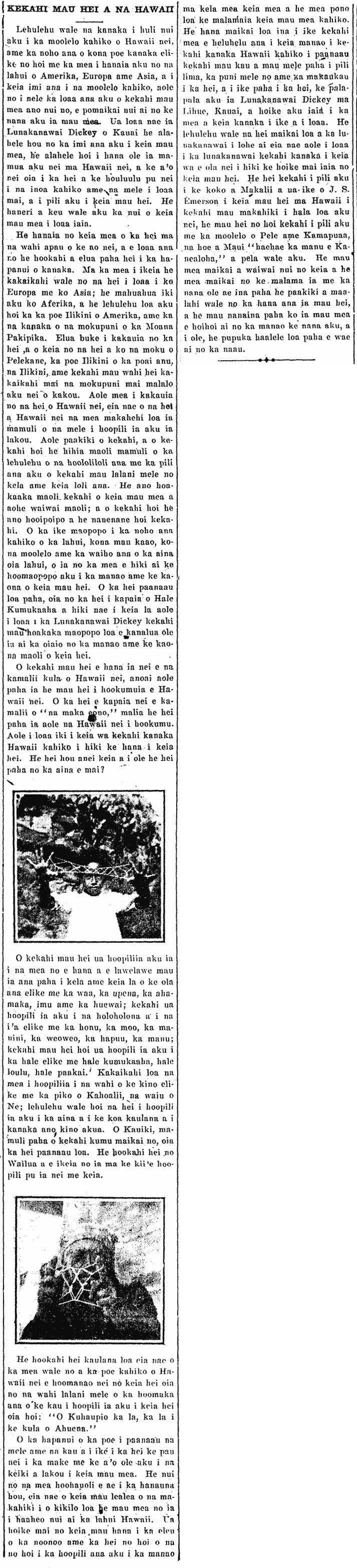
Ka Nupepa Kuokoa, Buke LIV, Helu 23, Aoao 3. Iune 9, 1913.
Mr. Solomon Hanohano, Editor of the Kuokoa, Aloha oe:—May your patient heart welcome these tears of love for my dearly beloved brother who has left his wife and their beloved lei, a daughter, as well as his brothers and sisters in great sadness for him.
The supportive bond within has been severed, we are heavyhearted to inform the many friends and companions of my beloved brother who passed, from the Kumukahi where the sun rises to the setting of the sun at the pleasant base of Lehua.
Aloha, much aloha for my brother who has gone afar; no more shall we see your face, you are gone forever.
My shock was immense at hearing the sad news, told to me, his sister, that my beloved brother had passed.
We did not witness his last breath; he carried alone his illness, and it is his death that revealed this to us, and we were beset with sadness and regret, we who were of the same womb [pupuu hookahi], as well as his companion, his wife, and the neck lei of my brother’s that he was to wear until grown [his daughter], we grieve for him in this world of much suffering.
He was born of the loins of Mr. and Mrs. Luka Nakapaahu, our parents, on June 22, 1884, at Waimea, Kauai; and died at Hilo Hospital on the 28th of February.
He was employed by the inter-island ferry as a sailor, with the thought that then he’d be able to see the famous land of Hilo, but here the life breathe of my beloved brother was taken away and he was returning as a corpse to his birth land of our ancestors and parents who went before him to the other side.
Aloha, aloha for the body of my beloved brother who has gone afar, travelling alone on your billows, O Alenuihaha, and arriving at the land of the Kukalahale rains [Oahu], being kept at Mr. Williams’ place; and then once again carried by the Kinau by which I brought the body of my beloved brother atop the shifting billows of Kaieie; no more will you moisten his young face with your sea spray for all times.
My brother and I arrived at Nawiliwili on the 12th of March, and we remained patiently aboard the Kinau until the most of the passengers disembarked, leaving just me and my brother, and when the freight was done with for that place where our kupuna lived, [?? pau na mili ana ia holo aku o kauanoe o Koloa, kahi i wahi,] for it was perhaps not known that I had an important delivery, and with tears, the ship went on to and stopped at Makaweli, and when the freight there was taken care of, i thought of seeing my elder siblings and our younger siblings waiting for me bringing back our beloved brother; the Kinau entered Waimea at 5 in the evening, and made way for the sands of Luhi; how sad, Kaimi Nakapaahu will no longer tread on your soft sands, O Waiula and Waikea; he will no more swim in those wondrous waters of the land.
We were let off; waiting patiently for us were his wife and child, along with our older siblings and our younger ones.
We reached the house, he was laid out, and we saw his face and were struck with much aloha and regret; on the following 13th, his funeral was carried out by Mr. H. M. Nawai, and we took his body and put it to rest by the side of our beloved father; and the words of the Great Book came to pass: man’s life is vapor that appears and vanishes.
We give our thanks to the inter-island ferry [moku holo piliaina] for agreeing to return the body of my beloved brother who has gone afar, to his land of birth to lie with our father.
Aloha, aloha my brother who has travelled alone on your two seas, O Hawaii.
We give thanks to everyone who came and stayed up with our beloved one the whole night, as well as those at the grave of our beloved who acted with loving hearts.
I will conclude here; it is God who bring solace to our never ending aloha, as well as for his wife who is left without, and their child who is without a father.
Me, with grief, his beloved sister,
KANIO NAKAPAAHU.
[Another example of how Hawaiian-Language Newspapers provide information not found anywhere else—From what i can tell, the only information about Kaimi Nakapaahu is based off of “The Cole-Jensen Collection : Oral genealogies and genealogical information collected from the Polynesian peoples and from the Pacific Islands.” in Utah. Here however in the announcement by his sister, we have a personal account, with much more added information, not to mention a picture!
I am certain that the picture in the original newspaper is much clearer, and this is yet another reason to have the Hawaiian-Language Newspapers scanned clearly!]
(Kuokoa, 4/2/1920, p. 3)

Ka Nupepa Kuokoa, Buke LVIII, Helu 13, Aoao 3. Aperila 2, 1920.
[Just one more reason why the Hawaiian-Language Newspapers need to be rescanned clearly!]
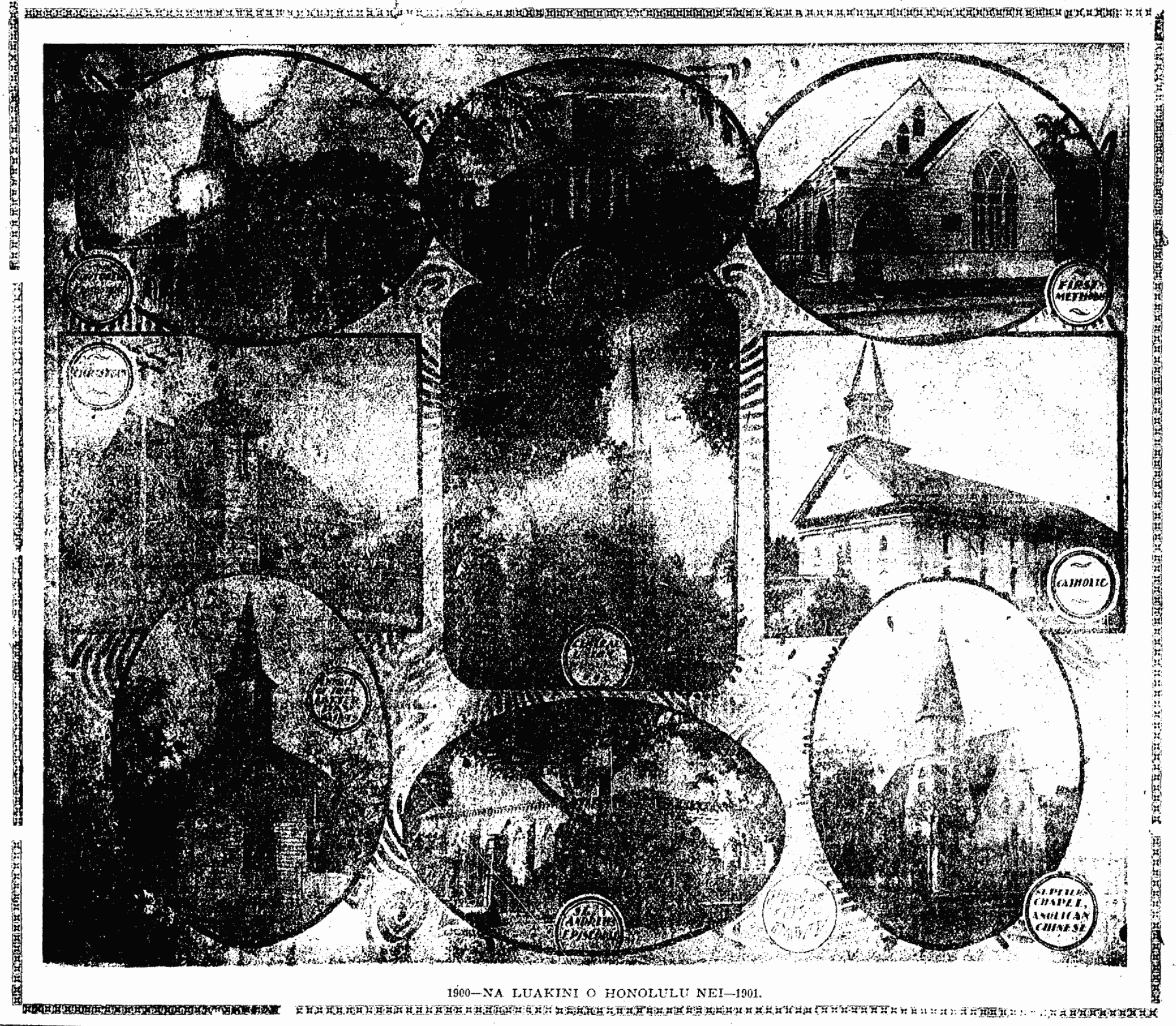
Ka Nupepa Kuokoa, Buke XXXIX, Helu 1, Aoao 1. Ianuari 4, 1901.
KEKELA O KA LANI
BORN IN 1824 AT MOKULEIA OAHU
EDUCATED BY JAMES HUNNEWELL AT LAHAINALUNA
FIRST HAWAIIAN CHRISTIAN MINISTER
ORDAINED AT KAHUKU DECEMBER 21 1849
IN 1853 HE WENT AS A PIONEER MISSIONARY TO THE MARQUESAS ISLANDS WHERE FOR 49 YEARS HE EXERCISED A REMARKABLE INFLUENCE AGAINST CANNIBALISM AND TRIBAL WARFARE
A TRUE SPIRITUAL GUIDE
IN 1864 HE WAS SIGNALLY REWARDED BY
ABRAHAM LINCOLN
FOR RESCUING AN AMERICAN SEAMAN FROM CANNIBALS
DIED IN HONOLULU NOVEMBER 1904
“O KE ALOHA, OIA KA MOLE O NA MEA PONO A ME NA MEA OIAIO A PAU”
LOVE IS THE ROOT OF ALL THAT IS GOOD AND TRUE
KEKELA
[Kekela is buried in the cemetery of Kawaiahao Church in front of his daughter Maria. His wife Naomi however is buried at the Waianae Church.]
(Kawaiahao Church)
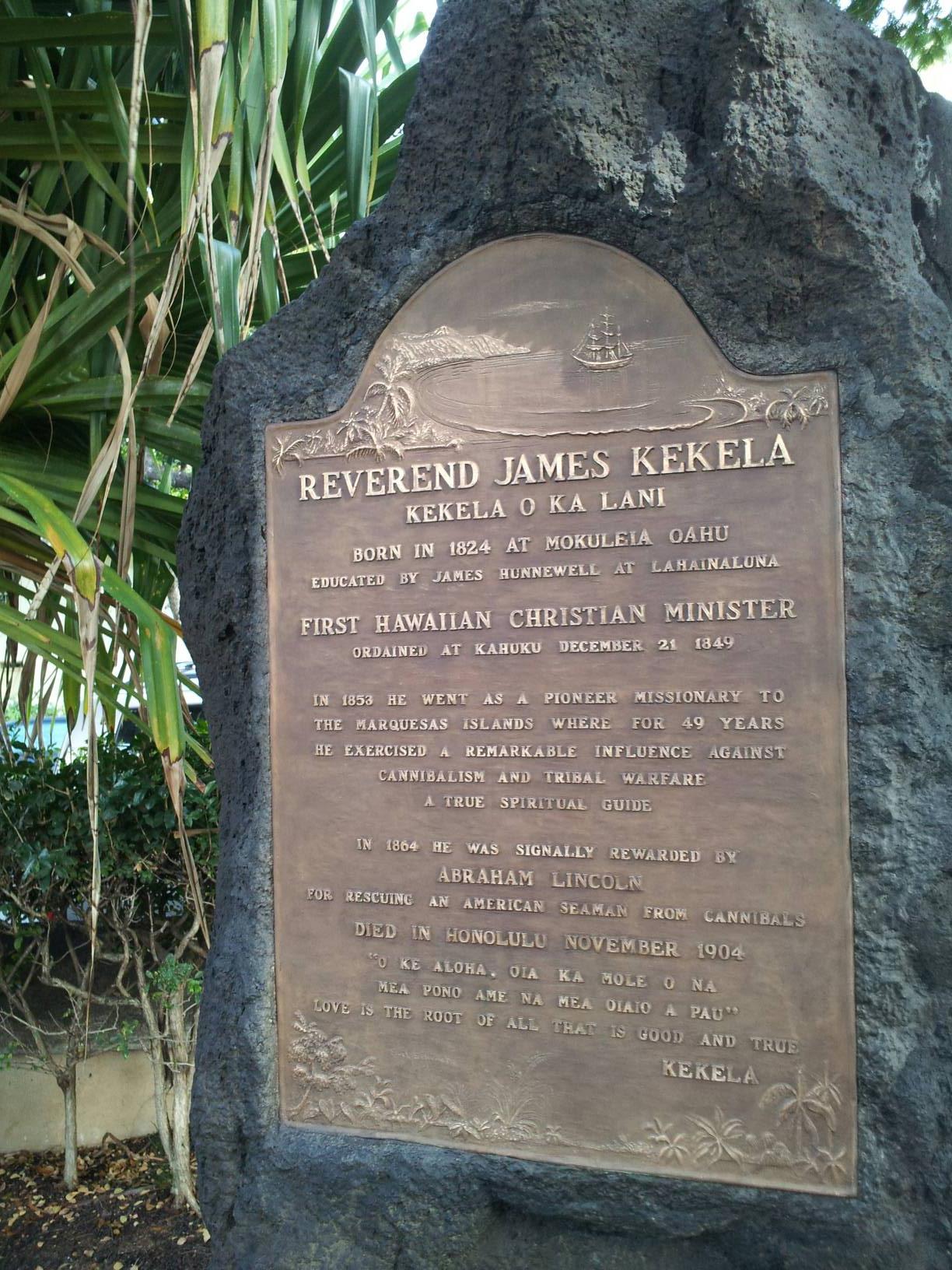
Rev. James Kekela Plaque, Kawaiahao Church
On the 22nd of May, 1821, at Mokuleia, Waialua Oahu, born of Awilinui and Kauwanui, his wife, was a big well filled-out baby with the blessings of the Heavens, and child was called by the name Kekelaokalani. This was the thirteenth of their children. Twelve were born prior, and with the [unclear phrase] of that fine offspring.
It was here that that child was raised until he was capable of understanding things for himself.
In the year 1832, Emerson, Sr. [Emekona Makua] arrived in Waialua, and in the following 1833 [unclear] he built a schoolhouse with his wife for the young men and women to enlighten them with knowledge. From among the first women to be taught there at that school was Kahaweli, the younger sister of the mother of that child. And following her, his mother as well attended the school until she was educated; and she began teaching the children the alphabet [Pi-a-pa], the beginnings of knowledge. It was this mother who guided him at that time in the knowledge about God and Sunday School, and it was thus that the sacred work of God was instilled a top the fontanel of the head [piko o ke poo] of this child, which is silver now, as in the picture above.
When that child was thirteen years old, being that he had received the beginnings of the light of true knowledge, he began to travel the width of the plain of Mokuleia for Waialua, with patience and without exhaustion, to receive the good teachings of the elder Emersons. In this year, those fine elders got great help in the form of Mr. Rose (Loke), a haole teacher. After one year of attending this school, Emerson went to Lahaina, and from there he told Kekelaokalani to come to Lahainaluna.
In August 1838, he entered Lahainaluna, and there he patiently remained for five years and he graduated in the year 1843. During those years at Lahainaluna, he learned everything about the true knowledge, as well as actual knowledge; and he remained, following the rules of the school, and as a result of his following the rules, he gained the full trust and total faith of the teachers.
After his days of learning were over, and he received his Diploma [Palapala Hoomaikai], Emerson, Sr. encouraged him to join the school for the clergy [Kula Kahunapule] that was started that very year. There were six students at the time, and Emerson wanted greatly for him to join. And because of the guidance of the righteous Spirit, he agreed, and so began his actual performing of the work of God. He spent four years at this work, and graduated with a Diploma from the teachers, in the year 1847.
When he received his Diploma, he married Miss Naomi, one of the educated young women of the time, and was living under the instruction of the teachers of the Girls’ School of Wailuku, Maui. After they were wed, he was sent to teach the Word of the Lord in the District of Kahuku, Oahu, and there he began his work with patience, with the word of life.
And he thus patiently continued as but a preacher; and when his readiness and progress was seen, he was ordained at his own parish.
From then until 1852, he strove to convert the Koolau Cliffs, and the fruits of his patience were many. When the head Missionaries saw his progress of his work, he was sent by the first Evangelical Convention held here on Oahu in the year 1852 as a Representative to travel to the places suitable to build parishes of the Lord in the Micronesian Islands.
He went to the islands of the South Pacific four times:
1. 1852—Went and returned that same year.
2. 1853—Went and returned in 1858.
3. 1859—Went again and returned in 1879.
4. 1880—Returned to his parish until this past year 1899, and came back, in feeble health.
Here is the entire story of his first excursion, copied from his journal:
[A long account follows. Perhaps i will post it here one of these days…]
¹Kekela was based in the Marquesas Islands, and not the Micronesian Islands.
(Kuokoa, 1/18/1901, p. 5)
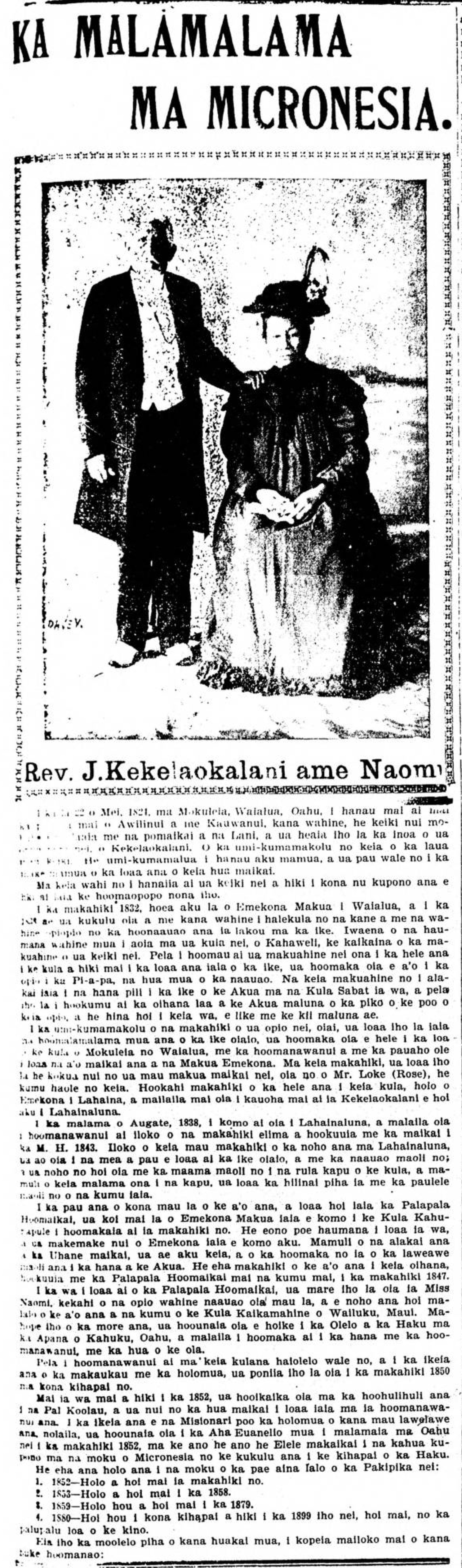
Ka Nupepa Kuokoa, Buke XXXIX, Helu 3, Aoao 5. Ianuari 18, 1901.
 nupepa