This is an independent blog. Please note that I am nowhere near fluent, and that these are not translations, but merely works in progress. Please do comment if you come across misreads or anything else you think is important.
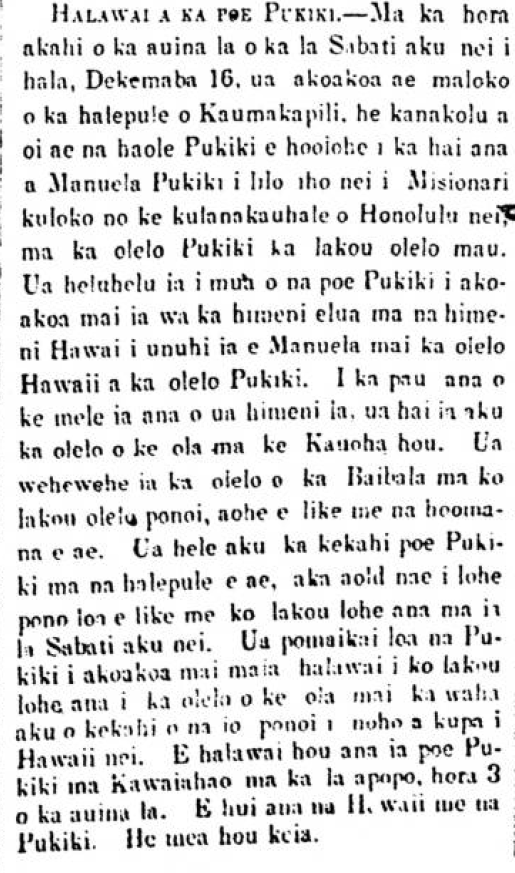
Meeting of the Portuguese.–At one in the afternoon of this past Sunday, December 16, thirty or more haole Pukiki gathered in Kaumakapili Church to hear the talk of Manuela Pukiki who just became a local missionary for the town of Honolulu. They generally speak in Portuguese. Read before the Portuguese gathered at that time were two hymns translated by Manuela from Hawaiian to Portuguese. When the hymns were done being sung, the word of life was told from the New Testament. The words of the Bible were explained to them in their own language, not like the other religions. Some of the Portuguese have gone to other churches, but they did not listen carefully like the did this past Sunday. The Portuguese who got together at that gathering were blessed to have heard the words of life from the mouth of one of their own flesh who have lived until familiar with Hawaii nei. The Portuguese will meet again at Kawaiahao tomorrow at 3 in the afternoon. The Hawaiians and the Portuguese are meeting together. This is something new.
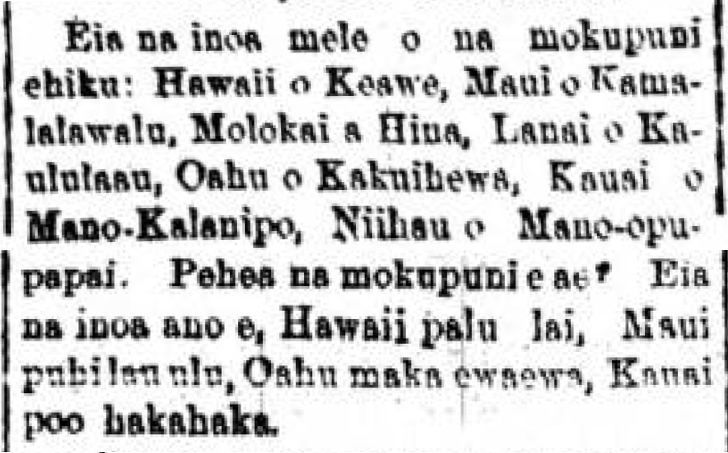
These are the mele names for the seven islands: Hawaii o Keawe, Maui o Kamalalawalu, Molokai a Hina, Lanai o Kaululaau, Oahu o Kakuihewa [Oahu o Kakuhihewa], Kauai o Manokalanipo, Niihau o Manoopupaipai. How about the other islands? Here are some unusual names: Hawaii palu lai [ti-leaf licking Hawaii], Maui puhi lau ulu [breadfruit leaf burning Maui], Oahu maka ewaewa [Oahu of indifferent eyes], Kauai poo hakahaka [empty headed Kauai].
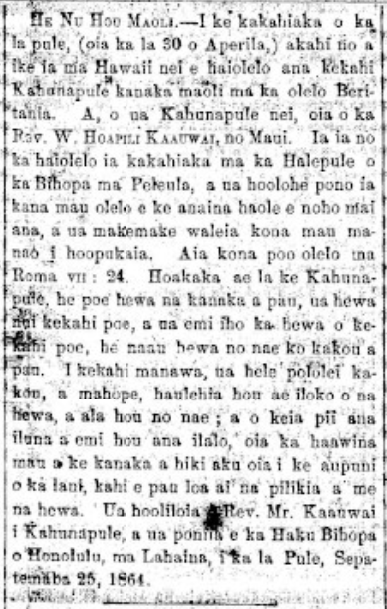
Real News–On Sunday morning (that being the 30th of April), there was seen here in Hawaii nei for the first time, a Hawaiian reverend preaching in English. And that reverend is Rev. W. Hoapili Kaauwai, from Maui. While he was preaching on that morning at the Anglican Church at Peleula, the haole congregation there was listening carefully, and the ideas he expressed were greatly appreciated. His topic was from Romans VII:24. The reverend clarified that all people are sinners; some are very sinful while other are less; but we all have sinful hearts. Sometimes we go straight, and thereafter we fall into sin, yet we rise up again; and this getting up and falling back down is something all people do until they reach the nation of heaven, where all troubles and sins are no more. Rev. Mr. Kaauwai became a reverend, and he was ordained by the Lord Bishop of Honolulu [Thomas Nettleship Staley], at Lahaina, on Sunday, September 25, 1864.
[This William Hoapili Kaauwai wrote a lengthy autobiography of his travels around the world. “Ka Moolelo no ka Makaikai ana a Puni ka Honua, i Kakauia e William Hoapili Kaauwai.” It appears in the Kuokoa from 8/29/1868 and abruptly stops on 1/9/1869. On 1/30/1869, in the article, “He mau olelo hoakaka,” explained is that Kaauwai returned to Wailuku with promises to continue writing from there.]
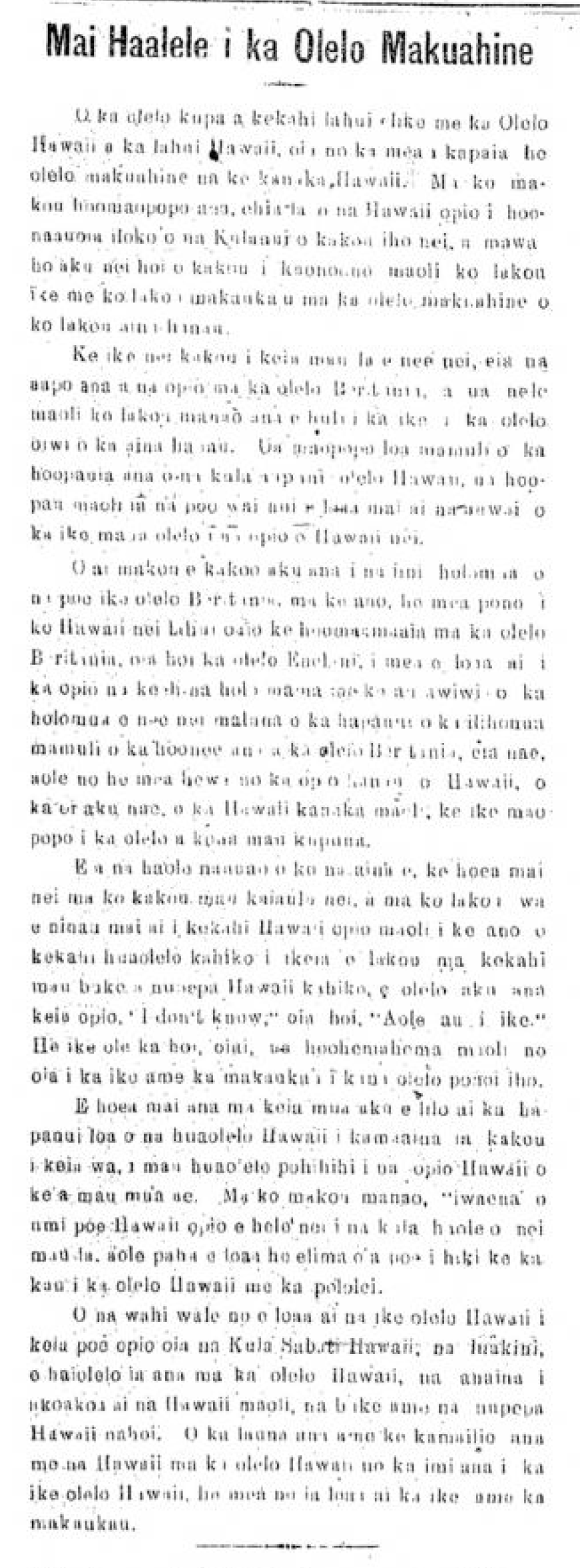
The native language of a people like the Hawaiian language to the Hawaiian people is called a mother tongue of the Hawaiians. In our understanding, how many Hawaiian youths could there be who are educated in our colleges or apart from us, and who are rich in their knowledge and preparedness in the mother tongue of their homeland.
We see in these days going by, the youth are acquiring English, and they have no intention of pursuing the native language of their land of birth. It is clear that because the Hawaiian language government schools were discontinued, the large sources of water [poowai] that fed the canals [auwai] of knowledge of that language to the youth of Hawaii were cut off.
While we support the desire to progress in speakers of English, being that it is beneficial for Hawaii’s people to become accustomed to the British language, that being English, so that the youth have a running start with the swift current of progress sweeping over the majority of the surface of the earth because of the push of English, and yet it would not be a bad thing for the young ones born here or even more so for Hawaiians to understand the language of their kupuna.
There are educated haole from other lands appearing in our neighborhoods and when they ask some native Hawaiian children about some old word they see in old Hawaiian books or old Hawaiian newspapers, they respond, “I donʻt know,” that being ”Aole au i ike.” They do not know for they are deficient in their knowledge and proficiency in their very own language.
There will come a a time when a majority of the Hawaiian words we are familiar with today will become words that are unclear to the Hawaiian youth of the future. We believe that among ten Hawaiian children attending a haole school today, there are probably not five of them that can write Hawaiian correctly.
The only places where these young ones can obtain Hawaiian language is at Hawaiian Sunday Schools, churches where Hawaiian is spoken, assemblies where Hawaiians gather, and Hawaiian books and newspapers. Associating with and talking with Hawaiians in Hawaiian in order to learn Hawaiian is the way to gain knowledge and proficiency.
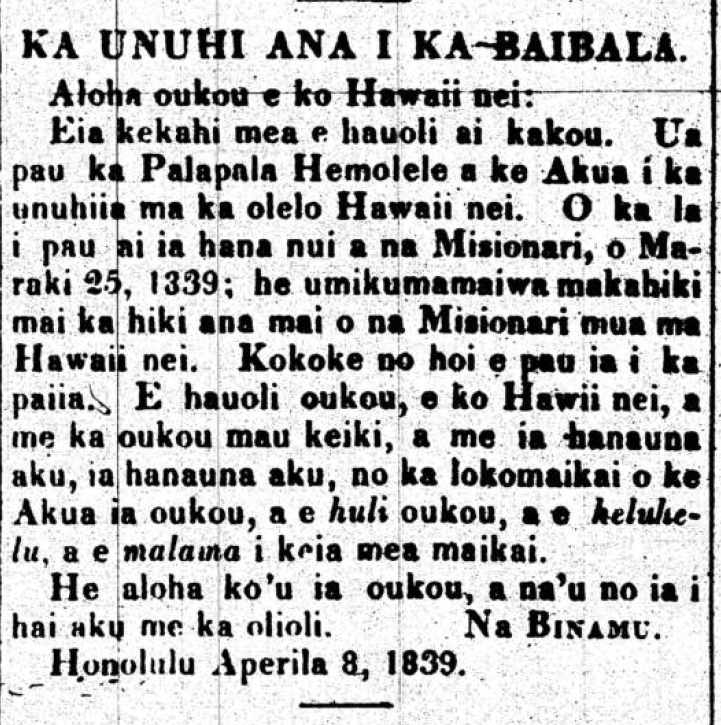
This is something for us to be happy about. The translation of the Holy Book of God into Hawaiian is complete. The day this great work of the Missionaries was completed was March 25, 1839; nineteen years since the first Missionaries arrived here in Hawaii. The printing is almost done. Rejoice, O Hawaii nei, and your children, and the generations to come, for the kindness of God to you. Seek it out, and read it, and take care of this fine thing.
I have aloha for you all, and I tell you this with joy.
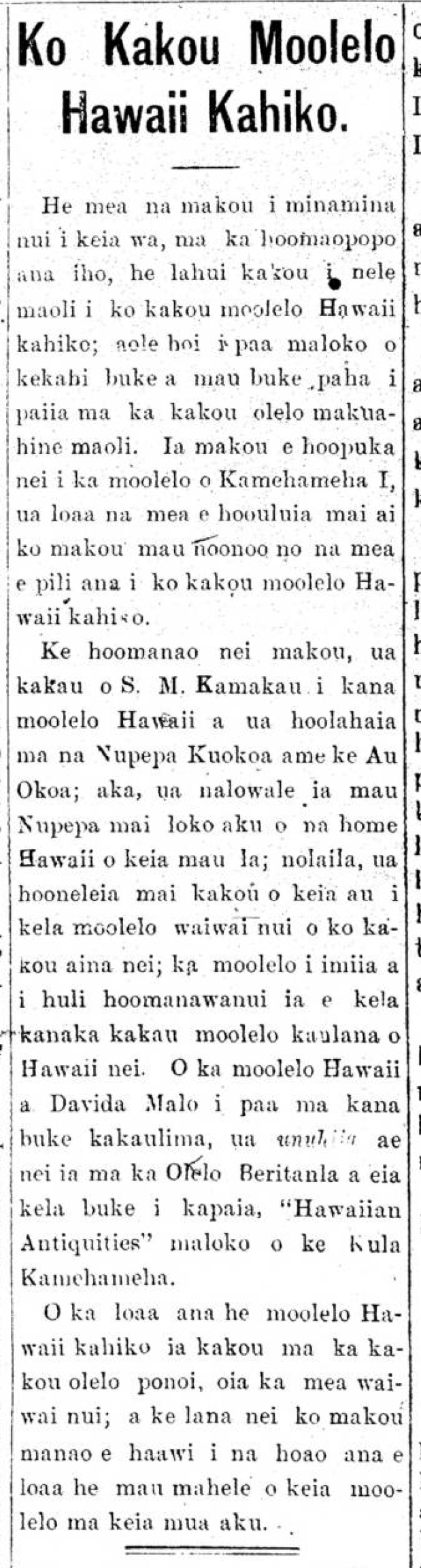
It is something we are regretful about at this time, as we realize, we are a lahui that truly is lacking in our Hawaiian history. It is not published in a book printed in our mother tongue. As we publish the history of Kamehameha I, we have found things that increasingly make us think about matters dealing with our Hawaiian history.
We remember that S. M. Kamakau wrote his Hawaiian history, and it was disseminated by the Nupepa Kuokoa and Au Okoa. But those newspapers have disappeared from the Hawaiian homes of these days; therefore, we are currently left without that very important history of our land, the history that was searched out and patiently studied by that famous historian of Hawaii nei. The Hawaiian history of Davida Malo that is set down in his handwritten book was translated into English and is now a book called, “Hawaiian Antiquities” at Kamehameha School.
Having a Hawaiian history in our own language is a very valuable thing; and we want to try to acquire some portions of this history in the future.
(Na’i Aupuni, 1/17/1906, p. 2)
Ka Na’i Aupuni, Buke I, Helu 44, Aoao 2. Ianuari 17, 1906.
To the Editor of the Kuokoa Newspaper; Aloha oe:–I ask of your graciousness in allowing me to clarify my thoughts on the title that appears above; I believe this title will become something that will motivate some of our people to also submit their thoughts [to be published] on that topic, that being: “Is it right to neglect our mother tongue?”
I bring up that question in regard to the Hawaiian language, the mother tongue of this lahui, because I see with these passing days, it is as if it is actually true, that there is no desire or wish within us to perpetuate our language to the very last generation of Hawaiians.
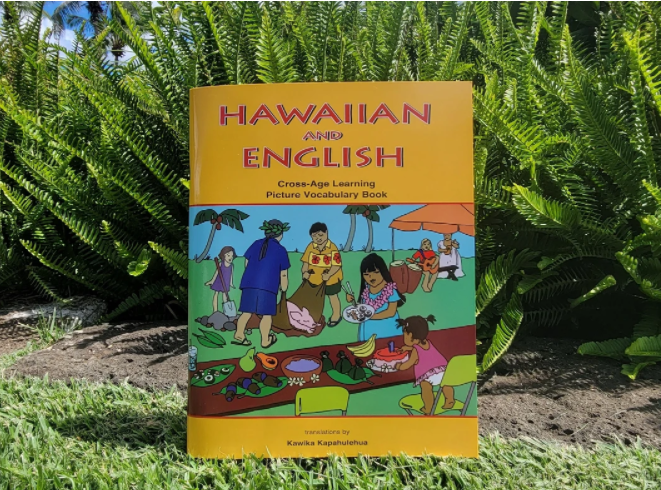
Did you see the announcement from Bishop Museum Press saying that the Hawaiian and English Cross-Age Learning Picture Vocabulary Book is back in print after a long time of not being available. For more information about the book and how to order copies for people you know, click the image below.
The reprint of the vocabulary book reminded me of an earlier column appearing in Hoku o Hawaii starting in 1938. It was called “He haawina i kekahi poe,” and was started to help people learn Hawaiian and to increase the number of subscriptions to the newspaper. This column would continue on until 4/19/1939. “Lesson in Hawaiian” followed from 4/26/1939 until 6/20/1945. Continue reading →
Did you see the latest Nūhou Monday post from Bishop Museum? It mentions Ka Nūhou, the Hawaiian language newsletter put out by the club, Hui Aloha ʻĀina Tuahine at University of Hawaii at Mānoa. That was 49 years ago! Click here for the Nūhou Monday post from He Aupuni Palapala!
E na makua Hawaiʻi me na kupuna Hawaiʻi
…ʻO ʻoukou no na kumu helu ekahi o ka ʻolelo Hawaiʻi. Ka ʻolelo i aʻo ʻia mai ka puke mai, oʻohe no e like me ka ʻolelo mai koʻoukou waha mai.
Hawaiian parents and grandparents, you are the best teachers of the Hawaiian language. The language taught from books is not like the language that comes from your mouths. —A plea written by Haunani Bernardino, editor of Ka Nuhou, an English-Hawaiian newsletter.
Haunani Bernardino
Nuulani Atkins
Lurline Naone
Bill Wilson
By Arlene Lum Star-Bulletinn Writer
Hawaiian is a living language and NOT a foreign one. And if a group of University of Hawaii students had their way, Hawaiian youngsters would be bilingual.
There are only 5,000 people in the State now who can speak the beautiful, musical language and only 150 at the University are trying to learn.
The reason?
“We were brought up feeling ashamed of our heritage,” according to Nuulani Atkins, a senior in his third year of language study. “I hated myself. I hated the Hawaiians. I felt inferior.” Continue reading →
Eddie Desha is Trying All Means to Save “Ka Hoku o Hawaii”
An effort to perpetuate the Hawaiian language and a Newspaper published in that language is being made in Hilo.
Eddie Desha, the nephew of the late Senator Stephen L. Desha Sr., is making this determined effort, with the courage and persistence which characterized his uncle, one of Hawaii’s noted orators and legislators.
Besides a small monthly magazine published by the Hawaiian Board of Missions [Ka Hoaloha], there now remains only one weekly newspaper printed in the native Hawaiian language of Hawaii. It is Ka Hoku o Hawaii (Star of Hawaii), published in Hilo by the Star of Hawaii Publishing Co., Ltd., of which W. H. Beers, Hilo attorney, is president, and Edwin M. Desha is treasurer and manager. Continue reading →

 nupepa