The Maori and Hawaiians, 1911.

Hawaiians and Maori Talk to Each Other.

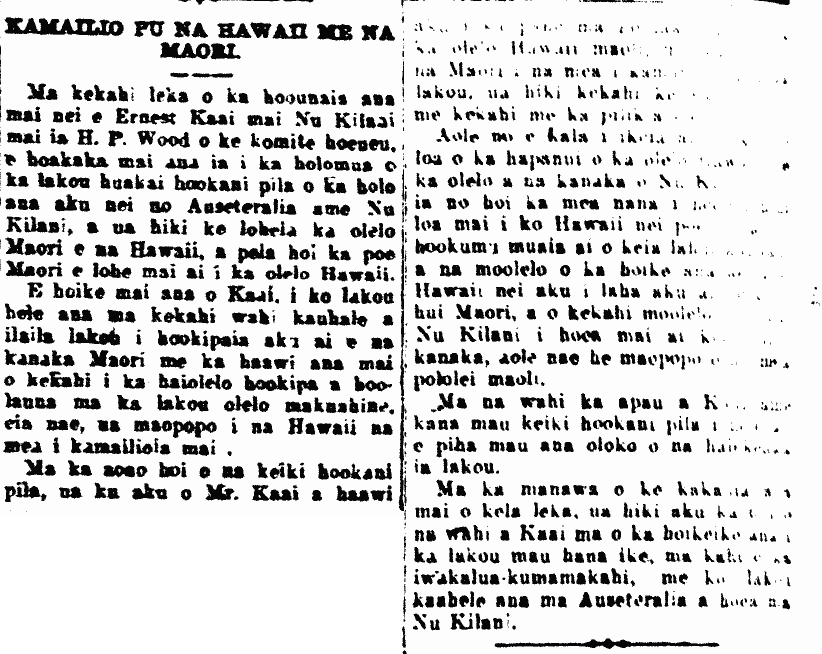
In a letter sent by Ernest Kaai from New Zealand to H. P. Wood of the Hawaiian Promotion Committee [which seems to be a precursor to the visitor’s bureau], he shows the progress of their musical touring of Australia and New Zealand. The Hawaiians could hear the Maori language and the Maori could hear the language of Hawaii.

Kaai said that when they went to some villages, they were hosted by Maori people, where one of them said words of welcome and friendship in their mother tongue. But the Hawaiians understood what was being said.

From the side of the musicians, Mr. Kaai stood and gave [rest of the paragraph unclear].

It was not long ago that [also unclear here, but they seem to be talking about the relationship between Aotearoa and Hawaii].

Everywhere that Kaai and his musical group went, the theaters would be filled with them.

When this letter was written, the number of places that Kaai them performed at was about 21, with them going around Australia and reaching New Zealand[?]

[A great deal of the Hawaiian Language Newspapers are bound into book form, and because they were purposely printed without much empty margins, often the printed portions that fall in the margin area of the books are not legible, especially when scanned. To get a clear image of the entire page, the books will have to be unbound first. That, it seems, takes a great amount of funding.]

(Kuokoa, 6/30/1911, p. 8)

KAMAILIO PU NA HAWAII ME NA MAORI.

Ka Nupepa Kuokoa, Buke XLVII, Helu 26, Aoao 8. Iune 30, 1911.

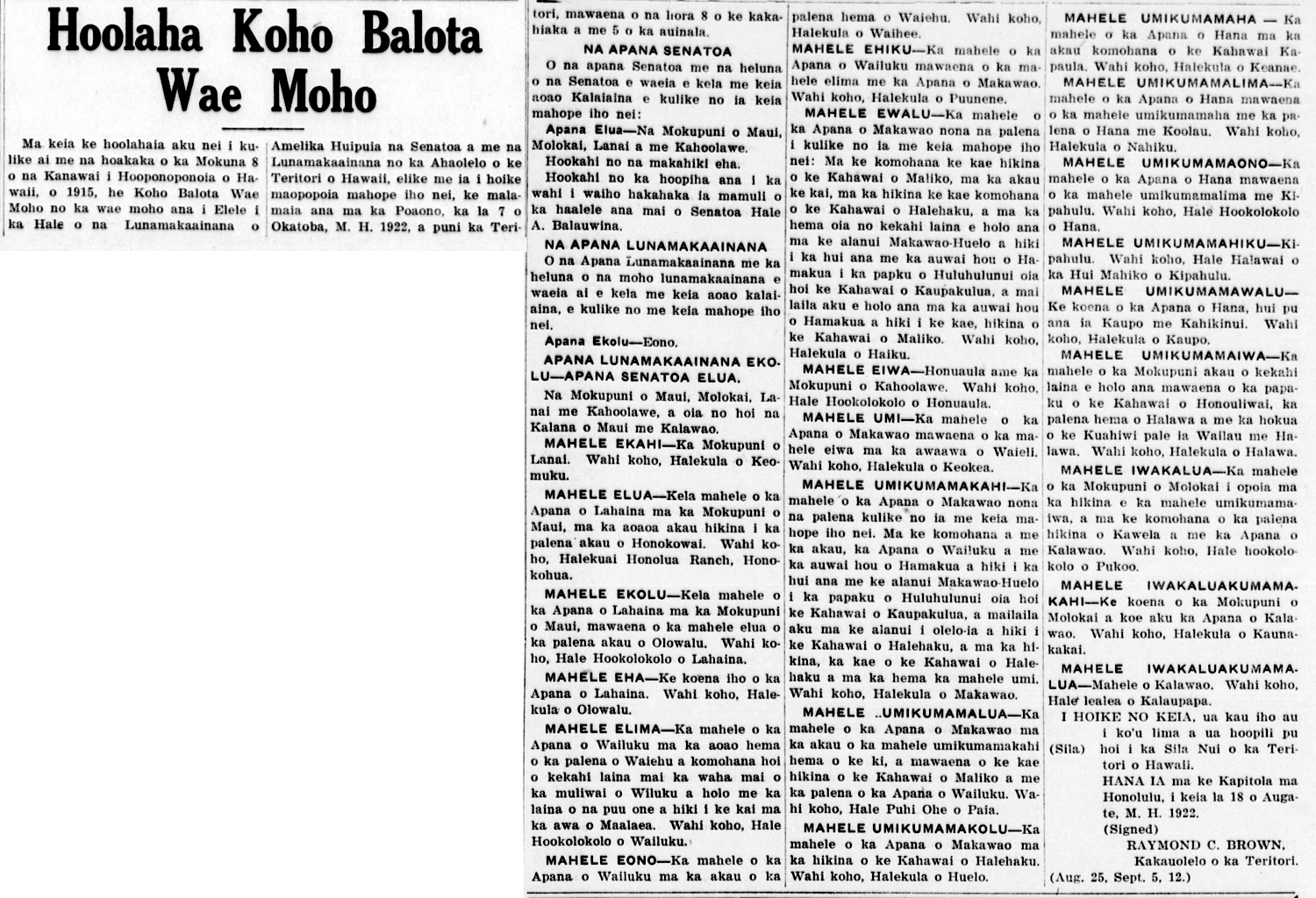
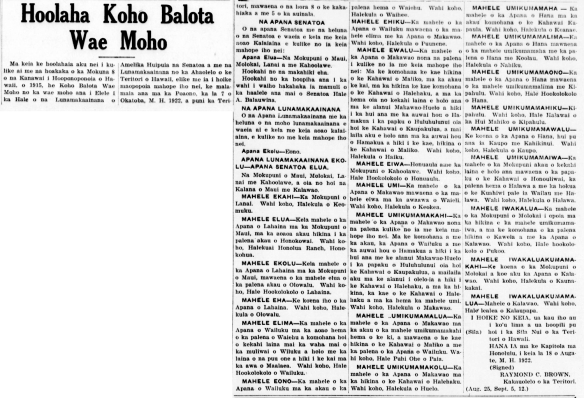
Voting Precincts in Hawaiian in an English newspaper, 1922.

Hoolaha Koho Balota Wae Moho

Ma keia ke hoolahaia aku nei i kulike ai me na hoakaka o ka Mokuna 8 o na Kanawai i Hooponoponoia o Hawaii, o 1915, he Koho Balota Wae Moho no ka wae moho ana i Elele i ka Hale o na Lunamakaainana o Amelika Huipuia na Senatoa a me na Lunamakaainana no ka Ahaolelo o ke Teritori o Hawaii, elike me ia i hoike maopopoia mahope iho nei, ke malamaia ana ma ka Poaono, ka la 7 o Okatoba, M. H. 1922, a puni ka Teritori, mawaena o na hora 8 o ke kakahiaka a me 5 o ka auinala.

NA APANA SENATOA

O na apana Senatoa me na heluna o na Senatoa e waeia e kela me keia aoao Kalaiaina e kulike no ia keia mahope iho nei:

Apana Elua—Na Mokupuni o Maui, Molokai, Lanai a me Kahoolawe.

Hookahi no na makahiki eha.

Hookahi no ka hoopiha ana i ka wahi i waiho hakahaka ia mamuli o ka haalele ana mai o Senatoa Hale A. Balauwina.

NA APANA LUNAMAKAAINANA

O na Apana Lunamakaainana me ka heluna o na moho lunamakaainana e waeia e kela me keia aoao kalaiaina, e kulike no me keia mahope iho nei.

Apana Ekolu—Eono.

APANA LUNAMAKAAINANA EKOLUAPANA SENATOA ELUA.

Na Mokupuni o Maui, Molokai, Lanai me Kahoolawe, a oia no hoi na Kalana o Maui me Kalawao.

MAHELE EKAHI—Ka Mokupuni o Lanai. Wahi koho, Halekula o Keomuku.

MAHELE ELUA—Kela mahele o ka Apana o Lahaina ma ka Mokupuni o Maui, ma ka aoao akau hikina i ka palena akau o Honokowai. Wahi koho, Halekuai Honolua Ranch, Honokohau.

MAHELE EKOLU—Kela mahele o ka Apana o Lahaina ma ka Mokupuni o Maui, mawaena o ka mahele elua o ka palena akau o Olowalu. Wahi koho, Hale Hookolokolo o Lahaina.

MAHELE EHA—Ke koena iho o ka Apana o Lahaina. Wahi koho, Halekula o Olowalu.

MAHELE ELIMA—Ka mahele o ka Apana o Wailuku a komohana hoi o ka palena o Waiehu a komohana hoi o kekahi laina mai ka waha mai o ka muliwai o Wailuku a holo me ka laina o na puu one a hiki i ke kai ma ka awa o Maalaea. Wahi koho, Hale Hookolokolo o Wailuku.

MAHELE EONO—Ka mahele o ka Apana o Wailuku ma ka akau o ka palena hema o Waiehu. Wahi koho, Halekula o Waihee.

MAHELE EHIKU—Ka mahele o ka Apana o Wailuku mawaena o ka mahele elima me ka Apana o Makawao. Wahi koho, Halekula o Puunene.

MAHELE EWALU—Ka mahele o ka Apana o Makawao nona na palena i kuliike no ia me keia mahope iho nei: Ma ke komohana ke kae hikina o ke Kahawai o Maliko, ma ka akau ke kai, ma ka hiki ke kae komohana o ke Kahawai o Halehaku, a ma ka hema oia no kekahi laina e holo ana ma ke alanui Makawao-Huelo a hiki i ka hui ana me ka auwai hou o Hamakua i ka papaku o Huluhulunui oia hoi ke Kahawai o Kaupakulua, a mai laila aku e holo ana ma ka auwai hou o Hamakua a hiki i ke kae hikina o ke kahawai o Maliko. Wahi koho, Halekula o Haiku.

MAHELE EIWA—Honuaula ame ka Mokupuni o Kahoolawe. Wahi koho, Hale Hookolokolo o Honuaula.

MAHELE UMI—Ka mahele o ka Apana o Makawao mawaena o ka mahele eiwa ma ka awaawa o Waieli. Wahi koho, Halekula o Keokea.

MAHELE UMIKUMAMAKAHI—Ka mahele o ka Apana o Makawao nona na palena kulike no ia me keia mahope iho nei. Ma ke komohana a me ka akau, ka Apana o Wailuku a me ka auwai hou o Hamakua a hiki i ka hui ana me ke alanui Makawao-Huelo i ka papaku o Huluhulunui oia hoi ke Kahawai o Kaupakulua, a mailaila aku ma ke alanui i olelo ia a hiki i ke Kahawai o Halehaku, a ma ka hikina, ka kae o ke Kahawai o Halehaku a ma ka hema ka mahele umi. Wahi koho, Halekula o Makawao.

MAHELE UMIKUMAMALUA—Ka mahele o ka Apana o Makawao ma ka akau o ka mahele umikumamakahi hema o ke ki, a mawaena o ke kae hikina o ke Kahawai o Maliko a me ka palena o ka Apana o Wailuku. Wahi koho, Hale Puhi Ohe o Paia.

MAHELE UMIKUMAMAKOLU—Ka mahele o ka Apana a Makawao ma ka hikina o ke Kahawai o Halehaku. Wahi koho, Halekula o Huelo.

MAHELE UMIKUMAMAHA—Ka mahele o ka Apana o Hana ma ka akau komohana o ke Kahawai Kapaula. Wahi koho, Halekula o Keanae.

MAHELE UMIKUMAMALIMA—Ka mahele o ka Apana o Hana mawaena o ka mahele umikumamaha me ka palena o Hana me Koolau. Wahi koho, Halekula o Nahiku.

MAHELE UMIKUMAMAONO—Ka mahele o ka Apana o Hana mawaena o ka mahele umikumamalima me Kipahulu. Wahi koho, Hale Hookolokolo o Hana.

MAHELE UMIKUMAMAHIKU—Kipahulu. Wahi koho, Hale Halawai o ka Hui Mahiko o Kipahulu.

MAHELE UMIKUMAMAWALU—Ke koena o ka Apana o Hana, hui pu ana ia Kaupo me Kahikinui. Wahi koho, Halekula o Kaupo.

MAHELE UMIKUMAMAIWA—Ka mahele o ka Mokupuni akau o kekahi laina e holo ana mawaena o ka papaku o ke Kahawai o Honouliwai, ka palena hema o Halawa a me ka hokua o ke kKuahiwi pale ia Wailau me Halawa. Wahi koho, Halekula o Halawa.

MAHELE IWAKALUA—Ka mahele o ka Mokupuni o Molokai i opoia ma ka hikina e ka mahele umikumamaiwa, a ma ke komohana o ka palena hikina o Kawela a me ka Apana o Kalawao. Wahi koho, Hale hookolokolo o Pukoo.

MAHELE IWAKALUAKUMAMAKAHI—Ke koena o ka Mokupuni o Molokai a koe aku ka Apana o Kalawao. Wahi koho, Halekula o Kaunakakai.

MAHELE IWAKALUAKUMAMALUA—Mahele o Kalawao. Wahi koho, Hale lealea o Kalaupapa.

I HOIKE NO KEIA, ua kau iho au i ko’u lima a ua hoopili pu hoi i ka Sila Nui o ka Teritori o Hawaii. HANA IA ma ke Kapitola ma Honolulu, i keia la 18 o Augate, M. H. 1922.

(Sila) (Signed)

RAYMOND C. BROWN,
Kakauolelo o ka Teritori.

[Yesterdayʻs post was of a personal ad, but here is a government announcement in Hawaiian from 1922. This is printed along with the English on the same page.]

(Maui News, 9/5/1922, p. 7)
Hoolaha Koho Balota Wae Moho

Semi-Weekly Maui News, Year 22, Number 1198, Page 7. September 5, 1922.

More on language, 2015.

LANGUAGE MATTERS

Language Matters asks what we lose when languages die and how we can save them. It was filmed around the world: on a remote island off the coast of Australia, where 400 Aboriginal people speak 10 different languages, all at risk; in Wales, where Welsh, once in danger, is today making a comeback; and in Hawaii, where a group of Hawaiian activists is fighting to save the native tongue.

Language Matters is a co-production of David Grubin Productions and Pacific Islanders in Communications. Major funding provided by the National Endowment for the Humanities with additional funding provided by the Corporation for Public Broadcasting, the Arthur Vining Davis Foundations, the National Endowment for the Arts.

[This showed on PBS on 1/19/2015. It might be a long show, but don’t skip to the back, it is well worth watching from the beginning! Click the picture below.]

Language Matters

Language Matters

More the celebrating the better? 1915.

[Found under: “Na Kuhinia o ka Manawa.”]

The celebration [hi’uwai] of the people of China [Aina Pua] is approaching, but perhaps there will only be a few because New Years was celebrated by some Chinese on this past New Years Day.

[Konohi is the lunar calendar new year. It probably comes from the Hawaiianization of the Chinese Kung Hei as in Kun Hei Fat Choi (恭喜發財).]

(Aloha Aina, 2/6/1915, p. 3

Ke hookokoke mai nei...

Ke Aloha Aina, Buke XIX, Helu 71, Aoao 3. Feberuari 6, 1915.

More on the pidgin in Kalaupapa article, 1882 / 2015.

Before getting to the pidgin phrase in question, I had a question in the last paragraph which in the original read: “ke hele la a mauakea i ka la.” And thankfully there was a response.

Puakea says:

Aloha – the last line might be missing an “o” – Ke hele la a moauakea i ka la – making a haughty display- like white-feathered chickens – in the sun. (moa uakea – often a reference for Maunaloa/Maunakea when snow-covered)

That would fit in nicely, considering there were typos in the newspapers even back then. The last paragraph would then read something like:

The white-haired old men of Kalaupapa are out surfing these days, resembling white-feathered chickens under the sun.

As for the pidgin phrase: “Kokami iu palali kanaka! Iu anu faita, ai am solon, mi kivi iu kut polo, mi inilis man,”

There was one suggestion.

Robert Ikuwa says:

“Go come you bloody kanaka. You wanna fight. I am strong. Me give you good blow, me is invisible [? invincible] man.”

Another suggestion I have is maybe:

“Goddam you bloody kanaka. You wanna fight? I am strong. Me give you good blow. Me Englishman.”

Also there was another comment just a few minutes ago!

Michael Newtson says:

In our Cummings Ohana I have written of many of our ancestors exploits. But these long overdue articles brings to mind an early story of our Patriarch Thomas Booth Cummings who was so inspired by a hapa Hawaiian who served alongside of him in the jury pools of Edwin Miner’s court in Lahaina (1848-50) that he named his first born son after him. The young man who had such a promising will to help the needy was William Humphreys, who often went by the name Ulawalea as a pen name when writing the countless articles in Hawaiian Nupepa about the injustices of the peninsula. Kalaupapa has received much of the attention, in part from Father Damien. However, there was a second smaller colony at the eastern end of the peninsula at Kalawao. Most patients here were Chinese, and this is where Humphreys concentrated his efforts in the early until his untimely death from a prescribed medicine in the mid 1860’s. He might have been one of the first to use the media of his day to educate those in the islands that were unaware of the seriousness of the conditions. At Kalawao he organized voting blocks, book clubs and taught many years for no expense. He served two terms as Sheriff and was imprisoned twice, once for refusing to arrest patients for victimless crimes and another for butchering beef on a nearby ranch to provide fresh meat for the starving. He like many others, worked under the radar and was but a small foot print in Hawaii’s history, but when passed the patients of Kalawao lost their dearest friend.

Mahalo to everyone that gave responses, they put much more meaning into this post!

Pidgin from down in Kalaupapa, 1882.

NEWS OF MOLOKAI.

O Greatest Prize of the Hawaiian Nation, the lightning that flashes over the cliff brows of the islands. Greeting between us.

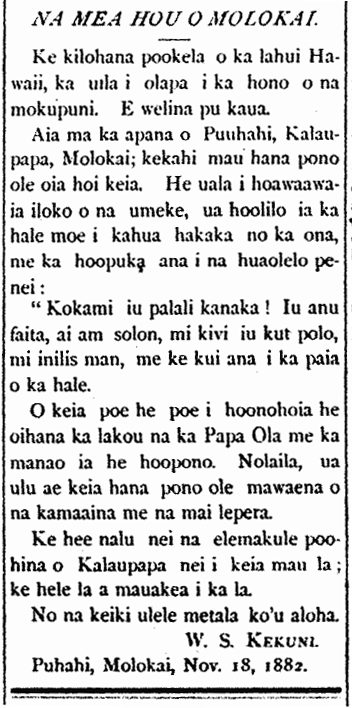
In the area of Puuhahi, Kalaupapa, Molokai, there were deplorable incidences, and those where these. There was sweet potato being fermented in pots, and this made the dormitory into a place of fighting because of drunkenness, along with the speaking of these words:

“Kokami iu palali kanaka! Iu anu faita, ai am solon, mi kivi iu kut polo, mi inilis man,” while he punched the wall of the building.

These are people who were appointed with positions from the Board of Health [Papa Ola] with the thought that it would be of help. Then this reprehensible thing happened between the locals [kamaaina] and the leprosy patients.

The gray-haired old men of Kalaupapa are surfing these days, and the land is being left fallow in the sun [??? ke hele la a mauakea (?? mahakea) i ka la.]

To the metal type-setting boys goes my aloha.

W. S. Kekuni.

Puhahi, Molokai, Nov. 18, 1882.

[Any ideas what is being said in pidgin? I will post what I think it says tomorrow morning.]

(Kuokoa, 12/9/1882, p. 3)

NA MEA HOU O MOLOKAI.

Ka Nupepa Kuokoa, Buke XXI, Helu 49, Aoao 3. Dekemaba 9, 1882.

Olelo Hawaii, 1896.

THE HAWAIIAN LANGUAGE WILL BE FORGOTTEN.

Those Hawaiian youths who are being trained by us in the English language cannot write correctly at all the Hawaiian language of their own land of birth.

We have seen some children like this. And we are very regretful in seeing this; they are being made unintelligent in their Mother tongue of their land, so that their thought are turned over totally to the land of those who are teaching them.

When they are asked, “What about you? Can you write in Hawaiian?” They will reply, “No! the haole teachers don’t give us time to write in the language of Hawaii nei, and that is why I can’t read and write in Hawaiian.” That is how the majority of the Hawaiian children will be in the future.

We feel great remorse that the Hawaiian children will be denied intimate knowledge of the Mother tongue of their own land.

There is no Lahui that is denied this right, amongst all the great nations of this world. Therefore, do not let the Hawaiian language be forgotten.

(Aloha Aina, 7/11/1896, p. 2)

E POINA ANA KA OLELO HAWAII.

Ke Aloha Aina, Buke II, Helu 28, Aoao 2. Iulai 11, 1896.

On the state of the Hawaiian Language, 1920.

PERTAINING TO THE HAWAIIAN LANGUAGE.

Mr. Editor of the Nupepa Kuokoa, Aloha oe:—In the Kuokoa of Friday, May 21, 1920, I saw your thoughts supporting Mr. Coelho on the Hawaiian Language, and about the lack of use of the Hawaiian language in some churches and Hawaiian organizations when they meet; English is what is spoken in meetings; not because Hawaiian is not understood, but because of their great embarrassment in speaking Hawaiian; there is English and it is attractive to speak, yet all the while they understand that it is not appropriate at all to be speaking in English.

It isn’t in some churches and Hawaiian associations that it is not spoken, but in markets, on streets, in homes in which true Hawaiians live, and all around this island of Oahu, only a very tiny fraction of true Hawaiians speak the Hawaiian language; most of the men, women, and children, all they speak is English.

It is not something that I’ve heard from a friend; no, I have seen it with my own eyes, and heard it with my own ears; a Hawaiian father and a Hawaiian mother, and children born of their loins, born here in Hawaii, yet the strange thing is that the language they speak is English, and not Hawaiian.

Who are the true Hawaiians that are snuffing out the Hawaiian language? The ones that are too haughty and the ones who are too ashamed to speak in Hawaiian, like with some churches and some Hawaiian organizations that don’t want to speak Hawaiian when they meet.

I do not oppose the speaking of English or other languages perhaps that we true Hawaiians know; it is a great benefit that we can converse in those languages, but the problem is that we’ve abandoned the Hawaiian language.

How can we Hawaiians say that we defend dearly [makee] the Hawaiian lahui from dying off and from coming into great difficulties if we do not cherish our mother tongue? Continue reading

Maori in Hawaii, 1899.

Speech of the New Zealander.

Wheraliko Rawei, a man from New Zealand [Nu Kilani], gave [a speech] in the YMCA building [Hale o ka Hui Opio] of Honolulu nei. The topic of his presentation pertained to New Zealand, the land of the Maori people.

He is a native New Zealander, and is fluent in English. He was well educated in that language in schools of the land of his birth.

His presentation was enhanced with lime light pictures [kii hoolele aka]; these pictures were of the very famous places of his homeland. His speech was made very delightful with songs of New Zealand.

There were many people of this town who showed up to listen to his speech. All of the seats were filled by the spectators, and some people stood. He gave another presentation on this past Thursday.

(Kuokoa, 9/29/1899, p. 1)

Haiolelo a ka Nu Kilani.

Ka Nupepa Kuokoa, Buke XXXVIII, Helu 39, Aoao 1. Sepatemaba 29, 1899.

Language, 2014.

Here is something to think about. The olelo noeau is indeed true, “Make ke kalo a ola i ka palili.” (The oldsters die, but they live on through their offspring.)* Language however is something that needs to be consciously worked at, for if we let it disappear, “when you cover him with dirt, language is not like a plant that grows again…”

*The old taro stalk dies, but lives on through the shoots. Also seen as “Make ke kalo, ola i ka naio.”