Early movies of Hawaii, 1913.

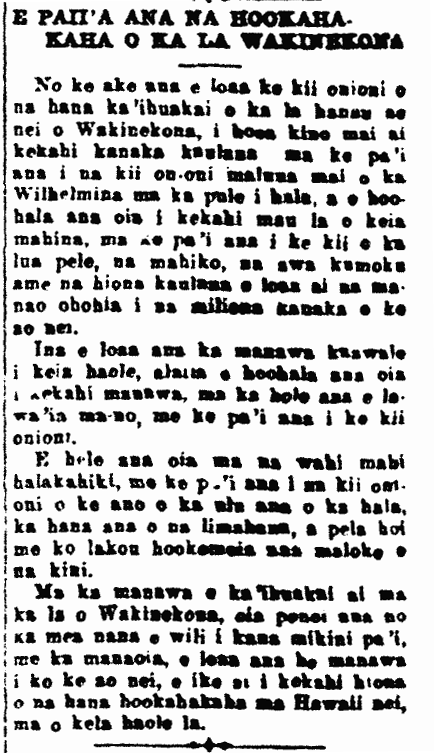
THE PARADE ON WASHINGTON’S [BIRTH]DAY WILL BE FILMED

Because there is a desire to have a movie of the parade on this upcoming birthday of Washington, a man famous for filming movies arrived aboard the Wilhelmina last week, and he is spending some days of this month filming the volcano, the sugar plantation, the harbors, and famous sights to delight the millions of people of the world.

If this haole has spare time, he will spend some time going shark fishing, and filming it.

He will go to the pineapple plantations, and film the growth of the pineapple, the activities of the laborers, as well as the canning.

During the parade on Washington’s birthday, he will be the one rolling his film; and it is believed that there will come a time when the world will see scenes of the parade in Hawaii because of this haole.

[Anyone know who this is, and where these reels might be today?]

(Kuokoa, 1/31/1913, p. 7)

E PAII'A ANA NA HOOKAHAKAHA O KA LA WAKINEKONA

Ka Nupepa Kuokoa, Buke XLIX, Helu 5, Aoao 7. Ianuari 31, 1913.

Early movie making in Honolulu, 1913.

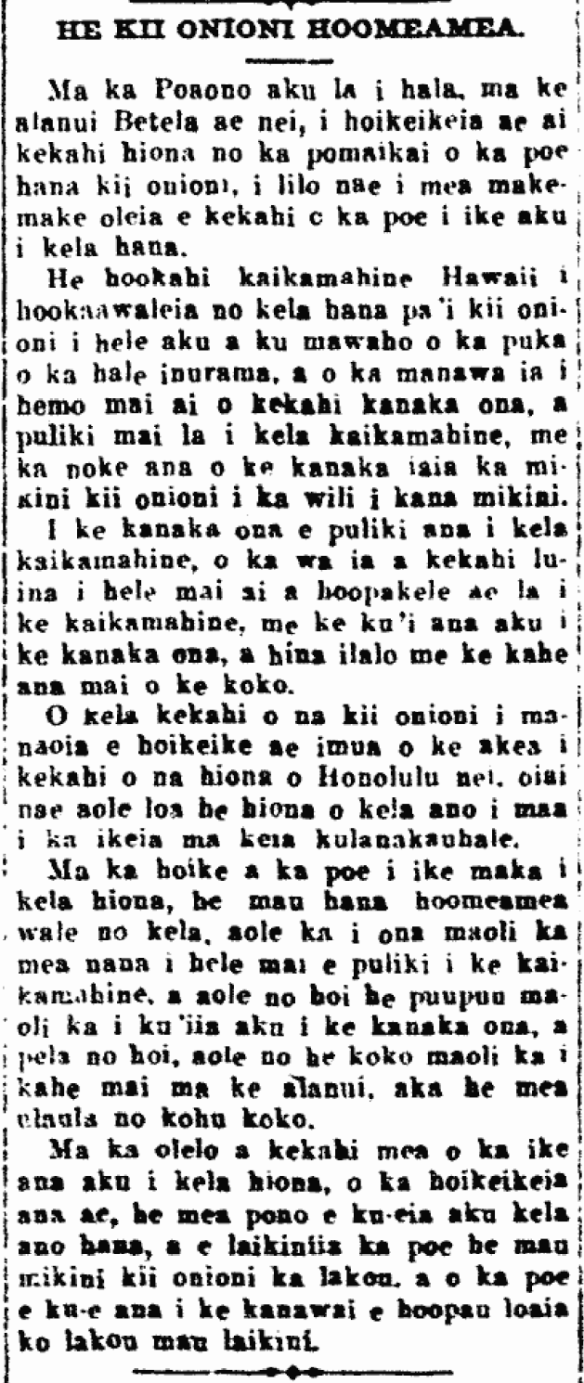
FAKE MOVIE.

Last Saturday, on Bethel Street, a scene was put on for movie makers, which became something unappealing to some who witnessed it.

There was a Hawaiian girl set aside for the shooting that went and stood outside the entrance of a bar, and at this was when a drunk man exited and clutched the girl, while the one with the camera continued to film.

As the drunkard continued to grasp the girl, a sailor came and rescued the girl, and he punched the drunk man, who fell down as blood flowed.

This was a movie meant to show a Honolulu scene before the public, even if that type of scene is not something seen regularly in this town.

According to those who witnessed this, it was nothing but acting; the one who went and grabbed the girl was not really drunk, and he was not hit with a real punch, also, it was not real blood that flowed on the street, but it was something red that resembled blood.

One of those who saw this being staged said that this kind of thing should be prohibited, and those who own movie cameras should be licensed, and those who break the law should have their licenses revoked for good.

(Kuokoa, 1/10/1913, p. 4)

HE KII ONIONI HOOMEAMEA.

Ka Nupepa Kuokoa, Buke XLIX, Helu 2, Aoao 4. Ianuari 10, 1913.

The latest from Kalawao, 1909.

News From the Land of the Suffering.

To the Editor of the Aloha Aina Newspaper, Aloha:

Please allow my small parcel a space in your newspaper which is greatly enjoyed, and that is what is down below; let the paper take it proudly around so that our multitudes of friends may see.

Movies come regularly every Wednesday, and are shown on the evenings of Wednesday, Thursday, and Friday; and every Saturday in Honolulu. There has been a building erected for the patients to watch the movies. The patients are thrilled. They donated money to buy a first-class phonograph [pahu olelo]. They are very happy with singing, the sweet sound of the strings and the blare of the brass instruments.

There was an announcement made to the ones without the sickness or those partially afflicted that wanted to be examined by the Doctors who are coming into the settlement.

Some went to sign up, and some just looked on because they did not want to go back to where they came from, being there might be difficulties waiting ahead for them. And because of the small number of those going to sign up, the Superintendent of the settlement ordered someone to go to the houses to sign people up; the total of those people number 58, but I don’t have their names; the only names I have are those who went to sign up, and they number 55, along with their doctor.

THE PEOPLE WHOSE DOCTOR IS DR. WAYSON

[Names difficult to make out.]

THE PEOPLE WHOSE DOCTOR IS DR. GOODHUE.

The Men

[Names difficult to make out.]

The Women

[Names difficult to make out.]

The total number told to the writer is 108. This includes the people chosen by the Legislature [?]

With much aloha for my Lahui.

Sincerely,

S. K. MAIALOHA.

Kalawao, Molokai, Aug. 2, 1909

[Here is just another example of why the original newspapers need to be reshot clearly before the acid in the paper consumes all of the words, leaving us with crumbs…]

(Aloha Aina, 9/4/1909, p. 3)

Na Mea Hou o ke Kahua Ma'i.

Ke Aloha Aina, Buke XIV, Helu 36, Aoao 3. Sepatemaba 4, 1909.

Another Hawaii Theater Ad, 1920.

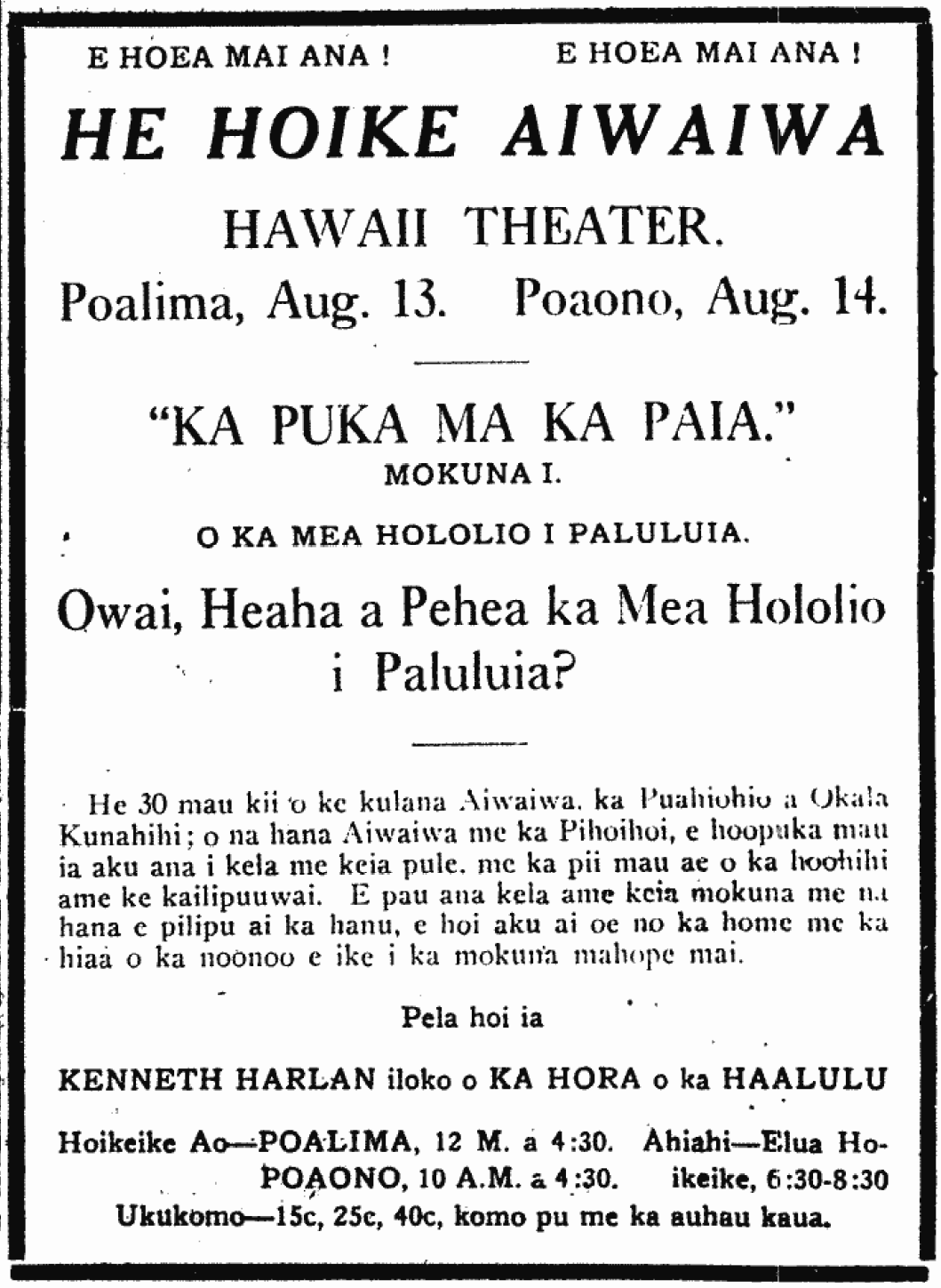
COMING! COMING!

AN AMAZING PERFORMANCE

HAWAII THEATER.

Friday, Aug. 13  Saturday, Aug. 14.

“THE HOLE IN THE WALL.”

EPISODE I.

THE MASKED RIDER.

Who, What and How is the Horseman Masked?

There are 30 films that are Amazing, with Fast Action [Puahiohio?] and Chicken skin; the amazing and astonishing acts will be shown weekly, ever increasing in fascination and emotion. Each episode will end with something that will leave you having a hard time breathing, and you will return home unable to sleep thinking about seeing the coming episode.

So too of

KENNETH HARLAN in THE TREMBLING HOUR

Matinees—FRIDAY, 12 M. and 4:30. Evening—Two Showings, 6:30-8:30.

SATURDAY, 10 A. M. and 4:30.

Entrance—15c, 25c, 40c, including war tax [auhau kaua].

[The things you can find on the internet these days! See here for more information on this movie, and a clip!!]

(Kuokoa, 8/13/1920, p. 3)

E HOEA MAI ANA! E HOEA MAI ANA!

Ka Nupepa Kuokoa, Buke XVIII, Helu 33, Aoao 3. Augate 13, 1920.

Tarzan ad, 1919.

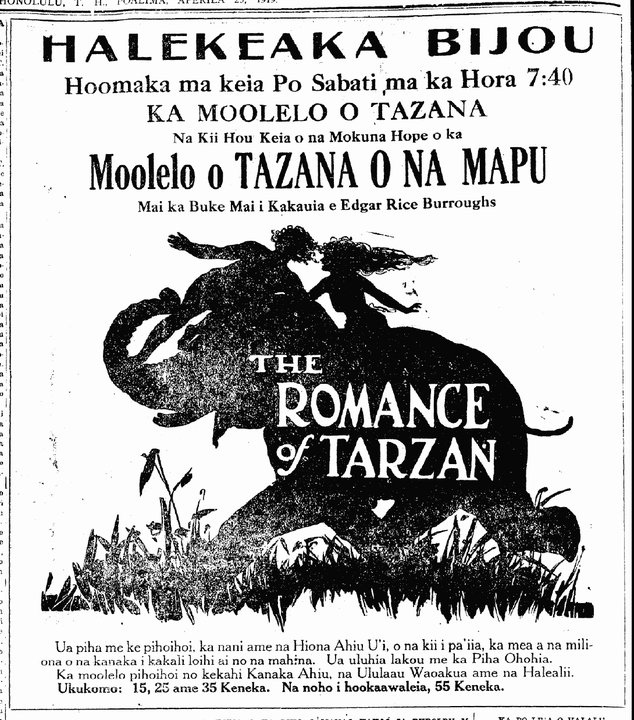
BIJOU THEATRE

Starting this Sunday Night at 7:40

THE STORY OF TARZAN

These are Pictures From the Last Chapters of the

Story of TARZAN OF THE APES

From the Book by Edgar Rice Burroughs

THE ROMANCE OF TARZAN

Filled with excitement, magnificence, and Wild Beauty; the images taken are what millions of people have been awaiting for months. They are overcome with total fascination.

The thrilling story of a Primitive Man, Jungle Wilds, and Palaces.

Entrance fee: 15, 25, and 35 Cents. Reserved seating: 55 Cents.

[Chronicling America does not have any Honolulu papers up yet for this year, so here is a similar ad printed in The Garden Island, 5/27/1919, p. 3.]

(Kuokoa 4/25/1919, p. 2)

HALEKEAKA BIJOU

Ka Nupepa Kuokoa, Buke LVII, Helu 17, Aoao 2. Aperila 25, 1919.

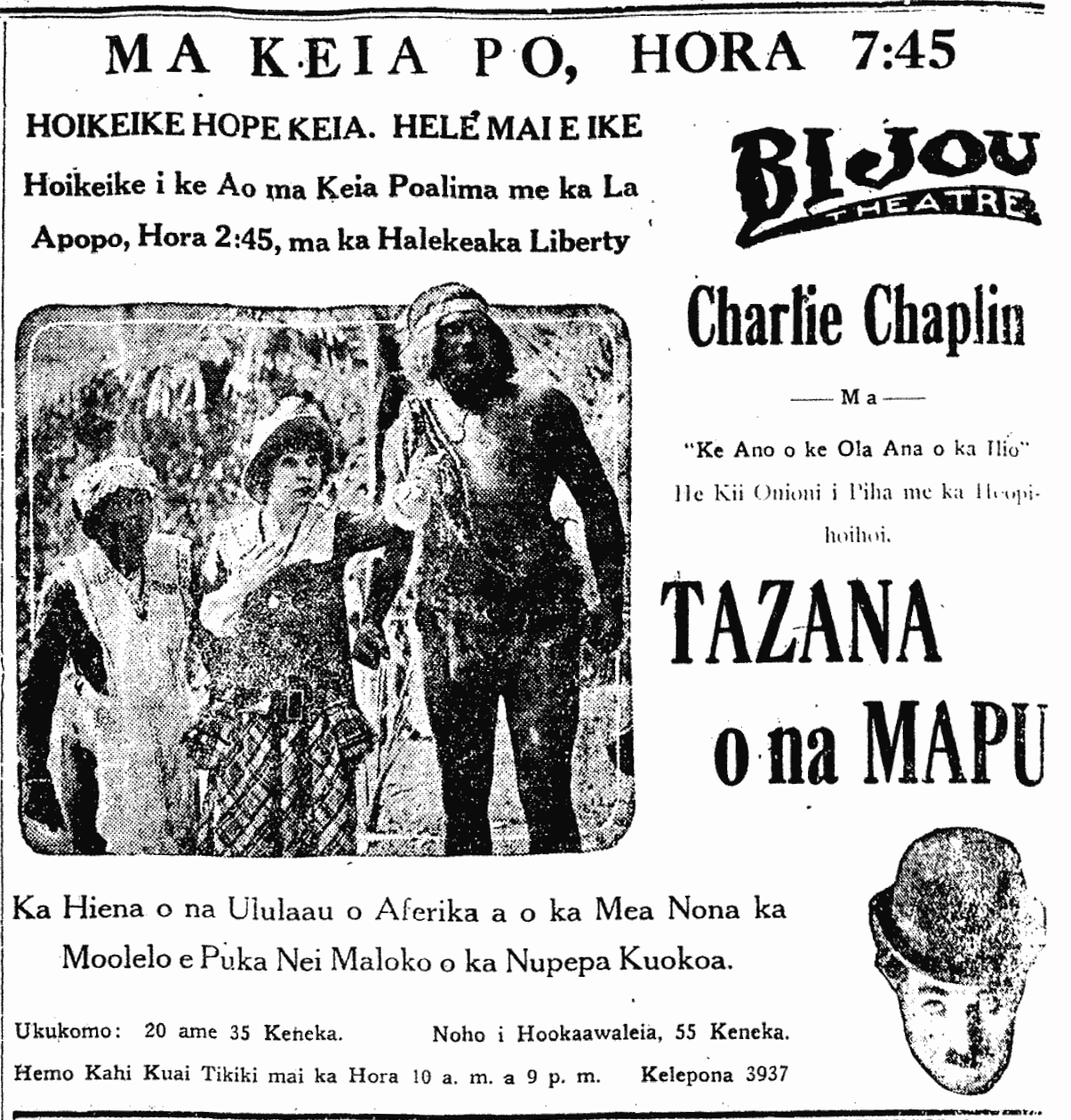
Tarzan and Chaplin! 1919.

TONIGHT, 7:45

THIS IS THE LAST SHOW, COME WATCH

Shown at Day on This Friday and Tomorrow,

2:45, at Liberty Theater

BIJOU THEATRE

Charlie Chaplin

—In—

“A Dog’s Life” [“Ke Ano o ke Ola Ana o ka Ilio”]

A Movie Full of Excitement.

TARZAN of the APES [TAZANA o na MAPU]

The Hyena of the Jungle of Africa and the One Whose Story is Being Run in the Kuokoa Newspaper.

Entrance: 20 and 35 Cents. Reserved Seats [Noho i Hookaawaleia], 55 Cents.

Ticket Box Open from the Hours of 10 a. m. to 9 p. m. Telephone 3937

[It is interesting to see that this ad is in Hawaiian, when the movies themselves were in English.]

(Kuokoa, 1/17/1919, p. 2)

MA KEIA PO, HORA 7:45

Ka Nupepa Kuokoa, Buke LVII, Helu 3, Aoao 2. Ianuari 17, 1919.

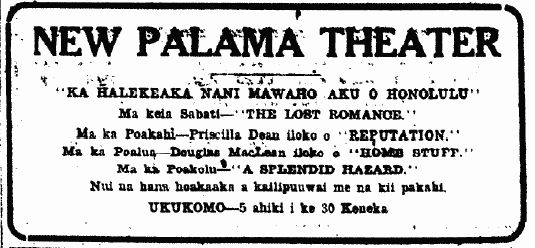
Theater announcement, 1921.

NEW PALAMA THEATER

“The Beautiful Theater Outside of Honolulu”

This Sunday—”The Lost Romance”

On Monday—Priscilla Dean in “Reputation”

On Tuesday—Douglas MacLean in “Home Stuff”

On Wednesday—”A Splendid Hazard”

Each movie is filled with scenes that make you laugh and tug at your heartstrings

Entrance—5 to 30 cents

(Kuokoa, 9/9/1921, p. 5)

NEW PALAMA THEATER

Nupepa Kuokoa, Buke LIX, Helu 49, Aoao 5. Dekemaba 9, 1921.

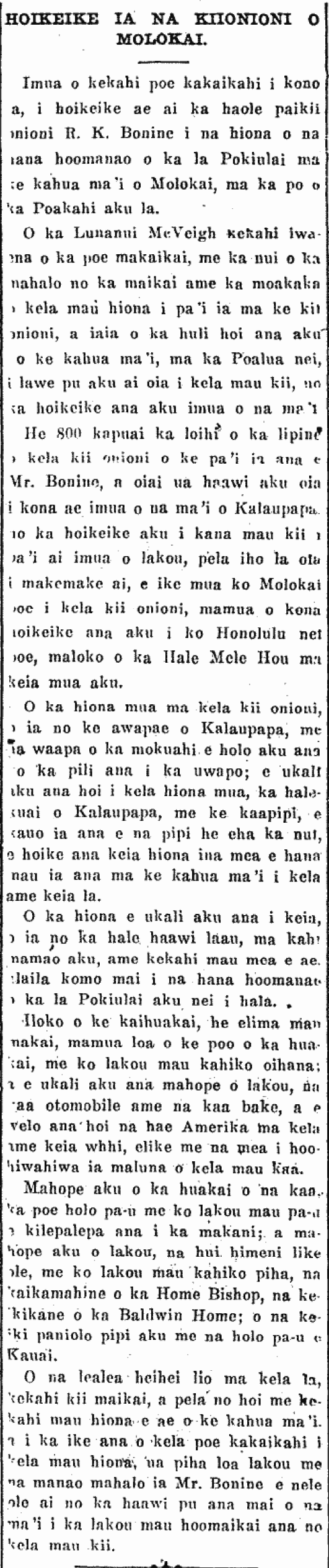
Film of Kalaupapa 4th of July celebration, 1915.

FILM OF MOLOKAI SHOWN.

Before a few invited people, the haole film maker, R. K. Bonine showed views of the celebration of the fourth of July at the land of the patients on Molokai, on the night of this past July 4th.

Superintendent McVeigh was amongst the audience, and was much appreciative of the quality and clarity of these views shot on film; and when he returned to the land of the patients this Tuesday, he took with him the movie to show before the patients.

The movie taken by Mr. Bonine was 800 feet in length, and as he agreed before the patients of Kalaupapa to show the movie he shot before them, therefore, he wanted Molokai’s people to see that movie first before him showing it to Honolulu’s people at the Opera House in the future.

The first scene in the movie is the port of Kalaupapa, with the skiffs of the steamship approaching the harbor; accompanying this first scene is the store of Kalaupapa, with a oxcart pulled by four oxen—this scene shows everyday life at the land of the patients.

The scene following this is the infirmary, which is far away, and some other things; and then it moves to the celebration of this past fourth of July.

In the parade are five police, all the way at the head of the parade, with their uniforms; following behind them are the automobiles and the Chinese carts [kaa bake?], and American flags wave everywhere like the ones decorating those vehicles.

After the parading cars were those pa-u riders with their skirts fluttering in the wind; and after them were the various singing groups all dressed up in their uniforms, the girls of Bishop Home, the boys of Baldwin Home; and following that was the cowboys and the pa-u riders of Kauai.

The entertaining horse races of the day is another good scene, along with some other views of the land of the patients; and when that small crowd saw these scenes, they were full of appreciation for Mr. Bonine, and the patients will certainly not fail to give their thanks for the movie.

(Kuokoa, 8/15/1915, p. 3)

HOIKEIKE IA NA KIIONIONI O MOLOKAI.

Nupepa Kuokoa, Buke LIII, Helu 33, Aoao 3. Augate 13, 1915.