Don’t leave the kitchen while cooking—still good advice a hundred and fifty years later, 1861.

House consumed by fire.

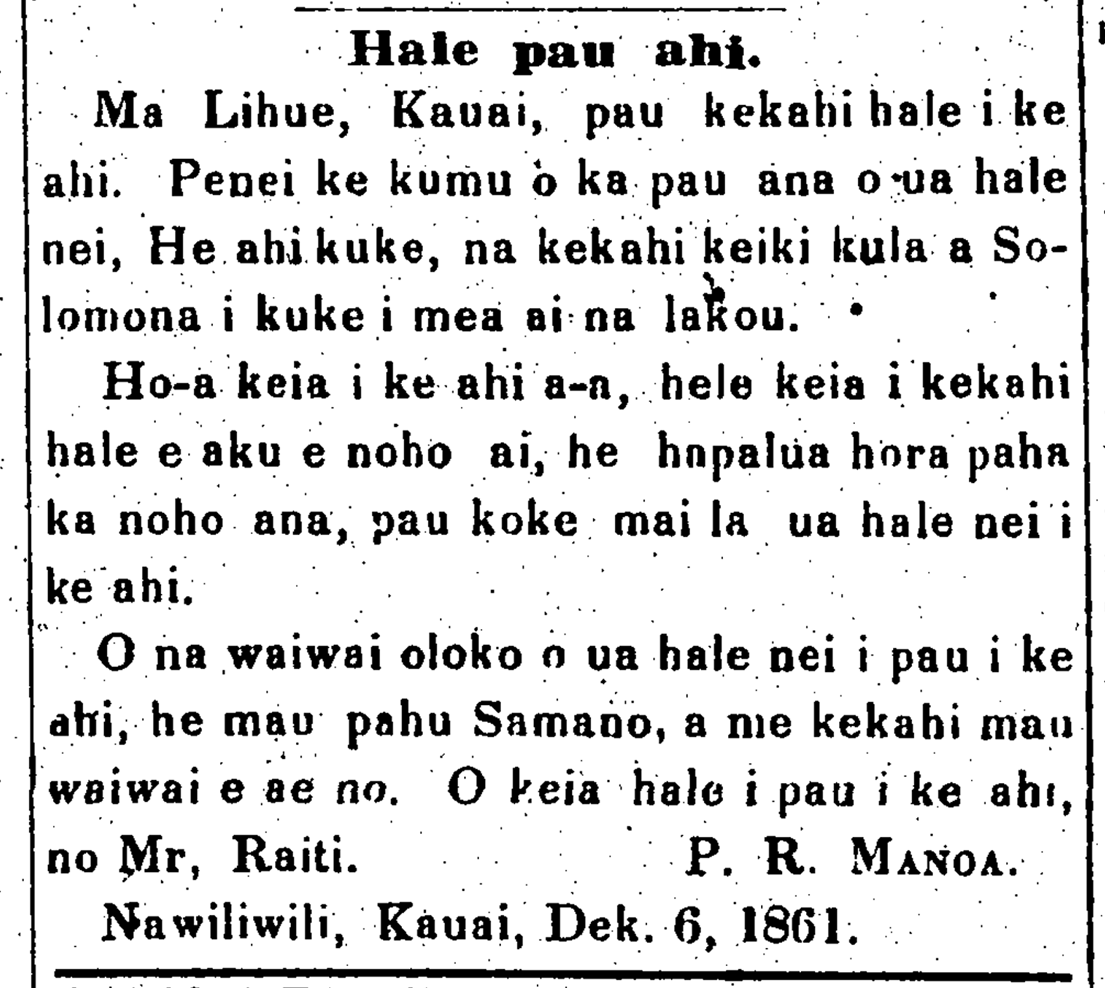
At Lihue, Kauai, a house was consumed by fire. This is the reason for that house burning down: A kitchen fire of one of the children of Solomon’s school, who was cooking something for himself.

He lit the fire and went away to another house, and was there for perhaps half an hour, and the house was immediately destroyed.

The contents of the house lost to the fire was some barrels of Salmon, and some other valuables. This house that was destroyed by fire belonged to Mr. Rice.    P. R. Manoa.

Nawiliwili, Kauai, Dec. 6, 1861.

[The original images of Ka Hae Hawaii are available on microfilm, but are still as of yet not available online. *It is always important to check the original image against any available typescript, just to make sure what it is you see is indeed what was originally written!]

(Hae Hawaii, 12/25/1861, p. 4)

Hale pau ahi.

Ka Hae Hawaii, Buke 6, Helu 39, Aoao 156. Dekemaba 25, 1861.

Christmas greetings for today as it was from yesterday, 1896.

MERRY CHRISTMAS TO US ALL.

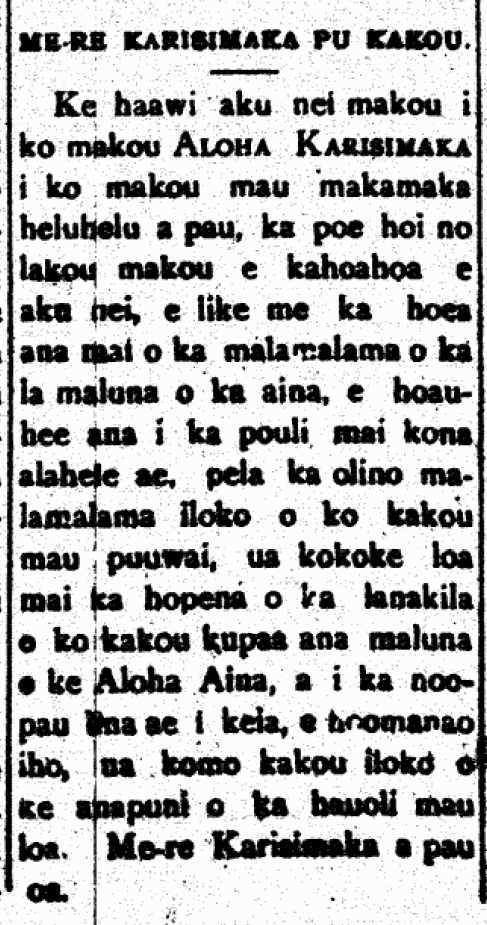
We give our ALOHA KARISIMAKA to all of our readers, to those people who we pray that just as the light of the sun reaches the land and dispels the darkness from its path, so too be the light shining in our hearts; we are near the conclusion of the victory in our loyalty behind the Aloha Aina [“Patriotism”], and after it is complete, remember that we will be surrounded by eternal happiness. Merry Christmas to all.

[I thought that this was just as fitting today as it was back then…]

(Aloha Aina, 12/26/1896, p. 2)

ME-RE KARISIMAKA PU KAKOU.

Ke Aloha Aina, Buke II, Helu 52, Aoao 2. Dekemaba 26, 1896.

Now this is one huge hapuupuu (sea bass)! 1917.

GRANDFATHER OF A HAPUUPUU FISH WAS CAUGHT, 750 POUNDS IN WEIGHT.

This Monday, a Japanese went out fishing on his 33 feet boat. When he was outside of Makua, close by Waianae, while he was letting out his line to fish, and as he pulled, it was as if his hook was stuck, and this Japanese didn’t think that he had hooked a huge fish, but he figured it out when the fish began to drag him and his tiny boat. The fish was left to do as it pleased, being that he realized that he would not be able to pull in this huge fish because it was too strong to pull in the water. He followed after the fish for a long period of time, and when the Japanese saw that the fish had grown weak, that was when he pulled it to the side of his boat and returned to Honolulu nei.

When this fish reached the fish market, it was auctioned off and was sold to the Chinese with a $100 cash.

After going to the Chinese, it was immediately cut up into small pieces at 50¢ a pound, and at that price, the money got by the Chinese through retail sale was $265; the gross sale [?] was about $365; and so the Chinese who sold the fish profited about $265.

They say that everything was sold, nothing was left. In the fishing profession, Japanese make a lot of money, when it was work done by Hawaiians in years past; these days, the work has gone to these people. These people are not better prepared at fishing than Hawaiians, but the problem lies in that Hawaiians neglect this money-making profession, and because of this, it moved into the hands of other people.

Look at the great profit this Japanese made in one day, so therefore, O Hawaiians, you must keep up so that you will be prepared in this profession from now on, and that goes for farming as well—that is the only road to living comfortably and independently.

[The current “Hawaii State Record” seems to be recorded as 563 pounds. Take a look at Hawaii Fishing News.]

(Aloha Aina, 1/27/1917, p. 4)

PAA KE KUPUNA O NA IʻA HAPUUPUU, HE 750 PAONA KE KAUMAHA.

Ke Aloha Aina, Buke XXII, Helu 4, Aoao 4. Ianuari 27, 1917.

More on traditional stories, and variation within, 1862.

About Kaao and Moolelo.

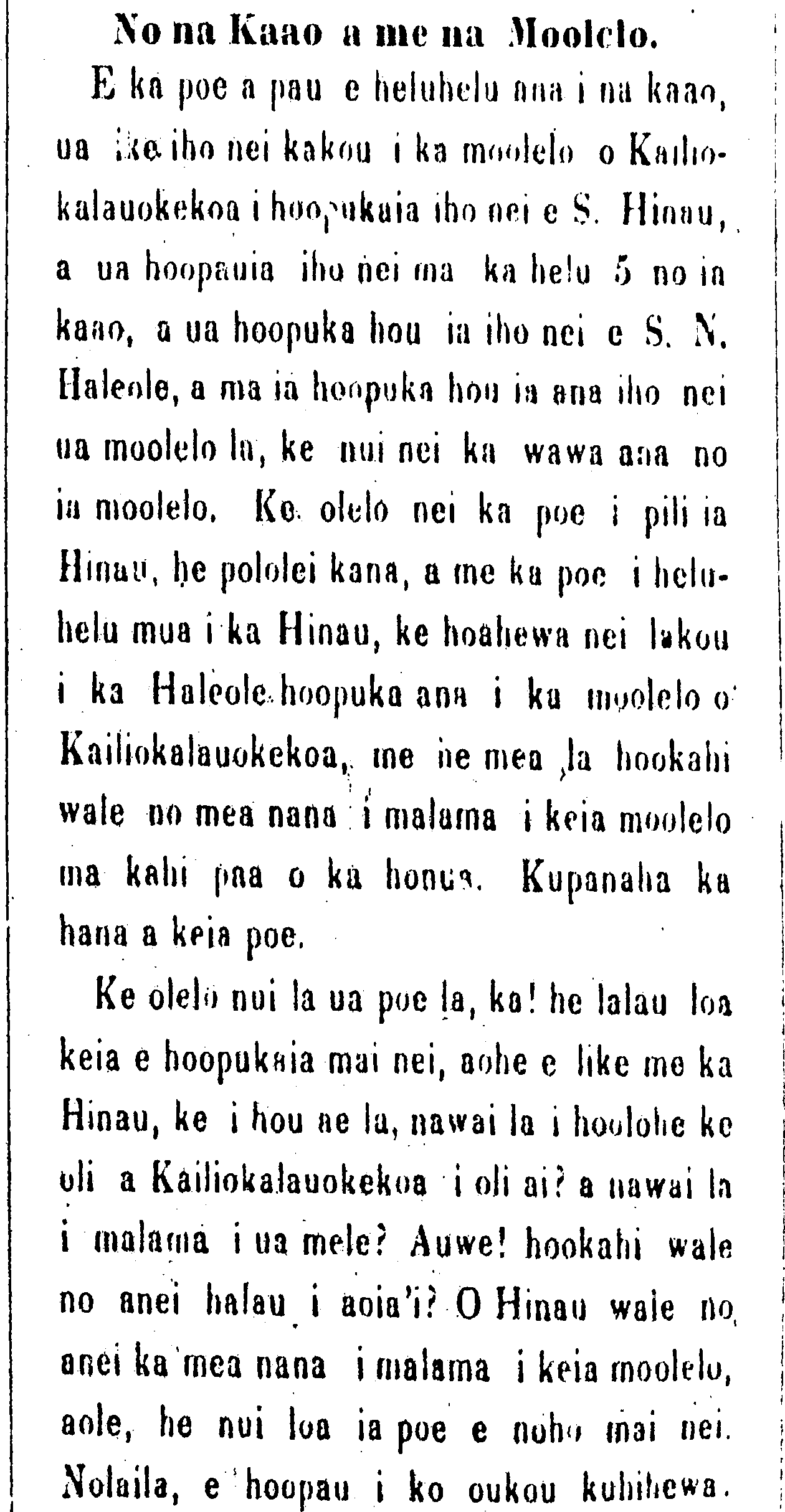
O Readers of kaao, we have seen the story of Kailiokalauokekoa that was published by S. Hinau, and it was just completed with the 5th installment [this series, “He Moolelo no Kailiokalauokekoa,” probably started on 10/24/1861 (which is missing) and S. Hinau closes his telling on 12/5/1861]; S. N. Haleole has just started that story again [which begins with genealogy, on 12/12/1861, restarts with installment 6 on 12/19/1861, and probably ended with installment 10, on 1/30/1862 (which sadly is also missing)], and with that retelling of the story, there has been quite the uproar. Those who are with Hinau say that his is correct, and those that read Hinau’s first fault Haleole’s publishing of Kailiokalauokekoa, as if there is but one person who retained this story on this solid earth. The actions of these people are unbelievable.

Those people go on and on saying, “oh please! this series is so misguided and not like Hinau’s”; further more, “Who has heard those oli which were chanted by Kailiokalauokekoa? and who kept those mele?” Auwe! Is there only one school where it was taught? Is it only Hinau who has kept this story? No, there are many people today. So stop with your unfounded ideas.

(Hoku o ka Pakipika, 1/16/1862)

No na Kaao a me na Moolelo.

Ka Hoku o ka Pakipika, Buke 1, Helu 17, Aoao 4. Ianuari 16, 1862.

On traditional stories and finishing properly what you begin, 1862.

Words of Advice.

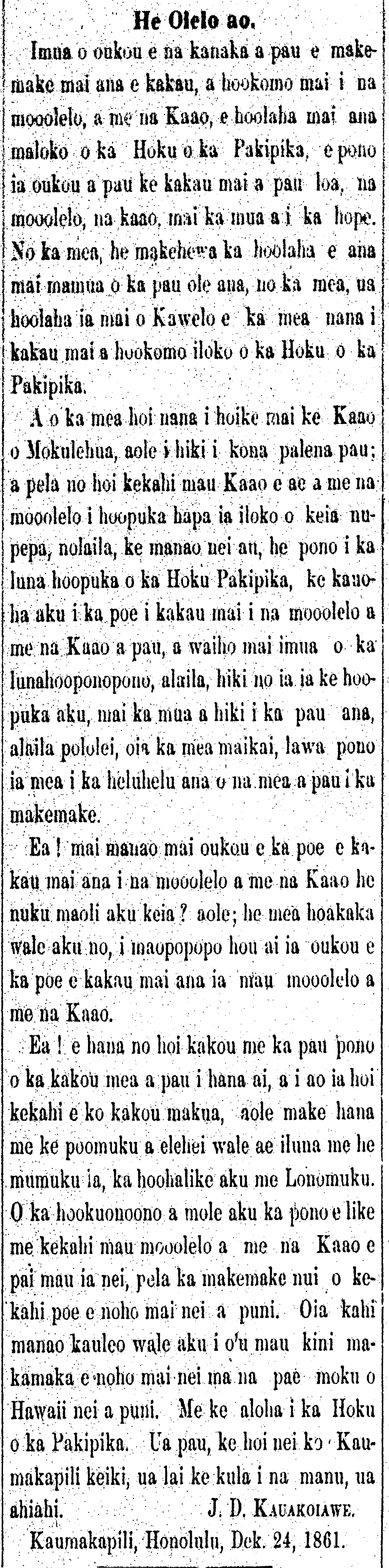
Before you, all those who want to write and publish stories (mooolelo and kaao) in the Hoku o ka Pakipika: you must all write the whole story from the beginning all the way until the end. Because it will be a waste of time to start printing before it is completed, as Kawelo by the person who submitted it, was printed in the Hoku o ka Pakipika [“Mooolelo no Kawelo” by S. K. Kawailiula from 9/26/1861 to 12/5/1861—5 helu total].

And as for the person who submitted the story of Mokulehua, he did not get to the end [“He wahi Kaao no Mokulehua” begins on 11/28/1861, and in the Helu 2 (12/5/1861), there is a note from the editor at the bottom, “Send in more of the story of Mokulehua; make it quick lest the Hoku o ka Pakipika give you a kick.” Helu 3 in the next issue (12/12/1861) is very short, and there is a long hiatus until well after this letter is published. It finally reappears as “He Moolelo no Mokulehua on 3/13/1862 to 3/27/1862, 6 Helu in total, by B. K. H.**.]; and so too of some other kaao and mooolelo that were published partially in this newspaper; therefore, i feel that it is necessary for the editor of the Hoku o ka Pakipika to require that those who write in mooolelo and kaao to complete it and then to put it before the editor, and then it can be printed from beginning to end, and it is right and good, and everyone who reads it will be satisfied.

Now then! all you people who write in mooolelo and kaao, don’t take this as a critique; no, it is just clarification, so that you all know.

Now then! let’s all finish everything we start properly, as some of us were taught by our parents: don’t do things leaving off the beginning, cutting off the top like a maimed one, imitating Lonomuku. What is necessary is to make it well-rooted, as are some of the mooolelo and kaao that are being published, and that is what what people all over really want. This is just encouragement to all my friends living throughout these Hawaiian islands. With aloha to the Hoku o ka Pakipika. I am done, Kaumakapili’s child returns, as the fields are tranquil with birds and it is eventide.  J. D. KAUAKOIAWE.

Kaumakapili, Honolulu, Dec. 24, 1861.

(Hoku o ka Pakipika, 1/2/1862, p. 4)

He Olelo ao.

Ka Hoku o ka Pakipika, Buke 1, Helu 15, Aoao 4. Ianuari 2, 1862.

A view of the current state and the future of Hawaii, 1916.

What is to Become of Hawaii?

(Written for the Puuhonua.)

As time goes on, the Hawaiian People move backwards.

Why is this?

First. Because they are not united. Because of the lack of aloha for their own. Because they do not support each other. Because they do not help one another.

Second. Because of greed. Because of wastefulness. Because of the love of alcohol. Because of not being thrifty. For their not thinking of and neglecting  God.

It is clear that the Hawaiian people are shoved up against a wall; as the malihini white-skinned people come in droves to this land, so are the Hawaiians People pushed against a wall, they are new, but already they have settled themselves in; there are only but a few years left, you can count them on your fingers; the Hawaiians will have no Power in Government of their beloved land which God bestowed upon them.

Therefore, now is the time to stand firm, to think, and to come together, to give aloha to your own people, to be courageous, to economize, to be vigilant, to help each other, to go down on bended knee and ask God to free us from that whirlpool of naught, and to bring us to state of plenty.

Just as King Kauikeaouli proclaimed to the Hawaiian Nation, about kneeling down on bended knee and praising the Glorious Name of the Lord of hosts, to restore the Sovereignty of the Land (the Flag), that was stripped away by George Paulette, and what came about was that the flag was returned without ever being troubled again by Great Britain; so too with this.

For there is no time left to dally; we’ve lost our independence, we have no Power for Governmental Reform, as a result of our neglect, waste, and so forth; and our beloved Mother Tongue will be lost for all times. Hawaiians are being selected for positions under the Government.

Therefore, if you possess some aloha, some affection, some sentiment for the lifestyle of our People, now is the time; let us join in thought, in cooperation, like one great rope made of many strands, until we are able to pull massive things, like huge islands; that is what we need to do in these ongoing times.

ALOHA LAHUI [Love for the People].
Honolulu, July 5, 1916.

(Puuhonua, 7/7/1916, p. 4)

E Aha ia Ana Hawaii?

Ka Puuhonua, Buke III, Helu 25, Aoao 4. Iulai 7, 1916.