Kilipaki and lauhala hats in Honolulu, 1903.

LAUHALA HATS SCARCE WHEN GILBERTESE LEAVE HONOLULU

Art of Hat Making is Falling Into Decadence Among the Hawaiians and Was Chief Industry Among the South Sea Islanders.

GILBERT ISLANDERS’ SETTLEMENT.

GILBERT ISLANDERS AT HOME.

With the departure of the Gilbert Islanders for their South Sea home in the British S. S. Isleworth, the art of native hat making is likely to fall into decadence. Strange as it may seem the majority of the native hats sold in Honolulu for many years past have been made by the Lewalewas who in turn were taught the art by the Hawaiians. Form the Island of Hawaii come the more expensive native hats, and the departure of the Gilbert Islanders will undoubtedly give an impetus to the art in Kona and Kohala.

In and around Honolulu there are but few Hawaiians who have the deft art at their fingers ends, and except among the older generations of natives, little about hat making is known. As with hat weaving, so with the making of mats. An old native woman at Waikiki is one of the few who can repair mats, and another in Manoa valley still manufactures mats, large and small. The present generation of Hawaiians has not added hat and mat weaving to its accomplishments.

A couple of years ago the Gilbert Islanders has a village on the naval reservation on the Waikiki side of the harbor channel. Camera fiends and brush artists found the village a picturesque attraction, where nearly all the women villagers manufactured the cheaper grade of hats which were sold here for $1 and $1.50.

The Honoluluans will miss the Gilbert Islanders from the streets on which they appeared barefooted and generally with about half a dozen of the cheap hats in their hands, going from one store to another in quest of a purchaser for the lot. When a tourist arrives in Honolulu about the first thing he or she does is to seek a curio store and invest in a native hat, and after adorning it with a flaring striped pugaree “do” the sights of the city. The hats have always an attraction for the newcomer. But few of the malihinis or even kamaainas have ever seen them made. Continue reading
Woven calabash just like one made of wood! 1877.

[Found under: “NA ANOAI.”]

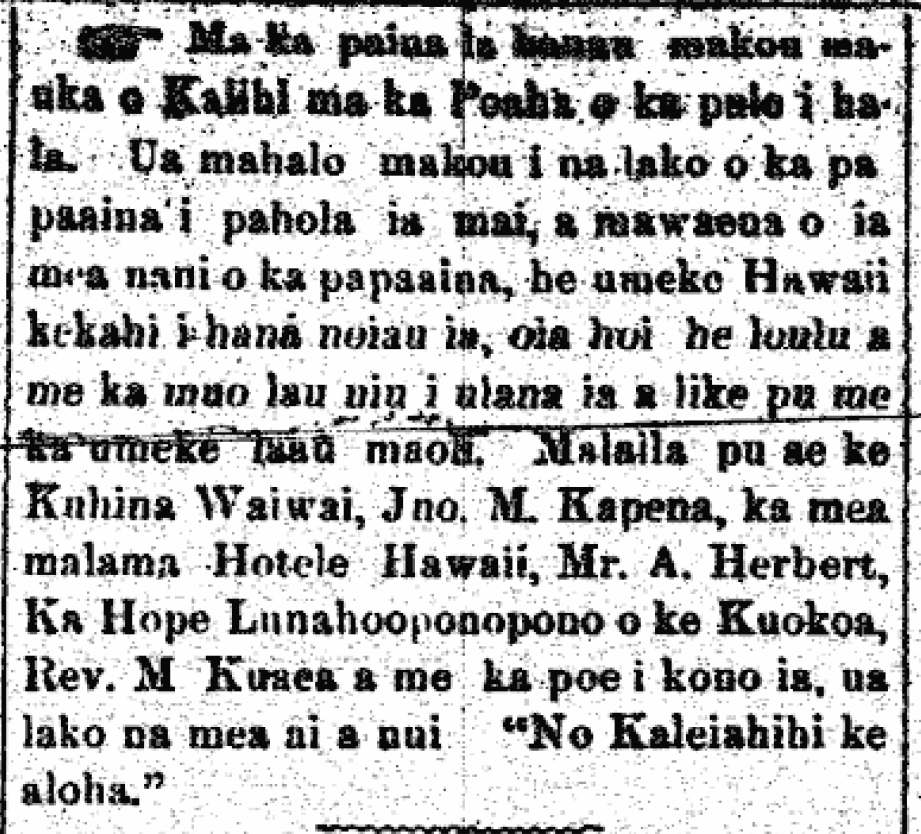
We were at a birthday party in the uplands of Kalihi on last week Thursday. We admired how well supplied the table was spread, and from among the beautiful things on the table, there was a skillfully crafted Hawaiian umeke, that is, it was loulu palm and the young coconut fronds woven just like a wooden calabash. Also there was the Minister of Finance, John M. Kapena; the Hawaiian Hotel keeper, Mr. A. Herbert; the subeditor of the Kuokoa, Rev. M. Kuaea; as well as those who were invited; there was much food supplied. “Aloha to Kaleiahihi.”

[There are other accounts of amazing umeke poi being woven with skilled hands. Here is one I like in particular describing a huakai taken by Pauahi and Likelike in 1872 to Kawainui in search of the famous edible mud there.]

(Lahui Hawaii, 8/9/1877, p. 3)

Ma ka paina la hanau...

Ka Lahui Hawaii, Buke III, Helu 32, Aoao 3. Augate 9, 1877.

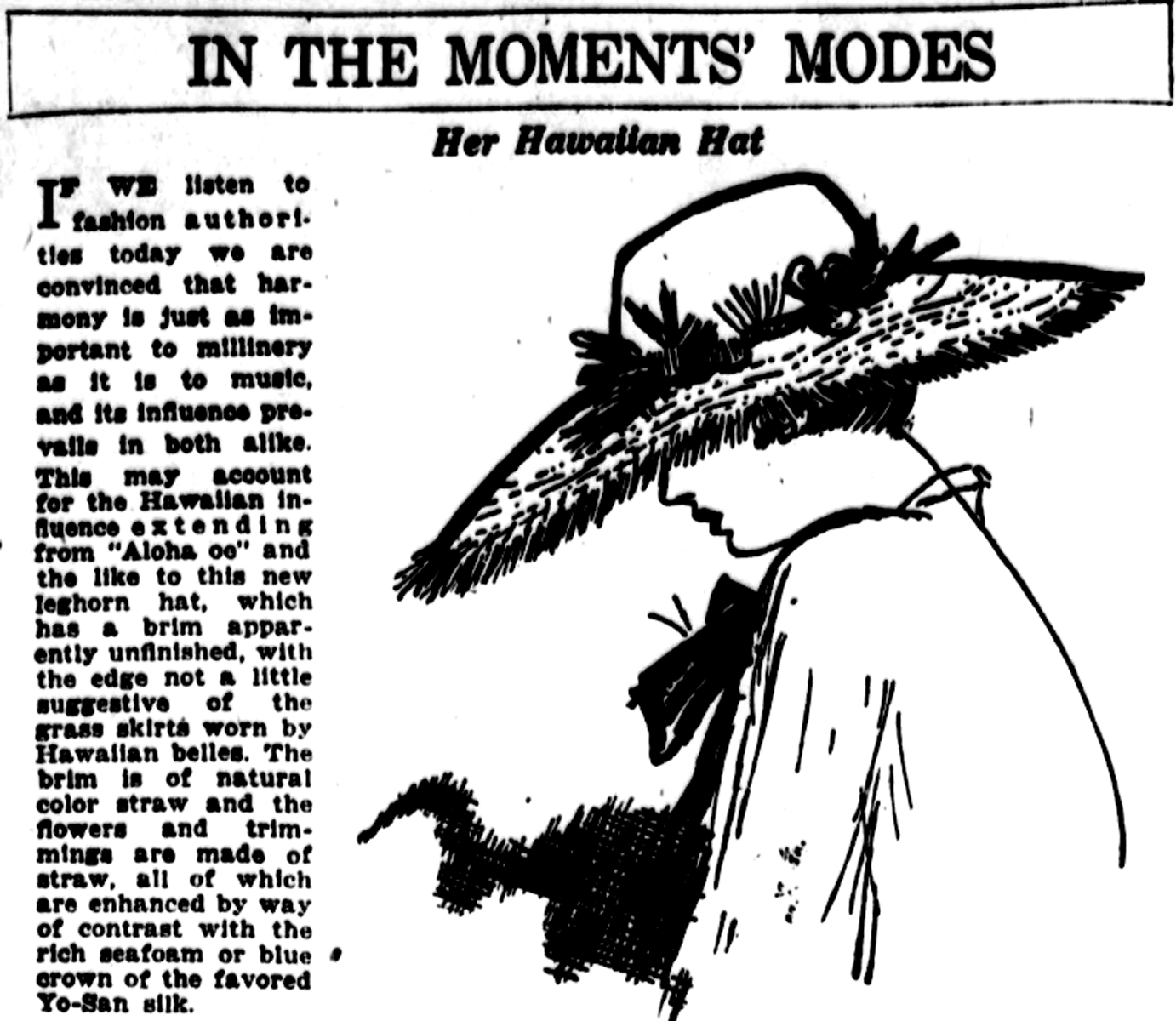
Hawaiian influence in music and fashion, 1917.

IN THE MOMENTS’ MODES

Her Hawaiian Hat

IF WE listen to fashion authorities today we are convinced that harmony is just important to millinery as it is to music, and its influence prevails in both alike. This may account for the Hawaiian influence extending from “Aloha oe” and the like to this new leghorn hat, which has a brim apparently unfinished, with the edge not a little suggestive of the grass skirts worn by Hawaiian belles. The brim is of natural color straw and the flowers and trimmings are made of straw, all of which are enhanced by way of contrast with the rich seafoam or blue crown of the favored Yo-San silk.

(Evening Ledger, 4/5/1917, p. 12)

IN THE MOMENTS' MODES

Evening Ledger, Volume III, Number 174, Page 12. April 5, 1917.

Papale fame to reach New York, 1906.

Hawaiian Hats for New York.

A question which has long puzzled the friends of the Hawaiian people has been how to provide, for the ones who wish to work, suitable occupations. Critics of the Hawaiian race have been free in their statements to the effect that the Hawaii is lazy and unprogressive, in utter forgetfulness of the fact that it takes more than a generation or two to outlive the old customs more especially when the vitality of a once healthy people has been sapped by the vices and evil productions of socalled civilizasion.

This attitude on the part of many whites and the importation of foreign goods has very nearly doomed to extinction many industries distinctively Hawaiian, but a determined effort is being made to revive at least some of them before they are forgotten entirely.

Perhaps among the most interesting of these is that of making Hawaiian hats and in this a fine start towards establishing a truely native industry has already been made.

The prices commanded by Panama and Filipino hats is such as to encourage those who are looking after the present attempt as there is no doubt that as good hats can be made by the Hawaiian women as any that come from the places mentioned. For these expensive hats however there is of course a limited demand and it is towards the production of grades for ordinary wear that attention has been directed.

First attempts to enlist Hawaiian women in the work were discouraging but after some time Theodore Richards and the Atherton Estate, recognizing the importance of the work, took it up in order to assist the lady who had the matter in hand.

“When Mr. Richards heard of the work he became interested and at once offered a work room at the Kauluwela lodgings, on Vineyard street,” she said this morning, “with out that we could have done nothing. There the women work on the hats and on the braids. Some of the original Hawaiian patterns for braids had disappeared entirely. Others were recalled by native women who remembered them from the early days. Others we managed to get from the other islands and one or two I designed. We have now thirty patterns in all.”
Continue reading

Lauhala weaving revival, 1936.

ANCIENT HAWAII ART REVIVAL

Kona District to Supply Lauhala Articles to Hawaiian Village At Waikiki

George P. Mossman, of the Hawaiian Village at Waikiki, who has been spending some time on the Big Island, has succeeded in making arrangements through which the Kona districts will supply the village with lauhala, mats and other articles.

Mr. Mossman reported that he found three grades of lauhala articles produced. the First grade, which is the cheaper grade, is turned out as a medium of exchange for which the family obtains clothing, groceries and other articles for home use. Continue reading

Tourism and the revival of lauhala, 1936.

Tourist Business In Hawaii Booms As Result Of Publicity

An influx of visitors to the Hawaiian islands during the past few years has revived many of the interesting traditions and practices of Old Hawaii.

This paradox was recently pointed out by Percy A. Swift, manager of the merchandise department of American Factors, Ltd., in a discussion of Hawaii’s tourist industry.

“An interesting sidelight of the travel business here has been the way it has encouraged Island customs and activities,” he said. “The nourishing influence of tourist interest has given added impetus to the lei tradition, for example; and it has revived native sports such as surfing and outrigger canoe riding, which were on the point of dying out 15 years ago.” Continue reading

Hala exhibit coming to the Bishop Museum, 2015.

It seems that the Museum is having an exhibit on weaving starting the end of this week. Maybe go check it out if you are on Oahu.

The beauty and significance of hala is woven throughout our history and throughout this exhibit. In ancient times, the sails of voyaging canoes were plaited of hala, and utilitarian hala baskets and mats were commonplace. The introduction of foreign items that replaced Hawaiʻi-made mats and baskets encouraged weavers to further their creativity, leading to a distinctive and truly exquisite Hawaiian style of lau hala hats that are coveted and treasured as fine art.

Nani i ka Hala

Much more on the protest mat, 1990.

For much, much more on Kalai’s mat of protest, see Roger G. Rose’s “Patterns of protest : a Hawaiian mat-weaver’s response to 19th-century taxation and change,” found in Bishop Museum Occasional Papers, Vol. 30 (June 1990). It can be found online by clicking here below:

Patterns of protest : a Hawaiian mat-weaver’s response to 19th-century taxation and change

Patterns of protest : a Hawaiian mat-weaver’s response to 19th-century taxation and change, Roger G. Rose

Kalai’s fame spreads to far away Pennsylvania, 1874.

[Found under: “Varieties.”]

King Kalakaua, of the Sandwich Islands, has requested an old woman named Kalai, who sent him a mat into which she had woven a petition praying for the removal of taxes on animals, to weave two mats, one with the American and the other with the English coat-of-arms, to be exhibited at our Centennial Exhibition as specimens of Hawaiian handiwork.

[There is mention of this also in the National Republican (Washington, DC) on 6/19/1874.]

(Juniata Sentinel and Republican, 6/24/1874, p. 1)

King Kalakaua...

Juniata Sentinel and Republican, Volume XXVIII, Number 25, Page 1. June 24, 1874.

The famous Niihau protest mat on display at the Bishop Museum, 1874 / 2015.

[Found under: “NOTES OF THE WEEK.”]

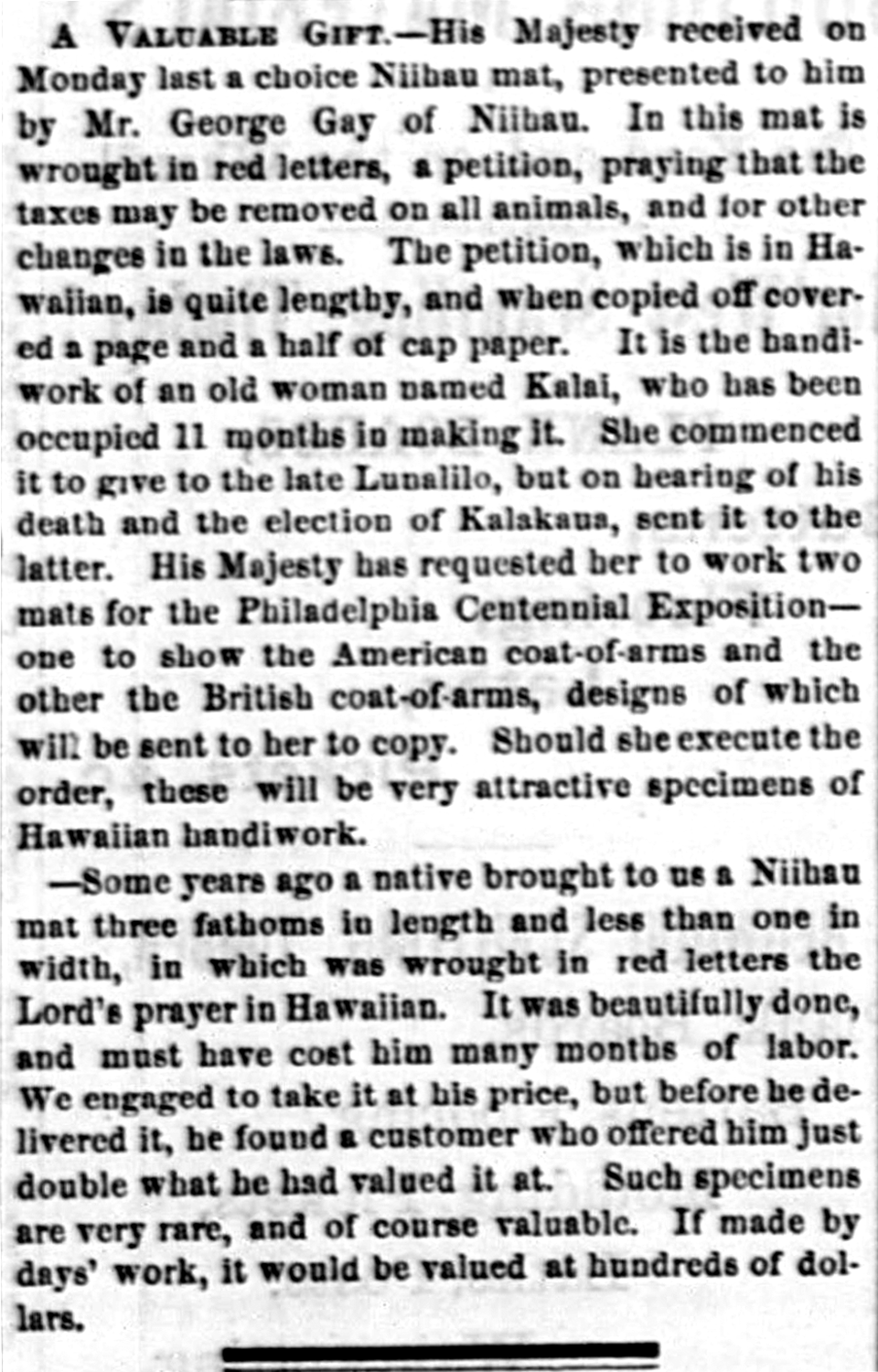
A Valuable Gift.—His Majesty received on Monday last a choice Niihau mat, presented to him by Mr. George Gay of Niihau. In this mat is wrought in red letters, a petition, praying that the taxes may be removed on all animals, and for other changes in the laws. The petition, which is in Hawaiian, is quite lengthy, and when copied off covered a page and a half of cap paper. It is the handiwork of an old woman named Kalai, who has been occupied 11 months in making it. She commenced it to give to the late Lunalilo, but on hearing of his death and the election of Kalakaua, sent it to the latter. His Majesty has requested her to work tow mats for the Philadelphia Centennial Exposition—one to show the American coat-of-arms and the other the British coat-of-arms, designs of which will be sent to her to copy. Should she execute the order, these will be very attractive specimens of Hawaiian handiwork.

—Some years ago a native brought to us a Niihau mat three fathoms in length and less than one in width, in which was wrought in red letters the Lord’s prayer in Hawaiian. It was beautifully done, and must have cost him many months of labor. We engaged to take it at his price, but before he delivered it, he found a customer who offered him just double what he had valued it at. Such specimens are very rare, and of course valuable. If made by days’ work, it would be valued at hundreds of dollars.

[This mat was put on display at the Bishop Museum just yesterday. Go check it out if you are on Oahu nei.]

(Hawaiian Gazette, 4/29/1874, p. 3)

A Valuable Gift.

Hawaiian Gazette, Volume X, Number 17, Page 3. Aprila 29, 1874.