Treasures spread across the four corners of the earth? 1906.

Auction Sale

Tourists! Collectors!

Thursday, Feb. 1, 1906,

10 O’CLOCK A. M.,

At my salesroom, 847 Kaahumanu Street, I will sell, under instruction from the Administrators of the Estate of

MARY AILAU

the eminent Hawaiian collector, the following ancient and other relics of

Ancient Chiefs

Pig Platters,

Calabashes,

Cocos (Calabash Nets),

Tapas,

Stone Adzes,

Stone Lamps,

Mike Stones,

Poi Pounders,

49 Fans,

2 Kauila Aumakuas (War Spears),

2 Hula Drums (Ancient),

1 Idol—Kukaili-iki—One of Kamehameha’s War Gods,

1 Ipu Hula (Gourd Drum),

1 Pawehe Calabash,

1 Pawehe Water Bottle,

1 Newa (War Club),

2 Bamboo Cushions,

1 Hinai Opae,

2 Samoan War Clubs,

1 Koko (Ancient),

1 Black Kapa (Burial),

1 Lauhala Hall Mat,

7 Samoan Cocoanut Bowls,

1 Lauhala Bag,

1 Case Stuffed Hawaiian Birds,

1 Aumakua,

1 Kauila Kahili Stick,

1 Kahili Stick (Tortoise) and Ivory (Ancient),

2 Emu Eggs,

1 Carved Coco Bank,

1 Large Show Case,

4 Lei Hulus (Native Birds),

1 Samoan War Club,

1 Moss Album.

JAMES F. MORGAN,

AUCTIONEER.

(Pacific Commercial Advertiser, 1/29/1906, p. 8)

Auction Sale

The Pacific Commercial Advertiser, XLIII, Number 7324, Page 8. January 29, 1906.

Changing values and the sad end to Kahaulelio’s Fishing Traditions, 1902.

With the death of David Kaukaha Kanewanui (Kamehameha class of ’94), editor of the Kuokoa and great advocate of traditions, and the rise of the young inexperienced editor, David Laanui A-i (Kamehameha class of ’93), the treatise on traditional fishing techniques by Daniela Kahaulelio was found no longer important. It came to an abrupt end without being completed. This short blurb was all that I could find explaining its demise.

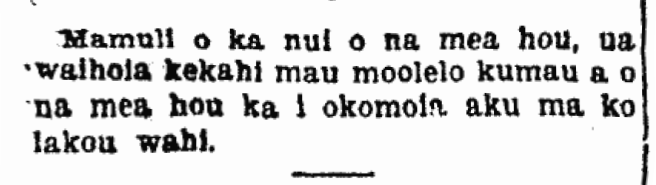
 Mamuli o ka nui o na mea hou, ua waihoia kekahi mau moolelo kumau a o na mea hou ka i okomoia aku ma ko lakou wahi.

Because of the great amount of news, several regular moolelo were put aside, and replaced with other new material.

[See more here from Nanea Armstrong-Wassel. See more here as well from a previous post on Kahaulelio’s fishing treatise.]

(Kuokoa, 7/11/1902, p. 6)

Mamuli o ka nui o na mea hou...

Ka Nupepa Kuokoa, Buke XL, Helu 28, Aoao 6. Iulai 11, 1902.

History and the kahu hanai of Kamehameha, 1911.

RESPONSE OF O-U KA MAKA O KA WAUKE OI OPIOPIO.

O Mr. Editor of the Kuokoa. With appreciation: Please allow my clarification pertaining to the person who raised Kamehameha I. which was shown in the newspaper Kuokoa Home Rula of the past 10th of February, 1911, which said that it was Naeole who raised him. Forgive me for my late response, but I just received the issue of the aforementioned newspaper from a friend last week, and so that the true person who raised Kamehameha I. is known, who is not Naeole, that is the reason I am disseminating this information without the intent to show my relation to royal genealogy, being that it is shameful to speak haughtily; there are many now living who are related to alii and who prize the alii genealogist who are written in the books about the relatives of the parents of Kamehameha I., and here they are:

Keaweikekahialiiokamoku (m) dwelt with Kalanikauleleiaiwi (f), born was Keeaumoku (m).

Keeaumoku (m) dwelt with Kamakaimoku (f), born was Keoua (m), the father of Kamehameha I.

Here is the mother’s side; Kalanikauleleiaiwi (f) dwelt with another kane, Kauauanuiamahi (m), born was Haae (m).

Haae (m) dwelt with Kekelaokalani (f), born was Kekuiapoiwa (f), the birth mother of Kamehameha I.

Kamehameha I was born of Kekuiapoiwa (f) at Ainakea, Kohala, Hawaii. They were living there at the time, and that is where King Kalakaua searched for and built the statue of Kamehameha I, and that is the truth; that is what I heard from my kupuna; he was not born on a canoe and not in Halawa or Kokoiki as it is being fabricated. Here is the story of his birth: Continue reading

Hawaiian Music, an editorial, 1911.

How Hawaiian Music is Being Misconstrued!

Perhaps the thoughts of the Kuokoa may not be the same as those of others about the way Hawaiian music is being sung these days, but because we hold dear listening to the beauty and the sweet sounds along with the joy of the voices, therefore the Kuokoa takes up this matter.

It is not something that we Hawaiians should criticize, that singing is something we are proud of, and something that makes this race famous all around the world, by tourists who visit Hawaii nei and hear us singing our enjoyable and entertaining songs, as well as by singing groups being seen travelling about America.

If we were to turn back in time, to many years past, when the Kawaihau Glee Club and many other groups were famous for singing, we will see when comparing them to those performing today, the differences between them; our admiration will be taken by the singing of the old days, which many groups in some places around Hawaii nei still practice that way of singing Hawaiian songs.

Our Hawaiian mele are composed with their many kaona, and it is by how they are sung, if it is not made clear by the lyrics, that give appreciation and admiration to the listener, from Hawaiians to those that don’t know our language, because it is only through the melody of the song that that listener is entertained.

These days however, our singers are following haole style singing; and when songs that we are used to hearing along with their tunes which fill us with energy and enthrallment are changed, when listening to that it is like ridicule, for we are not used to hearing that kind of melody, and Hawaiian songs are not famous for that style of singing.

Our people, from the men to the women are talented with fine singing voices; it is a talent not widely spread amongst other people of the world, but it is not by the the way some people now are singing, but by singing songs as they were sung in years past.

Perhaps the vibrato and the slow and drawn out of singing matches haole songs of this age, but by changing the way Hawaiian songs are sung in this way, we at the Kuokoa are not mistaken when we say that it is insulting to the listener.

We don’t wish to call this person or that one not a good singers, but should we want our goal to be to preserve this fame through song, there is only one arena for us to stand before the other races, that is through expressing what God has given to every Hawaiian man and woman, without mimicking or emulating what other people are doing; lest what is seen by us as good becomes something that is not good.

We have nothing to say to those who are studying music in books; that will be a great benefit to some, but the good seen in one aspect will not get better by changing another aspect; so it is with our Hawaiian music, by changing how they are sung, it will not make them better.

Each and every Hawaiian is the true witness, and they are the perfect judge to weigh what we now discuss, not to criticize or to assail upon someone with words of persecution, but for our affection of the grandeur and true beauty of Hawaiian mele which each and every one of us all love and cherish.

[On a somewhat related topic about tradition and kuleana and mele, there is a very thought-provoking essay for composers and non-composers alike, by Kainani Kahaunaele, printed in The Value of Hawaii 2: Ancestral Roots, Oceanic Visions, just recently out. In fact, if you haven’t got your copy yet, there are many stories by a wide range of writers in there that we should look at, and perhaps the many moolelo within the collection will then push us into thinking what we ourselves feel the value of Hawaii nei is and where we should be headed and what it is we need to do to get us there.]

(Kuokoa, 9/8/1911, p. 4)

PEHEA E HOOHEPAIA MAI NEI NA HIMENI HAWAII!

Ka Nupepa Kuokoa, Buke XLVII, Helu 36, Aoao 4. Sepatemaba 8, 1911.

Hula, mele, and tradition, 1928.

IN SEARCH OF HULA, OLIOLI HOAEAE, AND HAWAIIAN SONGS

There are some people here trying to find once more the hula, chants, and songs of old Hawaii.

Some people believe that it would be good to perpetuate the hula and olioli hoaeae of the the old. Some believe strongly that it is a waste of time or that type of endeavor would be old fashioned [olopaikini].

Some people think that it is very good for Hawaiian things to be fostered, and they are attempting to put an end to improper things like the kind of hula olapa of some people done in public. Continue reading