Lei Day in Honolulu, 1928.

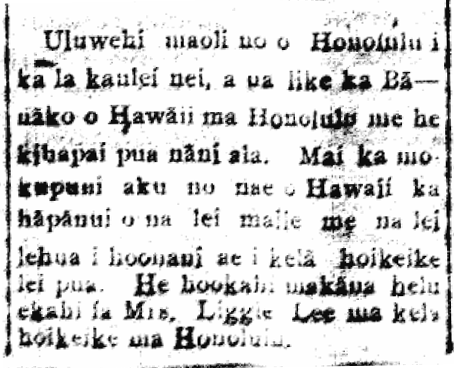
Honolulu was truly festive on this day to wear lei, and so too was the Bank of Hawaii in Honolulu, which was like a lovely flower garden. Most of the maile lei and lehua lei which decorated that display of flower lei were however from Hawaii Island. The single first prize went to Mrs. Liggie [Liggle?] Lee at that show in Honolulu.

(Hoku o Hawaii, 5/8/1928, p. 2)

Uluwehi maoli no o Honolulu...

Ka Hoku o Hawaii, Buke XXI, Helu 48, Aoao 2. Mei 8, 1928.

More from David Keaweamahi on Japanese contract laborers, 1890.

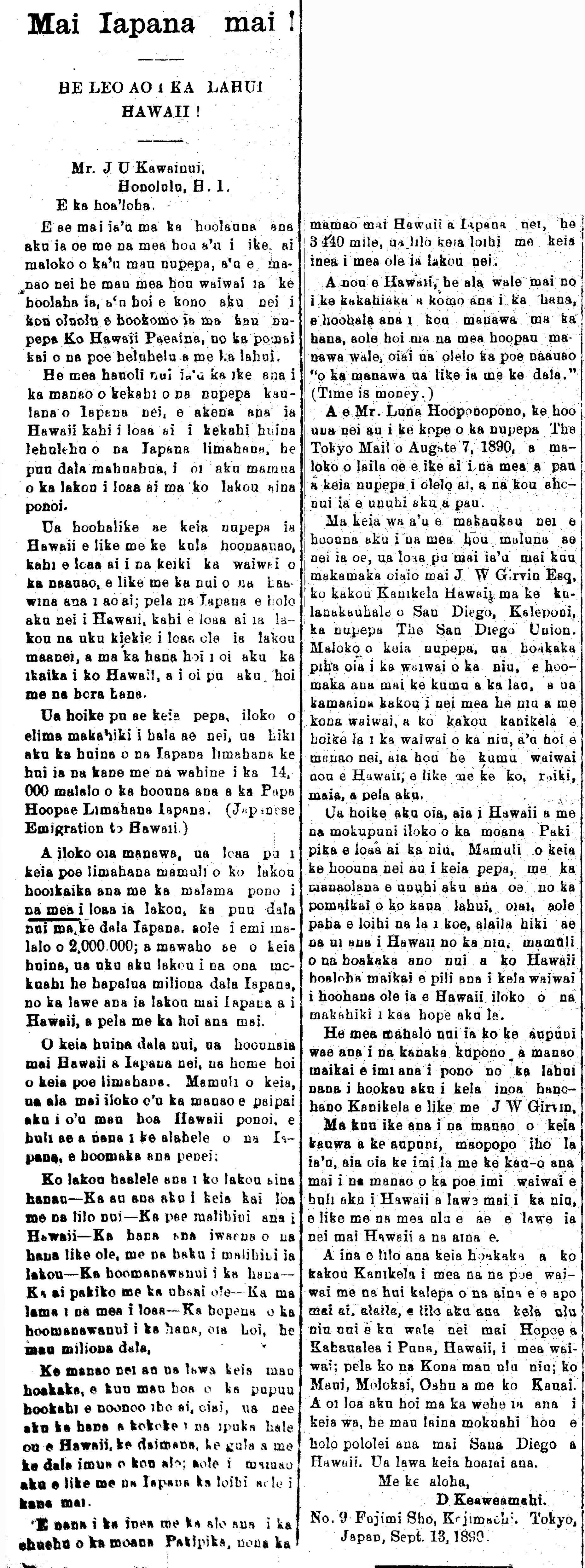
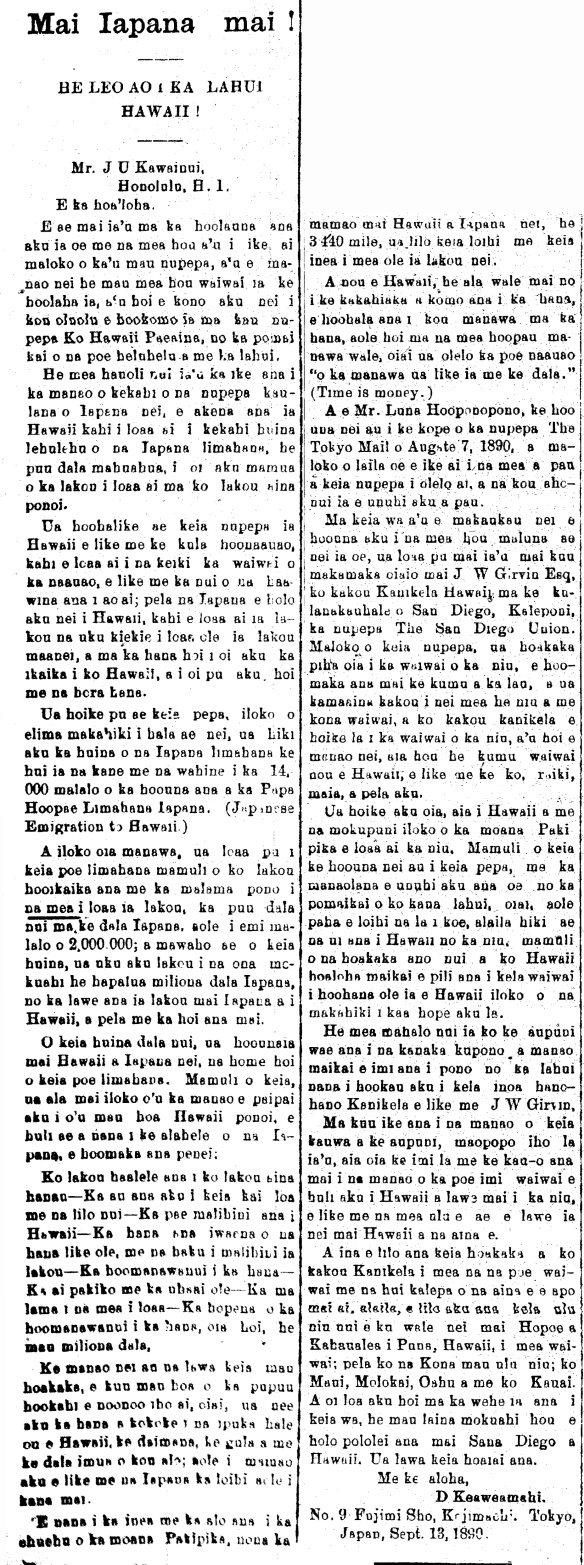
From Japan!

INFORMATION FOR THE HAWAIIAN PEOPLE!

Mr. J. U. Kawainui,

Honolulu, H. I.

O Friend,

Please allow me to introduce you to the new things I have seen in my newspaper which I believe are new information important to spread; which I invite you to kindly insert into your newspaper, Ko Hawaii Pae Aina, for the benefit of the readers and the nation.

I was pleased to see the thoughts of a famous newspaper of Japan, praising Hawaii as the place where a great number of Japanese laborers obtained a big sum of money, more than they’d receive in their homeland.

This newspaper likened Hawaii to a school of education, where a child receives the wealth of knowledge, equal to the amount of lessons he studies; so too with the Japanese who are going to Hawaii, where they get high salaries that they’d not get here, and for more intense work than in Hawaii, along with more hours.

This paper also stated that within the past five years, the total number of Japanese laborers including men and women has reached 14,000, sent by the Board for Emigration of Japanese Laborers.

And within this period, these laborers, as a result of their effort and their saving of what they earned, made a great amount in Japanese money, not less than 2,000,000 yen; and not included with this, they paid the ship owners half a million yen to take them from Japan to Hawaii and return.

This great sum of money was sent from Hawaii to here in Japan, the home of these laborers. As a result, there rose within me the desire to encourage my own Hawaiian friends to take a look at the path taken by the Japanese, starting like this:

Their departure from the land of their birth—Their travelling across the great ocean at great expense—The landing as strangers in Hawaii—Working all sorts of jobs for a boss who is a stranger—Enduring the work—Eating only a little without wasting—Caring for what they have—The results of their putting up with the work, that being millions of dollars.

I believe that this is ample explanation, O Friends of the same womb, for you to think about; for the work has come to your door O Hawaiians—diamonds, gold, and money, right before your eyes; it is not far away like for the Japanese for whom it is far, far away.

Look at the hardships and the facing of the spray of the Pacific Ocean whose distance from Hawaii to Japan is 3,440 miles; this distance and hardships became nothing to them.

And you, O Hawaiians, you wake up in the morning and take up your work, and put in your time working, and not with things that waste your time, as goes the saying of the educated people: “Time is like money.”

And O Mr. Editor, I am sending a copy of the newspaper, “The Tokyo Mail” of August 7th, 1890, and within it you will see all of what this paper has said, and it is for you to patiently translate it all.

As I am preparing to send to you the news above, I have also received from my true friend, J. W. Girvin, Esq., our Hawaiian Consul in the city of San Diego, California, the newspaper “The San Diego Union”. Within this paper, he explained fully the value of coconuts, starting from the trunk to the leaves; we are familiar with coconuts and its value; and with our consul explaining the value of the coconut, I am thinking that there are also other sources of wealth for you, O Hawaiians, like sugarcane, rice, bananas, and so forth.

He explains that coconuts can be found in Hawaii and the islands of the Pacific Ocean. Therefore, I am sending this paper with hopes that you will translate it for the good of our people, being that it should not be long before Hawaii starts receiving inquiries for coconuts because of this important description of Hawaii’s good friend dealing with the asset not put to use by Hawaiians in the past years.

It is a very admirable thing that the government selects good people with good ideas to search after the well being of the people that conferred upon him that honorable title, Consul, like J. W. Girvin.

When I look at the ideas of this servant of the nation, I know that he is searching while pulling along the minds of entrepreneurs to look to Hawaii to export coconuts, like the other produce exported from Hawaii to other lands.

And should this description of our Consul become something that the wealthy people and trade companies of foreign lands latch on to, then those great fields of coconut from Hopoe until Kahaualea in Puna, Hawaii will become a source of wealth; so too the stands of coconut in the Kona districts, along with those of Maui, Molokai, Oahu and Kauai. And even more so, with the opening these days of new steamship lines which go directly from San Diego to Hawaii. This clarification should be sufficient.

With aloha,

D. Keaweamahi.

No. 9 Fujimi Sho [Fujimi-cho], Kojimachi, Tokyo, Japan, Sept. 13, 1890.

[As we celebrate Merrie Monarch week, Japanese contract laborers is one of Kalakaua’s many legacies…]

(Ko Hawaii Pae Aina, 9/27/1890, p. 2)
Mai Iapana mai!

Ko Hawaii Pae Aina, Buke XIII, Helu 39, Aoao 2. Sepatemaba 27, 1890.

Poi description in English. 1909.

[Found under: “Our English Items”]

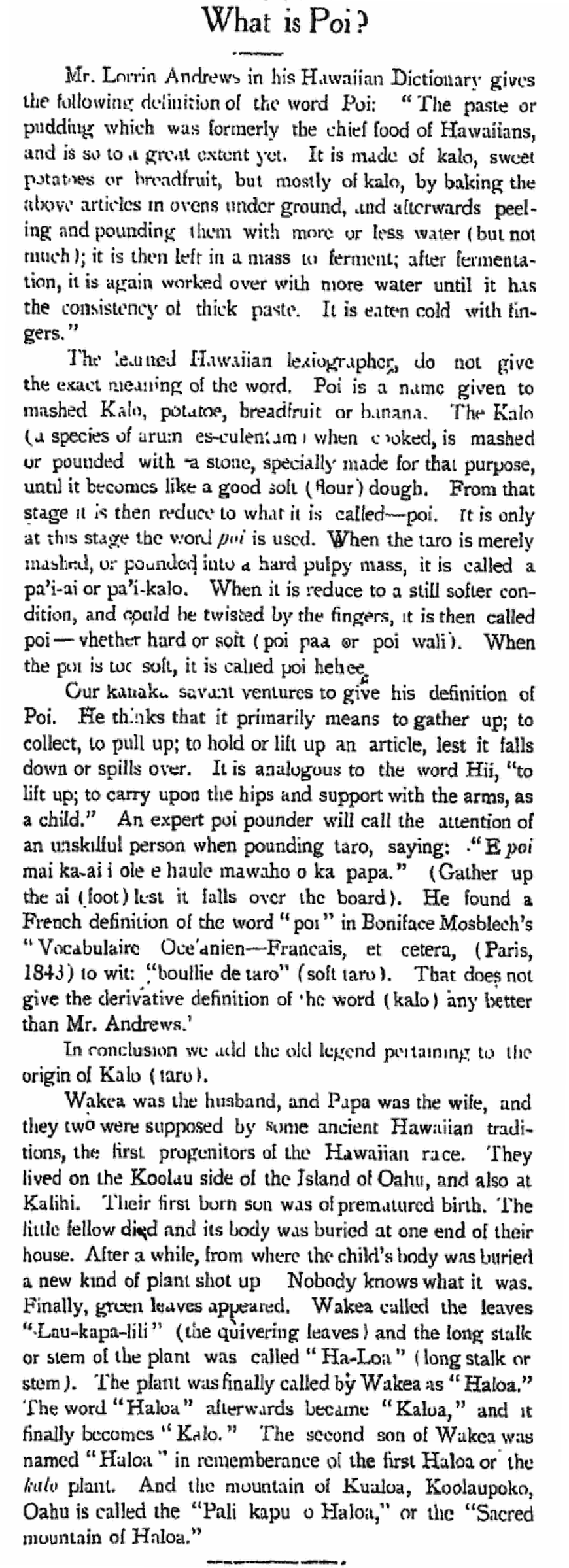
What is Poi?

Mr. Lorrin Andrews in his Hawaiian Dictionary gives the following definition of the word Poi: “The paste or pudding which was formerly the chief food of Hawaiians, and is so to a great extent yet. It is made of kalo, sweet potatoes or breadfruit, but mostly of kalo, by baking the above articles in ovens under ground, and afterwards peeling and pounding them with more or less water (but not much); it is then left in a mass to ferment; after fermentation, it is again worked over with more water until it has the consistency of thick paste. It is eaten cold with fingers.”

The learned Hawaiian lexiographer [lexicographer] do not give the exact meaning of the word. Poi is a name given to mashed Kalo, potatoe, breadfruit or banana. The Kalo (a species of arum ex-culentum [arum esculentum] when cooked, is mashed or pounded with a stone, especially made for that purpose, until it becomes like a good soft (flour) dough. From that stage it is then reduce to what is called—poi. It is only at this stage the word poi is used. When the taro is merely mashed, or pounded into a hard pulpy mass, it is called a pa’i-ai or pa’i-kalo. When it is reduced to a still softer condition, and could be twisted by fingers, it is then called poi—whether hard or soft (poi paa or poi wali). When the poi is too soft, it is called poi hehee.

Our kanaka savant ventures to give his definition of Poi. He thinks that it primarily means to gather up; to collect, to pull up; to hold or lift up an article, lest it falls down or spills over. It is analogous to the word Hii, “to lift up; to carry upon the hips and support with the arms, as a child.” An expert poi pounder will call the attention of an unskillful person when pounding taro, saying: “E poi mai ka ai i ole e haule mawaho o ka papa.” (Gather up the ai (foot [food]) lest it falls over the board). He found a French definition of the word “poi” in Boniface Mosblech’s “Vocabulaire Oce’anien—Francais, et cetera, (Paris, 1843) to wit: “boullie de taro” (soft taro). That does not give the derivative definition of the word (kalo) any better than Mr. Andrews.

In conclusion we add the old legend pertaining to the origin of Kalo (taro).

Wakea was the husband, and Papa was the wife, and they two were supposed by some ancient Hawaiian tradition, the first progenitors of the Hawaiian race. They lived on the Koolau side of the Island of Oahu, and also at Kalihi. Their first born son was of premature birth. The little fellow died and its body was buried at one end of their house. After a while, from where the child’s body was buried a new kind of plant shot up. Nobody knows what it was. Finally, green leaves appeared. Wakea called the leaves “Lau-kapa-lili” (the quivering leaves) and the long stalk or stem of the plant was called “Ha-Loa” (long stalk or stem). The plant was finally called by Wakea as “Haloa.”

(Kuokoa Home Rula, 1/1/1909, p.1)

What is Poi?

Kuokoa Home Rula, Buke VII, Helu 1, Aoao 1. Ianuari 1, 1909.

Description of native flora, 1857.

Hard Wood.

O Hae Hawaii:

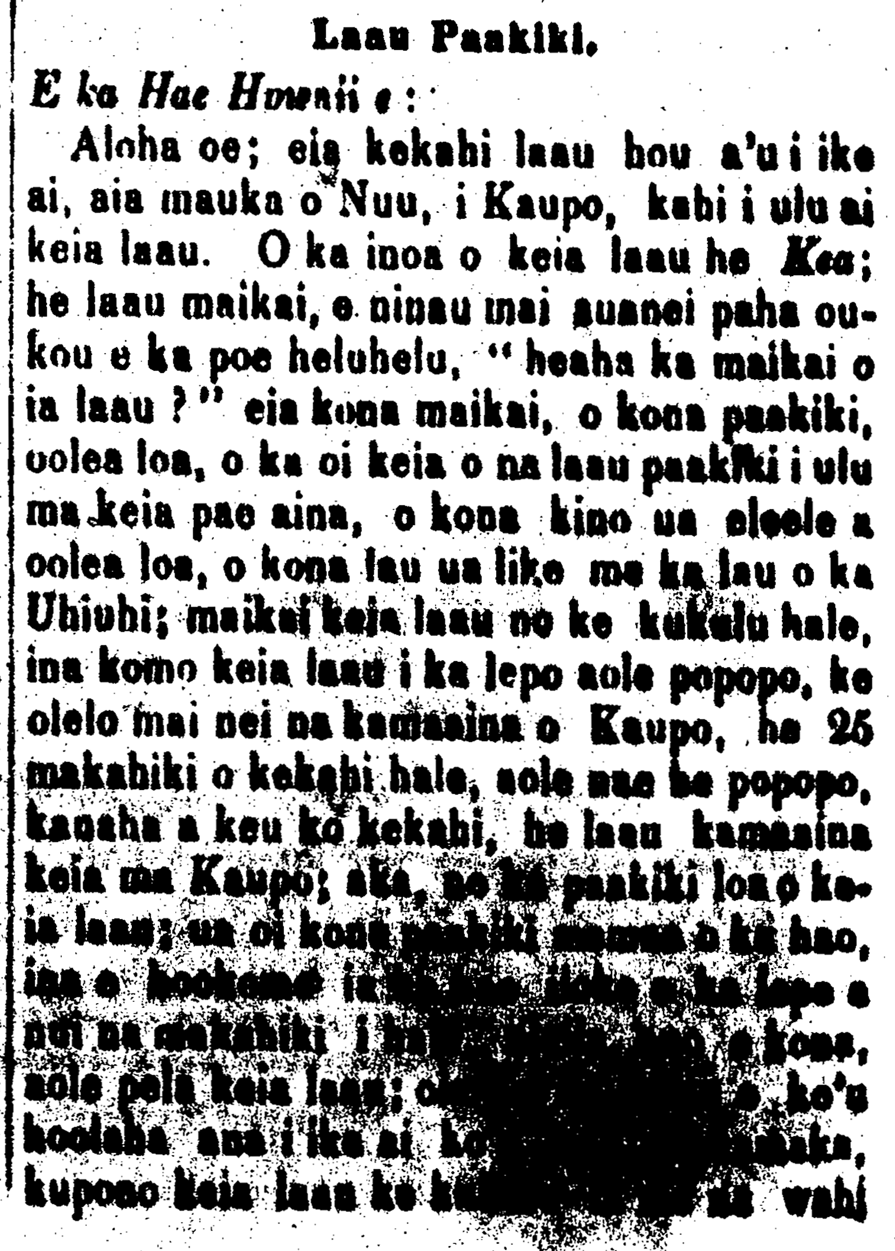
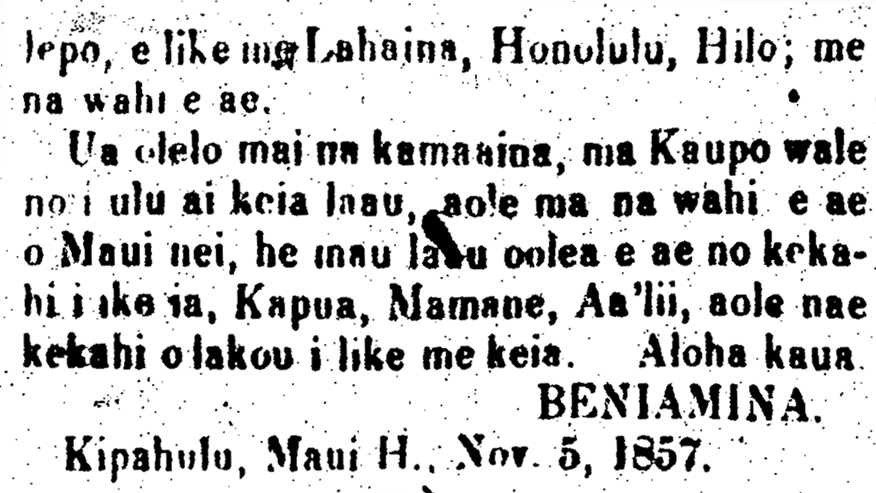
Aloha oe: this is a new tree I have seen, this tree grows in the uplands of Nuu, in Kaupo. The name of this tree is Kea, and it is a useful tree. You, the reader may ask, “What is good about this tree?” And this is why it is good, because of its solidness; it is very strong, it is the strongest tree growing in this archipelago; its body is black and it very strong, its leaves are like that of the Uhiuhi. This tree is good for house building; if the wood is put into dirt, it doesn’t rot. The natives of Kaupo say that some houses are over 25 years old and there is no rot, and some are over forty years old. It is a familiar tree in Kaupo. But because it is so solid, it is stronger than metal, in that if you put metal into the earth and many years go by, it deteriorates; not so of this wood. This is the reason I am getting the word out, so that my friends will know that this is a good wood for building in dirt, like in Lahaina, Honolulu, Hilo, and other places.

The locals say that it is only in Kaupo that this tree grows, and not any other place on Maui; there are other known strong-wooded trees like Kapua [Pua?], Mamani, and Aalii, but none are like this. Aloha amongst us.

Beniamina.

Kipahulu, Maui, Hawaii, Nov. 5, 1857.

(Hae Hawaii, 11/18/1857, p. 133 & 34)

Laau Paakiki.

Ka Hae Hawaii, Buke 2, Ano Hou----Helu 34, Aoao 133. Novemaba 18, 1857.

Laau Paakiki (hoomau ia).

Ka Hae Hawaii, Buke 2, Ano Hou----Helu 34, Aoao 134. Novemaba 18, 1857.

Awa for sale! 1917.

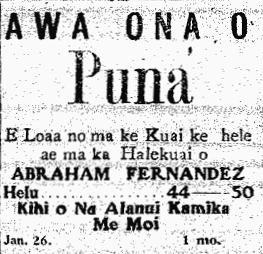
INTOXICATING AWA OF

Puna

Available for Purchase when you go
to the Shop of
ABRAHAM FERNANDEZ
Number 44———50
Corner of Smith Street
and King.

[Awa appears in the Hawaiian-Language Newspapers from early on, presented both negatively and positively. I will put up more on this topic as time goes on…]

(Puuhonua o na Hawaii, 1/26/1917, p. 4)

AWA ONA O Puna

Ka Puuhonua o na Hawaii, Buke IV, Helu 4, Aoao 4. Ianuari 26, 1917.