Mele, translations, and pen names, 1915.

[Found under: “Big Island News”]

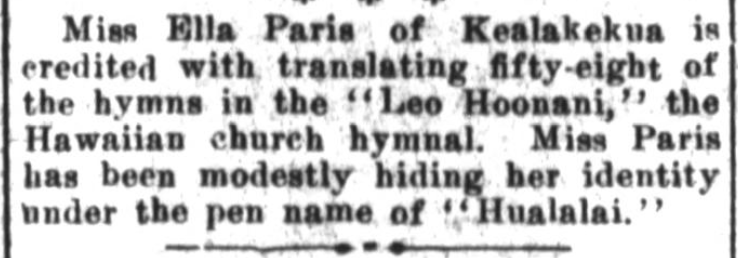
Miss Ella Paris of Kealakekua is credited with translating fifty-eight of the hymns in the “Leo Hoonani,” the Hawaiian church hymnal. Miss Paris has been modestly hiding her identity under the pen name of “Hualalai.”

[Although this pen name seems to be widely known, it is often difficult to ascertain the identities of people who use pen names. Every so often there are articles like this in the newspapers (and elsewhere)!]

(Hawaiian Gazette, 7/16/1915, p. 8)

Miss Ella Paris...

Hawaiian Gazette. Volume VIII, Number 57, Page 8. July 16, 1915.

Translation of a song from afar, 1876.

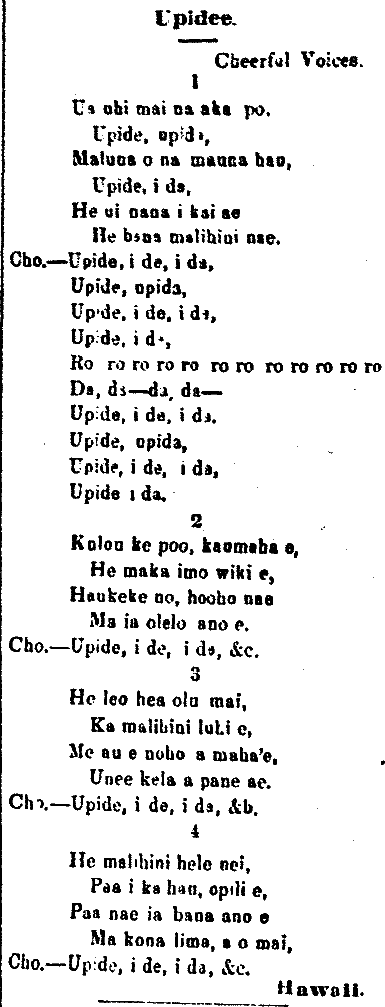
Upidee.

1
The shadows of night covered over
Upide, upida,
Atop the snowy mountains,
Upide, i da,
A youth came marching
[With] a strange banner.

Chorus.–Upide, i de, i da,
Upide, upida,
Upide, i de, i da,
Upide, i de,
Ro ro ro ro ro ro ro ro ro ro ro ro
Da, da—
da, da—
Upide, i de, i da,
Upide, upida,
Upide, i de, i da,
Upide i da.

2
Head bowed down, so sad,
And a quick wind of the eye,
Shivering, yet exclaimed
In that strange language,

Cho.–Upide, i de, i da, &c.

3
There was a kind voice of welcome,
Oh stranger,
Come rest here with me,
He moved on and answered,

Cho.–Upide, i de, i da, &c.

4
There is a stranger travelling,
Covered in snow, and numb,
Yet holding on to that strange banner,
In his hands, and calling,

Cho.–Upide, i de, i da, &c.

Hawaii.

[The person using the pen name “Hawaii” translates a great number of hymns and songs in general.

If you are interested in what this American Civil War song sounded like in English (and I suppose you can imaging the Hawaiian as a result), see: Smithsonian Folkways, Upidee, Tom Glazer, or: Legacy Preservation Society, Songs We Like to Sing, 1912, or even the Muppets, here at 1:00!]

(Kuokoa, 5/27/1876, p. 4)
Upidee

Ka Nupepa Kuokoa, Buke XV, Helu 22, Aoao 4. Mei 27, 1876.

“American Queen”? 1917.

QUEEN LILIUOKALANI.

Clarifications by a Newspaper Writer about Her.

(Translated)

To “Ke Ola o Hawaii,”

Appearing in the British newspaper, The Outlook, of the other week, there were a number of awe-inspiring lines about our Queen, Liliuokalani, titled: “An American Queen.” This is how it went:

Americans sometimes forget that within one of the Territories of the United States there lives a real ex-Queen who owes the loss of her crown to the activities of American missionaries.

This Queen is, of course, Liliuokalani, of Hawaii, dethroned in the revolution of 1893. She is now a frail old lady of nearly seventy-nine years, and few but her immediate household and closest friends ever have the opportunity of meeting and talking with her.

It is interesting to record that because of one of the tragedies of the present war this aged Queen has permitted for the first time an American flag to fly over her home. The news of this incident comes to us in a letter from a correspondent in Hawaii. This correspondent writes:

It was my privilege a few days ago to attend what will possibly be the last public reception she will ever give to members of the Hawaiian Senate—some of her own race, and some sons of the missionaries who were mainly responsible for her overthrow. Although they belonged to a body absolutely democratic in form and elected by vote of the people as citizens of the United States, it was most interesting and somewhat touching to note the loyalty and love shown the aged ex-Queen: almost, one could imagine, as if she were still their reigning sovereign. Continue reading

Re-population in the eyes of the haole, 1876.

Palapala Hoopii i ka Moi.

Ka Hooulu Lahui.

[This memorial urging re-population of the nation was probably an English document, translated here into Hawaiian. For the English and the interesting list of signatures, see the following post.]

(Kuokoa, 3/18/1876, p. 1)

Palapala Hoopii i ka Moi.

Ka Nupepa Kuokoa, Buke XV, Helu 12, Aoao 1. Maraki 18, 1876.

More on the originator of Lei Day, Don Blanding, 1939.

Don Blanding Dedicates this poem to the oldsters of Hawaii

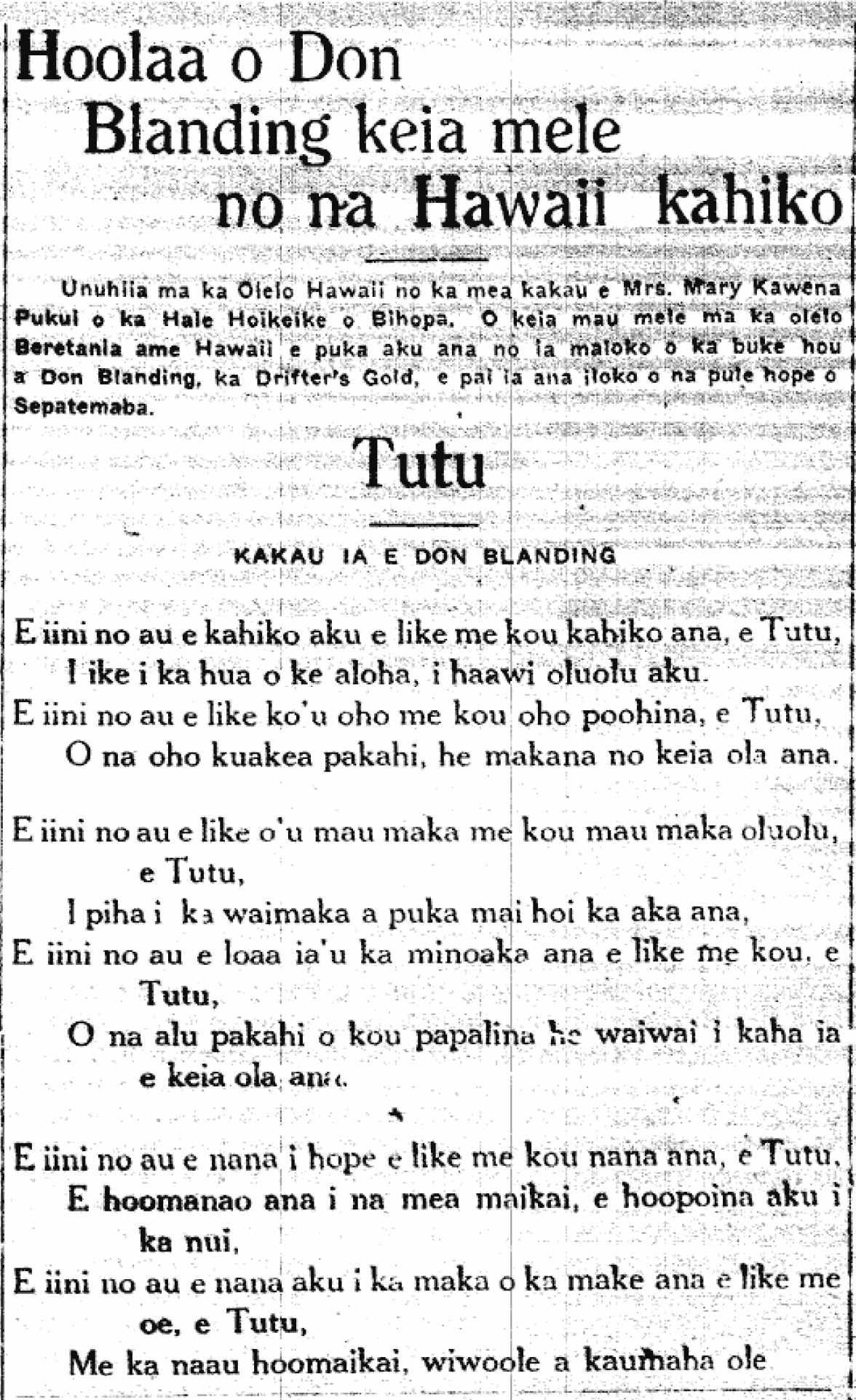
This was translated into Hawaiian for the writer by Mrs. Mary Kawena Pukui of the Bishop Museum. These mele in English and Hawaiian will come out in the new book by Don Blanding, Drifter’s Gold, which will be published in the last week of September.

Tutu

WRITTEN BY DON BLANDING

E iini no au e kahiko aku e like me kou kahiko ana, e Tutu,
I ike i ka hua o ke aloha, i haawi oluolu aku,
E iini no au e like ko’u oho me kou oho poohina, e Tutu,
O na oho kuakea pakahi, he makana no keia ola ana.

E iini no au e like o’u mau maka me kou mau maka oluolu, e Tutu
I piha i ka waimaka a puka mai hoi ka aka ana,
E iini no au e loaa ia’u ka minoaka ana e like me kou, e Tutu,
O na alu pakahi o kou papalina, he waiwai i kaha ia e keia ola ana.

E iini no au e nana i hope e like me kou nana ana, e Tutu,
E hoomanao ana i na mea maikai, e hoopoina aku i ka nui,
E iini no au e nana aku i ka maka o ka make ana e like me oe, e Tutu,
Me ka naau hoomaikai, wiwoole a kaumaha ole.

(Hoku o Hawaii, 7/12/1939, p. 1)

Hoolaa o Don Blanding keia mele no na Hawaii kahiko

Ka Hoku o Hawaii, Volume XXXIV, Nuimber 11, Aoao 1. Iulai 12, 1939.

Newspapers, translation, and a mele for the Merrie Monarch, 1913 / Timeless.

You can find various translations for the beautiful song, “Kaipoleimanu” in the archives of the Bernice Pauahi Bishop Museum, online, and on liner notes. None however seems to acknowledge that Kaipoleimanu itself was a wahi pana, along with its neighboring hau of Maihi, ulu of Weli [also seen as Wehi], and hala of Mapuana.

There is a priceless church meeting report/travelogue appearing in the Kuokoa from 12/5/1913 to 2/6/1914: Ka Ike Hou ana o ke Kamahele i ka Mokupuni o Kauai [The Traveler Sees Once More the Island of Kauai], signed, Kamahele. Amongst all the fascinating information found in this report is a description of the places hearkened to in the mele Kaipoleimanu, to which the traveller is taken by his guide, the Deputy Sheriff of Hanalei, William Werner. He says: Continue reading

And more on the passing of John G. M. Sheldon, 1914.

JOHN KAHIKINA KELEKONA HAS PASSED.

At nine o’clock in the morning of this past Friday, the life breath of John Kahikina Kelekona left forever at his home; he was a very famous historian, and an old newspaperman in this town in years past, and his famous works will become an unforgettable monument to him.

He left behind many children, six daughters and two sons. The girls are: Mrs. I. Cockett; Mrs. J. R. Francis; Mrs. Ernest Kaai; Mrs. Joseph Namea; Mrs. M. Dutro, of Wailuku, Maui; Miss Emma Sheldon; and the boys are: D. K. Sheldon and Henry Sheldon, who work as clerks on inter-island steamships.

He left also two brothers [hoahanau]: William J. Sheldon, one of the esteemed members of the legislature some sessions ago, and Lawrence K. Sheldon who is with the law enforcement office in Honolulu. Continue reading

More on John G. M. Sheldon’s passing, 1914.

[Found under: “NUHOU KULOKO”]

On the morning of this Friday, John Kahikina Sheldon, one of the old typesetters, a famous newspaper writer, and translator and interpreter for the court, left this life. He was a fellow laborer in this work. He has gone, but his work will not be forgotten. Aloha indeed.

(Holomua, 3/28/1914, p. 8)

Ua haalele mai i keia ola ana...

Ka Holomua, Buke I, Helu 26, Aoao 8. Maraki 28, 1914.

John G. M. Sheldon passes away, 1914.

SUDDEN DEATH OF J. G. M. SHELDON

John G. M. Sheldon, brother of Henry Sheldon, of Lihue, and Wm. J. Sheldon, formerly of Waimea, died in Honolulu of hemorrhage last Friday morning. He had been in rather poor health for several years. Henry Sheldon left by the Kinau Saturday for Honolulu to attend the funeral, which took place Sunday afternoon.

Mr. Sheldon was one of the oldest printers in the Islands, having begun work as such when quite young. Being proficient in both the English and Hawaiian languages, he was frequently employed as interpreter in the courts and elsewhere. He had many friends by whom he was well liked.

(Garden Island, 3/31/1914, p. 1)

SUDDEN DEATH OF J. G. M. SHELDON

The Garden Island, Volume 10, Number 12, Page 1. March 31, 1914.

Bilingual law announcements in English-language newspapers, 1902.

BY AUTHORITY.

REGULATIONS
FOR
HACK AND FOR PASSENGER VEHICLES
AND
RATES OF FARE.

By virtue of the authority in me vested and under the provisions of Section 794 of Chapter 55, of the Penal Laws of 1897, I, James H. Boyd, Superintendent of Public Works of the Territory of Hawaii, do make and declare the following Rules and Regulations to be observed by Licensed Carriers of Passenger Vehicles, in the District of Honolulu:

1st. Every licensed carriage, dray or vehicle must be numbered, and this number must be placed on a conspicuous part of the carriage, dray or vehicle.

2d. Every licensed carriage running at night must exhibit two lights, and the number of such carriage plainly shown on the glass of each lantern, in black figures, not less than one and one-half (1½) inches in height.

3d. Drivers of licensed vehicles must obey the orders of the Police.

4th. On all stands set apart for licensed carriages the horses must be headed parallel to the street, and close to the sidewalk.

5th. No horse harnessed to a licensed vehicle must be left on any stand unless properly secured by a hitching rope to an iron hitching weight.

6th. No licensed carriage will be allowed to be left on the street over night. Continue reading