Hail nearly the size of chicken eggs in Keaukaha, 1920.

There was heavy lighting and thunder in the evening of this past Monday, and hail [hua hekili] fell in some places of Keaukaha. Some of the hailstones that the children of a haole family staying there that evening picked up were almost the size of chicken eggs. Hail broke through the shingles of a house there.

(Hoku o Hawaii, 4/1/1920, p. 2)

Ikaika ka uwila...

Ka Hoku o Hawaii, Buke XIII, Helu 44, Aoao 2. Aperila 1, 1920.

Mrs. A. B. Palea reports on news from Kauai, 1939.

Various news from Kauai

Kekaha, Kauai

Dec. 18.

With Appreciation to the Editor of the Newspaper Ka Hoku o Hawaii.

Much aloha between us.

Please allow me some room on the deck of our beloved esteemed one. And it will be for you to carry the bits of news of the Flower garden famed for the Cherished Scent of Mokihana.

Kauaiomanookalanipo.

Kekaha, Kauai: The birthday of one of our granddaughters, Hildren Kawehionapuanani Palea, was celebrated at the home of our children, Mr. and Mrs. W. Palea, Jr.

The ohana who came were:

Mrs. A. B. Palea

Mr. & Mrs. Wailiula, Mrs. Dora Fellez, Miss Emily Niau, Mr. and Mrs. F. Furtado, W. Lalana Furtado, F. Kamakanaokalani Furtado, G. Keolamauloa Furtado, Oleiponimoi Furtado, D. Kealohaokalani Furtado, Mr. and Mrs. P. Palea, Miss Kananiokaohu Palea, and me, the one who is writing this reflection.

It was for our grandchild who is two years old, and we give our thanks to our Almighty Father for blessing his young servant, her parents, and entire family. With appreciation.

——— Continue reading

More from the mele aloha aina by G. K. Keawehaku, 1919.

[From the mele: “OIA ANEI? OIA NO.”]

Me he punohu ula la,
No Alenuihaha oluna ae;
Me he onohi ahiahi la,
No Alalakeiki oluna ae;
Me he ua nonoula la,
No Naeheehe oluna ae;
Me he leikoko-ula la,
No Kealaikahiki oluna ae; Continue reading

Strong winds on Niihau, 1868.

[Found under: “NU HOU KULOKO.”]

Kauai.

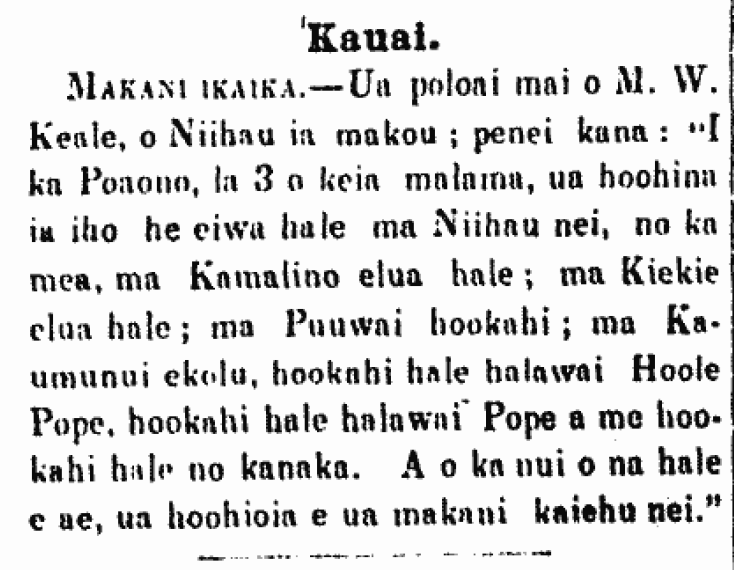
Strong Winds.—M. W. Keale of Niihau told us that on the 3rd of this month, toppled over were nine buildings on Niihau, for there were two in Kamalino; two in Kiekie; one in Puuwai; and three in Kaumunui, one being a Protestant meeting house, one a Catholic meeting house, and one a private residence. And most of the other houses were tilted to the side by the dirt-stirring winds.

(Kuokoa, 10/24/1868, p. 3)

Kauai.

Ka Nupepa Kuokoa, Buke VII, Helu 43, Aoao 3. Okatoba 24, 1868.

Snow… up in the Waianae mountains? 1862.

The Weather.

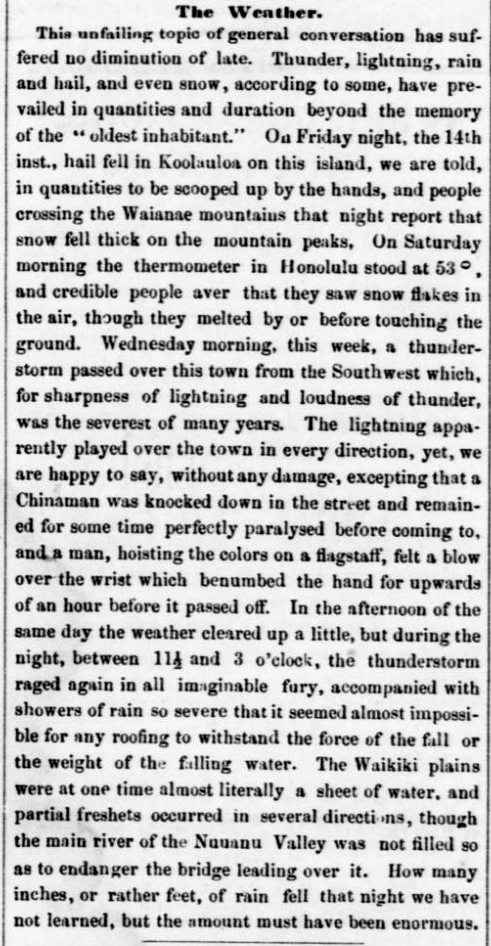
This unfailing topic of general conversation has suffered no diminution of late. Thunder, lighting, rain and hail, and even snow, according to some, have prevailed in quantities and duration beyond the memory of the “oldest inhabitant.” On Friday night, the 14th inst., hail fell in Koolauloa on this island, and we are told, in quantities to be scooped up by the hands, and people crossing the Waianae mountains that night report that snow fell thick on the mountain peaks. On Saturday morning the thermometer in Honolulu stood at 53°, and credible people aver that the saw snow flakes in the air, though they melted by or before touching the ground. Wednesday morning, this week, a thunderstorm passed over this town from the Southwest which, for sharpness of lightning and loudness of thunder, was the severest of many years. The lightning apparently played over the town in every direction, yet, we are happy to say, without any damage, excepting that a Chinaman was knocked down in the street and remained for some time perfectly paralysed before coming to, and a man, hoisting the colors on a flagstaff, felt a blow over the wrist which benumbed the hand for upwards of an hour before it passed off. In the afternoon of the same day the weather cleared up a little, but during the night, between 11½ and 3 o’clock, the thunderstorm raged again in all imaginable fury, accompanied with showers of rain so severe that it seemed almost impossible for any roofing to withstand the force of the fall or the weight of the falling water. The Waikiki plains were at one time almost literally a sheet of water, and partial freshets occurred in several directions, though the main river of the Nuuanu Valley was not filled so as to endanger the bridge leading over it. How many inches, or rather feet, of rain fell that night we have not learned, but the amount must have been enormous.

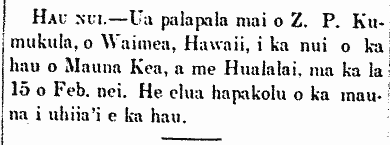
[This was a very strange year. Hualalai was cloaked in snow as well!]

(Polynesian, 2/22/1862, p. 2)

The Weather.

The Polynesian, Volume XVIII, Number 43, Page 2. February 22, 1862.

Hurricane passed by Ulupalakua? 1871.

From Ulupalakua.

O Kuokoa Newspaper; Aloha oe:—

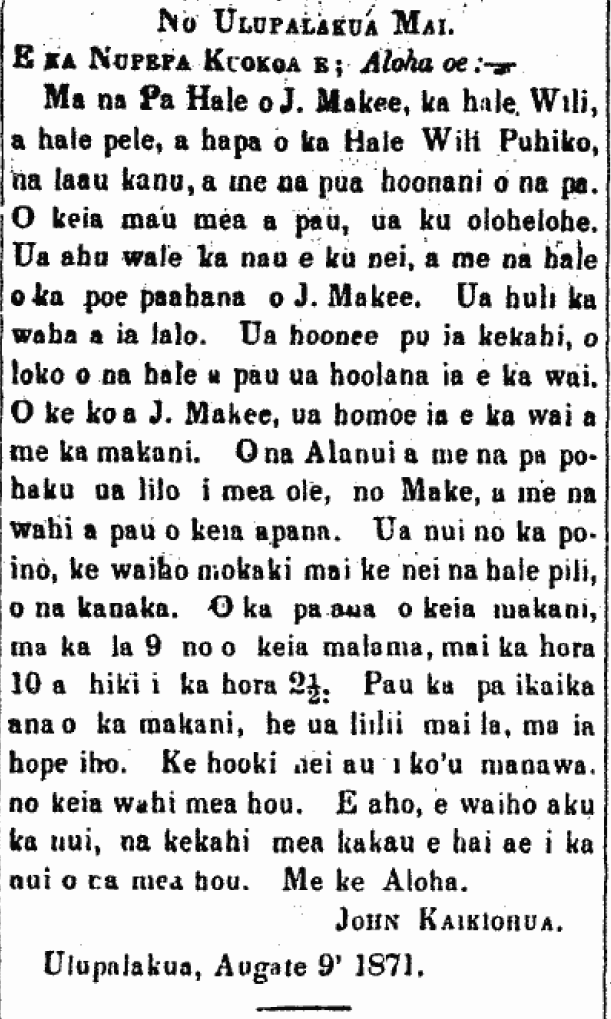
On the Estate of J. Makee, the Mill, the bell house, and a portion of the Mill Boiling House, the trees, and the decorative flowers of the yard. All of these things were left barren. The grinders are standing exposed, and the quarters of the employees of J. Makee were turned over, door faced down. Some were moved; all of the houses were flooded. The sugarcane of J. Makee was pushed down by the water and the wind. The Roads and stone walls turned into nothing, for Makee and all the areas of this district. There was much damage, and the thatched houses of the Hawaiians were left scattered about. This wind on the 9th of this month began at 10 o’clock until 1/2 past 2. After the strength of the wind died down, there was a little rain. I will conclude my time with this news. It would be better if I leave the majority for another writer to talk of the majority of the news. With Aloha.

John Kaikiohua.

Ulupalakua, August 9, 1871.

[John Kaikiohua appears to have been the Head Foreman of James Makee’s sugar plantation. This account is just one of many about the great storm’s affects on Ulupalakua, Makawao, Wailuku, and Hana, appearing in this issue of the Kuokoa.

It is interesting to see that this storm occurred 143 years ago, just one day later from Iselle!]

(Kuokoa, 8/19/1871, p. 3)

No Ulupalakua Mai.

Ka Nupepa Kuokoa, Buke X, Helu 33, Aoao 3. Augate 19, 1871.

Near tragedy on the way from Kauai to Niihau, 1864.

Barely survived at sea

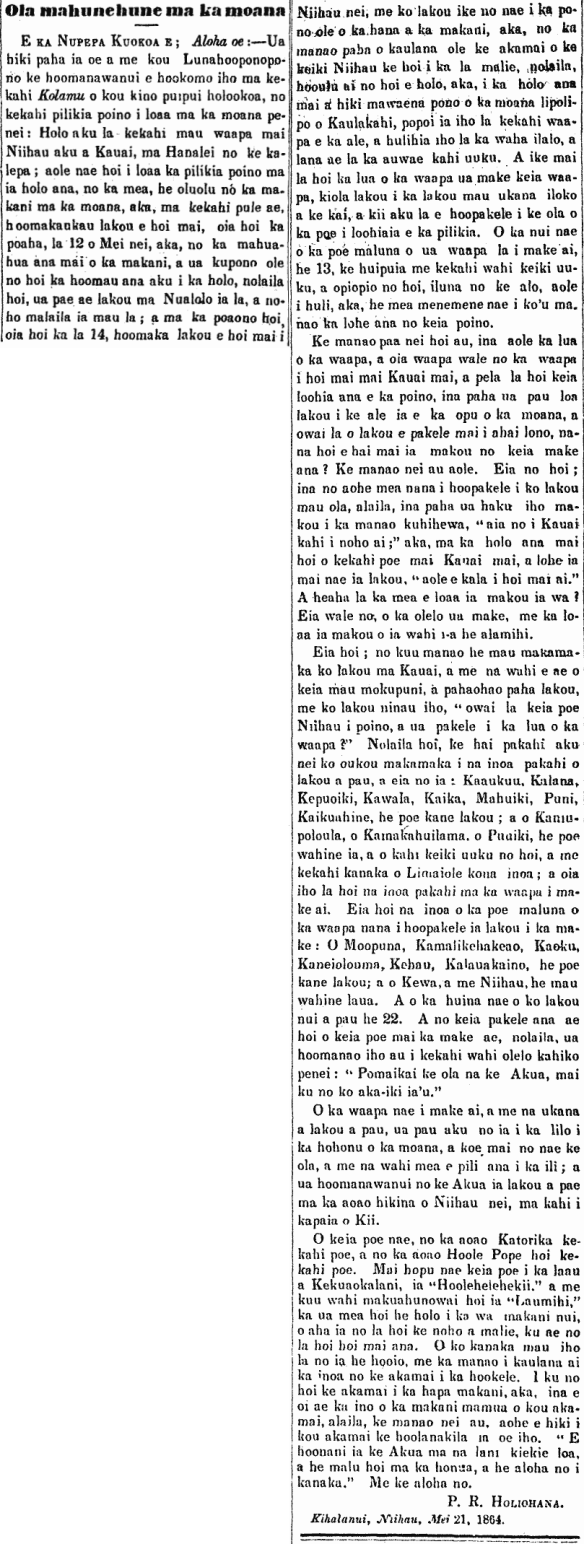
O Kuokoa Newspaper; Aloha oe:—Perhaps you and your Editor can be tolerant and include this in a Column of your entire stout body, about a crisis at sea, like this: Several skiffs left Niihau for Kauai, in Hanalei, to peddle goods; they did not face the crisis during this trip because the winds were calm on the sea, however, the next week they made ready to return, that being Thursday, the 12th of May, but because the wind was growing stronger, it wasn’t appropriate to continue the travels, therefore they landed at Nualolo that day, and stayed there for those days; and on Saturday, the 14th, they made to return here to Niihau while knowing the activity of the wind was bad; perhaps it was because they felt that the skill of the Niihau youth would not be acclaimed should they return in the calm, so they were worked up to sail, but after leaving and reaching the middle of the deep seas of Kaulakahi, one of the skiffs was pounded by a billow, and it overturned, and they were in dire straits. And when the second skiff noticed that this one had sunk, they threw their belongings into the sea and went to save the lives of the people overcome by calamity. The number of people aboard that vessel that had sunk was 13 including a small, young child who wasn’t yet crawling; I felt sorrow when I heard of this tragedy.

I strongly believe that if it wasn’t for the second skiff, and there was but just one skiff returning from Kauai, and they ran into this trouble, then they would be all gone, being swallowed by the belly of the ocean, and which of them would have escaped to be the messenger, the one to tell us of this sinking? I don’t think any one of them. And here is another thing; should none of them have lived, then we would have imagined something that was not true: “They are there living on Kauai;” but when some people from Kauai came and heard of them: “They left a long time ago.” Then what would we have then? Just this, the word that they had died, while accepting that fish, an alamihi.”¹

Here is another thing; being that I believe they have relatives on Kauai, along with other places of these islands, who are full of wonder, asking, “who are these Niihau people who were in trouble, and were they saved by the second skiff” So your friend will give each of their names, and here they are: Kaaukuu, Kalana, Kepuoiki, Kawala, Kaika, Mahuiki, Puni, and Kaikuahine, who are men; and Kamupoloula, Kamakahuilama, and Puuiki, who are women; and the small children and a man named Limaiole; those are the names of each of them in the skiff that sank. These are the names of the people aboard the skiff which saved them: Moopuna, Kamalikehakeao, Kaoku, Kaneiolouma, Kehau, and Kalauakaino, who are men; and Kewa and Niihau, who are women. The total number of them all was 22. And with this saving of these people from death, I recall an old saying: “Life is blessed through God, your snicker was almost fitting for me. [?? “Pomaikai ke ola na ke Akua, mai ku no ko aka-iki ia’u.”

As for the skiff that sunk and all of their cargo, it is all gone into the depths of the ocean, and all that was left are their lives, and what they had on; and God was patient with them and they landed on the east side of Niihau nei, in the place called Kii.

These people, some of them were of the Catholic faith, and some were Protestants. These people nearly grabbed onto the club of Kekuaokalani, “Hoolehelehekii,”² along with my father-in-law, “Laumihi,”³ as they set off in strong winds; what’s wrong with staying put until it is calm and then get up and come back. It is in man’s nature to show off, thinking that he will be famous for his prowess at sailing. You are competent facing a fraction of the wind, but should the ferocity of the wind be greater than your skill, then I believe that your intelligence would not leave you victorious. “Praise god in the high heavens, peace on earth, and good will towards men.” With aloha,

P. R. Holiohana.⁴

Kihalanui, Niihau, May 21, 1864.

¹A play on alamihi crab which can also sound like “path to repentance”.

²A play on the name “Hoolehelehekii,” meaning to be all talk.

³A play on the name “Laumihi,” perhaps meaning much remorse.

⁴P. R. Holiohana is most likely also known as P. R. Holi.

[On a related note, please don’t drive if you have been drinking. It isn’t worth the risk you are putting yourself and others on the road in.]

(Kuokoa, 6/18/1864, p. 4)
Ola mahunehune ma ka moana

Ka Nupepa Kuokoa, Buke III, Helu 25, Aoao 4. Iune 18, 1864.

Wind and Rain and Lighting, oh my, 1863.

Wind and Rain.

O Kuokoa Newspaper: Aloha oe:

On the 13th of Dec. and that night, a very strong wind appeared, along with rain, here in the town of Lahaina. When it came, we were sleeping in our beds, and I was startled by the great roaring of the wind shaking up the whole house. I heard the voice of my sister call out, “It’s a huge wind! It’s a huge wind!!” The buffeting winds passed and following it came heavy showers and Lightning flashing in the west.

The strong winds which appeared here in Lahaina blew against the houses but did not blow any of them down. There were however three ships in the harbor of Lahaina that night: the double-masted Emma Rooke; the Molokai, the double-masted ship of Kamaipelekane; and the Luiki, a single-masted ship. The double-masted Molokai was the ship that was dragged ashore at Puupiha and which broke up into pieces. The wind did not blow very long that night and it abated as night became day.  In the morning, I sailed aboard the single-masted ship to go sell awa; the strong winds reappeared and the anchor of the ship was pulled up. The captain made quick to sail. The double-masted Emma Rooke remained, but because of the terribly strong winds, it weighed anchor and made quick to lie off outside. Aloha by-and-by.

D. W. Kalaeloa.

Lahaina, December 17, 1863.

(Kuokoa, 12/26/1863, p. 3)

Makani ame ka Ua.

Ka Nupepa Kuokoa, Buke II, Helu 52, Aoao 3. Dekemaba 26, 1863.

More on the Earthquake and Tsunami of 1862.

[Found under: “NEWS FROM HERE IN HAWAII.”]

We received a letter from D. W. Kaiue of Waialua, Molokai, written on the 3rd of Feb. telling of the great tsunami [kaikoo] at Molokai. And these are his words:

“This Tuesday, the 28th of this past January. A high tide began in Kona, Molokai. This is the first time such big waves were seen here; the kamaaina said that they had never seen such a big tsunami [kaikoo] like this before. The fishponds were destroyed, and the road at Keanoaio at Kumimi are ruined. The homes of Timoteo in Halawa were inundated, and the lanai was wrecked, on the night of the 29th; it was indeed a huge kaikoo, and a strong Earthquake at daybreak; the ground and homes shook for perhaps five Seconds. Those inside sleeping were awakened. The working of the Highest God is amazing.”

[See the comment by Gerard Fryer in response to the earlier post on this same natural disaster (as well as all the other uploaded related articles). The Hawaiian-Language Newspapers need to be studied for information in all fields of knowledge! …And again, in order for all the information from those newspapers to be read and understood, they need to be rescanned clearly before they disintegrate from the acids within the paper itself.]

(Kuokoa, 3/8/1862, p. 2)

Ua loaa ia makou, he palapala...

Ka Nupepa Kuokoa, Buke I, Helu 15, Aoao 2. Maraki 8, 1862.