And more on tsunami, 1862.

Rough Seas.

On Tuesday, the 28th of January, at Waialua, Molokai, there was great rough seas that cannot be equalled. The fishponds from Moanui to Puako were smashed by the sea. The street in Hoonouliwai [Honouliwai] was broken up and horses cannot travel there. On the night of the 29th, there was a large earthquake; the shaking of the land lasted for five seconds. That is what M. Timoteo wrote to us.

(Hoku o ka Pakipika, 2/20/1862, p. 2)

Kaikoo nui.

Ka Hoku o ka Pakipika, Buke I, Helu 22, Aoao 2. Feberuari 20, 1862.

More on tsunami, 1862.

[Found under: “NEWS OF HAWAII NEI.”]

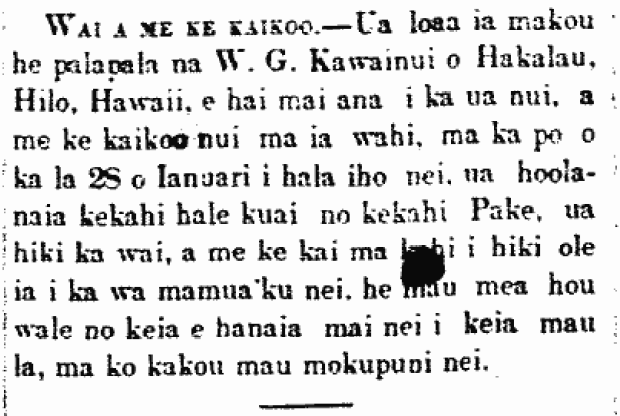
Water and the rough seas.—We received a letter from W. G. Kawainui of Hakalau, Hilo, Hawaii, telling us of the big rain and the rough seas in that area on the night of the 28th of this past January; a store of a Chinese floated away, and the water and tide reached areas not reached before; the things happening these days are truly something new for our islands.

(Kuokoa, 2/15/1862, p. 2)

Wai a me ke kaikoo.

Ka Nupepa Kuokoa, Buke I, Helu 12, Aoao 2. Feberuari 15, 1862.

Huge Tsunami, 1862.

[Found under: “NEWS OF HAWAII NEI.”]

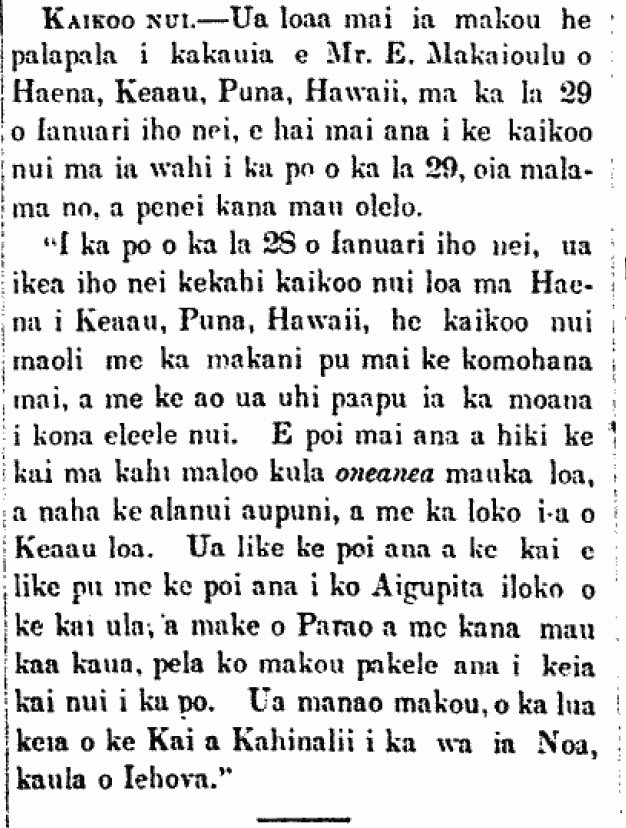
Large Tsunami [Kaikoo].—We received a letter written by Mr. E. Makaioulu of Haena, Keaau, Puna, Hawaii, on this past 29th of January, telling of the great tsunami at that place on the night of the 29th [28th] of that same month, and this is what he said.

“On the night of the 28th of this past January, an enormous kaikoo was seen in Keaau, Puna, Hawaii; it was a very big kaikoo with accompanying winds from the west, and the ocean was covered over with black rain clouds. The waves pounded and reached the barren plains high up inland, and the government road was smashed, as well as the fishpond of Keaau loa. The pounding of the ocean was like that of Egypt in the Red Sea, killing the Pharaoh and his war chariots; and we made it through those large waves in the night. We thought that is was the second Great Flood [Kai a Kahinalii] from the time of Noah, the prophet of Jehovah.”

[Anyone have more information on this fishpond?]

(Kuokoa, 2/15/1862, p. 2)

Kaikoo nui.

Ka Nupepa Kuokoa, Buke I, Helu 12, Aoao 2. Feberuari 15, 1862.

Hula mounds, shoddy roads, and inclement weather in Hilo, 1887.

Mr. Editor.

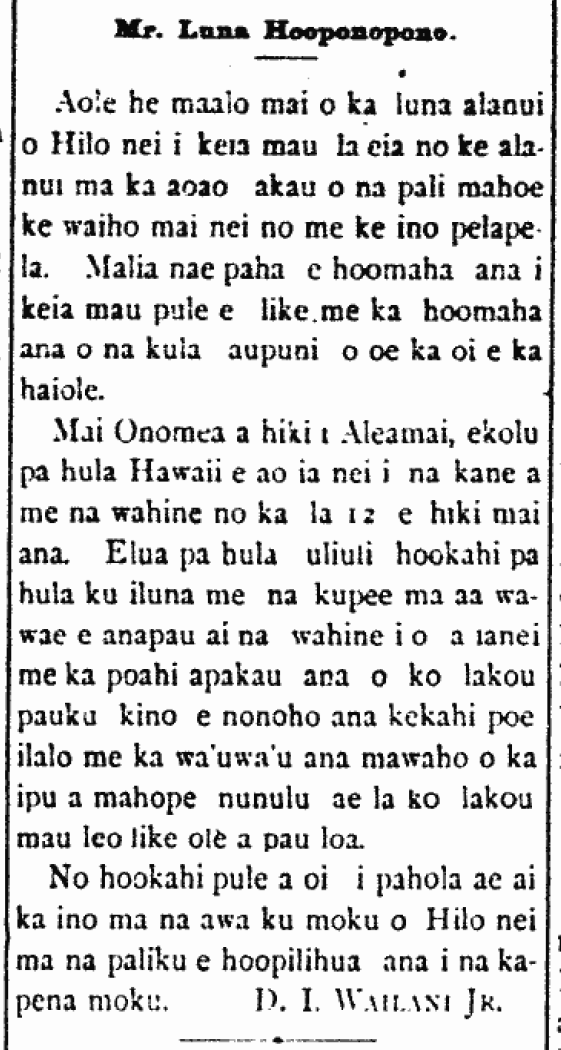
The road supervisor [luna alanui] of Hilo has not passed by these days; the road to the north of the twin cliffs [na pali mahoe] is left damaged and filthy. Perhaps he is on vacation these weeks as the public schools are on vacation; haiole [?], you are the best.¹

From Onomea until Aleamai, there are three Hawaiian hula mounds [pa hula] where men and women are being taught for the upcoming 12th. There are two green pa hula that are got on with anklets [kupee] on the legs as the women turn this way and that, while they rotate about [poahi apakau] their torsos; some people sit below while rasping [wa’uwa’u] against the outside of a gourd and then their various voices reverberate forth.

For over a week, there was a storm covering the docks here in Hilo, bewildering the ship captains on the Paliku side.

D. I. Wailana, Jr.

¹The Road Supervisor in Chief for Hawaii Island that year, according to Thrum, was C. N. Arnold.

(Kuokoa, 4/30/1887, p. 2)

Mr. Luna Hooponopono.

Ka Nupepa Kuokoa, Buke XXVI, Helu 18, Aoao 2. Aperila 30, 1887.

Huge hail on Maui, 1898/1868.

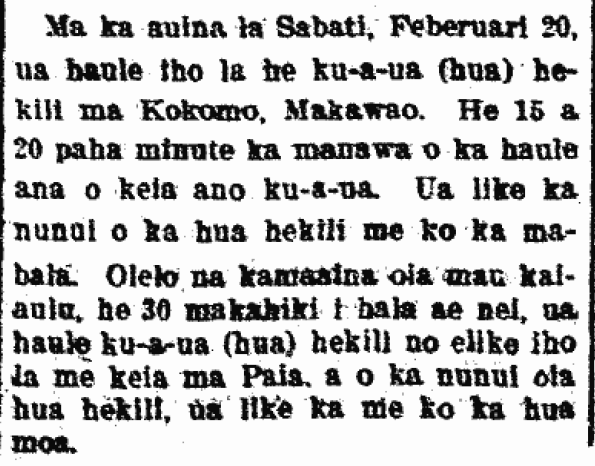
On the afternoon of Sunday, February 20, a hail storm fell at Kokomo, Makawao. This kind of storm went on for about maybe 15 or 20 minutes. The size of the hail [hua hekili] was like marbles. The locals of that area said, 30 years ago, a hail storm like this fell at Paia, and the size of the hail was like that of chicken eggs.

(Kuokoa, 3/4/1898, p. 2)

Ma ka auina la Sabati...

Ka Nupepa Kuokoa, Buke XXXVII, Helu 9, Aoao 2. Maraki 4, 1898.

Things you can find on an internet search: Puheemiki and weather studies, 2011.

I did a search on William Puheemiki, Jr. on the internet, and one of the hits was this “JIMAR/Kawaihuelani Collaborative Research Project Weather-related articles from the Hawaiian Language Newspapers, 1834–1948”. It seems to be an  index of Hawaiian-Language Newspaper articles dealing with weather phenomena. There are 4,050 articles listed, but there doesn’t seem to be any logical parameters—there are even pages of newspaper where one article on weather is listed but another is not. I also can’t find any public followup to this database, like any translations or resulting studies.

Hopefully the 15,500 newspaper pages transcribed by the 6,500 volunteers for the Ike Kuokoa project last summer (2012) are put up online soon, so that more information on weather or any other subject can be more easily found!

Would anyone have any new information on either?

Fish market affected by weather, 1929.

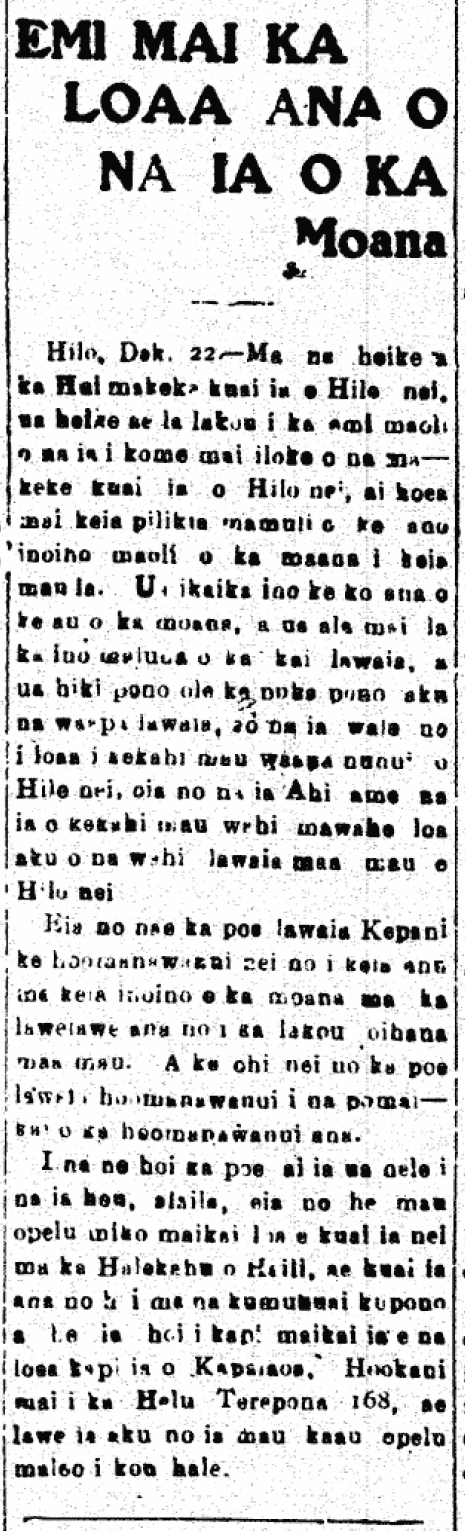
DECREASE IN THE CATCH OF OCEAN FISH

Hilo, Dec. 22—According to a report by the fish market association of Hilo, they said that there is a marked decrease in the amount of fish brought in to the fish markets of Hilo nei, and this is a result of the difficulty brought on by the very stormy seas these days. The pull of the currents is very strong, and this occurs in the fishing waters, so the fishing boats cannot head straight for them; the only fish caught by the large fishing vessels of Hilo are Ahi and other fish from far outside of the normal fishing areas of Hilo.

Here however are the Japanese, still persevering these stormy conditions of the sea by carrying out their regular work. And the determined fishermen are reaping the benefits of their persistence.

If those who eat fish are without fresh fish, here are nicely-salted opelu being sold at the pastor’s residence of Haili and it is being sold for a good price; it is fish salted well by the expert fish salters of Kapalaoa. Ring the Telephone Number 168, and the dried opelu in forties [kaau] will be delivered to your house.

(Hoku o Hawaii, 12/24/1929, p. 2)

EMI MAI KA LOAA ANA O NA IA O KA Moana

Ka Hoku o Hawaii, Buke XXIII, Helu 28, Aoao 2. Dekemaba 24, 1929.

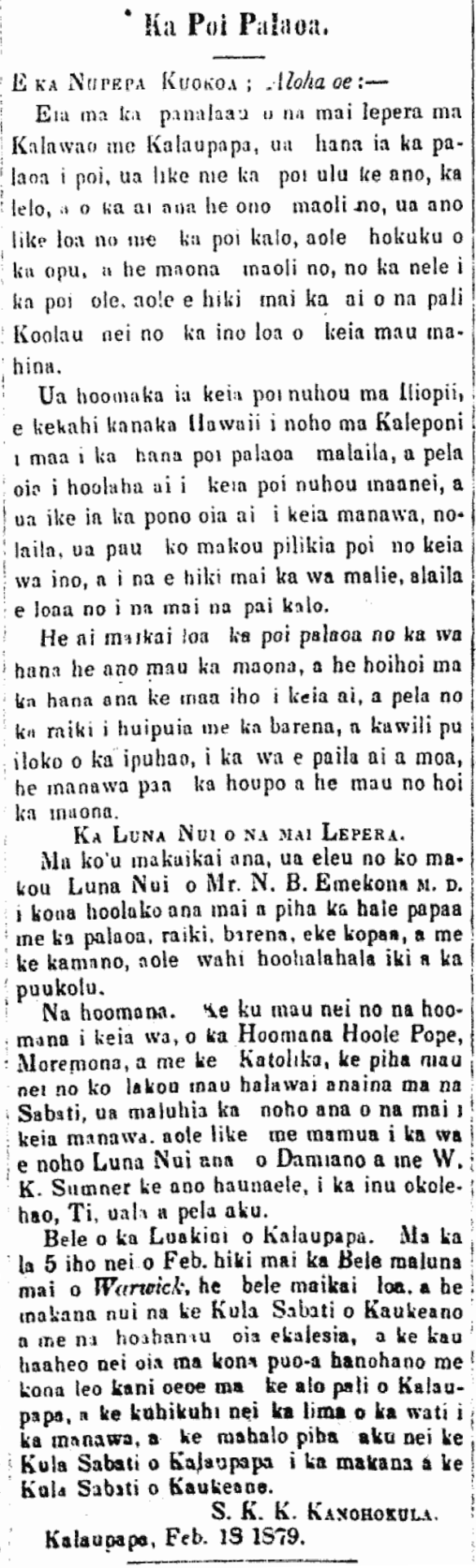
Poi made from wheat flour in Kalawao and Kalaupapa, 1879.

Poi Palaoa.

O Kuokoa Newspaper; Aloha oe:—

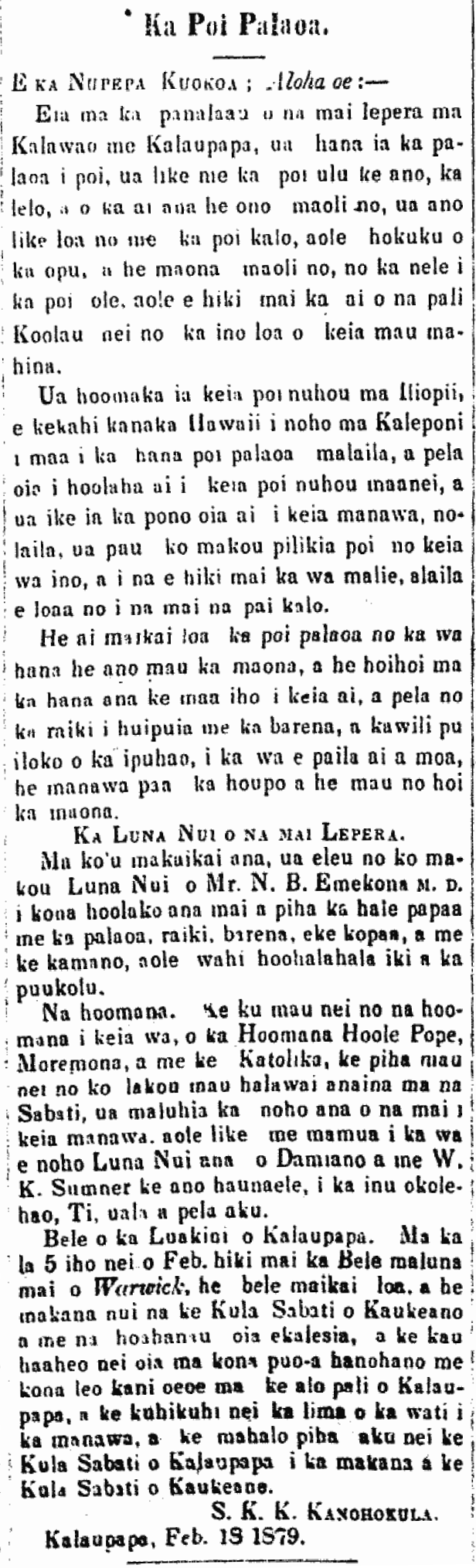
Here in the colony of the leprosy patients in Kalawao and Kalaupapa, flour is used to make poi [poi palaoa]; it is similar to poi made of breadfruit [poi ulu] in the yellow color, and it is truly delicious; it is a lot like taro poi [poi kalo]: your stomach doesn’t get sore, and you become full indeed; we have no poi because the taro won’t arrive to these Koolau cliffs because of the terrible weather during these months.

This new poi began at Iliopii, by a Hawaiian who lived in California who was used to making it there, and that is how he spread this new poi here; and the benefits of this poi is now known, and therefore, our poi problems are over during this stormy period, and should calm weather return, the patients will get their paʻi ʻai¹ [pai kalo].

Poi palaoa is very appropriate when working because you stay full, and it is fun to make when you get used to it, and so too with rice mixed with crackers and stirred up in a pot; when it boils and is cooked, it is time for to fill the stomach, and you will be always full.

The Superintendent of the Leprosy Patients.

In my observations, our Superintendent, Mr. N. B. Emerson [Emekona], M. D. is quick with filling the storehouse [hale papaa] with flour [palaoa], rice [raiki], crackers [barena], bags of sugar [eke kopaa], and salmon [kamano]; there is nothing to complain of Kapuukolu.²

Worship. Worship always happens now: Protestants [Hoole Pope], Mormons [Moremona], and Catholics [Katolika]; their meetings on Sundays are always full; life of the patients is peaceful now, not like before when Damien [Damiano] and when W. K. Sumner were Superintendent; there were uprisings from drinking okolehao and other alcoholic drinks made of ti, sweet potato [uala], and so forth.

Bell of the Church of Kalaupapa. On the 5th of Feb., the Bell arrived on the Warwick; a very fine bell which was a gift from the Sunday School of Kaukeano and the brethren of that church; and now it hangs proudly in its honored steeple with its ringing voice in the cliff faces of Kalaupapa, and it points out the movement of the hands of the clock, and the Sunday School of Kalaupapa fully appreciates the gift of the Sunday School of Kaukeano.

S. K. K. Kanohokula.

Kalaupapa, Feb. 18, 1879.

¹Although i tend not to use ʻokina and kahakō, i marked “pai ai” here for added clarity.

²Kapuukolu is a place on Kauai, figuratively used to represent abundance of good food.

(Kuokoa, 3/15/1879, p. 2)
Ka Poi Palaoa.

Ka Nupepa Kuokoa, Buke XVIII, Helu 11, Aoao 2. Maraki 15, 1879.

Children rescued out at sea, 1924.

CHILDREN RESCUED FROM DEATH

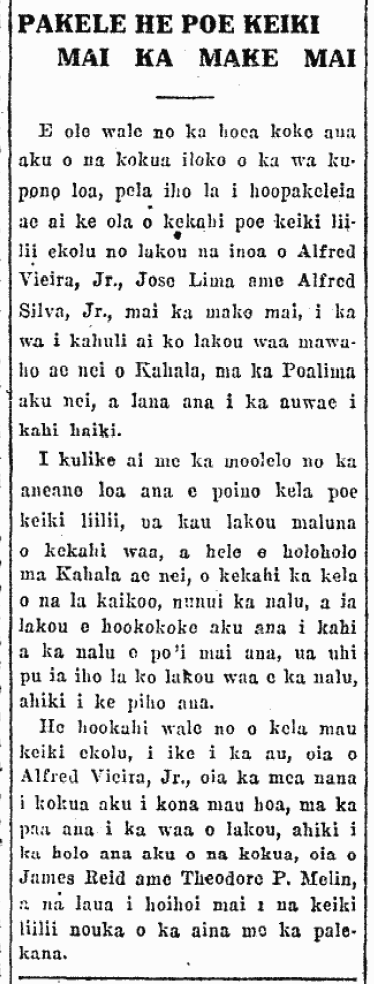
Because of the quick arrival of help at the right time, three small children were saved, named Alfred Vieira, Jr., Jose Lima, and Alfred Silva, Jr., from death, when their canoe overturned outside of Kahala, on this past Friday, and they were in dire straits.

According to the story of this near tragedy of the little children, they boarded a waa and travelled about Kahala; it was a day of rough seas and the waves were huge, and as they were approaching a crashing wave, their waa was covered over by the wave and went under.

There was but one of the three children who knew how to swim, that being Alfred Vieira, Jr., and he was the one who helped his two friends in holding on to their waa until help arrived: James Reid and Theodore P. Melin, who returned the little children to land safely.

[I wonder how this one act changed Hawaii’s future…]

(Kuokoa, 6/5/1924, p. 5)

PAKELE HE POE KEIKI MAI KA MAKE MAI

Ka Nupepa Kuokoa, Buke LXIII, Helu 23, Aoao 5. Iune 5, 1924.

Sun blocked out, 1868.

[Found under: “LOCAL NEWS: Oahu”]

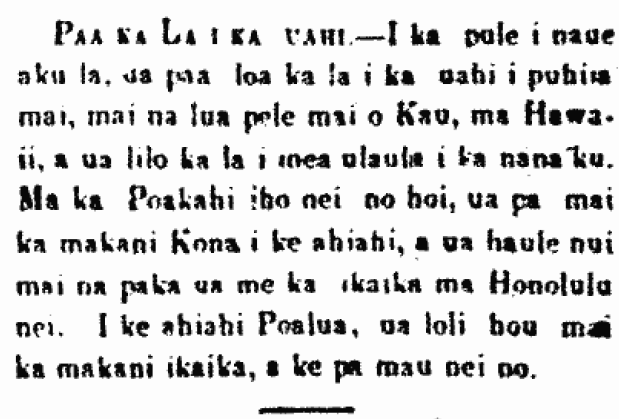
Sun Blocked by Smoke.—Last week, the sun was totally covered over by the smoke blown from the volcano of Kau on Hawaii, and the sun appeared red. On Monday, the Kona winds blew in the evening, and much heavy rains fell in Honolulu nei. On Tuesday evening, it turned into strong winds which are still blowing now.

(Kuokoa, 4/18/1868, p. 3)

Paa ka La i ka uahi.

Ka Nupepa Kuokoa, Buke VII, Helu 16, Aoao 3. Aperila 18, 1868.