One more mele for Kawailani, 1913.

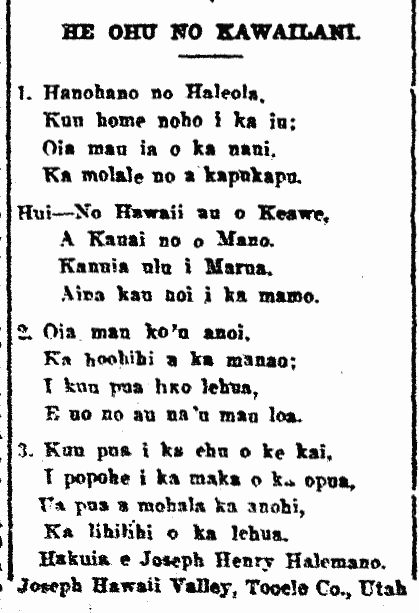
HE OHU NO KAWAILANI.

1. Hanohano no Haleola,
Kuu home noho i ka iu;
Oia mau ia o ka nani,
Ka molale no a kapukapu.

Hui—No Hawaii au o Keawe,
A Kauai no o Mano,
Kanuia ulu i Marna,
Aina kau hoi i ka mamo.

2. Oia mau ko’u anoi,
Ka hoohihi a ka manao;
I kuu pua liko lehua,
E uo no au na’u mau loa.

3. Kuu pua i ka ehu o ke kai,
I popohe i ka maka o ka opua,
Ua pua a mohala ka anohi,
Ka lihilihi o ka lehua.

Hakuia e Joseph Henry Halemano
Joseph Hawaii Valley, Tooele Co., Utah.

(Kuokoa, 1/10/1913, p. 6)
HE OHU NO KAWAILANI.

Ka Nupepa Kuokoa, Buke XLIX, Helu 2, Aoao 6. Ianuari 10, 1913.

Mele for Annie Kawailani Halemano (?) of Iosepa, Utah, 1913.

HE INOA NO KAWAILANI.

1. Wehiwehi no Halemano,
Ohuohu i ka lau lehua,
Hoohie no na kini,
A hoohihi no ilaila.

Hui—One, two, three, four, five,
Na hooheno ana, oni oi ala, piha hauoli.

2. Hanohano Kukaniloko,
Wehiwehi i na pua,
A hoohie no na manu,
A hoohihi no ilaila.

3. Haaheo o Leilehua,
Onaona i ke kupukupu,
Hoohie na ilikea,
A hoohihi no ilaila.

4. Kaulana no o Puaena,
Lamalama i ka ehu kai,
E nanea no na kupa,
A hoohihi no ilaila.

5. Kilakila no Hawaii,
Kaulana puni ka honua,
Hoohie na lehulehu,
A hoohihi no ilaila.

Hakuia e Joseph Henry Halemano.

Joseph Hawaii Valley, Tooele Co., Utah.

[I hardly hear this being sung today, but it is such a fun song!]

(Kuokoa, 1/10/1913, p. 7)

HE INOA NO KAWAILANI.

Ka Nupepa Kuokoa, Buke XLIX, Helu 2, Aoao 7. Ianuari 10, 1913.

Letter from Iosepa, Utah, 1913.

Word From Utah.

Iosepa, Toole County, Dec. 19, 1912.

Solomon Hanohano, Editor of the Kuokoa, Aloha oe:—Because we want to know of the news from our birth lands, we decided to subscribe to the Kuokoa. As the new year is arriving, it would be a means for us to see the news of our home and the progress of the political scene or its regression, as well as the victories or discouragements of our fellow makaainana.

This is an important year for the country, being that the great power of the nation has gong to the Democrats; the important question is this: Will the poor citizens of the land really benefit, or will they once again perhaps drift about like during Cleveland’s presidency, but it will be time that tells.

If those who were elected actually carry out what they promised with their lips to the people, then benefits will indeed result, however if it is like what Isaia said: “This people draweth nigh unto me with their mouth, but their heart is far from me.” Then those words of that old kamaaina of Lahaina will appear: “He says, when oh when will that happen.”¹ Recognized are the wealthy, and ignored are the poor. [Ikeia aku la no na kii maka nunui, nana oleia iho la na wahi kii maka liilii]. Continue reading

Speaking of language—and halahu and halahi, 2015.

I thought I would ask once again for people to maybe take some time to add corrections to misinterpretations that I make in these posts. I know for a fact that there are a lot of times that I may think that something is being said, but it actually is not. It would help me for one, and it might perhaps help others as well.

Also, if you have any comments or added information to contents of posts, please feel free and don’t hesitate to comment.

Mahalo.

More on William K. Kaleihuia. 1933.

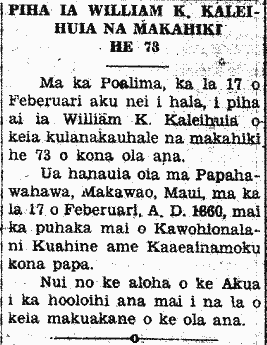
WILLIAM K. KALEIHUIA HAS MADE 73 YEARS OLD.

On Friday, the 17th of February past, William K. Kaleihuia of this town made 73 years old.

He was born at Papahawahawa, Makawao, Maui, on the 17th of February, 1860, from the loins of Kawohionalani Kuahine and Kaaeainamoku, his father.

God has much aloha in having extended the days of the life of this man.

[Would anyone have more information on this man?]

(Alakai o Hawaii, 3/2/1933, p. 2)

PIHA IA WILLIAM K. KALEIHUIA NA MAKAHIKI HE 73.

Ke Alakai o Hawaii, Buke 5, Helu 44, Aoao 2. Maraki 2, 1933.

Olelo Hawaii, 1896.

THE HAWAIIAN LANGUAGE WILL BE FORGOTTEN.

Those Hawaiian youths who are being trained by us in the English language cannot write correctly at all the Hawaiian language of their own land of birth.

We have seen some children like this. And we are very regretful in seeing this; they are being made unintelligent in their Mother tongue of their land, so that their thought are turned over totally to the land of those who are teaching them.

When they are asked, “What about you? Can you write in Hawaiian?” They will reply, “No! the haole teachers don’t give us time to write in the language of Hawaii nei, and that is why I can’t read and write in Hawaiian.” That is how the majority of the Hawaiian children will be in the future.

We feel great remorse that the Hawaiian children will be denied intimate knowledge of the Mother tongue of their own land.

There is no Lahui that is denied this right, amongst all the great nations of this world. Therefore, do not let the Hawaiian language be forgotten.

(Aloha Aina, 7/11/1896, p. 2)

E POINA ANA KA OLELO HAWAII.

Ke Aloha Aina, Buke II, Helu 28, Aoao 2. Iulai 11, 1896.

On the state of the Hawaiian Language, 1920.

PERTAINING TO THE HAWAIIAN LANGUAGE.

Mr. Editor of the Nupepa Kuokoa, Aloha oe:—In the Kuokoa of Friday, May 21, 1920, I saw your thoughts supporting Mr. Coelho on the Hawaiian Language, and about the lack of use of the Hawaiian language in some churches and Hawaiian organizations when they meet; English is what is spoken in meetings; not because Hawaiian is not understood, but because of their great embarrassment in speaking Hawaiian; there is English and it is attractive to speak, yet all the while they understand that it is not appropriate at all to be speaking in English.

It isn’t in some churches and Hawaiian associations that it is not spoken, but in markets, on streets, in homes in which true Hawaiians live, and all around this island of Oahu, only a very tiny fraction of true Hawaiians speak the Hawaiian language; most of the men, women, and children, all they speak is English.

It is not something that I’ve heard from a friend; no, I have seen it with my own eyes, and heard it with my own ears; a Hawaiian father and a Hawaiian mother, and children born of their loins, born here in Hawaii, yet the strange thing is that the language they speak is English, and not Hawaiian.

Who are the true Hawaiians that are snuffing out the Hawaiian language? The ones that are too haughty and the ones who are too ashamed to speak in Hawaiian, like with some churches and some Hawaiian organizations that don’t want to speak Hawaiian when they meet.

I do not oppose the speaking of English or other languages perhaps that we true Hawaiians know; it is a great benefit that we can converse in those languages, but the problem is that we’ve abandoned the Hawaiian language.

How can we Hawaiians say that we defend dearly [makee] the Hawaiian lahui from dying off and from coming into great difficulties if we do not cherish our mother tongue? Continue reading

Name song for “the Oleander lei,” by Mrs. Emalia K., 1879.

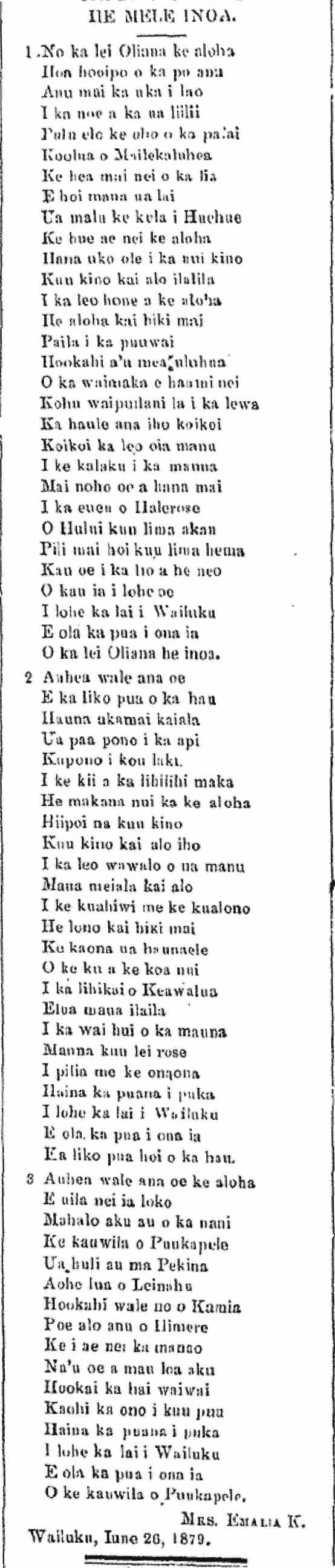
HE MELE INOA.

1. No ka lei Oliana ke aloha
Hoa hooipo o ka po ana
Anu mai ka uka i Iao
I ka noa a ka ua liilii
Pulu elo ke oho o ka palai
Koolua o Mailekaluhea
Ke hea mai nei o ka lia
E hoi maua ua lai
Ua malu ke kula i Huehue
Ke hue ae nei ke aloha
Hana uko ole i ka nui kino
Kuu kino kai alo ilalila [ilaila]
I ka leo hone a ke aloha
He aloha kai hiki mai
Paila i ka puuwai
Hookahi a’u mea uluhua
O ka waimaka e hanini nei
Kohu waipuilani la i ka lewa
Ka haule ana iho koikoi
Koikoi ka leo oia manu
I ke kalaku i ka mauna
Mai noho oe a hana mai
I ka eueu o Halerose
O Hului kuu lima akau
Pili mai hoi kuu lima hema
Kau oe i ka lio a he neo
O kau ia i lohe oe
I lohe ka lai i Wailuku
E ola ka pua i ona ia
O ka lei Oliana he inoa.

2. Auhea wale ana oe
E ka liko pua o ka hau
Hauna akamai kaiala
Ua paa pono i ka api
Kupono i kou laki
I ke kii a ka lihilihi maka
He makana nui ka ke aloha
Hiipoi na kuu kino
Kuu kino kai alo iho
I ka leo wawalo o na manu
Maua meiala kai alo
I ke kuahiwi me ke kualono
He lono kai hiki mai
Ke kaona ua haunaele
O ke ku a ke koa nui
I ka lihikai o Keawalua
Elua maua ilaila
I ka wai hui o ka mauna
Mauna kuu lei rose
I pilia me ke onaona
Haina ka puana i puka
I lohe ka lai i Wailuku
E ola ka pua i ona ia
Ea liko pua hoi o ka hau.

3. Auhea wale ana oe ke aloha
E uila nei ia loko
Mahalo aku au o ka nani
Ke kauwila o Puukapele
Ua huli au ma Pekina
Aohe lua o Leinahu
Hookahi wale no o Kamia
Poe alo anu o Himere
Ke i ae nei ka manao
Na’u oe a mau loa aku
Hookai ka hai waiwai
Kaohi ka ono i kuu puu
Haina ka puana i puka
I lohe ka lai i Wailuku
E ola ka pua i ona ia
O ke kauwila o Puukapele.

Mrs. Emalia K.

Wailuku, Iune 26, 1879.

(Ko Hawaii Pae Aina, 7/19/1879, p. 4)

HE MELE INOA.

Ko Hawaii Pae Aina, Buke II, Helu 29, Aoao 4. Iulai 19, 1879.

Hilo train, 1879.

Riding Steam Engine Train in Hilo.

Star Mill, Waiakea, Hilo, H.,
July 11, 1879, 1½ P. M.

Hon. Joseph U. Kawainui,

Aloha oe,—

Here I am now aboard the standing Locomotive, and I am writing what I see. Everything is going according to plans. The Locomotive is running with a single freight car attached, to test it out, for 840 feet in distance, and the tracks are still being laid.

Should you want to ride first on the train, come quickly. With delight,

Joseph Nawahi.

P. S. The steampower is 100 lbs, and its speed is between 18 and 20 miles per hour. J. N. Continue reading