Patriotism, 1894.

Great Meeting of the People!!!

Forward O Hawaiians!!

FOR THE RIGHTS OF YOUR LAND

A Great Meeting of Makaainana will be held at Palace Square, at 5 p. m. on this very day, July2, 1894; to show our steadfastness in our patriotism.

Hawaii’s own Lahui, as well as the other ethnicities who are of the same mind, are invited to go in unity and show their insistence behind the Resolution that will be passed at that time.

Invited are the Men, the Women, and all the young people of the Hawaiian Patriotic League [Hui Aloha Aina], and all friends, to go immediately with great enthusiasm and festivity to fill the meeting with numbers of Twenty and more thousand people.

And provided that the Marshal [Ilamuku] of the Provisional Government [Aupuni Kuikawa] has approved our meeting. Therefore, we have nothing to be concerned about. Let us however maintain the peace.

JOSEPH NAWAHI,

President of the Hui Aloha Aina.

JAMES K. KAULIA,

Head Secretary of the Hui Aloha Aina.

Honolulu, July 2nd, 1894.

(Leo o ka Lahui, 7/2/1894, p. 2)
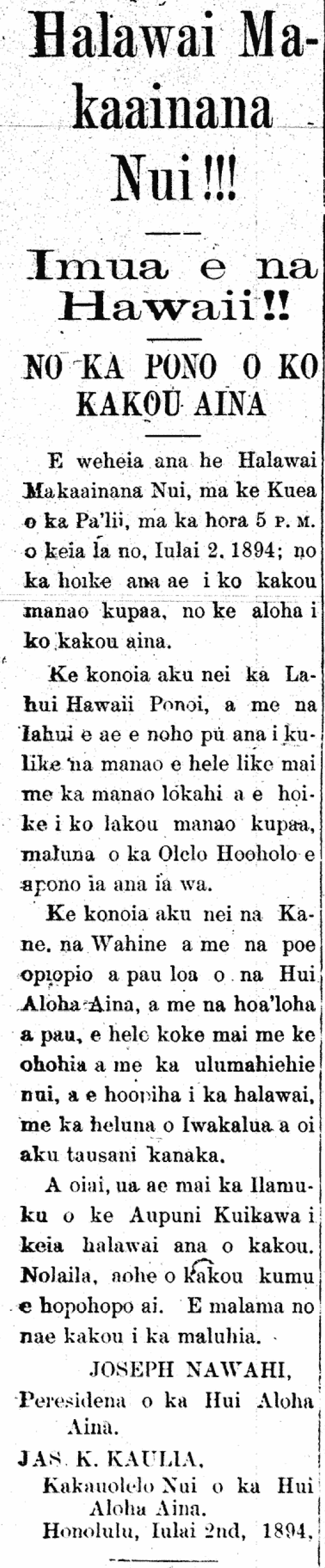
Halawai Makaainana Nui!!!

Ka Leo o ka Lahui, Buke II, Helu 974, Aoao 2. Iulai 2, 1894.
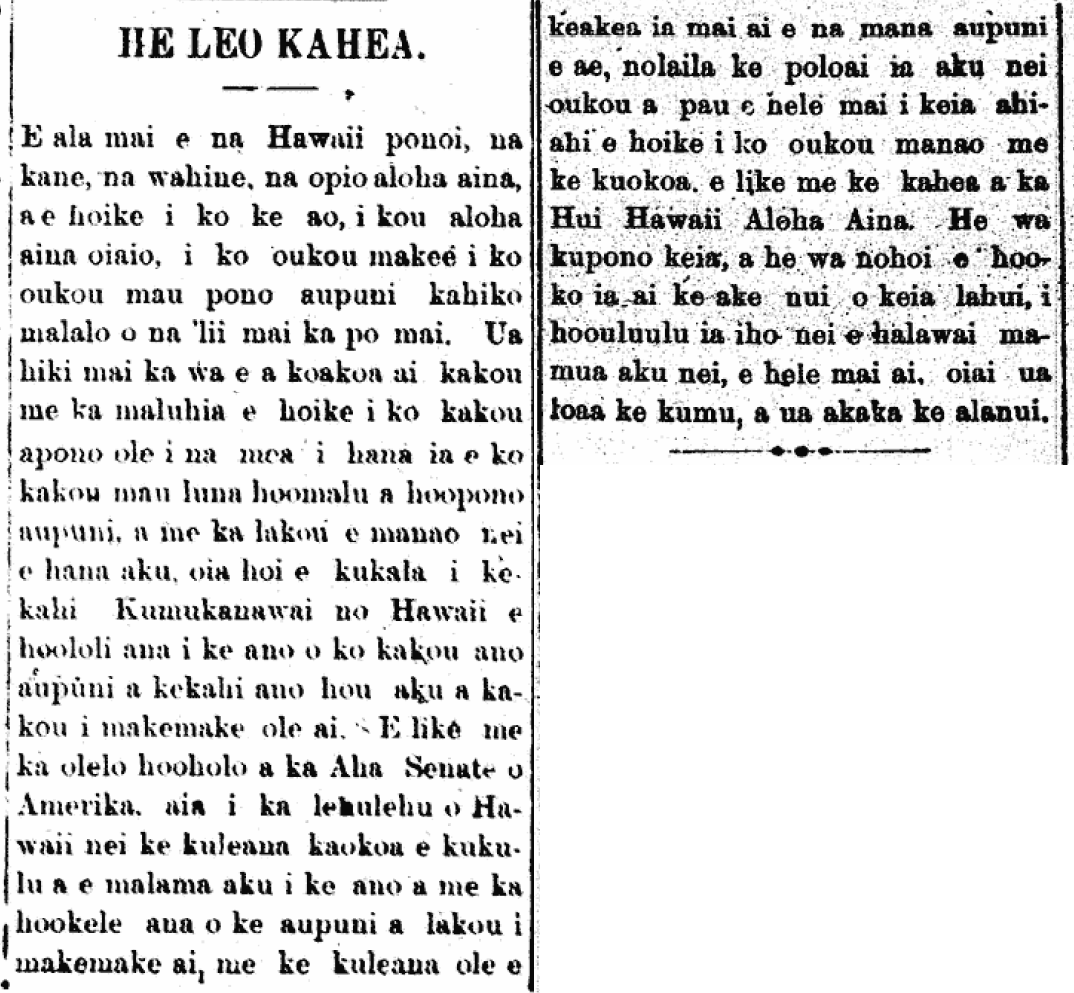
Patriotism, sovereignty, and unity, 1894.

A CALL.

Rise, O Hawaii’s Own, patriotic men, women, and youth, and show to the world your true patriotism, how you treasure your traditional rights to the land under the alii from time immemorial. It is time that we come together in peace to show our disapproval of what is being done by the our nation’s administrators, that being their proclaiming of a Constitution for Hawaii that changes the nature of our nation and other things which we do not desire. As per the resolution of the Senate of America, to the people of Hawaii belongs the total right to establish and protect the form and the leadership of their nation as they desire, without interference from other national powers, therefore, you are all being summoned to come this evening to show your thoughts and independence, in accordance with this call by the Hawaiian Patriotic League. This is the right time, the time when the great desire of this lahui who were just earlier stirred to meet, to come, for there is a goal and the means to it is clear.

(Leo o ka Lahui, 7/2/1894, p. 2)

HE LEO KAHEA.

Ka Leo o ka Lahui, Buke II, Helu 974, Aoao 2. Iulai 2, 1894.
Kaa kea of Waiakea dies at 110 years old, 1898.

[Found under: “Nuhou Kuloko.”]

At Waiakea Kai, Hilo, an old man just died whose name was Kaa kea, on Thursday last, at 110 years old. It is not exactly known when he was born, however, he stated that he was 30 years old when Kamehameha I died. He joined in the battles of Kamehameha I, and at the last battle in Kona. At the death of the king, he slashed a mark like a moo on his forehead, and he lived with this mark until his death.

(Aloha Aina, 2/14/1898, p. 7)

Ma Waiakea kai, Hilo...

Ke Aloha Aina, Buke IV, Helu 7, Aoao 7. Feberuari 12, 1898.

D. L. Conkling, from bicyclist to treasurer, 1909.

BICYCLE RACER IS NOW TERRITORIAL TREASURER

David L. Conkling Is Given Fat Job in Hawaii

[Special Correspondence of the Call]

HONOLULU, July 2.—David Lloyd Conkling, formerly chief clerk of the territory, has been appointed territorial treasurer to succeed A. M. Campbell, whom the senate refused to confirm.

Conkling is a young man who came to Hawaii from San Francisco as a fancy bicycle rider and racer, having been well known on the coast tracks 10 years ago.

After the bicycle craze died out he became purser on one of the inter-island steamers and later was a reporter for the Honolulu papers. He was appointed chief clerk by Governor Carter and received his promotion from Governor Frear.

Conkling’s appointment has been received with general favor.

(San Francisco Call, 7/11/1909, p. 28)

BICYCLE RACER IS NOW TERRITORIAL TREASURER

San Francisco Call, Volume CVI, Number 41, Page 28. July 11, 1909.

Hawaii and the United States, 1911.

Hawaii is a Gold Mine for America

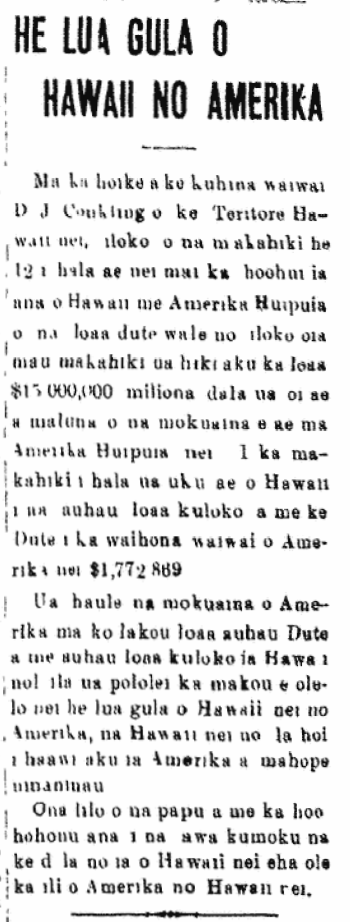
According to the report by the treasurer of the Territory of Hawaii, D. L. Conkling, in the 12 years which have passed since the annexation of Hawaii to America, the income just from duties during that time come to more than $15,000,000, more than the other states of the United States. In the past year, Hawaii paid $1,772,869 in income taxes and duties to the coffers of America.

The rest of the states fell behind Hawaii in duties and income taxes, and therefore what we say about Hawaii being a gold mine for America is true; it is Hawaii who gave it to America then asked questions.

All of the expenses for the forts and the dredging of the harbors are paid for by Hawaii’s dollars, and America suffers nothing for Hawaii.

(Kuokoa Home Rula, 8/11/1911, p. 1)

HE LUA GULA O HAWAII NO AMERIKA

Kuokoa Home Rula, Buke IX, Helu 32, Aoao 1. Augate 11, 1911.

Another mele for Kilauea Lighthouse, 1919.

HE MELE NO KA HALE KUKUI O KILAUEA.

HALE IPUKUKUI O KILAUEA, KAUAI.

Nani wale ka uwila i Kilauea,
E anapa mai la i ka paia lani;
Hoike mai ana i kona nani,
He malamalama oi kelakela;
Helu ekahi a o Hawaii nei.
Ma ka lihi kai o ka Pakipika;
Ua ana pono ia kona enekini,
No kanaha mile kona mamao;
Kaomi lima ia iho ke pihi,
E niniu ia no umi kekona;
Hihiu na hana a ka Puakea,
He oi pakela a ke akamai;
I hana noeau ia e Palani,
Me na waihooluu like ole;
He kinohinohi ke ike aku,
Ka anapa a ka onohi kaimana,
Ua hanaia a ku i ka nani,
Molina wai gula anapanapa;
Ka papa dala ke kahua ia,
Ka hulali a ka wai hoohinuhinu;
Ua kohu lihilihi anuenue,
Ka alohi, ka anapa ke ike aku,
Haina ia mai ana ka puana,
Hale kukui nani a o Hawaii nei.

Hakuia e MRS. W. PA.

Hanalei, Kauai.

(Kuokoa, 5/2/1919, p. 3)

HE MELE NO KA HALE KUKUI O KILAUEA.

Ka Nupepa Kuokoa, Buke LVII, Helu 18, Aoao 3. Mei 2, 1919.

Mele inoa for Kilauea lighthouse, 1914.

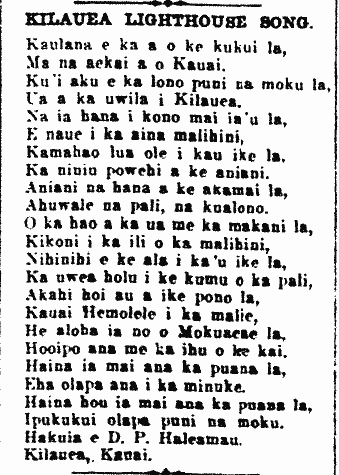
KILAUEA LIGHTHOUSE SONG.

Kaulana e ka a o ke kukui la,
Ma na aekai a o Kauai.
Ku’i aku e ka lono puni na moku,
Ua a ka uwila i Kilauea.
Na ia hana i komo mai ia’u la,
E naue i ka aina malihini.
Kamahao lua ole i kau ike la,
Ka niniu powehi a ke aniani.
Aniani na hana a ke akamai la,
Ahuwale na pali, na kualono.
O ka hao a ka ua me ka makani la,
Kikoni i ka ili o ka malihini.
Nihinihi e ke ala i ka’u ike la,
Ka uwea holu i ke kumu o ka pali.
Akahi hoi au a ike pono la,
Kauai Hemolele i ka malie.
He aloha ia no o Mokuaeae la,
Hooipo ana me ka ihu o ke kai.
Haina ia mai ana ka puana la,
Eha olapa ana i ka minuke.
Haina hou ia mai ana ka puana la,
Ipukukui olapa puni na moku.

Hakuia e D. P. Haleamau.

Kilauea, Kauai.

[This song composed by D. P. Haleamau is composed for the completion of the famous lighthouse still standing today, Kilauea Lighthouse!]

(Kuokoa, 4/10/1914, p. 4)

KILAUEA LIGHTHOUSE SONG.

Ka Nupepa Kuokoa, Buke LII, Helu 15, Aoao 4. Aperila 10, 1914.

Another love song from a hundred years ago, 1914.

KAWAI LANA MAUA.

Ka Pua Lilia ma ka Hikina

I ka lai no wau o ka palama
Kahi a na manu e pohai ana
Ke hana akawai epipii ana
Me he ala o kuu aloha kekahi

Akahi hoi au a ike maka
I ka hana a ka lio hapa kalakoa
Ko mai ke aloha pili me a’u
Ke ala huihui i ka puuwai

Na wai eole kou makemake
Ua kila paa ia e na lani
Ua nani oe e ka nalo meli
Ka pipili ka nanahe ikau pua

E kuhi ana wau ahe pono nei
Ka hana a ka manu ailaiki
Kiina i loaa eka n ulu [? Kiina i loaa e ka naulu]
E hoi mai oe pili me a’u

Uao kaua me ka hiehie
I ka wai ma puna lana malia
Lia aku wau ao ko nni [? Lia aku wau ao ko nani]
I lei kai mana no kuu kino.

Hea aku no wau o mai oe
E hoi mai oe pili me a’u
Haina ia mai ana ka pu ana
Kealoha kakia ika puuwai.

Haku ia keiki o Kaua Kanilehua

W. D. Kawailehua.

[Newspapers until their close were a place to publish mele of all sorts, whether it be mele aloha, ko’ihonua, kanikau, &c. If you are a composer or aspiring composer, this is one of the best places to study tradition, if you are interested in tradition.

Sometimes, the typesetters weren’t very careful, especially in the later years, and more so in some papers than in others. The word breaks in this mele by Hilo boy, William D. Kawailehua, are not very consistent, but well worth working out in your head.

(Aloha Aina, 6/27/1914, p. 4)

KAWAI LANA MAUA.

Ke Aloha Aina, Buke XIX, Helu 38, Aoao 4. Iune 27, 1914.

Sweet love song written a hundred years ago, 1914.

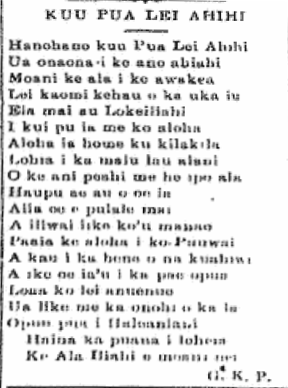
KUU PUA LEI AHIHI

Hanohano kuu Pua Lei Ahihi
Ua onaona i ke ano ahiahi
Moani ke ala i ke awakea
Lei kaomi kehau o ka uka iu
Eia mai au Lokeiliahi
I kui pu ia me ko aloha
Aloha ia home ku kilakila
Lohia i ka malu lau alani
O ke ani peahi me he ipo ala
Haupu ae au o oe ia
Alia oe e pulale mai
A iliwai like ko’u manao
Paaia ke aloha i ko Puuwai
A kau i ka hono o na kuahiwi
A ike oe ia’u i ka pae opua
Loaa ko lei anuenue
Ua like me ka onohi o ka la
Opuu pua i Halaaniani
Haina ka puana i loheia
Ke Ala Iliahi e moani nei

G. K. P.

[This mele was probably composed by Gulstan K. Poepoe, the owner and editor of the Holomua.]

(Holomua, 6/20/1914, p. 8)

KUU PUA LEI AHIHI

Ka Holomua, Buke I, Helu 40, Aoao 8. Iune 20, 1914.

Hula in Hanapepe, 1863.

[Found under: “NA MEA HOU O HAWAII NEI.”]

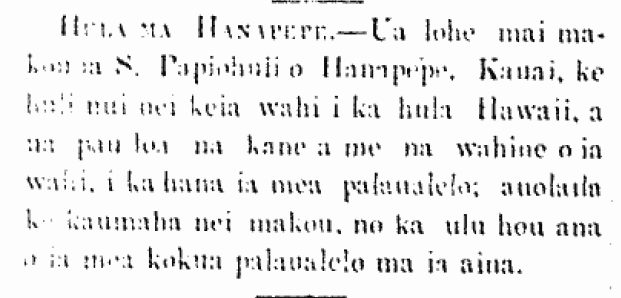
Hula in Hanapepe.—We hear from S. Papiohuli of Hanapepe, Kauai, that the people of this place are turning to the Hawaiian hula, and all of the men and women of the area are doing that idle activity; therefore, we are dismayed at this resurgence of this encouragement of indolence in that place.

(Kuokoa, 8/29/1863, p. 2)

Hula ma Hanapepe.

Ka Nupepa Kuokoa, Buke II, Helu 35, Aoao 2. Augate 29, 1863.