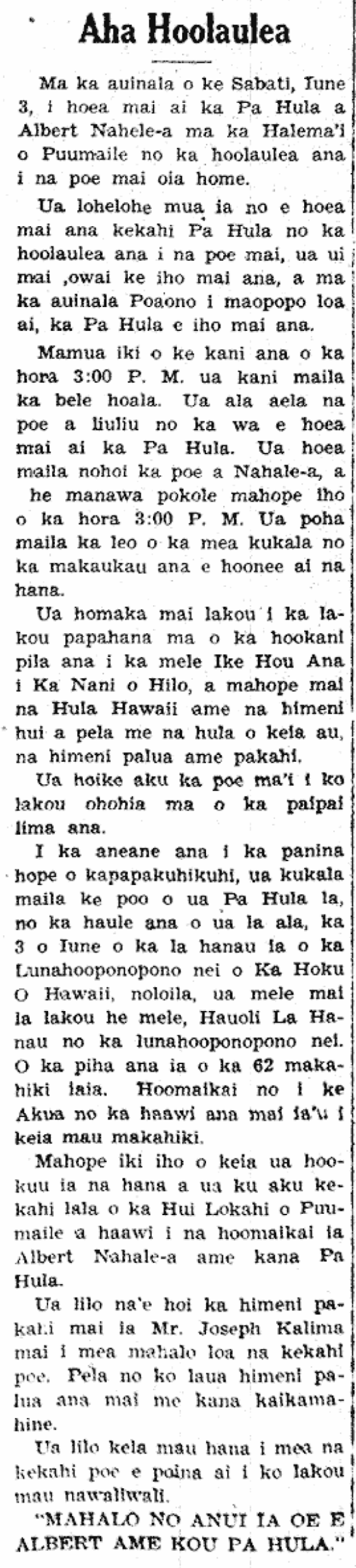
Hula to entertain the sick, 1945.

A Celebration

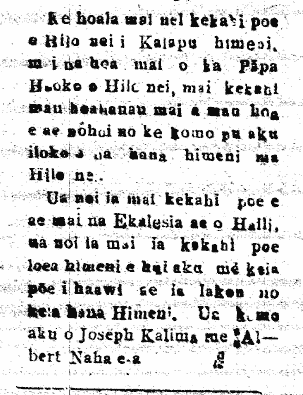
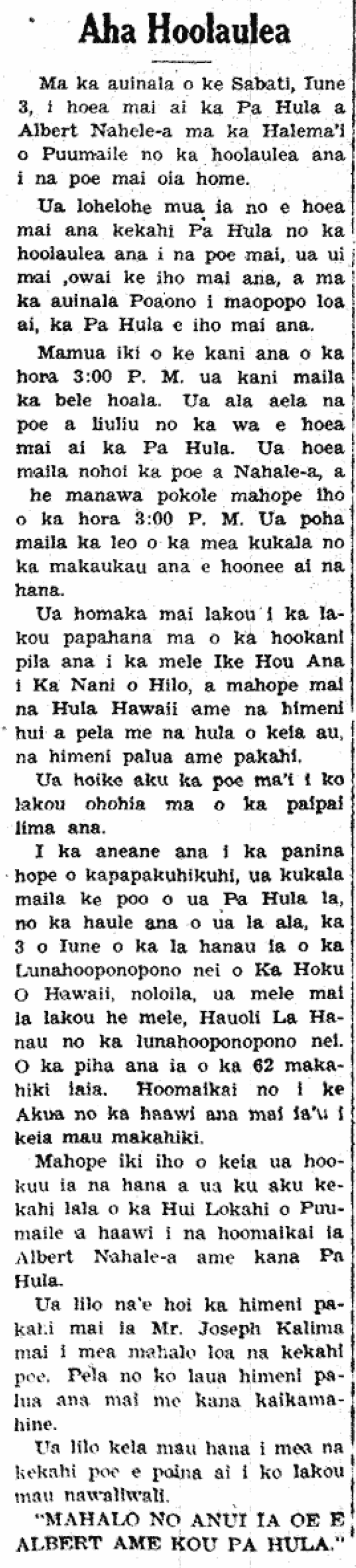
On the afternoon of Sunday, June 3, the Pa Hula of Albert Nahale-a arrived at Puumaile Hospital to bring good will to the patients.

There was word that there was going to be a visit from a Hula Troupe to entertain the patients; it was asked who was coming, and in the afternoon of Saturday, it was clear which Hula Troupe was coming.

A little before 3:00 P. M., the waking bell was sounded. The people got up and got ready for when the Hula Group would arrive. Nahale-a’s people came, and it was but a short time after 3:00 P. M. The announcer voice rang forth announcing that it was ready for the activities to proceed.

They started their program with the performance of the song Ike hou ana i ka nani o Hilo,¹ and after that there were Hawaiian Hula and joint singing, and hula of this era, duets and trios.

The patients showed their enthusiasm by applauding.

When the close of the program was near, the head of the Hula Troupe announced that the day fell on the birthday of the Editor [Solomon Anakalea] of the Hoku o Hawaii, therefore they sang the song, “Happy Birthday” for this editor. He was 62 years old. I thank God for giving me these years.

Following this, the festivities were let out, and the members of the Hui Lokahi of Puumaile stood and gave their thanks to Albert Nahale-a and his Hula Troupe.

However, it was the solo singing performance of Mr. Joseph Kalima that was most admired by some. As well as the duets performed with his daughter.

This program was for some something that would not be forgotten in their weakened state.

“MUCH APPRECIATION TO YOU, ALBERT AND YOUR PA HULA.”

¹Perhaps this is the mele that begins:

Ike hou ana i ka nani o Hilo,
I ka uluwehiwehi i ka lehua,
Lei hoohihi a ka malihini,
Mea ole i ke kono a ke aloha.

(Hoku o Hawaii, 6/20/1945, p. 1)
Aha Hoolaulea

Ka Hoku o Hawaii, Volume XL, Number 8, Aoao 1. Iune 20, 1945.

Pele makes appearance atop Mokuaweoweo, 1914.

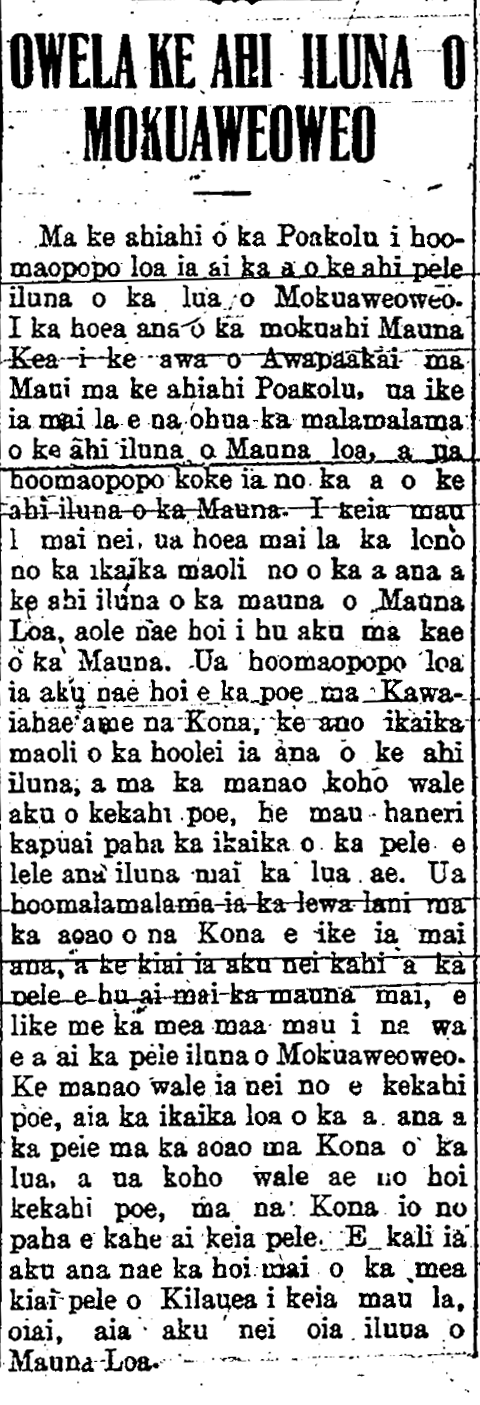
FIRES BURN ABOVE MOKUAWEOWEO

On the evening of Wednesday the burning of lava above the crater of Mokuaweoweo was clearly known. At the arrival of the steamship Mauna Kea in the port of Awapaakai on Maui, on the Wednesday eve, the glow of fire atop Mauna Loa was witnessed by her passengers, and the fires above the Mountain was soon learned. These past days, word of the very intense fires above Mauna Loa has arrived, yet it did not pour over the side of the Mountain. However it was clear to the folks of Kawaihae and North and South Kona the power of the spouting of the fires above, and in the estimation of some people, the strength of the lava shooting above the crater was perhaps several hundred feet. The skies on the Kona side was illuminated, and it is being watched for where the lava will erupt from the mountain as is usual when eruptions occur atop Mokuaweoweo. Some people think that the strongest eruption will occur on the Kona side of the crater, and some predict that the flow will indeed happen on the Kona side. But the return of the person watching for the lava flow of Kilauea is awaited for being that he is now atop Mauna Loa.

(Hoku o Hawaii, 12/3/1914, p. 2)


OWELA KE AHI ILUNA O MOKUAWEOWEO

Ka Hoku o Hawaii, Buke 9, Helu 26, Aoao 2. Decemaba 3, 1914.

Further information on articles, 2014 and beyond.

I was just thinking that if anyone has any supplementary information on any of the posts appearing here that they might be holding on to and that they might want to share, that it might be helpful if they respond to that particular post with what they know, or even with questions they have (who knows, someone might have the answer). Or if perhaps one of the posts from the past sparks some recollection or conversation just amongst yourselves, that too i believe is worthwhile.

Miss Kuaana Nathaniel starts a pa hula, 1945.

PA HULA

Miss Kuaana Nathaniel has begun a pa hula that is opened every Wednesday evenings beginning from 7:00 and ending at 8:00 in the evening.

She is a youth that is proficient in the Hawaiian hula, and should anyone desire their children to gain this knowledge, go and meet and talk with Kuaana Nathaniel on Alae Street on the premises of Halai.

(Hoku o Hawaii, 10/10/1945, p. 1)

PA HULA

Ka Hoku o Hawaii, Volume XL, Number 22, Aoao 1. Okatoba 10, 1945.

The Queen visits Hilo, 1914.

QUEEN LILIUOKALANI

Queen Liliuokalani arrived here in Hilo in the afternoon of this past Sunday, and she is an honored guest of Mrs. Aima Nawahi these days. The Royal one of Hawaii is in good health. She will return to Honolulu the following Friday.

This Thursday, at 10 a. m. until 12 noon, our Queen graciously has granted loving audience with all those who go to see her at the home of Mrs. Aima Nawahi. The members of all the Hawaiian Associations of Hilo nei also want to see their beloved Queen. This audience is open to all the people here in Hilo. Continue reading

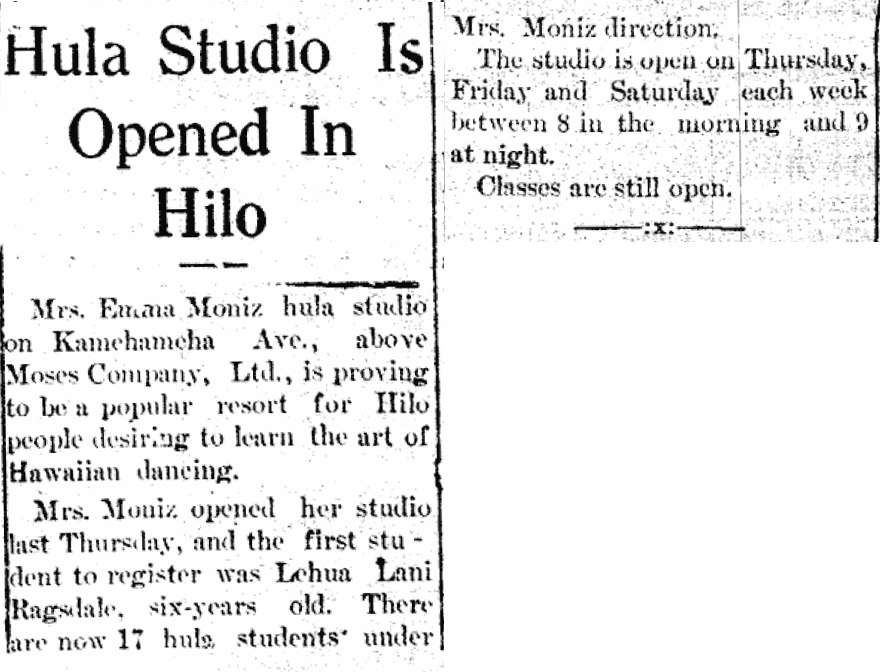
Mrs. Emma Moniz opens hula studio, 1936.

Hula Studio Is Opened In Hilo

Mrs. Emma Moniz hula studio on Kamehameha Ave., above Moses Company, Ltd., is proving to be a popular resort for Hilo people desiring to learn the art of Hawaiian dancing.

Mrs. Moniz opened her studio last Thursday, and the first student to register was Lehua Lani Ragsdale, six-years old. There are now 17 hula students under Mrs. Moniz direction.

The studio is open on Thursday, Friday and Saturday each week between 8 in the morning and 9 at night.

Classes are still open.

(Hoku o Hawaii, 7/1/1936, p. 1)

Hula Studio Is Opened In Hilo

Ka Hoku o Hawaii, Volume XXXI, Number 10, Aoao 1. July 1, 1936.

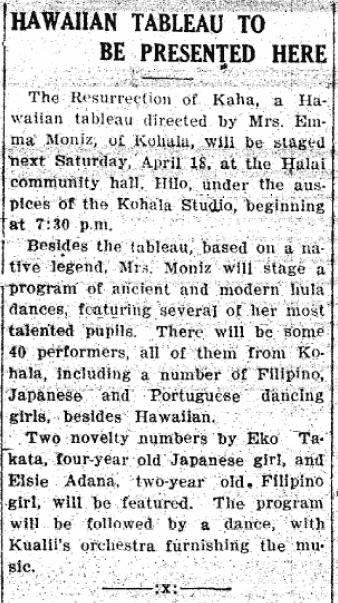
Hula in Hilo, 1914.

HAWAIIAN HULA

There will be first-class Hawaiian Hula which have never been seen before here in Hilo, being shown at the Waiakea Theater on the evening of this Saturday, June 6, at 7:30 P.M. One of the famous Hawaiian expert hula practitioners of Honolulu, Mrs. Hiaa, is the kumu of this hula troupe, along with her daughter, a girl that is skilled in the art; and she also has accepted two more girls from Waiakea.

And on this past Memorial Day [La Kaupua], they held a public show (called uniki or hu-e lepo perhaps in Hawaiian). According to those who were present on that day of the performance, it was the best that they had seen, and it was beautiful in all respects, with the elegant swaying of the hips of the Hawaiians. One of the most marvelous things and a reason for all of you fun-loving Hawaiians of the Kanilehua Rain to go and see them, is because they were trained until proficient in this skill right here in Hilo, and they can most definitely be compared to the troupes of the royal court of Honolulu who are continuously training.

And on that evening, you will hear the chanting of the name chant of Kalanianaole. Come down to witness for yourselves; just hearing about it is nothing. Entrance is $.25 and the upper level seats are $.50.

At the invitation of Waiakea Theater

Hilo, June 3, 1914.

(Hoku o Hawaii, 6/4/1914, p. 3)

HULA HAWAII

Ka Hoku o Hawaii, Buke 8, Helu 52, Aoao 3. Iune 4, 1914.

Paaiea Pond, part 3, from the pen of J. W. H. Isaac Kihe, 1914.

SOME STORIED LANDS OF KONA

Written for the Hoku o Hawaii by ka Ohu Haaheo i na Kuahiwi Ekolu¹

PAAIEA POND

Meeting with Kolomu’o and Pahinahina.

When the woman left that place at the seaside of Kaelehuluhulu, she arrived in the uplands of Keoneeli, a place that is renown to this day called Kepuhiapele [‘the scorching of Pele’], a heap of aa lava that is almost 200 Feet high, downside of the place where J. A. MaGuire [known also as Keoni Kaimana] is living.

When the woman arrived there, there were two girls named Kolomu’o and Pahinahina broiling breadfruit, while the parents were away farming. This was a huge town during those days, with many people living there. When the woman met up with the girls broiling ulu. The woman said, “The ulu that you are cooking is done.” One of the girls responded, “We are cooking ulu, but it is not totally done.”

The woman went on, “When you ulu is cooked, who will partake of it first?” “La’i, my god, will eat first.” “So La’i is a powerful akua?” “Yes, La’i is powerful.” The name of this girl was Kolomu’o, and the area beneath that scorching of Pele is famous to this day and called Kolomu’o, and famous too is the Opelu fishing shrine [Ko’a] at the beach of Kaupulehu.

Then the woman asked the other girl, Pahinahina, “And when your ulu is done, who is it for?” “It is for Pele Honuamea, my god.” “Then it is our ulu; your ulu is cooked, let the two of us partake in it.” Pahinahina agreed, and the ulu was peeled [makikoe²] and eaten up. Continue reading