More on Kaiulani buttons, 1899.

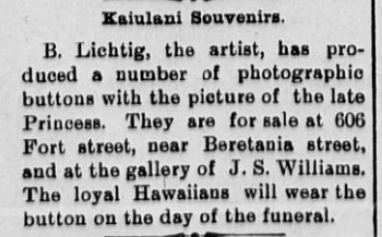
Kaiulani Souvenirs.

B. Lichtig, the artist, has produced a number of photographic buttons with the picture of the late Princess. They are fro sale at 606 Fort street, near Beretania street, and at the gallery of J. S. Williams. The loyal Hawaiians will wear the button on the day of the funeral.

[How is that for advertising? “The loyal Hawaiians will wear the buttons…”]

(Independent, 3/7/1899, p. 3)

Kaiulani Souvenirs.

The Independent, Volume VIII, Number 1142, Page 3. March 7, 1899.

Mourning of Princess Kaiulani, 1899.

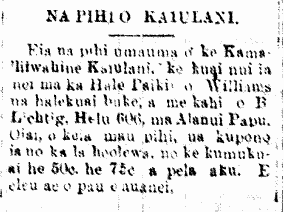
KAIULANI BUTTONS.

Buttons to be worn on the chest [pihi umauma] of Princess Kaiulani are being widely sold a the Photography Studio of Williams; at bookstores; and at B. Lichtig’s place, Number 606, Fort Street.  Being that these pins are perfect for the day of the funeral, for the price of 50¢, 75¢, and so forth. Be quick lest they sell out first.

[Has anyone seen examples of these?]

(Aloha Aina, puka pule, 3/18/1899, p. 1)

NA PIHI O KAIULANI.

Ke Aloha Aina (puka pule), Buke V, Helu 11, Aoao 1. Maraki 18, 1899.

Vital Statistics, 1913.

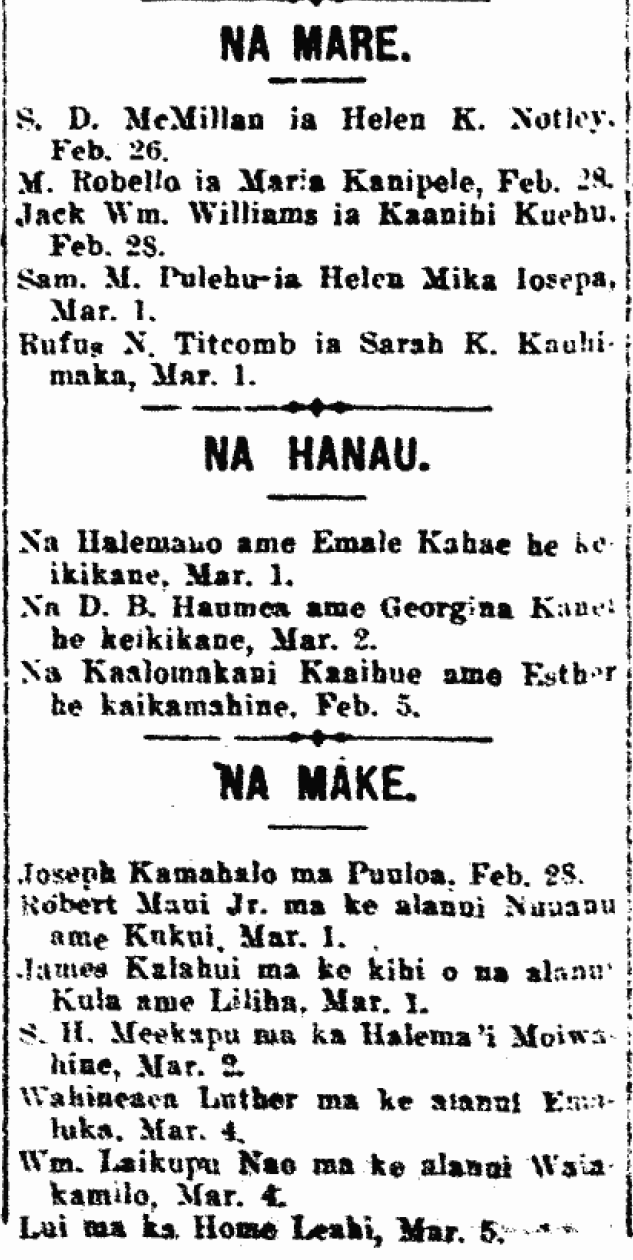
MARRIAGES.

S. D. McMillan to Helen K. Notley, Feb. 26.
M. Robello to Maria Kanipele, Feb. 28.
Jack. William Williams, to Kaanihi Kuehu, Feb. 28.
Samuel M. Pulehu to Helen Mika Iosepa, Mar. 1.
Rufus Titcomb to Sarah K. Kauhimaka, Mar. 1.

BIRTHS.

To Halemano and Emale Kahae, a son, Mar. 1.
To D. B. Haumea and Georgina Kanei [? Kane], a son, Mar. 2.
To Kaalomakani Kaaihue and Esther, a daughter, Feb. 5.

DEATHS.

Joseph Kamahalo at Puuloa, Feb. 28.
Robert Maui, Jr., at Nuuanu and Kukui Streets, Mar. 1.
James Kalahui at the corner of School and Liliha Streets, Mar. 1.
S. H. Meekapu at Queen’s Hospital, Mar. 2.
Wahineaea Luther on Emmeluth [Emaluka] Street, Mar. 4.
William Laikupu Nao [? Nae] on Waiakamilo Street, Mar. 4.
Lui at Leahi Home, Mar. 5.

(Kuokoa, 3/7/1913, p. 8)

NA MARE. / NA HANAU. / NA MAKE.

Ka Nupepa Kuokoa, Buke LI, Helu 10, Aoao 8. Maraki 7, 1913.

Vital Statistics, 1913.

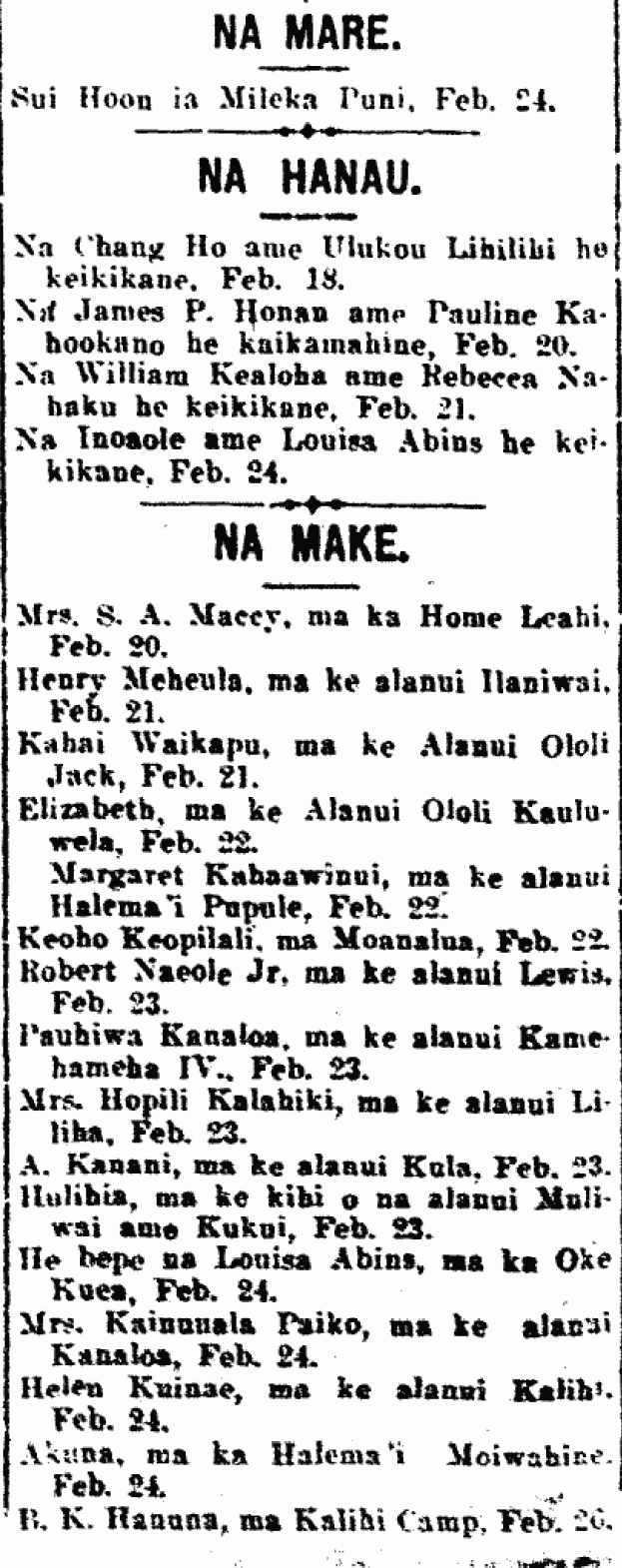
MARRIAGES.

Sui Hoon to Mileka Puni, Feb. 24.

BIRTHS.

To Chang Ho and Ulukou Lihilihi, a son, Feb. 18.
To James P. Honan and Pauline Kahookano, a daughter, Feb. 20.
To William Kealoha and Rebecca Nahaku, a son, Feb. 21.
To Inoaole [Nameless] and Louisa Abins, a son, Feb. 24.

DEATHS.

Mrs. S. A. Maccy, at Leahi Home, Feb. 20.
Henry Meheula, on Ilaniwai Street, Feb. 21.
Kahai Waikapu, on Jack Lane, Feb. 21.
Elizabeth, on Kauluwela Lane, Feb. 22.
Margaret Kahaawinui, on Insane Asylum Road, Feb. 22.
Keoho Keopilali, at Moanalua, Feb. 22.
Robert Naeole, Jr., on Lewis Street, Feb. 23.
Pauhiwa Kanaloa, on Kamehameha IV. Road, Feb. 23.
Mrs. Hopili Kalahiki, on Liliha Street, Feb. 23.
A. Kanani, on School Street, Feb. 23.
Hulihia, at the corner of River and Kukui Streets, Feb. 23.
A baby of Louisa Abina, at Oke Kuea [? Oak Square], Feb. 24.
Mrs. Kainuuala Paiko, on Kanaloa Street, Feb. 24.
Helen Kuinae, on Kalihi Street, Feb. 24.
Akuna, at Queen’s Hospital, Feb. 24.
B. K. Hanuna, at Kalihi Camp, Feb. 26.

(Kuokoa, 2/28/1913, p. 8)

NA MARE. / NA HANAU. / NA MAKE.

Ka Nupepa Kuokoa, Buke LI, Helu 9, Aoao 8. Feberuari 28, 1913.

Report on Jack Kaleiwahea, 1893.

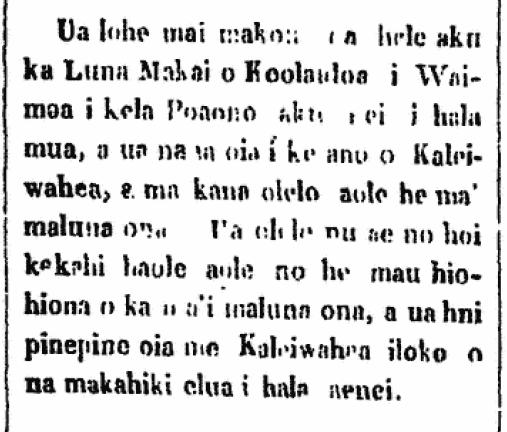
We’ve heard that the District Sheriff [Luna Makai] of Koolauloa went to Waimea this past Saturday, and saw the condition of Kaleiwahea, and according to him [the sheriff], he [Kaleiwahea] has no sickness. A haole also stated that he has no signs of the sickness upon him, and that he met with Kaleiwahea many times these past two years.

(Lei Momi: Oili Pule, 8/5/1893, p. 8)

Ua lohe mai makou...

Ka Lei Momi, He Nupepa Oili Pule, Buke I, Helu 1, Aoao 8. Augate 5, 1893.

Martha Poepoe Hohu and three Hilo women honored, 1929.

THREE HILO STUDENTS HONORED

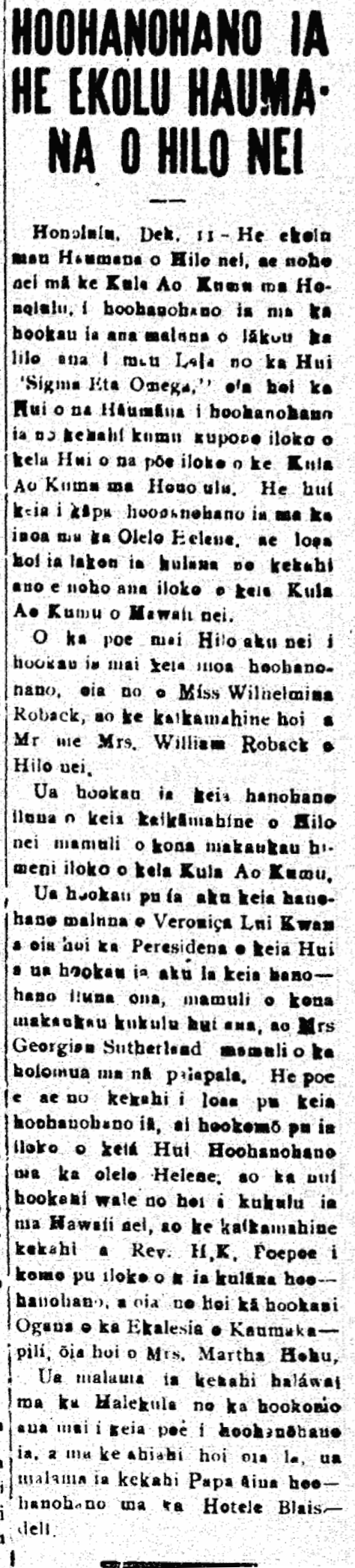
Honolulu, Dec. 11—Three Students from here in Hilo, who are boarding at the Teachers’ School in Honolulu, were honored by being initiated as members of the Society of “Sigma Eta Omega,” which is the Association of the Students who were honored for doing good works among that Association of those in the Teachers College [Kula Ao Kumu] in Honolulu. This Association is honorably named in Greek, and they are bestowed this position because of their standing in this Teachers College of Hawaii.

The ones from Hilo upon whom were bestowed this honored name, were Miss Wilhelmina Roback, the daughter of Mr. and Mrs. William Roback of Hilo nei.

This honor was conferred upon this girl from Hilo because of her singing abilities at that Teachers College.

This honor was also conferred upon Veronica Lui Kwan, the President of this Association, and this honor was bestowed upon her because of her skill in organizing the association; and to Mrs. Georgian Sutherland for her progress in studies. There were others as well receiving this honor and were initiated into this Greek Honors Society, the only society established in Hawaii nei; the daughter of Rev. H. K. Poepoe was also one included in this honored position, that being the Organist of Kaumakapili Church, Mrs. Martha Hohu.

A gathering was held at the College to initiate those who were honored, and on the evening of that day a celebratory party was held at the Blaisdell Hotel.

[Hoku o Hawaii, the last of the historic Hawaiian-Language Newspapers and one of the longest running (1906–1948) was printed in Hilo. For some reason, there seems to be at this time no issues online from before 5/31/1917. Eleven years of this paper is available on microfilm, but are not online as of yet. Hopefully, this newspaper can get reshot in entirety soon, because much of the available images are hard to read.]

(Hoku o Hawaii, 12/17/1929, p. 1)

HOOHANOHANO IA HE EKOLU HAUMANA O HILO NEI

Ka Hoku o Hawaii, Buke XXIII, Helu 27, Aoao 1. Dekemaba 17, 1929.

More on Jane Loeau, 1867.

[Found under: “LOCAL NEWS: Hawaii.”]

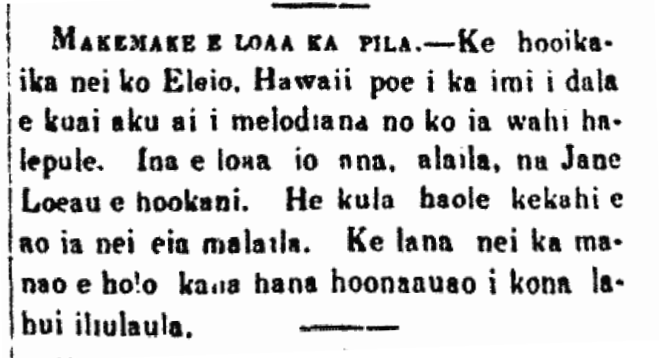
Instrument is sought after.—Eleio, Hawaii is putting effort into raising money to purchase a melodeon [melodiana] for its church house. If they should obtain one, then it will be Jane Loeau who will play it. An English school is also being taught by her there. It is hoped that her education effort for her dark-skinned [iliulaula] race will progress

(Kuokoa, 1/12/1867, p. 2)

Makemake e loaa ka pila.

Ka Nupepa Kuokoa, Buke VI, Helu 2, Aoao 2. Ianuari 12, 1867.

More stories about alalaua, 1873.

Alalauwa

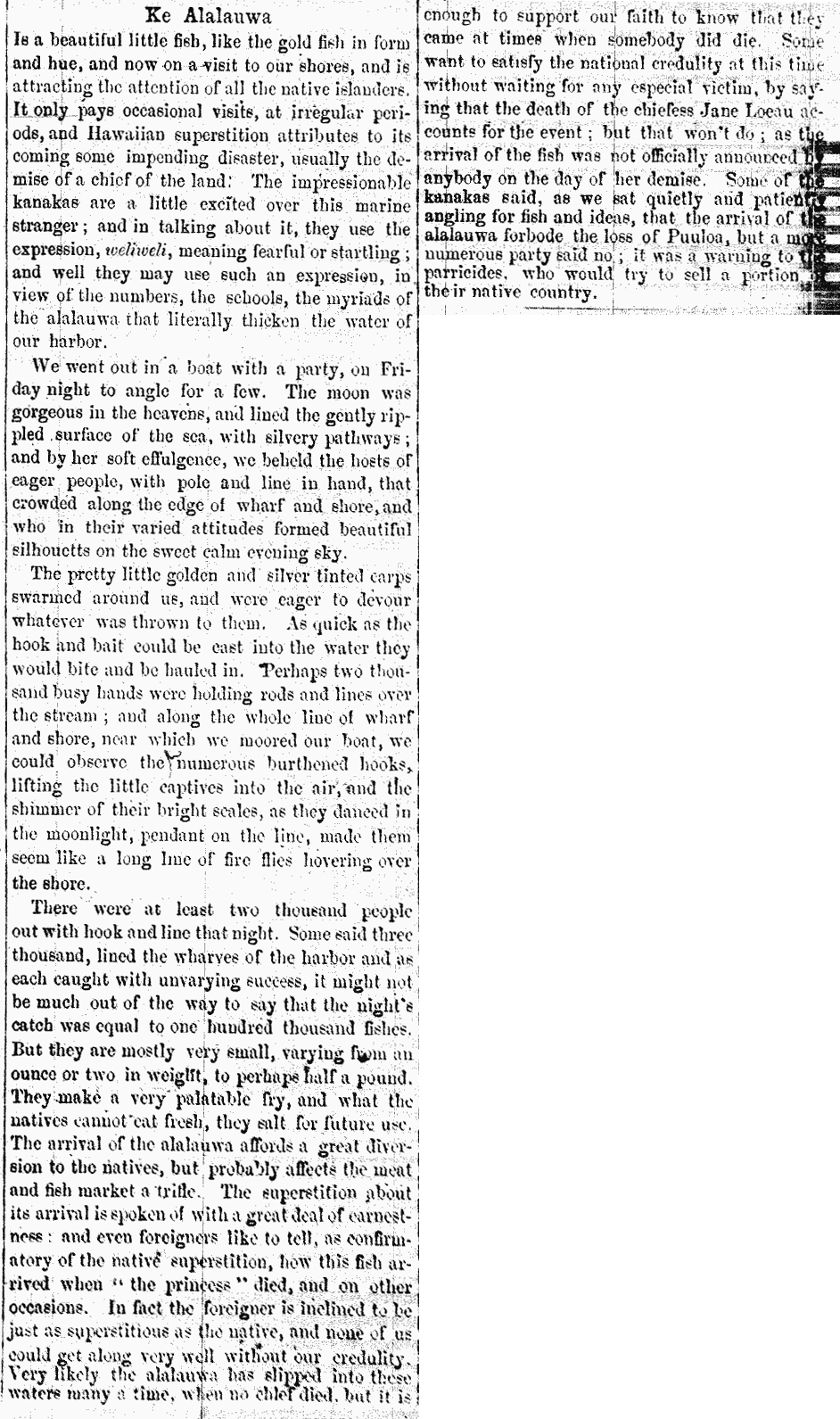
Is a beautiful little fish, like the gold fish in form and hue, and now on a visit to our shores, and is attracting the attention of all the native islanders. It only pays occasional visits, at irregular periods, and Hawaiian superstition disaster, usually the demise of a chief of the land. The impressionable kanakas are a little excited over this marine stranger; and in talking about it, they use the expression, weliweli, meaning fearful or startling; and well they may use such expression, in view of the numbers, the schools, the myriads of the alalauwa that literally thicken the water of our harbor.

We went out in a boat with a party, on Friday night to angle for a few. The moon was gorgeous in the heavens, and lined the gently rippled surface of the sea, with silvery pathways; and by her soft effulgence, we beheld the hosts of eager people, with pole and line in hand, that crowded along the edge of wharf and shore, and who in their varied attitudes formed beautiful silhouetts on the sweet calm evening sky.

The pretty little golden and silver tinted carps swarmed around us, and were eager to devour whatever was thrown to them. As quick as the hook and bait could be cast into the water they would bite and be hauled in. Perhaps two thousand busy hands were holding rods and lines over the stream; and along the whole line of wharf and shore, near which we moored our boat, we could observe the numerous burthened hooks, lifting the little captives into the air, and the shimmer of their bright scales, as they danced in the moonlight, pendant on the line, made them seem like a long line of fire flies hovering over the shore.

There were at least two thousand people out with hook and line that night. Some said three thousand, lined the wharves of the harbor and as each caught with unvarying success, it might not be much out of the way to say that the night’s catch was equal to one hundred thousand fishes. But they are mostly very small, varying from an ounce or two in weight, to perhaps half a pound. They make very palatable fry, and what the natives cannot eat fresh, they salt for future use. The arrival of the alalauwa affords great diversion to the natives, but probably affects the meat and fish market a trifle. The superstition about its arrival is spoken of with a great deal of earnestness: and even foreigners like to tell, as confirmatory of the native superstition, how this fish arrived when “the princess” died, and on other occasions. In fact the foreigner is inclined to be just as superstitious as the native, and none of us could get along very well without our credulity. Very likely the alalauwa has slipped into these waters many a time, when no chief died, but it is enough to support our faith to know that they came at times when somebody did die. Some want to satisfy the national credulity at this time without waiting for any especial victim, by saying that the death of the chiefess Jane Loeau accounts for the event; but that won’t do; as the arrival of the fish was not officially announced by anybody on the day of her demise. Some of the kanakas said, as we sat quietly and patiently angling for fish and ideas, that the arrival of the alalauwa forbode the loss of Puuloa,¹ but a more numerous party said no; it was a warning to the parricides, who would try to sell a portion of their native country.

¹Pearl Harbor

(Nuhou, 8/12/1873, p. 1)

Ke Alalauwa

Nuhou, Volume II, Number 9, Page 1. August 12, 1873.

Aua ia, 1862.

An ancient song.

O Kuokoa Newspaper; Aloha oe:

I just took a look within you, as well as the Hoku [o ka]  Pakipika; and I saw mele, and kanikau of all sorts. I however did not see this mele printed by the people who fancy publishing mele. Therefore, I ask you, Nupepa Kuokoa, to include this little mele in some available space.

E ke kama, kama—e,
Auaia e kona moku,
E ke kama kama,
Kama i ka huli nu,
E ke kama kama kama,
Kama i ka huli au,
Hulihia ke au,
Ka papa honua a ka moku,
Hulihia papioia ilalo ke alo,
E ui—e, a ui ia,
Hulihia i Manuakele,
I ka umu kaokoa a Ku,
I ka maka o Ku,
Kaaha mikii lohelohe,
Ka aha nana i hikii,
O hulahula Mea,
Ua kalakala ia,
Ua wekewekea.

Ua hemo aku la ka piko o ka aina,
Ua kala kaalihi pohakuku,
Me ka upena a Ku,
O ihu aniani,
Me kauluna o Nioalani,
O Keawe, o ka manu,
Ai kualaahia,
Keiki ehu kamaehu,
A Kanaloa,
Ua mokuhia kamakama,
A Kalino a ka moku,
Ua kalalia i ka ua lena a Lono,
Na Lono na ka mano nui,
Huki ai moku,
O Kalani o Kauila,
E a i Kahiki,
He ulunaio makawalu,
He ohia ako,
He hakoko i ka ua na ke’lii,
O Namakaeha e ku i ke kaua,
Nana i hoopehee ka honua,
O ka moku,
I haalaia i ke kiu e Loka,
Ka pua ka welohi a Kanaloa,
I ka puulele i ka hana oi a Hina,
E Hina, e une a hano, e una,
Unaia i mama,
I mama, mama,
I mamaia me he pule la.

Hooe io io Nana,
O nana ka hakui,
Io io Nana,
O nana ke au haku,
O kuu Haku ka’u aloha e uwe nei,
Uwe au—e, uwe au,
Uwe au ia oe e Lumialani,
O ka Lumialani o ka haku,
E kaa i ka honua,
O ke kaa i maukuku,
I ka maka o Lono,
O ke kauwahi aloha,
O Halakaina,
O Halakinau oe,
O Keala o Kolole,
No Kololehiwa ia ala,
Nona no ka Lukapewa,
Enaena Puna koele wahine i ka la,
Pua lohelau ka hala,
Ko ohia o Makuukeeu,
I ka papa o Papalauahi,
A Nanawale, ke hoolana no,
Keaiwa, ka e au—e,
I kaeu no a hopuhia loaa,
Loaa ka inoa ino,
He inoa hue—e,

This mele was composed for Namakaeha, an alii in the time of Kamehameha I. With appreciation. S. W. Kekalohe.

Kipahulu, Maui, H., Oct. 1, 1862.

(Kuokoa, 11/8/1862, p. 1)

He mele kahiko.

Ka Nupepa Kuokoa, Buke I, Helu 50, Aoao 1. Novemaba 8, 1862.