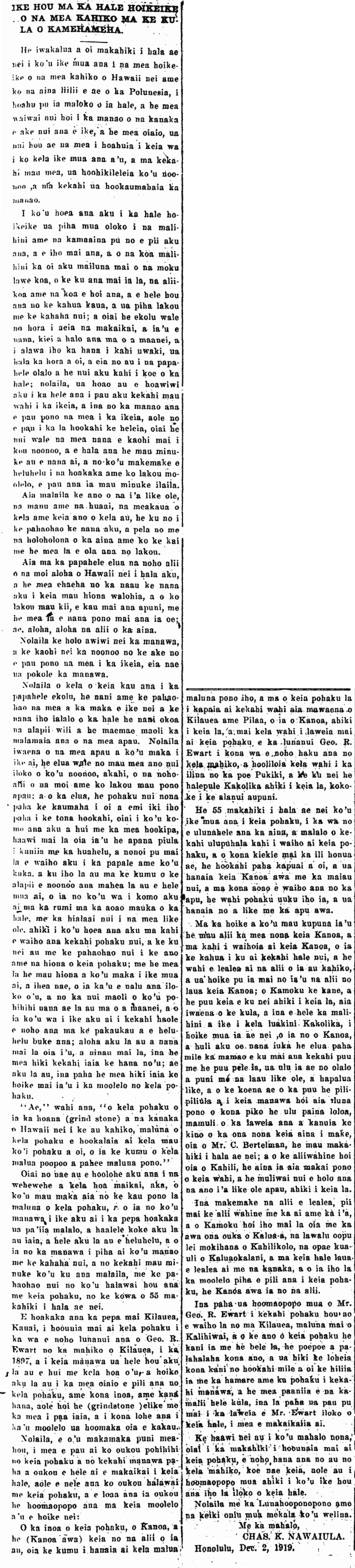
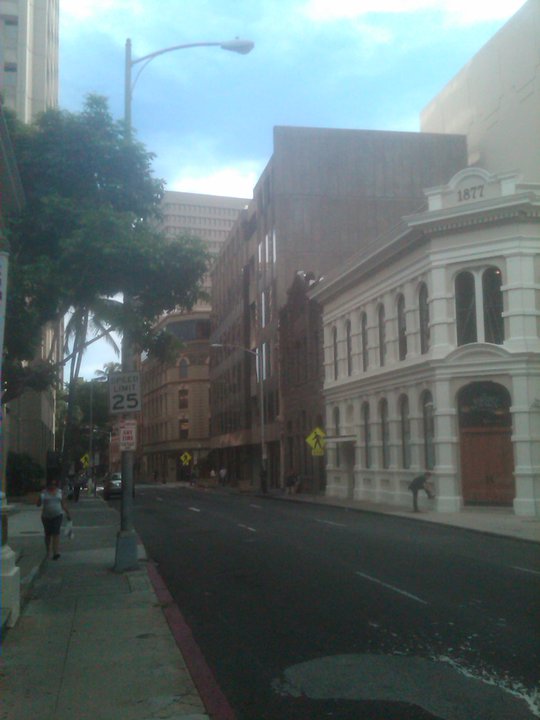
SEEING ONCE AGAIN THE MUSEUM AT KAMEHAMEHA SCHOOL.
Twenty years or more has past since I first saw exhibits of the antiquities of Hawaii nei and the tiny islands of Polynesia that are stored in that building, and it is of great value to those who wish to see, and it is true, there are more things stored there from when I first saw it; and there were things which shocked me while other things made me sad.
When I arrived at the museum, it was already filled with foreigners and locals going upstairs and downstairs, and soldiers were the majority, from the military ships docked those days; officers as well as enlisted men returning and going back to the battlefield, they were awestruck; and being that there was only three hours allowed for going around, and while I looked, peeped, and peered here and there, I looked at my watch and more than an hour had past, and here I was on the first floor with so much more of the building to see; therefore, I tried to quicken my pace so that I see things; but if you intended to see everything, you would not be able to do that walking around the whole day because there are so many things that catch your attention and you’d spend some minutes looking at them; and because I wanted to read the explanations and all of the stories, minutes were spent there.
There were all types of fish, birds, and fruits, war implements of all sorts of that time, and they were amazing to see; plus the animals of the land and the sea, it was as if they were living.
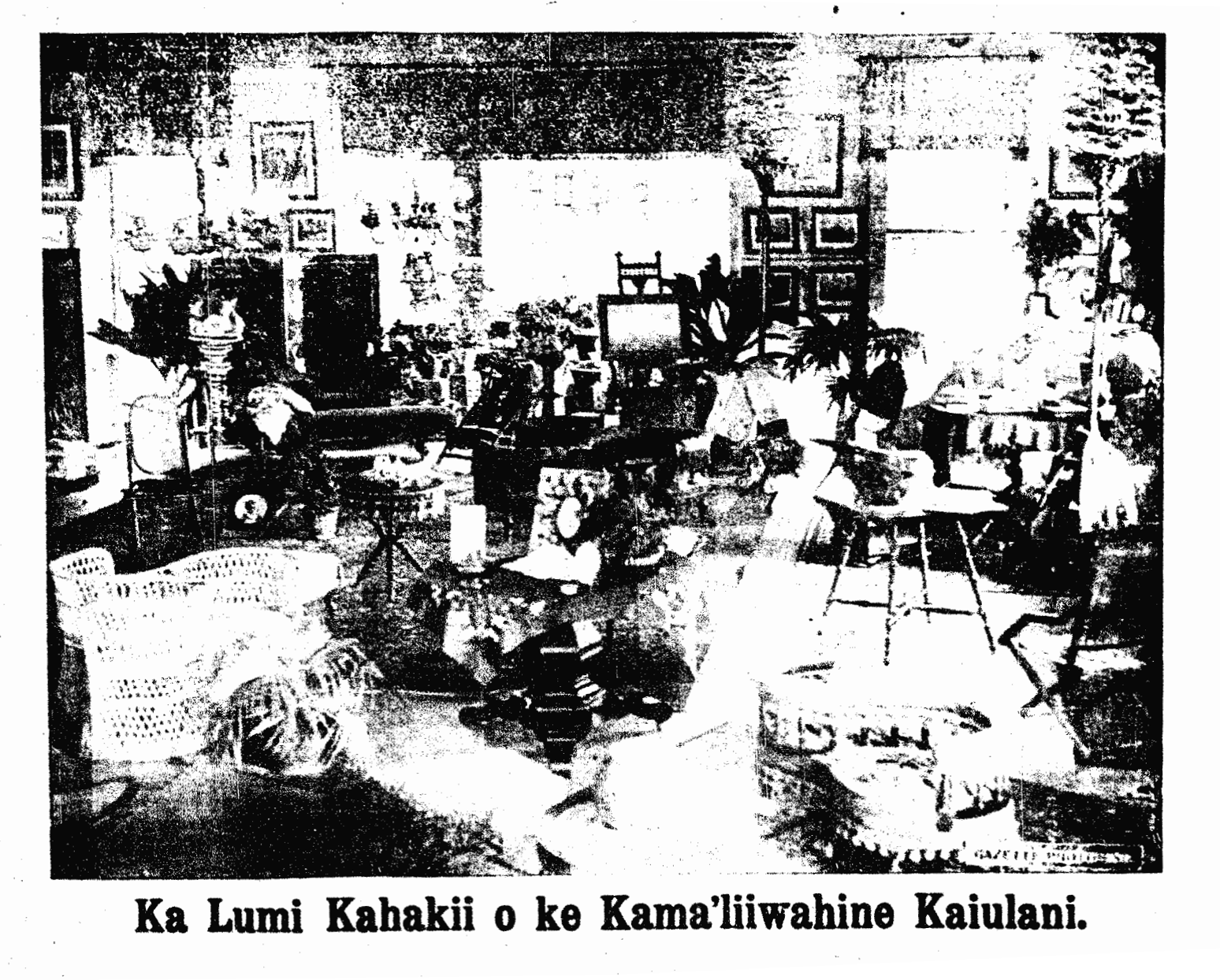
On the second floor were the thrones of the beloved monarchs of Hawaii nei who passed, and it was painful in my gut to see this touching sight; and their portraits hung all about, looked as if they were watching you; yes, aloha, aloha for the chiefs of the land.
The time was going quickly, and I was intent on seeing everything, and yet the time was short.
With every step on the third floor, everything was fascinating to see, and looking blow, the winding stairs were just so beautiful and everything was kept so nicely. But amongst everything I saw, there were but two most important things: the first being the thrones and all of their belongings, and the second was a huge stone which weighed more or less a ton; when I entered and met the greeter, I was given a piece of tin stamped with a number, and was asked to leave my hat and coat, and then I stood at the base of the stairs thinking where should I go first; that is when I entered the room on the mauka side of the building, greatly delighted by everything until I reached the place where the great stone stood, and I was astonished at the look and appearance of this stone; as if it was something I saw before, but when; that is what I thought to myself; and because I was very unclear about it, I looked here and there and I saw a haole sitting at a desk reading a book; I gave my aloha and he looked at me and asked if there was something he could do for me; I said yes, if he could explain to me the story of the stone.
“Yes,” he said, “that stone is the grinding stone of the Hawaiians in the old days; it was upon that stone that adzes were sharpened, and that is the reason for that smooth indentation on the top.”
While I was listening to the explanation of that fine friend, my eyes were set directly upon that stone, and that is when I saw the description printed below it; I immediately left him and I went to read, and I was shocked and for several minutes I stood there, astounded that I met up again with this rock after a span of 55 years gone by.
That label explained that this rock was sent from Kilauea, Kauai, when George R. Ewart was boss of the Kilauea sugar plantation, in 1897, and then I went and joined my friend, and told him the truth about that stone, and its name, and its function; it wasn’t a grindstone like what he believed; and as he heard my story he began to write.
Therefore my news loving friends, so that your confusion over this stone is put to an end, and for when you go to visit this building, you won’t fail to meet up with this rock, and you will have an understanding through this story I am revealing:
The name of this stone is Kanoa, and this was a awa bowl [Kanoa awa] for the alii of that time, and this is the reason why that depression was made right on the top, and there is a place between Kilauea and Pilaa called Kanoa until this day, named for this stone; and from this spot, the sto0ne was taken away by the boss George R. Ewart when he was the head of that sugar plantation, and this place became the graveyard for the Portuguese, and a Catholic Church [Saint Sylvester Church] stands there until today near the government road.
It was 55 years ago that I first set my eyes on this stone, during those days when the land was forested, and beneath a pandanus tree was where this stone was placed; its height from the ground was perhaps a foot or so, and this Kanoa awa was crafted with great skill and at its side was the cup [apu], which was a smaller stone fashioned like an awa cup.
From what my kupuna told me, this Kanoa belonged to some chiefs and where the Kanoa was left was where a great house one stood, which was a place where the alii of the old times would enjoy themselves. And I was also informed of the alii to whom belonged the Kanoa; Kamoku was the man, and this is a hill that stands to this day in the middle of a field, and should a malihini go and see that Catholic church mentioned earlier, that place is Kanoa, and if you turn to look inland, about two miles away a hill stands like a heap of lava, and below all around it grow all sorts of plants, and from the middle until the top is pilipiliula grass, and today on its peak is a grove of tall pine trees planted after the owner of this land, Mr. C. Bertelman, died and his body was brought and buried some years ago; as for the chiefly woman, she was Kahili, and this is a land immediately seaward of this place, with a huge estuary where fishes of all types swim today.
Should the alii want to have fun, the chiefess went up with poi and fish, and Kamoku went down with the intoxicating awa of the uplands of Kahua-a, bundles of oopu fish, mokihana lei of Kahihikolo, dark shrimps [opae kuauli] of Kaluaokalani, and it was in this house that they would enjoy themselves with their people; that is the whole story dealing with this stone, a awa bowl for the chiefs.
If Mr. George R. Ewart had known of yet another stone that is in Kilauea in Kalihiwai, which rings like a bell, and it is rounded flat, and its sound can be heard for a mile or more if it is struck with a hammer or a rock in other times, and it was something played with by school children; then it would have probably been taken by Mr. Ewart to the museum to be viewed.
I give my appreciation to him being that in that year that this stone was sent, I was working at that sugar plantation, but I had no prior knowledge of this until I saw it once again in this museum.
With the Editor and the metal type setting boys go my valediction.
Me ka mahalo,
Charles K. Nawaiula.
Honolulu, Dec. 2, 1919.
(Kuokoa, 12/12/1919, p. 3)
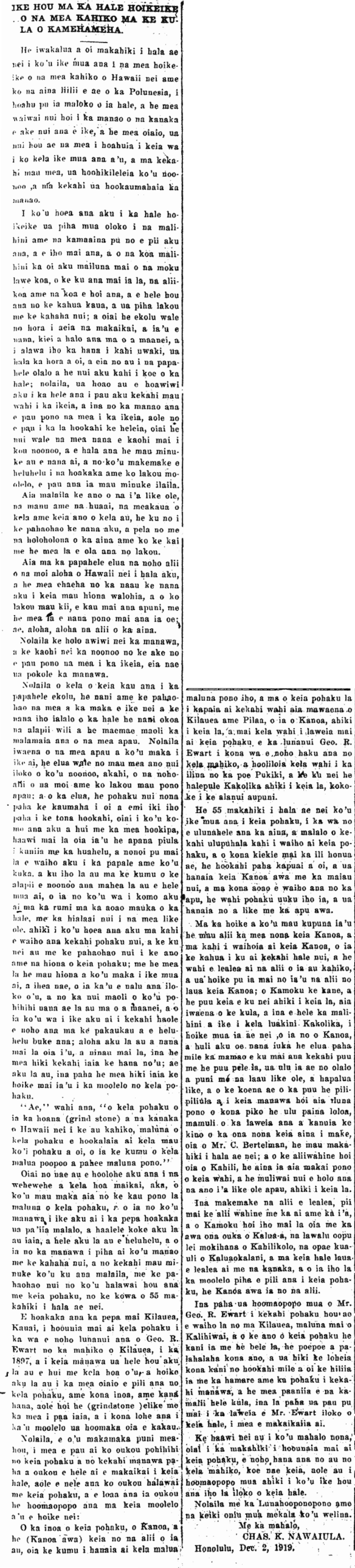
Ka Nupepa Kuokoa, Buke LVII, Helu 50, Aoao 3. Dekemaba 12, 1919.The