A New Year’s Gift: a Genealogy of Rulers, 1874.

A NEW YEAR’S GIFT.

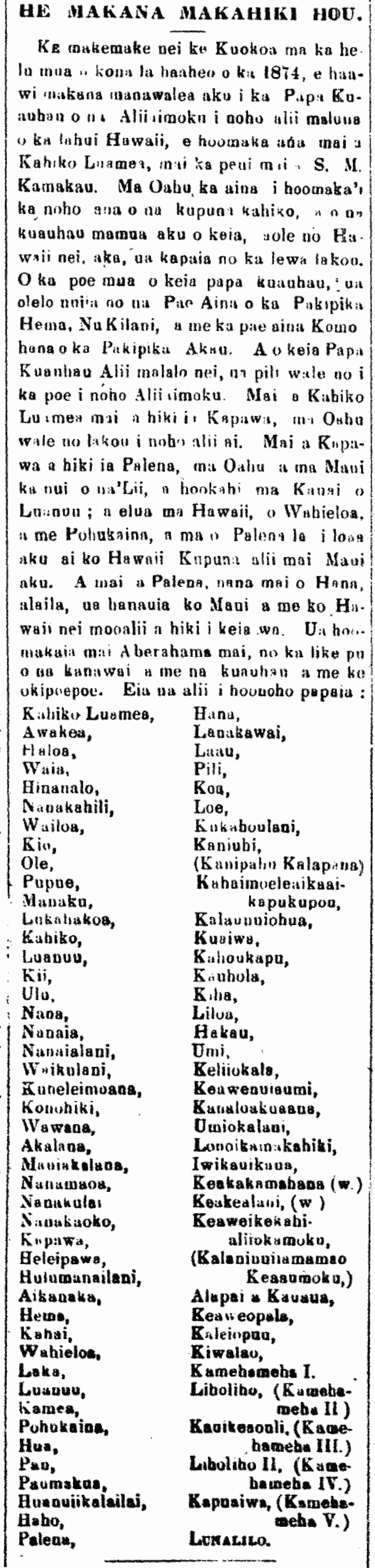
The Kuokoa, on this first issue of its proud days of 1874, wants to gift this Genealogical List of the Rulers over the Hawaian people, starting from Kahiko Luamea, from the pen of S. M. Kamakau. It was upon Oahu that the ancient ones first lived, and the genealogy from before this is not from here in Hawaii, but it is said that they were from the sky [lewa]. The first people in this genealogy, it is widely stated that they are from the Islands of the South Pacific, New Zealand, and the islands to the Western North Pacific. And the listing of Alii Genealogy below just pertains to those who were Aliiaimoku. From Kahiko Luamea to Kapawa, they just ruled on Oahu. From Kapawa to Palena, most of the Alii were on Oahu and Maui; one was from Kauai, Luanuu; and two on Hawaii, Wahieloa and Pohukaina; and from Palena is where Hawaii’s royal Ancestry from Maui come from. And from Palena was born Hana, thereafter Maui’s and Hawaii’s chiefly line have been born until this time. It began from Abraham, being that the laws were the same, the genealogy was the same, and the circumcision was the same. Here are the alii listed out:

Kahiko Luamea,
Awakea [Wakea],
Haloa,
Waia,
Hinanalo,
Nanakahili,
Wailoa,
Kio,
Ole,
Pupue,
Manaku,
Lukahakoa,
Kahiko,
Luanuu,
Kii,
Ulu,
Nana,
Nanaia,
Nanaialani,
Waikulani,
Kuheleimoana,
Konohiki,
Wawana,
Akalana,
Mauiakalana,
Nanamaoa,
Nanakulai,
Nanakaoko,
Kapawa,
Heleipawa,
Hulumanailani,
Aikanaka,
Hema,
Kahai,
Wahieloa,
Laka,
Luanuu,
Kamea,
Pohukaina,
Hua,
Pau,
Paumakua,
Huanuiikalailai,
Haho,
Palena,
Hana,
Lanakawai,
Laau,
Pili,
Koa,
Loe,
Kukahoulani,
Kaniuhu,
(Kanipahu Kalapana)
Kahaimoeleaikaaikapukupou,
Kalaunuiohua,
Kuaiwa,
Kahoukapu,
Kauhola,
Kiha,
Liloa,
Hakau,
Umi,
Keliiokala,
Keawenuiaumi,
Kanaloakuaana,
Umiokalani,
Lonoikamakahiki,
Iwikauikaua,
Keakakamahana (w [wahine])
Keakealani (w),
Keaweikekahialiiokamoku,
(Kalaninuiiamamao Keeaumoku),
Alapai a Kauaua,
Keaweopala,
Kaleiopuu,
Kiwalao,
Kamehameha I.
Liholiho (Kamehameha II),
Kauikeaouli (Kamehameha III),
Liholiho II (Kamehameha IV),
Kapuaiwa (Kamehameha V),
Lunalilo.

[This seems to be a little different from what is seen in the appendix of Kamakau’s “Ruling Chiefs of Hawaii”.]

(Kuokoa, 1/3/1874, p. 2)
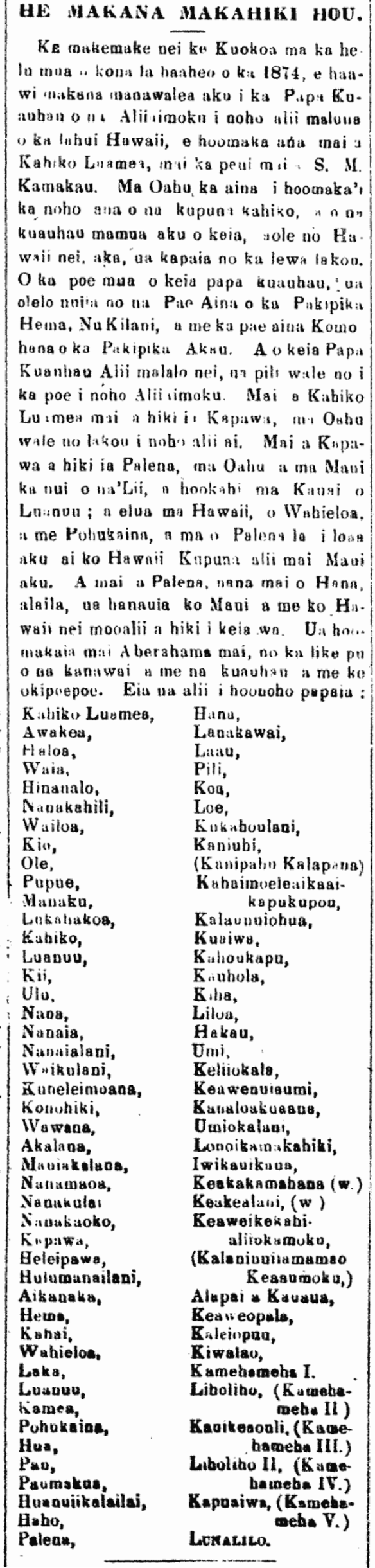
HE MAKANA MAKAHIKI HOU.

Ka Nupepa Kuokoa, Buke XIII, Helu 1, Aoao 2. Ianuari 3, 1874.

Vital Statistics, 1913.

MARRIAGES.

J. H. Akana to Mrs. Eliza K. King, January 3.
William K. M. Makanui to Hattie K. Manoha, January 4.
William Ayau to Miss Annie Fernandez, January 9.
Daniel Aona to Mrs. Maria Kapehe Hugo, January 9.

BIRTHS.

To Moses Ehu and Rose Kaeo, a daughter, January 5.
To Rodrigo Villafor and Mary Lui, a daughter, January 7.
To William P. Dole and Emily Kekoa, a daughter, January 8.

DEATHS.

Iokewe Niauhoe, on Kunawai Lane, January 15.

(Kuokoa, 1/17/1913, p. 8)

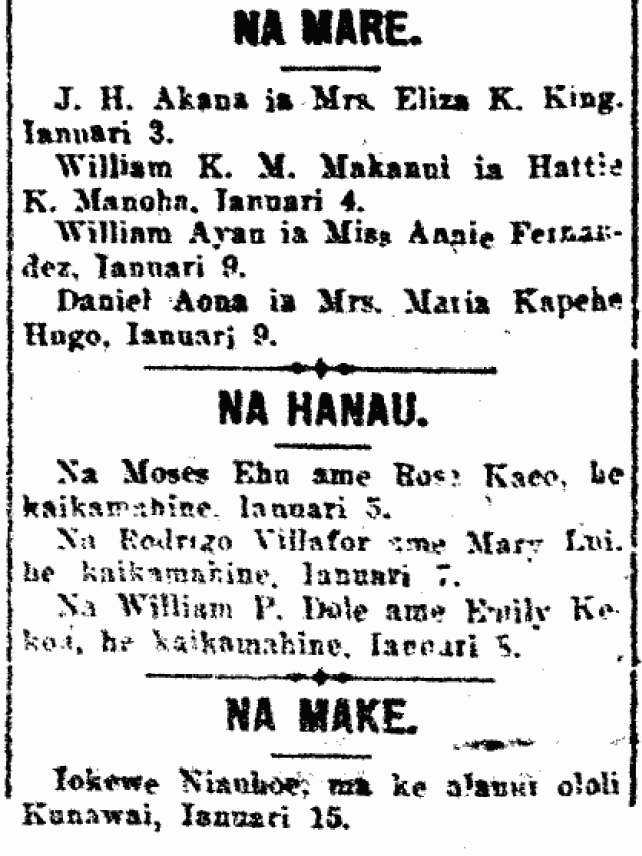
NA MARE. / NA HANAU. / NA MAKE.

Ka Nupepa Kuokoa, Buke XLIX, Helu 3, Aoao 8. Ianuari 17, 1913.

Mistreatment of leprosy patients and why we need to reshoot the Hawaiian-Language Newspapers, 1886.

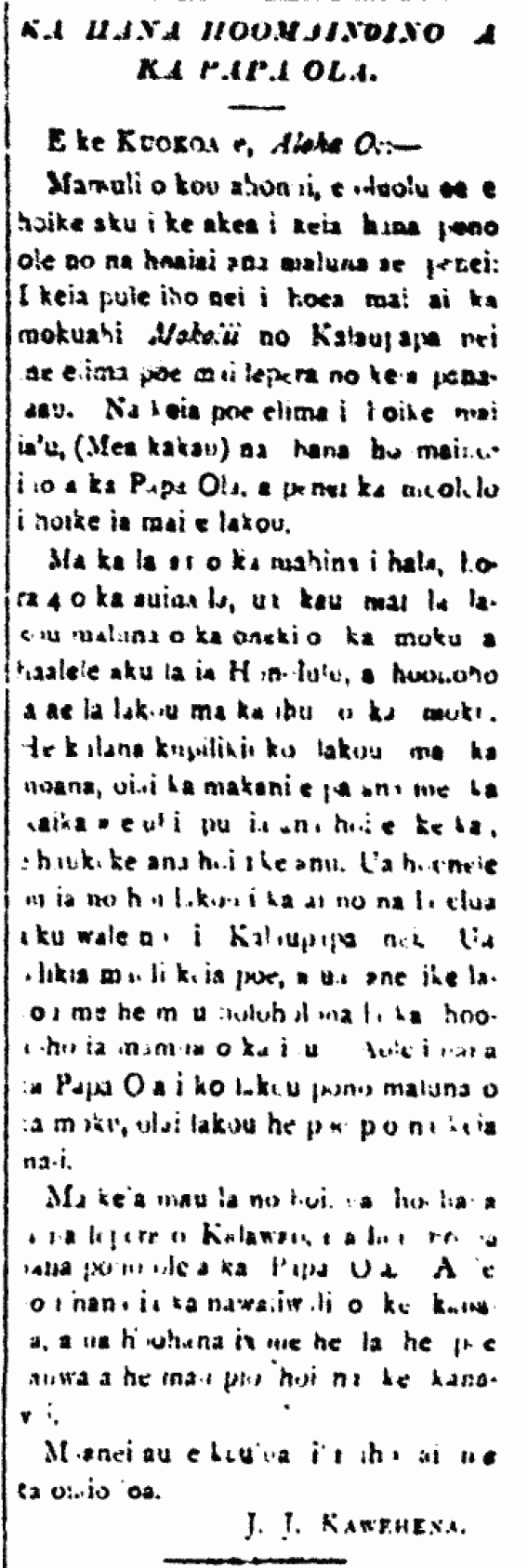
ABUSE BY THE BOARD OF HEALTH.

O Kuokoa, Aloha Oe:—

Please be so patient as to show this improper behavior to clarify the above, thus: This past week the steamship Makalii arrived here in Kalapapa with five leprosy patients for this colony. These five people told me (the Writer) about the cruelty done by the Board of Health, and this is the story told by them.

On the 21st of the past month, at 4 in the afternoon, stepped onto the deck of the ship and left Honolulu, and they were placed at the bow of the ship. They were in distress while at sea due to the winds that were blowing strongly and they were covered by the sea and shivered in the cold. They were not give food for two days and then landed here in Kalaupapa. They were in desperate shape, and were treated like animals being placed at the bow. The Board of Health did not look after their well-being even if they ?????

These days, the leprosy patients of Kalawao are made to work ?????? mistreated by the Board of Health. They don’t consider the weak state of the people and are worked like slaves and they are prisoners of the law.

Here, I ????? with sincerity.

J. J. Kawehena.

[I know i keep saying that the Hawaiian-Language Newspapers need to be reshot again so that we can have the clearest images possible, but i can’t help it. Here is a perfect example. I am guessing at a good deal of the content, and where i couldn’t, i left as “????” Once the papers deteriorate and crumble away, there is no way we can get these histories.]

(Kuokoa, 7/3/1886, p. 1)

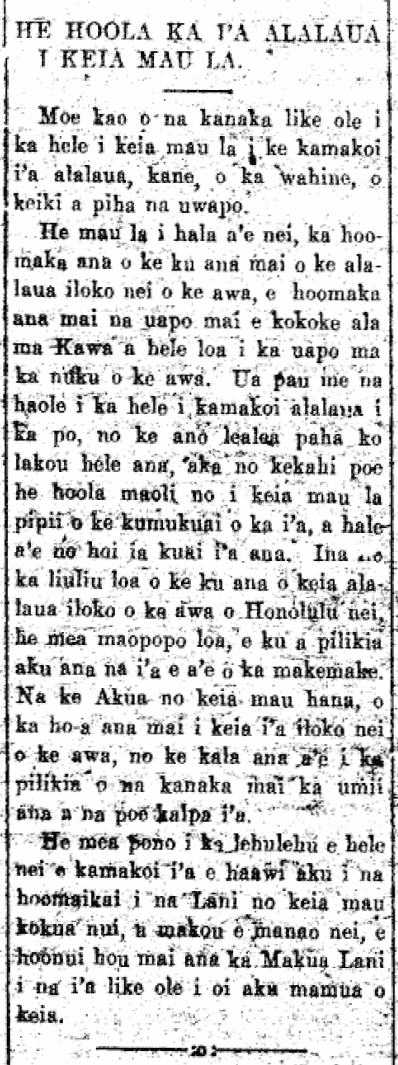
KA HANA HOOMAINOINO A KA PAPA OLA.

Ka Nupepa Kuokoa, Buke XXV, Helu 27, Aoao 1. Iulai 3, 1886.

Writing on the wall, 1894.

The Day of Happiness is a Day of Sadness.

On this day, those who took our beloved land by force rejoice, and it makes a full years since they’ve feasted wastefully of the fertile soil of our mother land. This day is one of happiness for the circle of missionaries, plunderers of land, and overthrowers of the Hawaiian Kingdom, as well as for those who enter join their circle.

It is true, they will indeed rejoice; however, along with this joy, there is hurt within. Look at Belshazzar [Belehazara] the one whose boast went, “Am I not Belshazzar, the builder of the Great Babylon? Look at its shiny walls, its beautiful images, and its Throne has authority and might.”

However, let us recall, O Hawaiian Lahui, his story; what is known? it is this: That night, everyone was joyous, and drinking wine from cups sacred to Jehovah, Almighty God; and they praised Belshazzar for his great beauty. However, while the rejoicing was going on, there was seen part of a hand writing some words on the wall of the house—Mene, Mene, Setela, Uparesina; You have been weighed on the scales and have been found wanting. It was these astonishing words which caused a fear to fall over everyone in the house; and as for the king Beshazzar, he was shaking with trepidation at this amazing portion of a hand.

And that is what we are saying: the day of joy of the Government of the P. G. [Provisional Government], is the day that sadness will come; for we have seen their actions done over the past year. They were not actions done to move this land forward, but actions that were clearly harmful as well as squandering. Therefore O Pious Ones, do not forget to remember Jehovah, God, and he shall help us.

Puuwaialoha [“Loving-heart”]

(Leo o ka Lahui, 1/17/1894, p. 2)

Ka La o ka Hauoli oia no ka La o ka Luuluu.

Ka Leo o ka Lahui, Buke II, Helu 856, Aoao 2. Ianuari 17, 1894.

More on the Boston, in English, 1893.

The U. S. S. Boston Lands Sailors and Marines.

(From Daily, January 17.)

Yesterday was an eventful day in this city. At early morning groups of men could be seen about the streets talking over the present critical situation.

About eleven o’clock the following notice was handed about but it was not received with favor as it was considered but a ruse on the part of the revolutionists:

BY AUTHORITY.

Her Majesty’s Ministers desire to express their appreciation for the quiet and order which has prevailed in this community since the events of Saturday, and are authorized to say that the position taken by Her Majesty in regard to the promulgation of a new Constitution, was under stress of Her native subjects.

Authority is given for the assurance that any changes desired in the fundamental law of the land will be sought only by methods provided in the Constitution itself.

Her Majesty’s Ministers request all citizens to accept the assurances of Her Majesty in the same spirit in which it is given.

(SIGNED) Liliuokalani.

Samuel Parker,
Minister of Foreign Affairs.

W. H. Cornwell,
Minister of Finance.

John F. Colburn,
Minister of the Interior.

A. P. Peterson,
Attorney-General.

Iolani Palace, January 16, 1893.

In the afternoon all of the principal business houses closed up to allow the owners and their clerks to attend the mass meeting at the Armory. A full report of the enthusiastic meeting appears elsewhere in this issue.

After the meeting adjourned many people returned to Fort street, and stood around as if they expected some new developments, and they were rewarded when one of the most important events of the day happened.

About 5 o’clock in the afternoon, the U. S. S. Boston landed about three hundred men. Each man had two belts of cartridges around his waist and was armed with a rifle. The men marched up to the office of the Consul-General of the United States, where a halt was made.

The marines were detached and sent to the American Legation on Nuuanu Avenue, while the sailors marched out along Merchant street with two gatling guns and made a halt in front of Mr. J. A. Hopper’s residence. About sundown they moved to the grounds of Mr. J. B. Atherton’s and after a stay of several hours returned to Arion Hall, where they camped over night.

[The “Daily” here mention at the top refers to the Daily Pacific Commercial Advertiser.]

(Hawaiian Gazette, 1/24/1893, p. 6)

The U. S. S. Boston Lands Sailors and Marines.

Hawaiian Gazette, Volume XXVIII, Number 4, Page 6. January 24, 1893.

More on the Boston, in English, 1893.

Of What Are They Afraid?

Editor Bulletin:—

The Advertiser this morning says: “The landing of troops from the Boston furnishes a guarantee that the persons and property of American citizens will be safe from violence, etc.” What are those who claim to be American citizens afraid of? From what quarter is violence expected? None whatever, except like Banquo’s ghost, from the “deep shadows of cowardly and guilty consciences.” It would be well under present circumstances, for the Advertiser to come forward and state to the public who were the ones that forced the late King at the point of the bayonet to break his oath and forswear the late constitution tha he had sworn to uphold?

An American.

(Daily Bulletin, 1/17/1893, p. 3)

Of What Are They Afraid?

The Daily Bulletin, Volume 5, Number 626, Page 3. January 17, 1893.

More on the landing of the Boston, 1893.

OPPOSED.

We have received news that the Ministers of the Queen sent their written protest to the Minister of the United States for his ordering the landing of the armed men from the man-of-war Boston on the evening of this Monday notwithstanding that there was peace on land. And this objection was jointly supported by the Commissioners of the Nations of Great Britain, France, Portugal, and Japan, by them signing a document opposing this action over these reasons—(1), Because of the agreement under law between the Nations to give prior notice. (2),  There was no cause to land the troops being that there was peace.

This is the Law, that being there is no other Nation that has any right to land its troops while there is peace; were there internal problems, but only if there was an uprising or a civil war, only then could there be troops landed to watch over and protect the safety of their citizens as well as their property.

(Hawaii Holomua, 1/18/1893, p. 3)

UA KUE IA.

Hawaii Holomua, Buke III, Helu 141, Aoao 3. Ianuari 18, 1893.

More on the Boston, 1893.

[Excerpt from the article: “OVERTHROW IN HAWAII NEI: The Queen Attempts to Push a New Constitution”]

At perhaps 5 oʻclock in the afternoon, the American warship Boston [Bosetona] landed its officers and sailors who were armed. When they came ashore, the marines were split up to go and guard the residence of the American Minister Stevens on Nuuanu Avenue, and the American Consulate on Merchant Street, and the sailors were sent to King Street and stood before the residence of J. A. Hopper, and later they were sent to the residence of Mr. J. B. Atherton. They stayed there for some time, and then all came back and slept in Arion Hall [Ariona Holo] makai of the Opera House. They are still on shore to the present.

(Kuokoa, 1/21/1893, p. 2)

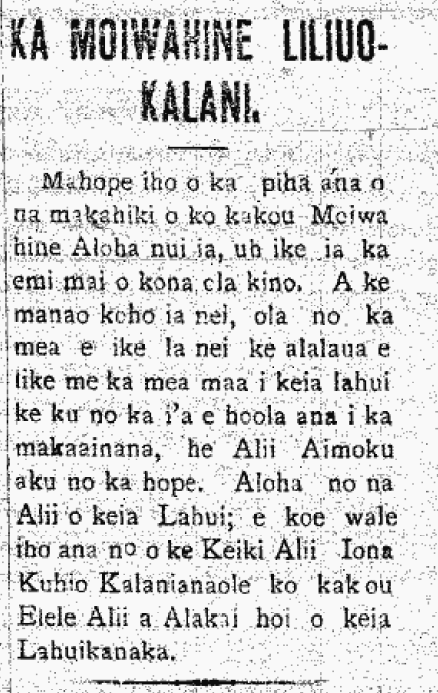
I ka hora 5 paha o ke ahiahi...

Ka Nupepa Kuokoa, Buke XXXII, Helu 3, Aoao 2. Ianuari 21, 1893.

Coverage of the landing of the USS Boston, 1893.

The American Troops Come Ashore.

Without knowledge of the Government, and regardless of the agreement of the American Minister that the soldiers from the warship would not come ashore, being that the Government was prepared to uphold the peace; the American Minister ordered the soldiers of the Boston to to take control. This is an apparent act of aggression, and if that nation learns of the truth of this act by its official, it will be grounds for him to be condemned.

[This article and the following are coverage of the landing of the U. S. S. Boston 120 years ago today by different newspapers. Just as we see today, back then there was different coverage depending on what you read.]

(Leo o ka Lahui, 1/17/1893, p. 2)

Ua Lele Mai na koa Amerika.

Ka Leo o ka Lahui, Buke II, Helu 624, Aoao 2. Ianuari 17, 1893.

Competing rallies, 1893.

O HAWAIIAN LAHUI!

Today, there is a rally being called by the Missionaries of the Reformist Party [Poai Hoomaemae] and those who favor them, at Manamana, with the intent to bring harm to the Queen for Her aloha she has for the lahui, in Her proclaiming a new Constitution; by ending Her reign and making this nation a republic. Therefore, patriots, those born of this land, stand strong behind this nation; there shall not be a single true Hawaiian who will participate in this gathering, should they be invited. All of you true Hawaiians, let us stand behind our Sovereign and give our lives for the rights of our Queen and peace over the land. Those citizens who love their alii are called to join together to march straight to the rally fronting the Opera House [Hale Mele Hou] at 2 o’clock in the afternoon. With one heart of aloha and breasts side by side all across the land, you descendants of Kamehameha.

(Leo o ka Lahui, 1/16/1893, p. 2)

E KA LAHUI HAWAII!

Ka Leo o ka Lahui, Buke II, Helu 623, Aoao 2. Ianuari 16, 1893.