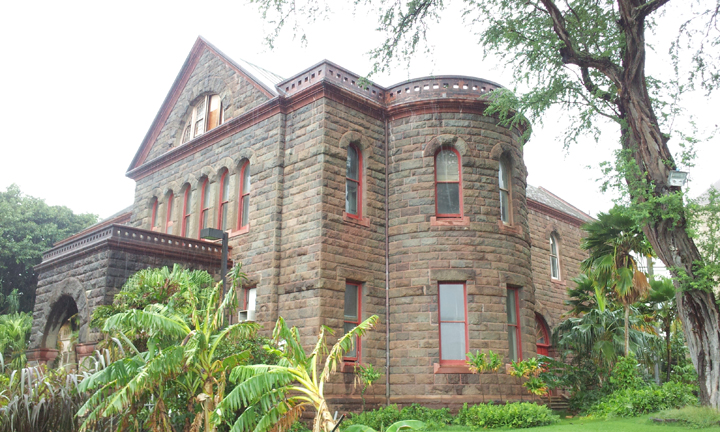
Bishop Hall as it stands today, 2013.

Here is Bishop Hall today on the campus of the Bernice Pauahi Bishop Museum. Although it is not open to the public, you still can see the beautiful stone facade! Please consider a membership at the Museum, and support a good cause. The Bishop Museum cares for one of the largest collections of Hawaiian-Language Newspapers in its archives!!

Bishop Hall 2013

Bishop Hall, Bernice Pauahi Bishop Museum, 2013.

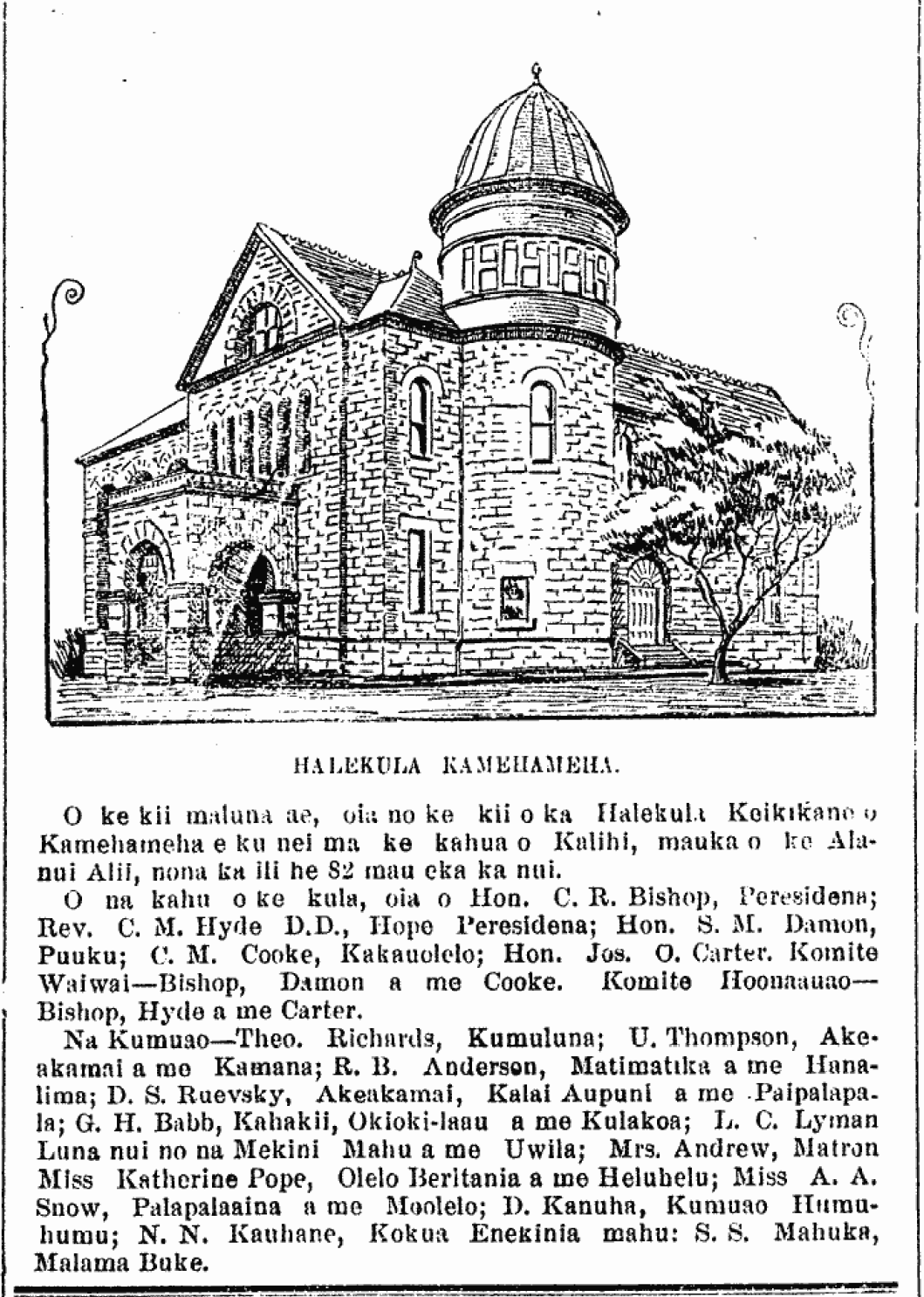
Kamehameha Boys’ School, Bishop Hall, 1894.

KAMEHAMEHA SCHOOLHOUSE.

The picture above is a picture of the Kamehameha Boys’ Schoolhouse, which stands on the grounds in Kalihi, upland of King Street [Alanui Alii], and its area is 82 acres.

The school supervisors are the Hon. C. R. Bishop, President; Rev. C. M. Hyde, D. D., Vice President; Hon. S. M. Damon, Treasurer; C. M. Cooke, Secretary; Hon. Joseph O. Carter. Financial Committee—Bishop, Damon, and Cooke. Education Committee—Bishop, Hyde, and Carter.

Instructors—Theodore Richards, Principal; U. Thompson, Science and Carpentry; R. B. Anderson, Mathematics and Manual Labor; D. S. Ruevsky, Science, Political Science, and Printing; G. H. Babb, Drawing, Wood Shop, and Military Education; L. C. Lyman, Head of the Steam and Electric Engines; Mrs. Andrews, Matron; Miss Katherine Pope, English Language and Reading; Miss A. A. Snow, Geography and History; D. Kanuha, Sewing Teacher; N. N. Kauhane, Assistant Steam Engineer; S. S. Mahuka, Librarian.

(Kuokoa, 6/2/1894, p. 1)

HALEKULA KAMEHAMEHA.

Ka Nupepa Kuokoa, Buke XXXIII, Helu 22, Aoao 1. Iune 2, 1894.

King Kalakaua gifts some 200 kii¹ to the National Academy of Sciences. 1887.

A Gift from the King.

The alii, the King, sent a number of beautiful pictures [kii] and old godly images [akua kii] of Hawaii to the hands of Mr. F. L. Clarke² in San Francisco, a gift from Him to the National Academy of Sciences [? ke kula ao Akeakamai o ia Repubalika]. There were a great many images sent which are well attested to as seen in the old accounts written by the great explorer Captain Cook and the faint recollections of those who have slight knowledge of that era.

The gift of the King was greatly appreciated and it was accepted with much thanks. When Queen Kapiolani arrived in San Francisco, she met with Mr. F. L. Clarke, the representative sent for this gift. There were two hundred or more images, from images that were printed on paper, to wooden idols. It’s been heard that they will go all the way to the city of Paris for the great exposition to be held next year.³

¹”Kii” refers to any image or representation of something, whether it be printed on paper, painted on canvas, carved out of wood, or cast in metal.

²See Clarke’s short history of Hawaii, “Hawaii’s Real Story,” which appeared in The Forum, July 1900, pp. 555–565.

³Exposition Universelle, 1889. See “Catalogue of the Hawaiian Exhibits at the Exposition Universelle, Paris, 1889.” by John A. Hassinger, Department of the Interior.

[Does anyone know of what happens to all of this?]

(Kuokoa, 5/14/1887, p. 2)

He Makana mai ka Moi aku.

Ka Nupepa Kuokoa, Buke XXVI, Helu 20, Aoao 2. Mei 14, 1887.

A haole kamaaina’s advice on teaching English instead of Hawaiian, 1872.

Pertaining to the English Language.

O Kuokoa Newspaper: Aloha oe:—

In the year 1866, I asked a missionary, “What is the reason English isn’t being taught in the government schools,” and he replied, “That is what I think as well, but we are weak, there are not enough of us, and we teach Hawaiian, and from amongst our students we find teachers.”

The Hawaiians are often astounded at seeing how quickly the haole gains wealth, and one asked me, “How does the haole get rich?” I answered this way, “Why is the cow in the fields fatter than the cow that works, isn’t it because it isn’t tamed? or because it is independent? or because it refuses to have it’s neck put in a yoke? That’s it. So when shown the yoke of the haole, your necks are put within it and your noses are soon wired; some may say, ‘How are we to live if we don’t work under the haole; they have the work, to them belongs the land, because soon our land will all be taken by you.’ It is true, you cannot survive without working for the rich (haole), but you can think about your children, lest they fall into the abyss with you. This race was called a race of slaves in a newspaper in New York, and I say to you that this will soon be true. ‘Your noses will be put through with a wire.’ until the day when the English language spreads amongst you, then you’ll will be able to remove your yokes and associate with the haole.

If you all understand the language and the knowledge of the haole, then you’d be able to climb the path and meet up with them in law, medicine, &c.

What is the reason that the college of Lahainaluna is not changed, having only English taught there?

This college is currently a waste. And so too the other schools, the government schools. We must all think carefully about the good of our children. That is no reason for them to forever more work under yearly contracts, for we’ve worked under yearly contracts during out lifetimes.

If the schools were changed so that just English was taught, I predict that after fifteen years, and if the haole leave, then you’d become your own leaders in the government, and not only haole would be appointed.

Kamaaina haole.

Lahaina, Maui.

{This is a letter written by a haole, and it is for us to determine his competence.}

[The argument over what language should be taught in schools is a heated topic that can be seen throughout the life of the Hawaiian-Language Newspapers. At first the argument is whether or not to teach English, and in later years when more and more schools are taught in English, the argument for teaching Hawaiian in schools will become prominent. Most everyone it seems were concerned with the future of the children (whether they were for English or Hawaiian-language education).]

(Kuokoa, 10/26/1872, p. 2)

No ka Olelo Haole.

Ka Nupepa Kuokoa, Buke XI, Helu 43, Aoao 2. Okatoba 26,1872.

Anonymous accusations against a Catholic priest in Kalawao, 1874.

The deeds of the Catholic teacher in Kalawao.

We are printing below the deeds of a certain Catholic priest amongst the leprosy patients in Kalawao:

1. Clothes—The clothes donated by the brethren of Honolulu for the needy leprosy patients of Kalawao, that is what the Catholic teacher is using to lure the people of the Evangelical faith [hoomana Euanelio] to join the Catholic religion. While he goes around doing his converting, and when they hear him they convert, but should they be steadfast, the teacher will say, “Should you join the Catholic faith, I will give you the clothing and things that you lack, should you desire.” By this action, some agree to join; there have been many converted over the clothes. This is the cunning way [kumu hinu ?] of the Catholic priest.

2. Wooden staff—The Catholic teacher constantly carries a staff in his hand, and it is with this that he converts people to his faith. This is what he does. For that person or persons who are resolute against being converted over clothes, they are struck by the cane of the Catholic teacher. This is what he does with the cane, and he converts them.

3. The church house—The church in Kalaupapa is of the Catholics.¹ He uses this church to convert some people to his religion. This is basically what he does. When the church was completed in Kalaupapa, the Catholic teacher when to the houses to convert people; the Catholic teacher said, “What is your faith.” “I’m a Calvinist [Kalawina],” that being a Protestant of the Evangelist faith, said the person in response. “That is a faith without any church,” said the Catholic teacher.”We are fine without a church; we hear that our kahu is coming and will hold services at the homes of brethren, and if we are in good health, we will attend the services,” he answered. “That’s no good, for here is our church, you all should come in, and then I’ll give you people clothes, and things you need, should you all desire,” replied the Catholic teacher. With this and everything else said in that conversation, some people converted, and some others remained steadfast behind the truth of the Gospel.

4. The cemetery.—The cemetery of the Catholics recently constructed here in Kalawao is one of the things used by that Catholic teacher and the Catholic disciples to convert people to their side. This Catholic teacher saw that the people were troubled with dead bodies left out, eaten up by pigs; and he was intent on converting the people to his belief, and therefore, he ordered Honolulu to send over several bundles of pine lumber; it arrived recently and is now standing here in Kalawao like a net to catch stupid fish who stray and are caught. So too is this graveyard; there are two faiths who come in, and they are left until the day they rise; who will they be for?

5. Extreme Unction [Ukione].—This act, Extreme Unction, is one of the most heinous acts which the Catholic teacher is doing here in Kalawo, and we all agree that this is akin to thievery. This is what he does. For those who don’t convert over clothes, or the rod, or the church, or the cemetery, he practices Extreme Unction on them. When the Catholic teacher sees or hears of a that a patient has grown weak, one that is from another faith, he goes to them constantly to urge them, and because the patient grows weary, he submits, whereupon the Catholic teacher performs the Extreme Unction; and when the patient recovers, he protests this improper deed of the Catholic teacher; this happens often; some people protest, and other mistakenly submit. From what we’ve seen, the Catholic teacher by these actions is like a yellow-eyed cat spying on its enemy, the mouse. And we believe that these actions of the Catholic teacher are not right in his sacred and faithful position.

Here is another new important thing we are witnessing. On the night of the 22nd of Dec. of the year 1873, at maybe 10 o’clock of that night, Kaiakoili (m) died, he was a brethren of the church of Kawaiahao, and he contracted leprosy and lived here in Kalawao, and was a member of the Siloama Church, and this was his faith until the day he died. However, on the night shown above, during his last hours, he was Baptized [Babetema ia] by Kulia (f), who is a disciple of the Catholic faith, but he was Baptized when he was dead.

Leprosy Patient.

¹St. Philomena Church

(Kuokoa, 1/17/1874, p. 1)

Na hana a ke kumu Pope ma Kalawao.

Ka Nupepa Kuokoa, Buke XIII, Helu 3, Aoao 1. Ianuari 17, 1874.

Vital Statistics, 1913.

MARRIAGES.

Christopher J. Holt to Elizabeth K. Kahele, Dec. 31.
Thomas Sluney [?] Lone to Mrs. Hannah Ii, Dec. 31.
Henry Kea to Ahu Lung Lee Heong, Jan. 4.
William T. Lee Kwai to Alma Sophia Bartels, Jan. 4.
Keaokalani Aki to Julia Kanakaole, Jan. 4.

BIRTHS.

To John B. Kawaikapu and Kahahai Kaiwahine, a daughter, Nov. 24.
To Thomas E. Robinson and Iwalani Jaeger, a son, Dec. 31.
To Joseph Enoka and Annie Charlton, a son, Jan. 5.
Mrs. T. B. Kaneihalau and Helen Carter, a daughter, Jan. 5.

DEATHS.

Keawe Hoolapa, on Liliha Street, Jan. 4.
Kamaka Kahoomaemae, in Nuuanu Valley, Jan. 4.
Likapeka Waialua, in the Insane Asylum, Jan. 4.
John Keaulani, Jr., on Kamehameha IV Road, Jan. 4.
A baby of T. B. Kaneihalau, on Auld Lane, Jan. 5.
Mrs. Mary Maikai, on School Street, Jan. 5.
Emily Kalawela, on Hustace Lane, Jan. 5.
Mrs. Mary Mahiai, on Liliha Street, Jan. 8.
Miss Sarah K. Kekipi, at Kunawai, Jan. 9.

(Kuokoa, 1/10/1913, p. 8)

MARE. / HANAU. / MAKE.

Ka Nupepa Kuokoa, Buke XLIX, Helu 2, Aoao 8. Ianuari 10, 1913.

Pauahi and Likelike and the edible mud of Kawainui, 1872.

[Found under: “LOCAL NEWS”]

Excursion to eat the mud.—During the most recent days of rest and relaxation of our royal one, Mrs. B. Pauahi Bishop, at her vacation place, Hanakamalaelae, Heeia, Koolaupoko, she and Mrs. Likelike Cleghorn went to see for themselves the edible mud of the pond of Kawainui in Kailua, and they formed an excursion. While precipitation from the clouds fell heavily, the two of them boarded a canoe and the mud was dove for; the beloved ones, as well as the multitudes of Kailua, Kaneohe, and Heeia ate heartily. The feast went nicely and the attractive items there were the pandanus-frond [lauhala] bowls that were woven expertly by the women. The characteristics of this mud is that it is speckled pink and gelatinous like pia; it’s taste is like cooked pia and it is so smooth going down. It is perhaps 8 feet to the bottom from the surface of the water where this mud is found. There are two amazing things heard of in relation to this Kawainui Pond: this mud, and the fish entrancing stick (Makalei) which was why the number of fish increased in the pond. Maybe it is because Kailua had no food that God made this mud?

J. B. Keliikanakaole

[Does anyone know if Hanakamalaelae is documented on any map? And also does anyone have information on J. B. Keliikanakaole?]

(Kuokoa, 10/26/1872, p. 2)

Moe kaoo i ka ai lepo.

Ka Nupepa Kuokoa, Buke XI, Helu 43, Aoao 2. Okatoba 26, 1872.

Mele Inoa for Kauikeaouli, Kamehameha III. 1862.

HE INOA NO KAUIKEAOULI.

Auhea wale ana oe, kapua hau o Maleka,
Ke au nei ka manao, Pehea o Niagala,
Kela wai kamahao, wai halulu o ka moano,
Nene i na moku, lohe aku nei Lukini,
Ua ana ia Kuleke, aohe i hopo Ladana,
I ka nui o Asia, hue a ke kaona nui,
Laki ka moana Iniana, ehuehu Enelani,
Ke kowa o Sekotia, aita oe e palau,
No’u o Ainahau, a ka wai o Nolewai,
Pau mai ko’u palena, ilaila a’u la oki,
Lawe u’a linohau, a ai ka manu iluna,
I kilohi iho kuu hana, he nani o Hudesona,
Kaikuono Papine, mea ua ae ia,
Me oe a ke aloha iwini o ke aumoa,
Auhea wale ana oe, e ka uneune puuwai,
E ke kaukini ma-lo, nana i ue laholio,
Hoomaloe i kuu kino, hooueue i ka moe,
Lana koi kahi manao, halanalana i ka leo,
O ua mea ino nei, he hoouluulu ia,
Keehi pono i ko haka, i luhi lai ko kahu,
A ao luau ai, pau ko aumakua pi kai a kaua,
I ka lihi kai o lalo, eia la he manao,
Kai hiki mai ia nei, e kali iki iho oe,
A hala ae Welehu, ka malama ino ke kau,
Hiki ae la ia Nana, pe oi kahi manao,
Olu ka noho na o ka lani me oe a ke aloha,
Iwini o ke aumoe, i mai nei o Piuta,
Ua hala kou palena, aohe koina oonei,
O kou la luu loli, a lae hao au lohe,
Ilaila ka wahine Ia, nana i nai ka moana,
He ukali aina ahi, i ka lae o Kepohoni,
Aia iho o Palema, ke noho la i ka hema,
Nana e kuhikuhi mai, ka lonitu akau,
Ike ia na degere, na kuea o ka honua,
Alo mai Kapena Kuke, ka noe i Nouaiki,
Ikiiki wale hoi au, i ka lohe pepeiao,
E ake ko’u manao, ka ike ia Panama,
I pau kuu kuhihewa, i ke kai o Inia,
Nopia o Iapana, ke hui me Ualana,
Me oe a ke aloha, iwini o ke aumoe.

Ii.

Honolulu, Aperila 14, 1862.

[This is a mele known as a mele inoa for Kamamalu, but here it is submitted by Ioane Ii as a mele inoa for Kauikeaouli.]

(Hoku o ka Pakipika, 5/8/1862, p. 4)

HE INOA NO KAUIKEAOULI.

Ka Hoku o ka Pakipika, Buke I, Helu 33, Aoao 4. Mei 8, 1862.

A Kanikau for Mrs. Fidelia Church Coan, done in Hawaiian and English! 1872.

[Translation.]

A Dirge for Mrs. Coan,

Composed by request for the Church and friends at Hilo.

Tune, A Mother’s Kiss,—Golden Robin.

1.

What hand is this stretched from above,
From where kind Spirits blend?
It is a hand let down in love
To bear away a friend.
A stranger friend she came to us
From homes beyond the seas,
And moved by love she staid with us
To teach us words of peace.

2.

Long she abode in our domain,
And domiciled with us;
A Mother teacher she became,
A kind and tender nurse;
A mother dear and much beloved,
A guide both safe and sure
O’er verdant fields with flowers perfumed,
By waters still and pure.

3.

Look upward, lo! what sight is this?
A shining cloud appears,
It floats, and thence an angel’s voice
Falls on our listening ears;
O friend beloved, there’s waiting nigh
An angel carr for thee;
Take passage, and ascend on high,
To the world though long’st to see.

4.

Hark! hark! what notes are these we hear?
they are deep sorrow’s wails;
They roll, and swell, and fill the air,
And echo o’er the hills—
The angel choir has borne away
From children weeping here
A mother whom they loved to obey,
A mother teacher dear.

5.

Our mournful tears are flowing fast,
And falling here and there,
For thee, our mother in days past,
Our leader kind and dear.
We bend in sorrow o’er one loved,
Our grief for thee is great—
Thou came’st, and we together moved;
But now we separate.

6.

Hark! hark! what bell is tolling thus?
It is a mournful bell:—
Gather together in God’s house—
It is the funeral knell.
We listen and together come,
Dear friends the summons heed;
And draped mourning, to the tomb
We march with sorrow’s tread.

7.

Mournful we move, and all are hush!
Angels are looking on,
And Jesus comes to walk with us,
And comfort those who mourn.
The hills and vales, and streams that flow,
Together with us mourn.
The loved one’s form is lower’d, and lo!
The clouds are dak’ning round!

8.

But look again, the clouds have flown,
And light breaks thro’ the gloom;
A voice exhorts with gentle tone,
O cease, ye friends, to mourn.
The dear and much beloved one
Lies not in this drear tomb,
She’s risen and to heaven has gone,
With Jesus she’s at home.

Hawaii.

[Unuhiia.]

He Kanikau no Mrs. Koana,

I hakuia ma ke noiia mai no ka ekalesia a me na makamaka o Hilo.

Leo, A Mother’s Kiss,—Golden Robin.

1.

He lima aha e o nei
Mai luna mai ke ao?
He lima kii e lawe ae
Kekahi hoahanau.
He hoa malihini nei
Mai kahi loa mai no,
Aloha nae a noho mai
I kumu no kakou.

2.

Ua noho a loihi no,
A kamaaina pu,
A lilo i makua ao,
A hanai ia kakou;
Makuwahine makamae,
A alakai maikai
Ma kahi kula uli e,
A ma na wai maemae.

3.

E nana, e, heaha nei?
He ao olino e,
Ke kau la, a noloko mai
He leo hea mai;
Ke hoa aloha, ke ku nei
He kaa anela nou;
E ee maluna, a pii ae,
Pii i ke ao ma o.

4.

Hamau! he lohe aha nei?
He olo pihe no;
O olo ae, a kupinai
Maluna o na puu—
Ua kai na anela aulii,
Mai na keiki ae,
I ka makua aloha e,
Makua ao maikai.

5.

Ke kahe nei a helelei
Na u waimaka e
Nou, ka makua aloha e,
Ko makou alakai—
Ke haalou nei, a hu ka uwe,
Pau mako e makou!
Hoea a noho pu maanei,
Kaawale nae ano.

6.

Hamau! he bele aha nei?
He bele kanikau—
E hui ma ka halawai
Hoolewa kupapau.
Ke hui nei na hoahanau,
Na hoaaloha pu;
Paa i ka lole kanikau,
A nauwe u kakou.

7.

Ke nauwe kanikau hamau—
Nana na anela,
Me Iesu hoi ke hele pu,
A, nana e hoona.
Na puu, na awawa a kahawai
Ke kanikau pu no.
Ka mea aloha ua nalo ae,
Pouli mai na ao!

8.

E nana hou, ua hee na ao,
Poha he lama e;
He leo paipai olu no,
E pau, e pau ka uwe—
Ka mea aloha makamae,
Aole ia maanei.
Ua lele i ke ao maikai
Me Iesu e maha’i.

Hawaii.

[I thought to post this piece because it is one of the few examples where the author/composer did both the Hawaiian and English version. It is interesting to look at the two compositions side by side. This is a kanikau written for Fidelia Church Coan who arrived in Hawaii along with her husband, Titus Coan, on June 6, 1835. They were stationed in Hilo, and she ran a boarding school there for girls.

The composer who calls himself “Hawaii,” is a prolific translator of English hymns into Hawaiian in the Kuokoa newspaper. Could this possibly be Lorenzo Lyons? Would anyone have any information on this?]

(Kuokoa, 11/2/1872, p. 7)

[Translation.] A Dirge for Mrs. Coan...

Ka Nupepa Kuokoa, Buke XI, Helu 44, Aoao 7. Novemaba 2, 1872.