People suspected of having leprosy held in jail, 1872.

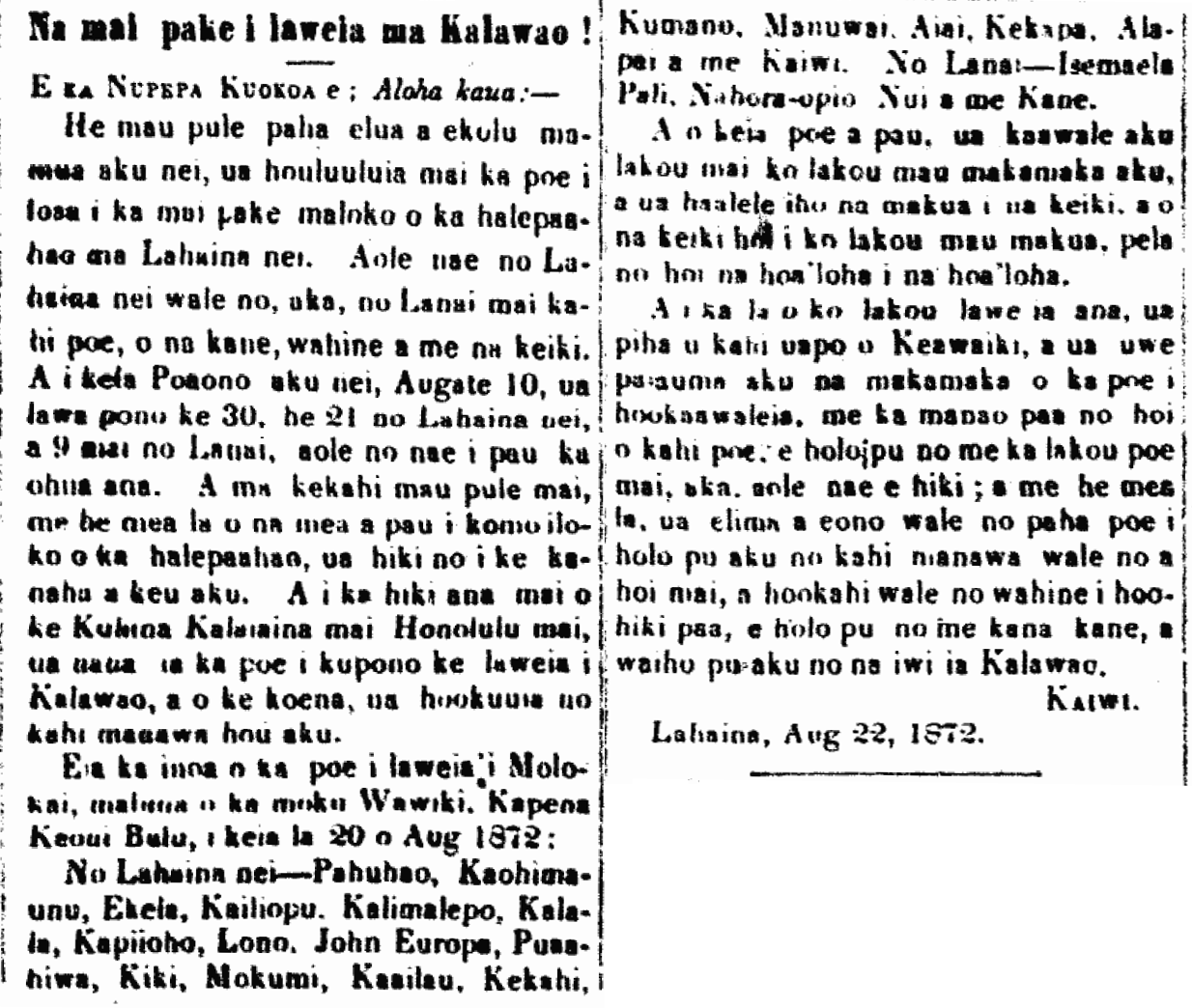
The leprosy patients taken to Kalawao!

O Kuokoa Newspaper: Aloha kaua:—

Perhaps some two or three weeks ago, those afflicted with the “Chinese disease” were assembled in the jail here in Lahaina. And it wasn’t just people from Lahaina, but some were also from Lanai: men, women, and children. And on this past Saturday, August 10, they totalled 30; 21 from Lahaina nei and 9 from Lanai; but the gathering is not over. And in the coming weeks, it seems as if the total of all those put in the jail will reach forty or more. And when the Minister of the Interior [Hutchison] arrives from Honolulu, they are examined for those who should go to Kalawao, and the rest are released for another time.

Here are the names of those taken to Molokai aboard the ship Warwick [Wawiki], Captain Keoni Bulu, today, the 20th of Aug. 1872:

From here in Lahaina—Pahuhao, Kaohimaunu, Ekela, Kailiopu, Kalimalepo, Kalala, Kapiioho, Lono, John Europa [? Europe], Puaahiwa, Kiki, Mokumi, Kaailau, Kekahi, Kumano, Manuwai, Aiai, Kekapa, Alapai, and Kaiwi. From Lanai—Isemaela Pali, Nahora opio, Nui, and Kane.

All of these people, they were separated from their companions, and parents left their children, children left their parents, and so too did friends leave friends.

On the day they were taken, the pier of Keawaiki was packed, and the friends of those who were being separated wailed in grief, while some of them were determined to go along with their sick, but that was not possible; and it seemed that there were but five or six who went along for just a while then returned; and there was only one woman who swore that she’d go with her husband and leave her bones in Kalawao.

Kaiwi.

Lahaina, Aug. 22, 1872.

(Kuokoa, 8/31/1872, p. 2)

Na mai pake i laweia ma Kalawao!

Ka Nupepa Kuokoa, Buke XI, Helu 35, Aoao 2. Augate 31, 1872.

New Years celebration in Kalawao, 1888.

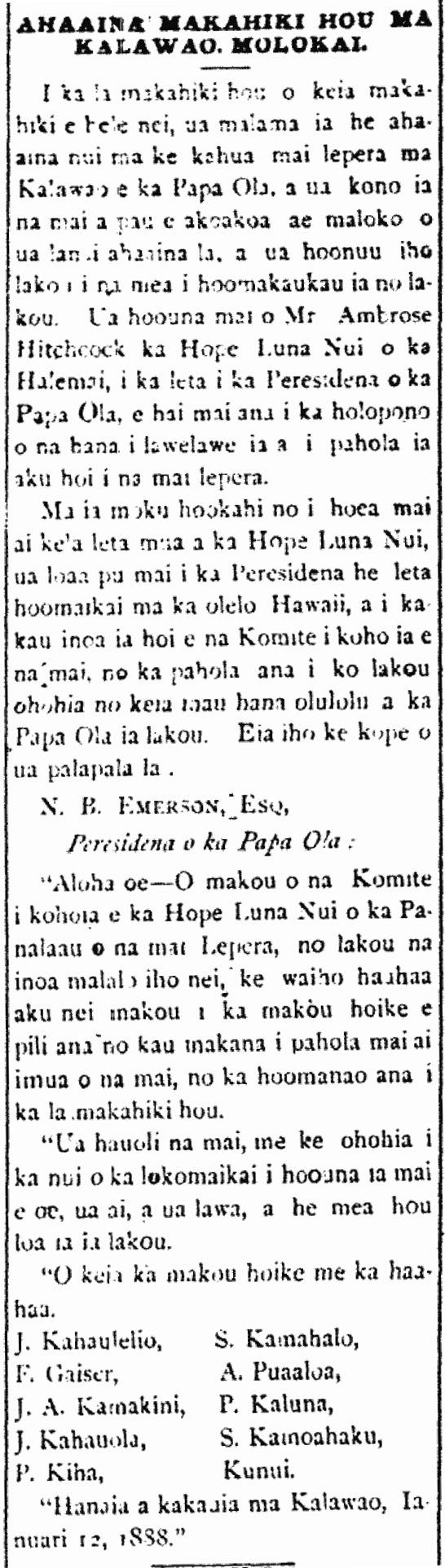
NEW YEAR’S FEAST IN KALAWAO, MOLOKAI.

On new year’s day of this year, a feast was held in the land of the leprosy patients at Kalawao by the Board of Health, and all of the patients were invited to gather within the party lanai where they feasted upon the things prepared for them. Mr. Ambrose Hitchcock [Hutchinson], the Assistant Superintendent of the Hospital, sent a letter to the President of the Board of Health, reporting on the good outcome of the efforts done for the leprosy patients.

Upon that same ship which arrived the letter from the Assistant Superintendent, the President [of the Board of Health] also received a letter of appreciation in Hawaiian, which was signed by the Committee chosen by the patients, to express their delight in the kind act done by the Board of Health for them. Here is a copy of that document.

N. B. Emerson, Esq.,

President of the Board of Health:

“Aloha oe—We are the Committee chosen by the Assistant Superintendent of the Leprosy Colony, whose names appear below; we humbly put before you our expression in response to your gift spread before the patients, to celebrate the new year.

“The patients are joyous and delighted with the great blessings sent by you, they ate until full, and this a something brand new for them.

“This is our expression, respectfully,

J. Kahaulelio,  S. Kamahalo,

F. Gaiser,  A. Puaaloa,

J. A. Kamakini,  P. Kaluna,

J. Kahauola,  S. Kamoahaku,

P. Kiha,  Kunui.

“Done and signed at Kalawao, January 12, 1888.”

[I think that the phrase, “this is something brand new for them,” is something to ponder and consider.]

(Kuokoa, 1/21/1888, p. 2)

AHAAINA MAKAHIKI HOU MA KALAWAO, MOLOKAI.

Ka Nupepa Kuokoa, Buke XXVII, Helu 3, Aoao 2. Ianuari 21, 1888.

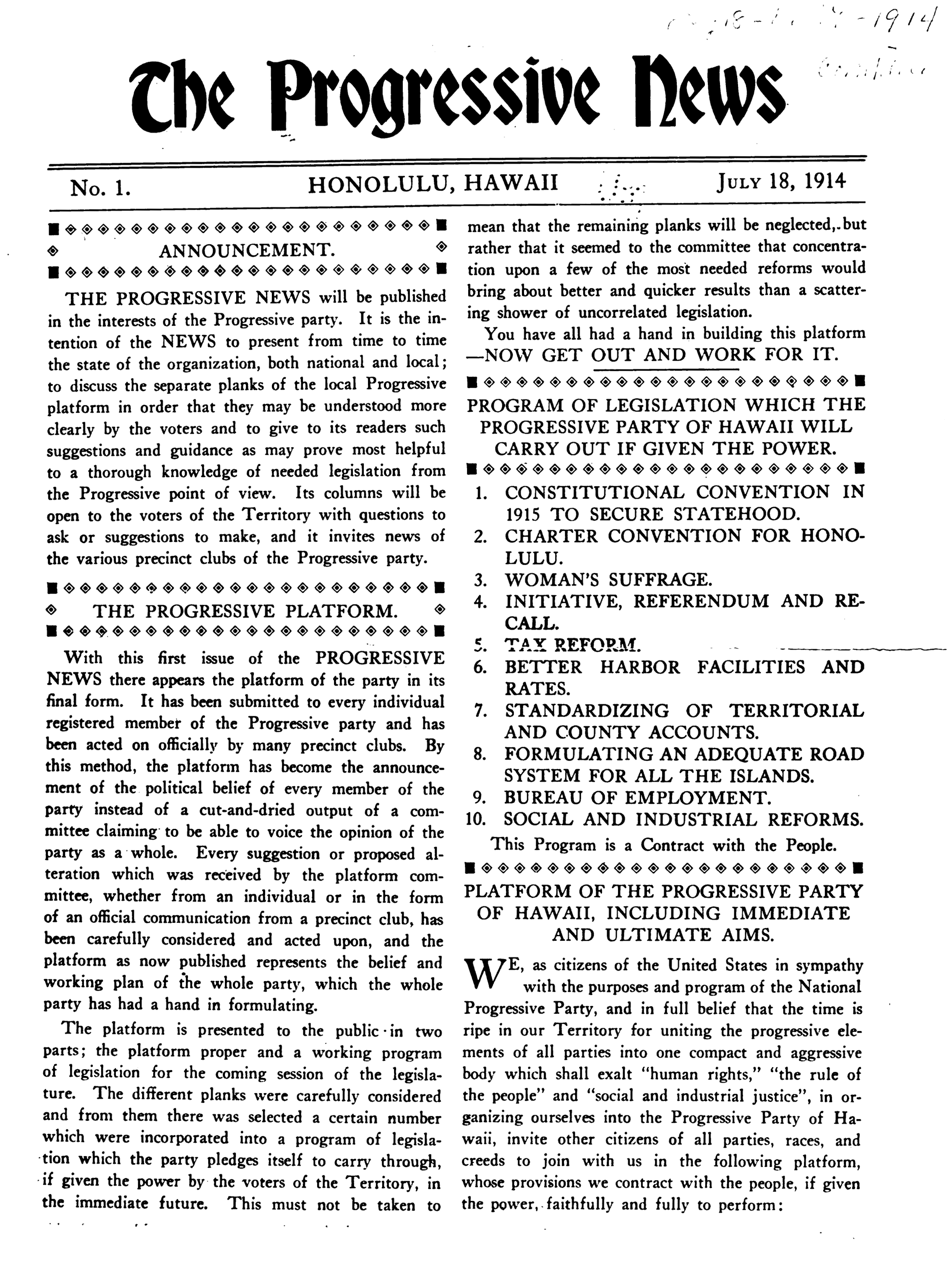
The Progressive News, 1914.

[Other than Chronicling America, you can also find newspapers from Hawaii on Google Books. Here below for instance is an image of the first page of the first issue of “The Progressive News”; Publisher: Howard M. Ballou, Editor: Francis J. Green, and Assistant Editor: John Uilani Joseph.  It is printed partially in English and in Hawaiian.

There is also the Hawaiian-Language Newspaper, “Ka Holomua: The Progressive” printed during the same time period; Owner and Editor: Gulstan K. Poepoe; Owner and Business Manager: John N. Keola; and Owner and Publisher: Samuel Kanio.]

The Progressive News

The Progressive News, Number 1, Page 1. July 18, 1914.

Eagle Brand Condensed Milk in Hawaii, 1923.

EAGLE
BRAND

Condensed Milk

Thousands of babies grew up big and strong being fed Eagle Milk. It is wholesome and nourishing.

[From the Eagle Brand website: “Eagle Brand Sweetened Condensed Milk was credited with significantly lowering the infant mortality rate in North America. Gail Borden’s discovery provided milk that would remain safe and wholesome—at that time, an important contribution to the nourishment of infants and children.”]

(Kuokoa, 5/10/1923, p. 3)

HOAILONA AEKO WAIU KIA

Ka Nupepa Kuokoa, Buke LXII, Helu 19, Aoao 3. Mei 10, 1923.

Another cool picture from Hawaii’s musical past. 1923.

Members of the Hui Himeni Hawaii¹

Standing from the left to right: Mrs. Andrade; Mrs. Clemans, the leader; Mrs. Pahu; Mr. Andrade. Crouching:² Mr. O. Pahu; Steven P. Lukua; Mr. Schenck Clemans, business manager.

¹Hawaiian Glee Club?

²I wonder what the difference is between kīʻenenei (kīʻelelei) and ʻōkuʻu is.

(Kuokoa, 5/24/1923, p. 3)

Na Hoa o ka Hui Himeni Hawaii

Ka Nupepa Kuokoa, Buke LXII, Helu 21, Aoao 3. Mei 24, 1923.

John James Kawehena passes away in Kalawao, 1887.

He has Passed on; He has Gone

With a heart darkened by sadness, I ask you to kindly leave me a space in your pages¹ for this, so that the many people of the one who has passed on to death will know. At dawn of yesterday, June 22, John James Kawehena left this life, and returned to the everlasting side of the earth. He spent 7 years, 10 months, and 26 days in this forsaken land; and as for us, his friends of this land without parents save one, the Board of Health [Papa Ola], for him is our remembrance.

His land of birth was Kaupo on Maui; his parents were Maunaloa (m) and Kauahine (f), and the three of them lived together; he has a younger sibling in the Apuakea rain,² D. Loheau.

He was growing thin with shortness of breath for these past months, and in the night of the 22nd of this past June, the shortness of breath grew worse and his breath was unbeknownst to us snatched away for good; and the next morning, we went to wake him but he was already gone and his body was stiff; much aloha for him.

He was an active writer for this colony, reporting the news of this land of leprosy patience to the whole world; and he was one of the heads of a newspaper. His writings will no longer appear in your columns.

Aloha to the [kikiipi ?] boys of the press.

JAMES IMAIKALANI.

Kalawao, June 23rd, 1887.

¹Literally a parlor or a room to greet people

²Famous in Koolaupoko on Oahu

[Although the information from Kalaupapa and Kalawao were not usually included in the regular Vital Statistics column, they were often printed in the other columns of the Hawaiian-Language Newspapers!]

(Kuokoa, 7/9/1887, p. 3)

Ua hala, Ua nalo

Ka Nupepa Kuokoa, Buke XXVI, Helu 28, Aoao 3. Iulai 9, 1887.

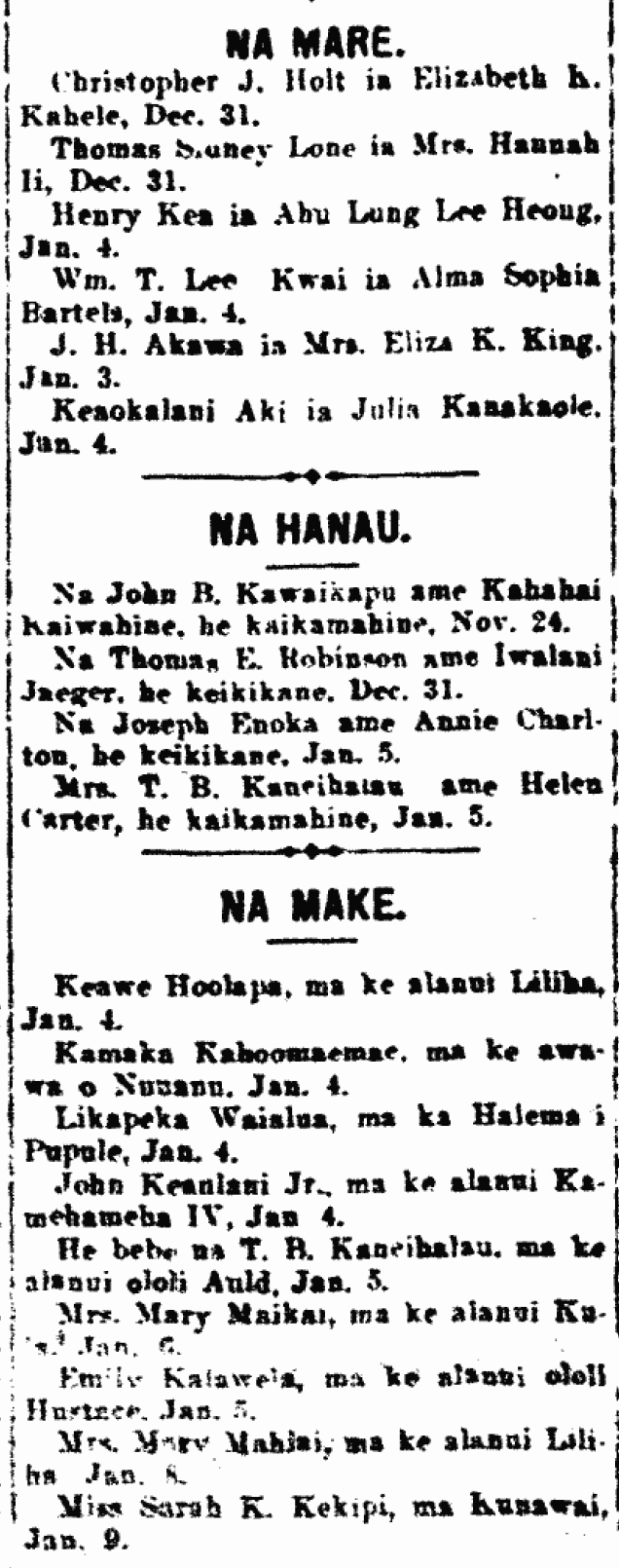
Vital Statistics, 1913.

MARRIAGES.

Richard Davenport to Emma Makaula, Dec. 24.
Antone Nuuanu Bright to Miss Emily Thomas, Dec. 24.
William Dykes to Dina Vida, Dec. 27.

BIRTHS.

To William Hart and Clara McColgan, a daughter, Dec. 12.
To Thomas Mahoahoa and Ella Likela, a son, Dec. 19.
To Benjamin J. Kahele and Becky Kelii, a daughter, Dec. 24.
To James Walaaulani and Louisa Kalama, a daughter, Dec. 24.
To John Kenala and Lizzie Napua Kahikina, a son, Dec. 25.
To Joseph Kaaaa and Maryann Montero, a daughter, Dec. 25.
To Levi Kalauli and May Iona, a son, Dec. 26.
To Klemme M. Hui and Emma P. Hoopii, a son, Dec. 30.

DEATHS.

A baby of Phillip Keliikoa, on Dowsett Lane, Dec. 19.
??????, Jr., on ?????
?????? on Kel???? Lane ???
?????
?????
?????
????weamahi [? Keaweamahi], ???? Dec. 25.
???? Rodrigues, in Kalihi Valley, Dec. 25.
James M. Kalalakoa, on Hobron Lane, Dec. 25.
Peter Thomas, on Ala Moana Boulevard, Dec. 25.
Hana Keahi, at the corner of Fort and Vineyard Streets, Dec. 27.
Kaliko Piko, on Kamehameha IV Road, Dec. 28.
Kamai Naopeope, on Houghtailing Street, Dec. 28.
Lydia Wood, on Smith Lane, Dec. 29.
Foster Mahoahoa, on Dement Street, Dec. 29.
David Kama, on Kalihi Street, Dec. 29.
Elizabeth Polakamu, on Jack Lane, Dec. 30.
A baby of Klemme M. Hui, on Iwilei Street, Dec. 30.
Charles Kaiama, at Mokauea, Kalihi, Dec. 30.

[What a way to start the year! The finger holding the torn sides together hides at least seven people. If only there was funding to reshoot the Hawaiian-Language Newspapers so the information they hold can be clearly seen…]

(Kuokoa, 1/3/1913, p. 8)

NA MARE. / NA HANAU. / NA MAKE.

Ka Nupepa Kuokoa, Buke XLIX, Helu 1, Aoao 8. Ianuari 3, 1913.

Announcement for the opening of Kamehameha School for Boys, 1887.

THE KAMEHAMEHA SCHOOL FOR
BOYS

THE KAMEHAMEHA SCHOOL FOR BOYS
will be ready for the admission of students on the

First Tuesday of October, 1887

Only a limited number of Students will be received this year, and those desiring to enter the School in the future must apply on the 1st day of September 1887.

Each student will occupy a separate room furnished with bed, table, and chair; and a list of items to be furnished by each student will be sent if asked for in advanced to the teacher.

Each student will be allowed to carry out 12 hours a week of manual labor. For industrial arts, two hours a day, and five days a week. Military drilling and physical education will be a portion of the curriculum everyday.

Arithmetic, English Language, Popular Science [Akeakamai], Elementary Algebra [Anahonua], Free-hand and Mechanical Drawing [Kakau me Kaha Kii], Practical Geometry [Moleanahonua], Bookkeeping [malama Buke Kalepa], tailoring [tela humu lole], printing [pai palapala], masonry [hamo puna], and other similar things, and blacksmithing.

tuition for the schooling.

($40) FORTY DOLLARS PER YEAR.

$20 to be paid at the beginning of each quarter.

The students must get prior approval from the Doctor attesting to their good health, and letters of recommendation from other schools.

Examinations for those entering will be held on MONDAY, OCTOBER 25, 1887, at the schoolhouse at Palama, 8:30 A. M. They will show their knowledge in reading, writing, geography, the four rules of Arithmetic, writing in English, and the spelling of 100 English words.

As for anything else, you may find out by asking the principal.

REV. WILLIAM B. OLESON.

[See also the English-language announcement found in the May 24th issue of the Hawaiian Gazette. It is interesting to note especially the difference in the wording for the part about manual labor.]

(Kuokoa 5/28/1887, p. 2)

KE KULA KAMEHAMEHA NO NA KEIKIKANE.

Ka Nupepa Kuokoa, Buke XXVI, Helu 22, Aoao 2. Mei 28, 1887.

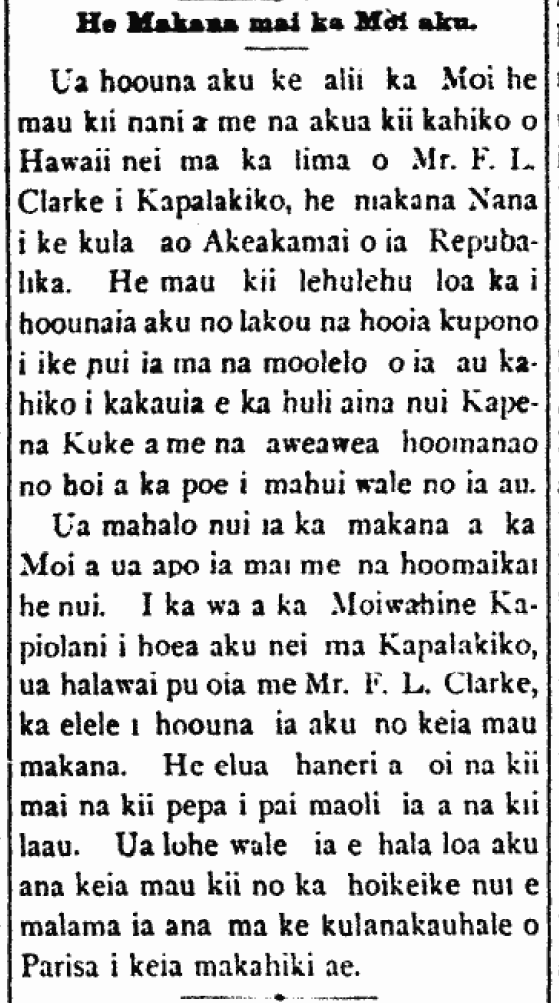
E o, e Kaleleonalani! Queen Emma and Kamehameha Schools, 1887.

KAMEHAMEHA SCHOOL.

The gates of the Kamehameha School for boys will open in October of this current year. The imperfections of one of the dormitories of 30 x 64 [feet] are almost smoothed out, and another was complete before. These dormitories are two storied, bottom floor and top floor, and each of them have 24 rooms of 8 x 12, and a hallway [keena waena loloa]. One room of each house is furnished with facilities to wash up and clean, and the rest of the rooms are bedrooms, each being supplied with a iron bed, desk, chair, closet, and some other furnishings. The rooms are clean and lighted, and well-furnished for the student.

The dining hall of 29 x 81 feet is a separate building, and it is 18 feet from the bottom to the ceiling, and it will fit two-hundred people. A stone building will be built behind this, which will be the kitchen and and a place to store the food and all cookware and dinnerware.

A proper schoolhouse will be built after the buildings that are desired to be completed quickly are done, and in the meantime, parts of the dining hall will be set aside as school rooms.

A clear spring will supply the school with water and it is by steam pumps that the water will be brought up and filled into a separate water tank, and from there into many pipes laid all over the grounds and buildings.

The curriculum at this school teaches thoroughly the branches of the English language; and outside of that are the teaching of industrial arts. Some rooms of the school house will be set aside as rooms for carpentry, printing, tailoring, blacksmithing, and masonry. The instruction will take place under the direction of a mechanic [mekanika]. Some time will also be set aside for military drilling, physical development, and so forth.

There are fun and cheerful activities for the students. This school sits on a serene site, living there is pleasant, and it is separated from the town of Honolulu.

In a section of this paper, the reader will see the advertisement dealing with this School. This is the educating home established for the benefit of Hawaii’s children who seek education, and built by way of the estate of the late Dowager Queen Ema Kaleleonalani. This home stands in the plain of Kaiwiula in Kalihi, and it is near completion. On the first Tuesday of October 1887, this school will open to students.

It has been heard that the assets of the school will be increased for the good of the children, and for now, parents who want their children to progress forward are being urged to rush to this new home where knowledge is increased. Much benefits will be gained if patient and if the aloha of the royal parent Ema Kaleleonalani is held resolute as well by Hawaii’s children, the one who left this great gift behind. Look at its published notice.

[On this, the day after Queen Emma’s 177th birthday, i thought it would be a good thing  to look back at her role in the establishment of the Kamehameha Schools, a role which she is not recognized often for today.

Notice the difference between the article appearing in the May 24th edition of the Hawaiian Gazette, “The Kamehameha Schools.” (probably what the article is based upon) and this Hawaiian-Language article.]

(Kuokoa, 5/28/1887, p. 2)

KE KULA KAMEHAMEHA.

Ka Nupepa Kuokoa, Buke XXVI, Helu 22, Aoao 2. Mei 28, 1887.