Keeaumoku ahuula destroyed in Peleioholani house fire, 1901.

Couple of years ago, I posted two articles on an insurance claim by Peleioholani after a priceless ahuula was destroyed in the great Chinatown fire of 1900. I just ran across this just now:

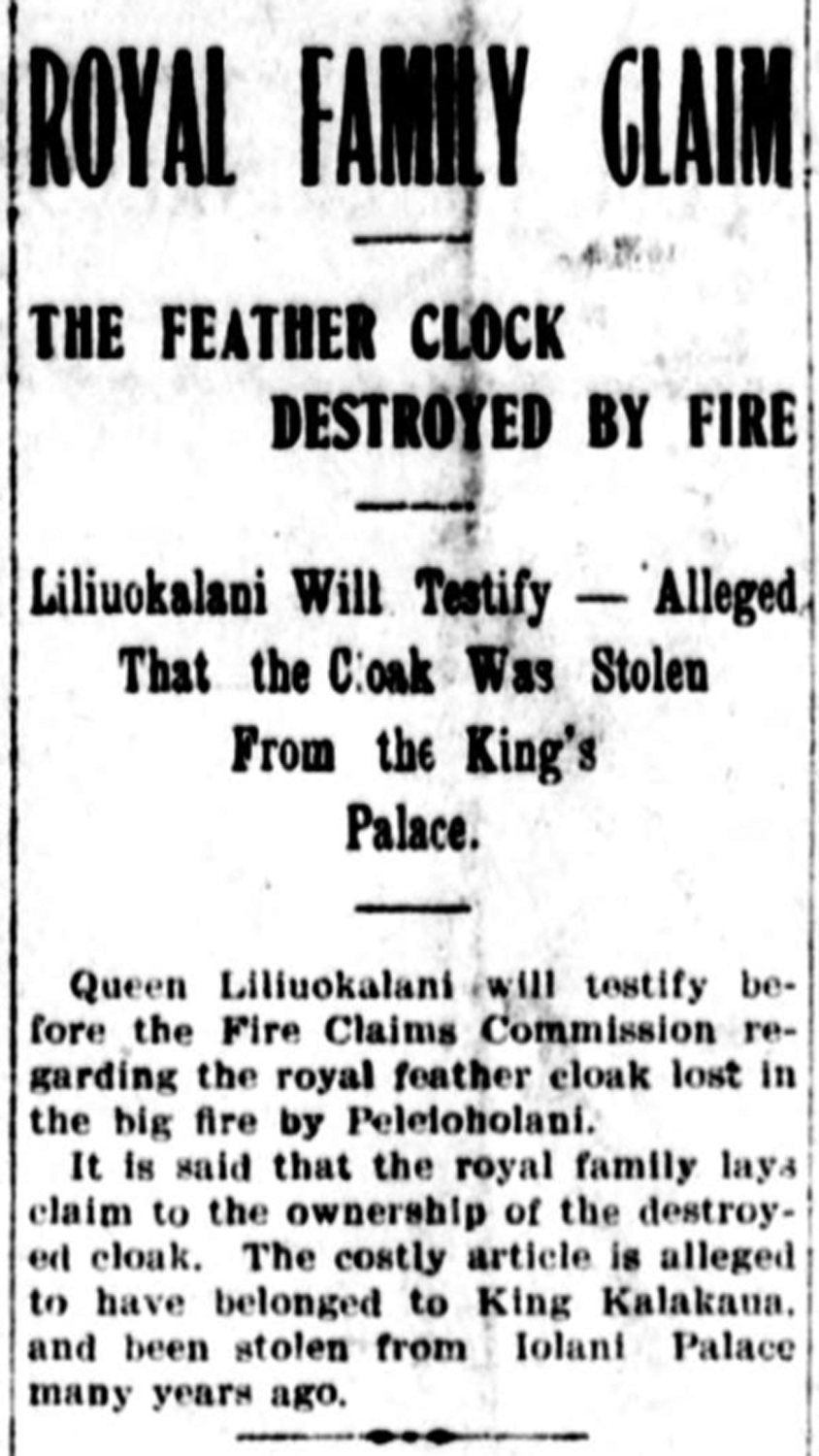
ROYAL FAMILY CLAIM

THE FEATHER CLOAK DESTROYED BY FIRE

Liliuokalani Will Testify—Alleged That the Cloak Was Stolen From the King’s Palace.

Queen Liliuokalani will testify before the Fire Claims Commission regarding the royal feather cloak lost in the big fire by Peleioholani.

It is said that the royal family lays claim to the ownership of the destroyed cloak. The costly article is alleged to have belonged to King Kalakaua, and been stolen from Iolani Palace many years ago.

[See: Ancient Relics Were Destroyed & Pau ka Ahuula i ke Ahi]

(Evening Bulletin, 11/2/1901, p. 1)

ROYAL FAMILY CLAIM

Evening Bulletin, Volume XI, Number 1984, Page 1. November 2, 1901.

“Kearny cloak” aboard the Malolo, 1927.

[Found under: “Nuhou Kuwaho”]

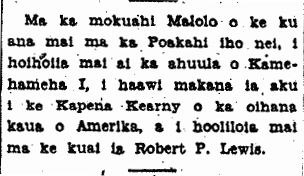
By way of the steamship Malolo which arrived this past Monday, returned was the feather cape of Kamehameha I that was presented to Captain Kearny of the armed forces of America, and which was obtained through purchase by Robert P. Lewis.

(Kuokoa, 11/24/1927, p. 4)

Ma ka mokuahi Malolo...

Ka Nupepa Kuokoa, Buke LXVI, Helu 52, Aoao 4. Novemaba 24, 1927.

Names of the stevedores who participate in Queen Liliuokalani’s funeral, 1917.

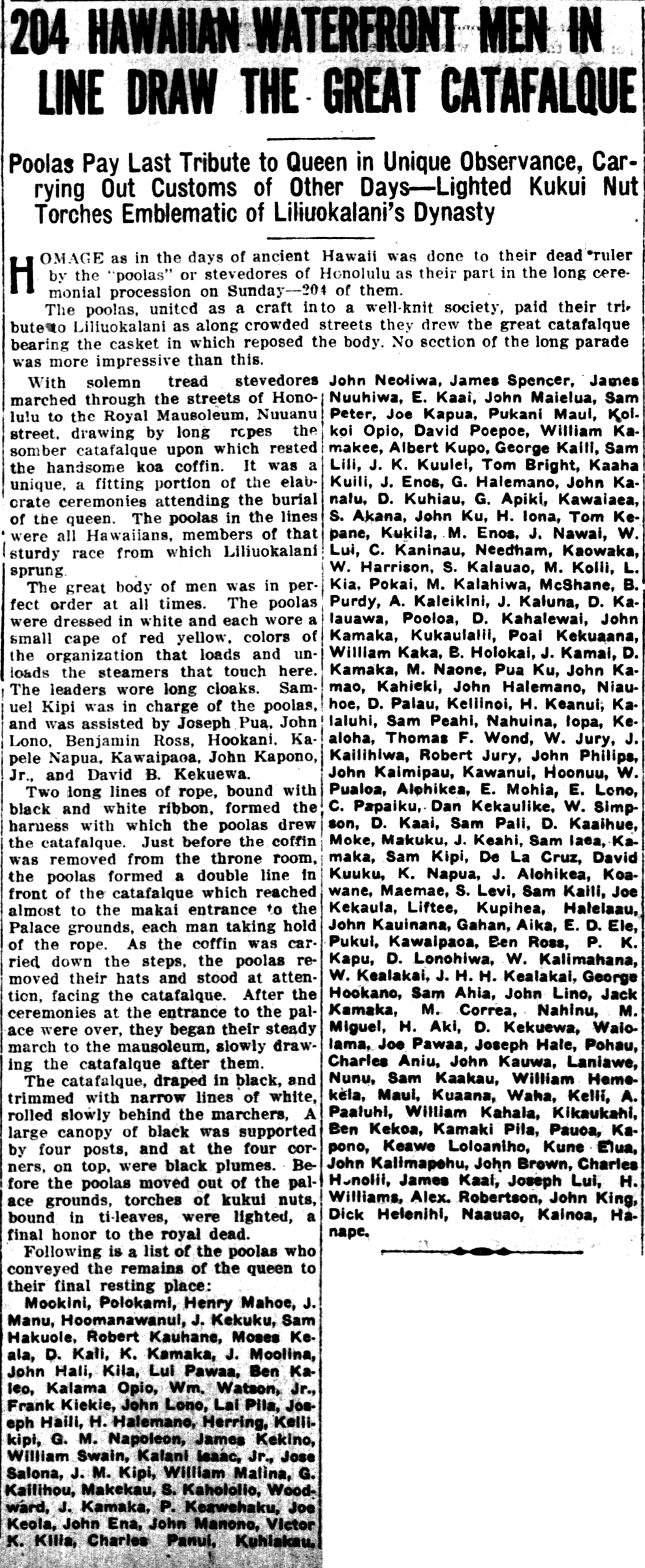
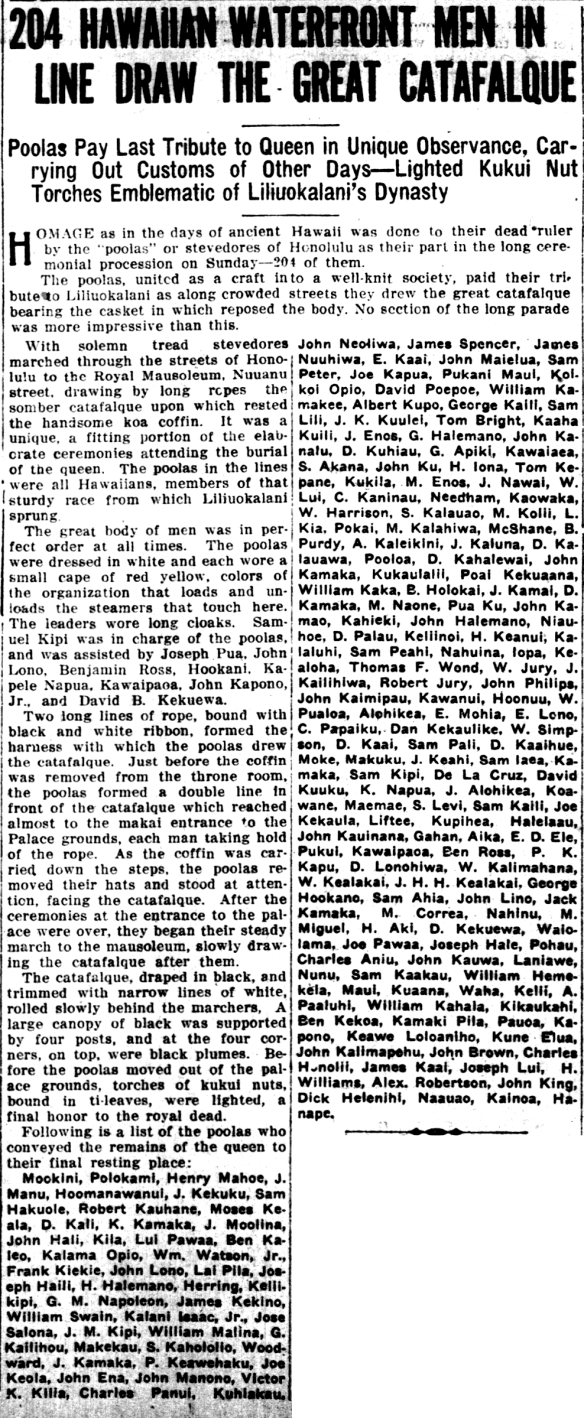
204 HAWAIIAN WATERFRONT MEN IN LINE DRAW THE GREAT CATAFALQUE

Poolas Pay Last Tribute to Queen in Unique Observance, Carrying Out Customs of Other Days—Lighted Kukui Nut Torches Emblematic of Liliuokalani’s Dynasty

HOMAGE as in the days of ancient Hawaii was done to their dead ruler by the “poolas” or stevedores of Honolulu as their part in the long ceremonial procession on Sunday—204 of them.

The poolas, untied as a craft into a well-knit society, paid their tribute to Liliuokalani as along crowded streets they drew the great catafalque bearing the casket in which reposed the body. No section of the long parade was more impressive than this.

With solemn tread stevedores marched through the streets of Honolulu to the Royal Mausoleum, Nuuanu street, drawing by long ropes the somber catafalque upon which rested the handsome koa coffin. It was a unique, fitting portion of the elaborate ceremonies attending the burial of the queen. The poolas in the lines were all Hawaiians, members of that sturdy race from which Liliuokalani sprung.

The great body of men was in perfect order at all times. The poolas were dressed in white and each wore a small cape of red yellow, colors of the organization that loads and unloads the steamers that touch here. The leaders wore long cloaks. Samuel Kipi was in charge of the poolas, and was assisted by Joseph Pua, John Lono, Benjamin Ross, Hookani, Kapele Napua, Kawaipaoa, John Kapono, Jr., and David B. Kekuewa.

Two long lines of ropes, bound with black and white ribbon, formed the harness with which the poolas drew the catafalque. Just before the coffin was removed from the throne room, the poolas formed a double line in front of the catafalque which reached almost to the makai entrance to the Palace grounds, each man taking hold of the rope. as the coffin was carried down the steps, the poolas removed their hats and stood at attention, facing the catafalque. After the ceremonies at the entrance to the palace were over, they began their steady march to the mausoleum, slowly drawing the catafalque after them.

The catafalque, draped in black, and trimmed with narrow lines of white, rolled slowly behind the marchers. A large canopy of black was supported by four posts, and at the four corners, on top, were black plumes. Before the poolas moved out of the palace grounds, torches of kukui nuts, bound in ti-leaves, were lighted, a final honor to the royal dead.

Following is a list of the poolas who conveyed the remains of the queen to their final resting place:

Mookini, Polokami, Henry Mahoe, J. Manu, Hoomanawanui, J. Kekuku, Sam Hakuole, Robert Kauhane, Moses Keala, D. Kali, K. Kamaka, J. Moolina, John Hali, Kila, Lui Pawaa, Ben Kaleo, Kalama Opio, William Watson, Jr., Frank Kiekie, John Lono, Lai Pila, Joseph Haili, H. Halemano, Herring, Keliikipi, G. M. Napoleon, James Kekino, William Swain, Kalani Isaac, Jr., Jose Salona, J. M. Kipi, William Malina, G. Kailihou, Makekau, S. Kahololio, Woodward, J. Kamaka, P. Keawehaku, Joe Keola, John Ena, John Manono, Victor K. Kilia, Charles Panui, Kuhiakau, John Neoliwa, James Spencer, James Nuuhiwa, E. Kaai, John Maielua, Sam Peter, Joe Kapua, Pukani Maui, Koikoi Opio, David Poepoe, William Kamakee, Albert Kupo, George Kaili, Sam Lili, J. K. Kuulei, Tom Bright, Kaaha Kuili, J. Enos, G. Halemano, John Kanalu, D. Kuhiau, G. Apiki, Kawaiaea, S. Akana, John Ku, H. Iona, Tom Kepane, Kukila, M. Enos, J. Nawai, W. Lui, C. Kaninau, Needham, Kaowaka, W. Harrison, S. Kalauao, M. Koili, L. Kia, Pokai, M. Kalahiwa, McShane, B. Purdy, A. Kaleikini, J. Kaluna, D. Kalauawa, Pooloa, D. Kahalewai, John Kamaka, Kukaulaili, Poai Kekuaana, William Kaka, B. Holokai, J. Kamai, D. Kamaka, M. Naone, Pua Ku, John Kamao, Kahieki, John Halemano, Niauhoe, D. Palau, Keliinoi, H. Keanui, Kalaluhi, Sam Peahi, Nahuina, Iopa, Kealoha, Thomas F. Wond, W. Jury, J. Kailihiwa, Robert Jury, John Philips, John Kaimipau, Kawanui, Hoonuu, W. Pualoa, Alohikea, E. Mohia, E. Lono, C. Papaiku, Dan Kekaulike, W. Simpson, D. Kaai, Sam Pali, D. Kaaihue, Moke, Makuku, J. Keahi, Sam Iaea, Kamaka, Sam Kipi, De La Cruz, David Kuuku, K. Napua, J. Alohikea, Koawane, Maemae, S. Levi, Sam Kaili, Joe Kekaula, Liftee, Kupihea, Halelaau, John Kauinana, Kahan, Aika, E. D. Ele, Pukui, Kawaipaoa, Ben Ross, P. K. Kapu, D. Lonohiwa, W. Kalimahana, W. Kealakai, J. H. H. Kealakai, George Hookano, Sam Ahia, John Lino, Jack Kamaka, M. Correa, Nahinu, M. Miguel, H. Aki, D. Kekuewa, Waiolama, Joe Pawaa, Joseph Hale, Pohau, Charles Aniu, John Kauwa, Laniawe, Nunu, Sam Kaakau, William Hemekela, Maui, Kuaana, Waha, Kelli, A. Paaluhi, William Kahala, Kikaukahi, Ben Kekoa, Kamaki Pila, Pauoa, Kapono, Keawe Loloaniho, Kune Elua, John Kalimapehu, John Brown, Charles Honolii, James Kaai, Joseph Lui, H. Williams, Alex. Robertson, John King, Dick Helenihi, Naauao, Kainoa, Hanape.

(Honolulu Star-Bulletin, 11/19/1917, p. 7)
204 HAWAIIAN WATERFRONT MEN IN LINE DRAW THE GREAT CATAFALQUE

Honolulu Star-Bulletin, Volume XXV, Number 7988, Page 7. November 19, 1917.

Amazing story about the capes given by Kalaniopuu to Cook, 1908.

The Ahuula Garments of Kalaniopuu!

Given by the Chief to Captain Cook!

It is understood in Hawaii’s ancient history, before Captain Cook [Kapena Kuke] left Hawaii, on the 3rd of February, 1779, King Kalaniopuu gave a gift to Captain Cook some Ahuula and Ahu Mamo and feather mahiole headgear of Hawaii. After the ships of Captain Cook left Hawaii Island shortly after the death of that British Captain, the ships went and landed at Kamchatka, on the eastern shores of Siberia.
Continue reading

The “Kearny Cloak” at Tiffany & Co., 1893.

THE WAR CLOAK OF KAMEHAMEHA I.

AN INTERESTING HAWAIIAN RELIC TO BE SEEN IN THIS CITY.

The recent proposed annexation of the Sandwich Islands has revived much forgotten lore concerning the people of Hawaii and their history, and nothing perhaps is more interesting than specimens of the handiwork of this semi-barbarous people who possessed certain arts for ingenuity and patient labor that cannot be equalled by the boasted civilization of the nineteenth century. In Tiffany & Co.’s window, in Union Square, there is on exhibition for a few days a feather war cloak or namo, once the property of Hawaii’s giant King, Kamehameha I (The Lonely One), which tradition says cost the labor of several generations of skilled workers. The body consists of a fine network of homespun cord, make from the native hemp or olona, the meshes of which vary from an eight to a thirty-second of an inch; over this is laid the feather-work in small bunches of three or four feathers each, tied with a minute thread highly twisted, made from the same fibre. The cloak is almost semicircular in shape, and cut to fit in at the neck. The meshwork being made in sections of various shapes, allows it, when placed on a tall man’s shoulders, to fall in graceful lines about his body. Continue reading

Hawaii at the Great London Exposition, 1862.

The Sandwich Islands.—During the last few days a stall has been fitted up near the department of the Ionian Islands which represents the latest and most distant echo in response to the invitation given to all nations and peoples to exhibit their natural and artificial products under the domes of South Kensington. The Hawaiian, or, as they are better known, the Sandwich Islands, were unrepresented in 1851, owing to the collection made there not reaching England till the Exhibition had finally closed, the voyage by a sailing vessel occupying five or six months. This year a similar fate threatened this remote group in the Pacific, and it seemed likely that the name of Hawaii would only be known in connexion with the International Exhibition of 1862 by a pair of silk banners in the nave, and a foreign commissioner with nothing to do. Continue reading

More on Lady Franklin and ahuula and upcoming events, 1861 / 2015–2016.

While in Hawaii in 1861, Lady Franklin enjoyed the company often of King Kamehameha IV and Queen Emma. According to newspaper reports, the relationship between them was very cordial. She was given this treasured ahuula in commemoration of this bond.

If you find yourself in San Francisco at the end of this summer until the early part of next year (8/29/2015–2/28/2016), do make your way to the de Young Museum:

Lady Franklin cape

Lady Franklin cape (detail) (#5948). ‘apapane feathers, ‘ō‘ō feathers. Bernice Pauahi Bishop Museum, Ethnology Collection, 09670/1909.007

Royal Hawaiian Featherwork: Nā Hulu Ali‘i

August 29, 2015February 28, 2016

Explore the distinctive art, culture, and history of Hawai‘i with the first exhibition of Hawaiian featherwork on the U.S. mainland, developed in partnership with the Bernice Pauahi Bishop Museum, Honolulu. Presented in San Francisco, which is considered to be the gateway to the Pacific, the exhibition will feature approximately 75 rare and stunning examples of the finest featherwork capes and cloaks in existence, as well as royal staffs of feathers (kāhili), feather lei (lei hulu manu), helmets (mahiole), feathered god images (akua hulu manu), and related eighteenth- and nineteenth-century paintings and works on paper. Continue reading →

Feather capes, genealogies, and controversy, 1902.

LETTERS.

We do not accept the responsibility for the blame for ideas published under this heading, but it falls on those who write them.

HE IS NOT CORRECT.

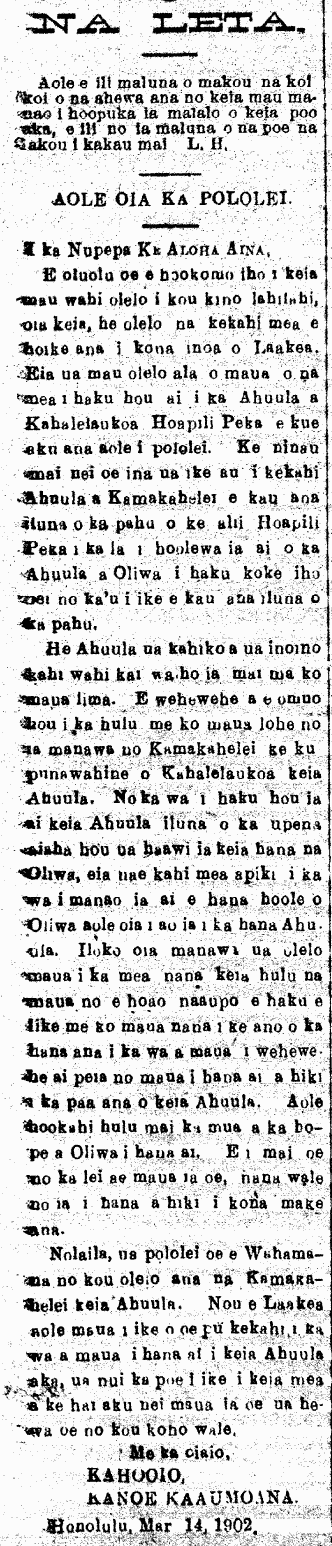
O Aloha Aina Newspaper,

Please include these words in your delicate body, that being this, there is talk from someone calling himself Laakea. This is what we have to say, the two of us who redid the Ahuula of Kahalelaukoa Hoapili Baker [Kahalelaukoa Hoapili Peka], denying what he said is true. You asked if I had seen an Ahuula belonging to Kamakahelei upon the coffin of the alii Hoapili Baker on the day of his funeral, and if what I saw was the Ahuula that Oliwa quickly made on the coffin.

Put in our hands was an old Ahuula that was damaged in some places. We unfurled it and plucked off once again the feathers, hearing at that time that the Ahuula belonged to Kamakahelei, the grandmother of Kahalelaukoa.  When the time came to rework the feathers to the new net [? upena aiaha], this job was given to Oliwa, but strange enough, when it was thought that he was going to do it, Oliwa refused, saying that he was not taught the craft of the Ahuula. At this time, we told the one to whom the feathers belong that the two of us would blindly attempt to rework them like how we saw it was done when we took them off, and this is what we did until this Ahuula was completed. There was not a single feather from the first to the last that Oliwa did. You speak of the lei, and we two agree that it was just him that worked at it until his death [?? E i mai oe no ka lei ae maua ia oe, nana wale no ia i hana a hiki i kona make ana.]

So you, Wahamana, are correct in saying that this Ahuula is from Kamakahelei. As for you Laakea, we did not see you there when the two of us were putting together the Ahuula, but there were many who did witness it, and we say to you, you are wrong for making assumptions.

Sincerely,

KAHOOIO,

KANOE KAAUMOANA,

Honolulu, March 14, 1902.

(Aloha Aina, 3/15/1902, p. 5)

NA LETA.

Ke Aloha Aina, Buke VIII, HElu 11, Aoao 5. Maraki 15, 1902.

Birthday of the Queen, 1902.

THE BIRTHDAY OF OUR QUEEN

There Will be a Great Royal Audience on That Day

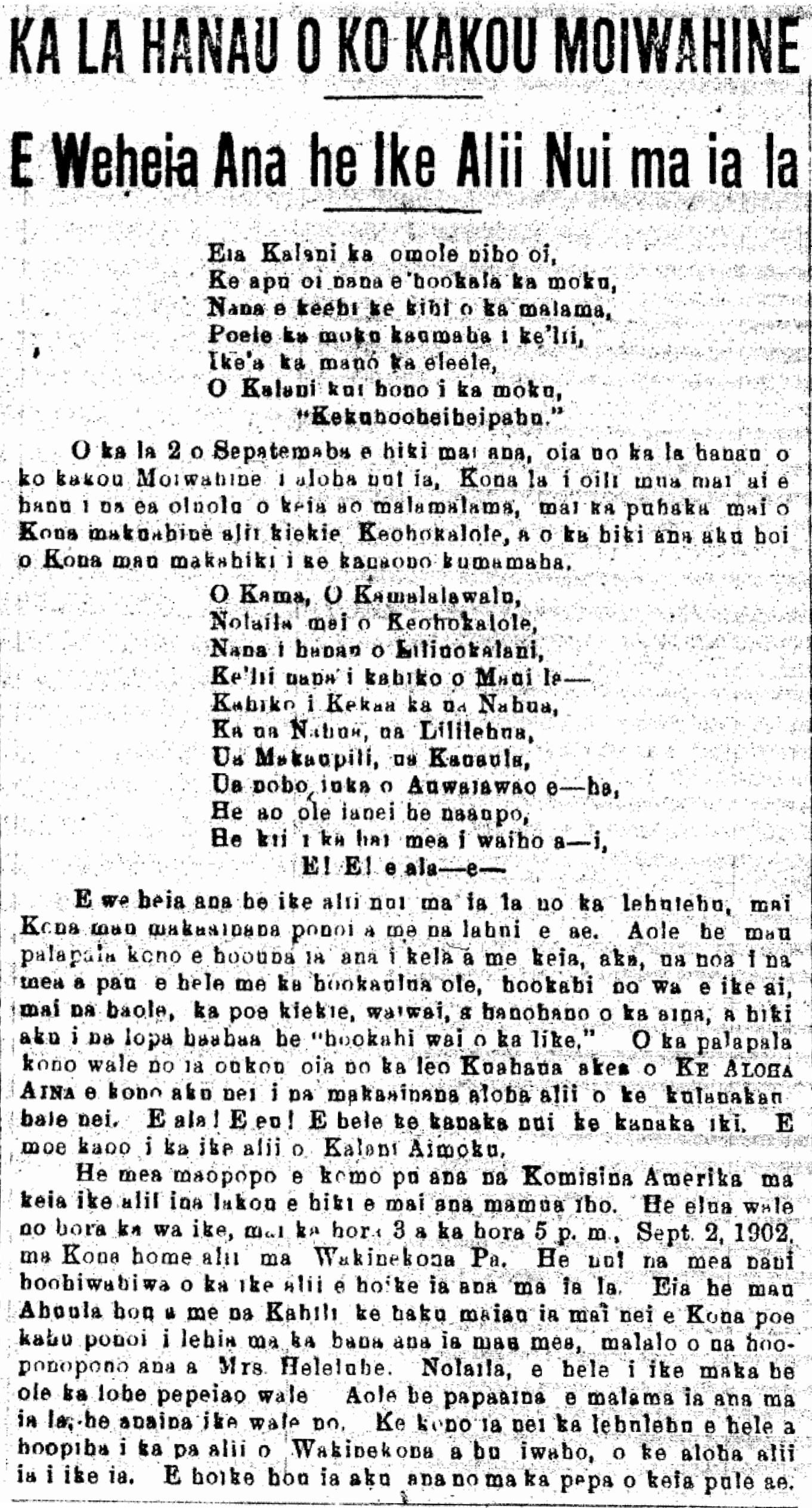
Eia Kalani ka omole niho oi,
Ke apu oi nana e hookala ka moku,
Nana e keehi ke kihi o ka malama,
Poele ka moku kaumaha i ke’lii,
Ike’a ka mano ka eleele,
O Kalani kui hono i ka moku,

“Kekuhooheiheipahu.”

The coming 2nd of September is the birthday of our dearly beloved Queen, the day that She first arrived and breathed in the sweet air of this world of light, from the loins of Her mother, high chiefess Keohokalole, and She has now reached the age of sixty-four.

O Kama, O Kamalalawalu,
Nolaila mai o Keohokalole,
Nana i hanau o Liliuokalani,
Ke’lii nana i kahiko o Maui la—
Kahiko i Kekaa ka ua Nahua,
Ka ua Nahua, ua Lililehua,
Ua Makaupili, ua Kauaula,
Ua noho iuka o Auwaiawao e—ha,
He ao ole ianei he naaupo,
He kii i ka hai mea i waiho a—i,
E! E! e ala—e—

There will be a great royal audience for the people that day, from Her own makaainana to the people of other ethnicities. There will not be invitations sent out to each person, but it is open to all without hesitation, and there will be but one audience, from the haole, the rich and prestigious of the land all the way to the humble peasants; they are all the same. The only invitation to you all will be this public Announcement by the Aloha Aina inviting all those of this town who have aloha for the monarch. Rise! Get going! Go forth, big man and little man. File along to the royal audience with the Queen.

It is understood that the American Commissioners [the Subcommittee on Pacific Islands and Porto Rico] will be present at this royal audience if they arrive before then. The audience will only be for two hours, from 3 to 5 p. m., Sept. 2, 1902, and Her royal residence at the grounds of Washington Place [Wakinekona Pa]. There will be many beautiful adornments displayed that day at the royal audience. There are new Feather Capes [Ahuula] and Kahili being skillfully crafted by Her own attendants who are skilled at the making of such things, under the guidance of Mrs. Heleluhe. So go and see for yourself, and not just hear about it. There will  not be a meal presented that day, only an audience. The public is invited to go a fill the yard of Washington Palace until it overflows, showing the love for the alii.  This will be shown once more in the paper of this coming week.

(Aloha Aina, 8/23/1902, p. 1)

KA LA HANAU O KO KAKOU MOIWAHINE

Ke Aloha Aina, Buke VIII, Helu 34, Aoao 1. Augate 23, 1902.

Celebrating Liliu’s 75th birthday, 1913.

LILIU IS 75 YEARS OLD

There Were Many Who Went to Congratulate Her This Tuesday.

This Tuesday past, Queen Liliuokalani was seventy-five years old, and her friends, companions, locals and foreigners visited her at her home at Washington Place to see her, and to give their congratulations to the Queen of Hawaii nei for reaching that old age.

Just like in past years, there was a rush of the citizens of town to see Queen Liliu; it was so in the morning of this Tuesday, and the Queen welcomed warmly all who shook hands with her; it is estimated that their number reached a thousand.

The hours set aside for the public to visit her was from eleven o’clock to twelve o’clock, but there was celebration on the previous Monday night by singing groups with their instruments, as they serenaded the window of the home of the person for whose birthday it was, until the hours when the sun appeared.

After eight o’clock in the morning of that Tuesday, there was also a luau given to celebrate the day, and the royal attendants and a few malihini were invited, and they sat at the table laden with so many good things.

When the time came for the opening of the audience with the public at eleven o’clock of that morning, everyone showed up at Washington Place [Wakinekona Hale], and there too was the Royal Hawaiian Band [Bana Hawaii] honoring the one whose birthday it was.

Present was the Honorable Edward K. Lilikalani, where he stood ready to greet the public, and Colonel Iaukea and John Dominis introduced them before Queen Liliu, as the Queen would always give a smile to each and everyone who shook hands with her.

There also was Princess Kawananakoa to assist the Queen, wearing her finery, while the interior of the reception room was decorated with flowers, and feather capes [ahuula], kahili, and everything hearkening back to the past era, the time when this archipelago was governed by Monarchs.

At this audience, there were many Hawaiians who showed their affection for their queen, by kneeling before her and kissing her hand as they were used to doing.

After the audience, the Queen and her attendants got aboard automobiles headed for her seaside home in Waikiki, where a party was prepared and waited for her and the malihini invited to meet with her and to enjoy with her that day.

The Royal Hawaiian Band [Bana Hawaii] was also there following her to Waikiki, to continue to give honor to the table of the queen.

There were several hundreds of invited people that arrived to that party, from kamaaina to malihini, and they all ate until satiated of what was prepared, and they drank to the health and happiness of the mother, with happy thoughts and with hope that the life of Queen Liliu would be extended and that she would have more years to live.

(Kuokoa, 9/5/1913, p. 1)

PIHA NA MAKAHIKI HE 75 IA LILIU

Ka Nupepa Kuokoa, Buke LI, Helu 35, Aoao 1. Sepatemaba 5, 1913.