Queen Emma in Washington D. C., 1866.

WASHINGTON.

Movements of Queen Emma—Visit to the Tomb of Washington—No More Rations to be Issued to the People of the South.

Washington, August 16.—In consequence of the report of Messrs Steedman, and Fullerton, and other information from the South, obtained through reliable sources, General Howard will issue, in a day or two, an order cutting off all rations issued to the people of the South, both white and black, and throw the means of support of destitute people upon the local authorities. This order will apply to inmates of hospitals or insane asylums. It is said President Johnson is in favor of the above order.

Her Majesty Queen Emma has spent the whole of to-day in visiting the tomb of Washington at Mount Vernon. Secretary McCullouch placed at her disposal the light and elegant revenue cutter Northerner, which returned yesterday from a trip to Portland, where she had been to convey Secretary McCulloch and family. The party, consisting of the Queen Dowager, Miss Spurgeon, Mr. P. S. Chilton, of the State Department, Consul General Odell, and Mr. Hopkins, Chamberlain, left Willard’s Hotel at eleven o’clock, and drove direct to the Navy Yard, where the Northerner was stationed. Through some misunderstanding the order for the trip did not reach Captain McGowan until nearly ten o’clock this morning, and consequently when the party reached the Navy Yard the cutter had not sufficient steam to start at once. There was also a blunder in the time at which her Majesty was expected to arrive, so that the Admiral commanding was not on hand to welcome her; but this was fortunately remedied by the politeness of that old and tried sailor, who received her Majesty and suite, escorted them on board the cutter, and apologized for the temporary absence of the Rear Admiral.

The news of the arrival of the Queen soon spread, when Read Admiral Radford, together with Commodore Smith, Captain Brown, Captain Balch and other officers of the navy, arrived and were introduced to the Queen, simultaneously with which a salute of twenty-one guns was fired in honor of her arrival. A short time was spent in interchange of friendly sentiment, some of the officers present having visited the Sandwich Islands and met the Queen at her palace. When the Admiral invited her Majesty to inspect the Navy Yard she was first shown the large fifteen-inch guns and a number of pieces captured from the enemy at different times and places, many of them broken and shattered by shell and explosion, but all of historic interest, and was then conducted to the ordinance room, shrapnel room, laboratory, room for the manufacture of percussion caps, and, in fact, shown everything of interest connected with the Navy Yard, in every department of which she seemed to be much interested. The Queen seemed particularly interested in the process of making percussion caps. The machine was put in operation, and a rod of copper given her. After explaining the process of manufacture she went to work and made over a hundred caps, which she desired to take with her. Another room was subsequently visited, where the explosive substance of the caps was supplied, and the caps made ready for use. Shortly after twelve o’clock the Queen and party returned to the cutter, which was then in readiness to start, when the Hawaiian flag was hoisted in honor of her Majesty, and the vessel loosened from her moorings and headed for Mount Vernon. The party on board, besides her Majesty and suite and the officers of the cutter, consisted of Rear Admiral Radford and two daughters, Captain Balch, Captain Brown, and Commodore Smith. The Queen and suite occupied seats upon the upper deck, beneath the awning, where they had a fine view of either bank of the Potomac, and seemed greatly interested in all they saw. Queen Emma asked many questions as to the positions occupied by the contending parties in the late war, and showed and intimate knowledge of the history of the Rebellion. The low stage of water prevented the cutter landing at the wharf upon her arrival at Mount Vernon, and all hands were compelled to go on shore in small boats. Previous to landing, however, an elegant cold collation, consisting of roast chicken, game, fruit, wine, and other delicacies, were served in the cabin of the Northern Light, furnished by Messrs. Sykes & Chadwick, of Willard’s Hotel, and served under their superintendence. Upon landing the first place visited was the tomb of Washington, where due respect was paid to the memory of the Father of this country, after which they repaired to the mansion, where they were kindly welcomed by Mr. U. H. Herbert, who for several years has had charge of the grounds, and who took particular pains to show and explain everything of interest. Every room of the house was explored, all the relics of Washington examined, and everything connected with Mount Vernon fully explained to her Majesty during the two hours passed within and around its sacred precincts. Nothing connected with the visit of Queen Emma to Washington has seemed to afford her so much genuine pleasure as the trip to-day. The fine weather, cool breeze, and splendid view, together with the freedom from restraint seemed to make her feel more at home, and she entered fully into the spirit of the occasion. She expresses herself highly pleased with Washington, its public buildings, and the reception she has met with while here, but greatly disappointed in the city itself as falling far short in size, beauty of its private residences, and general appearance from what she supposed the capital of so great a nation would possess. She expected to find the same magnificent palaces which she saw in Fifth avenue, New York, but instead has seen only common two-story brick tenements. The party arrived at the Navy Yard at 6 o’clock this evening, when the Queen made a short call at the residence of Rear-Admiral Radford, with whose daughters she had become well acquainted, and then returned to Willard’s to dinner.

A number of the representatives of the several tribes of American Indians now in the city, having expressed a desire to call on the Queen, claiming her as of the Indian race, their request was laid before her Majesty by the Acting Commissioner of Indian Affairs, Mr. Charles E. Mix, when she expressed her delight at the opportunity of seeing these representatives of the aboriginal races of this continent. She had contemplated a journey across the plains, expressly to see the native Americans, but by this unexpected opportunity a long and fatiguing journey would be avoided, and her wish be gratified. It was arranged that the Indians should be presented to her this evening at half-past 8 o’clock. At the appointed hour, accompanied by Miss Spurgeon, Mr. Chilton, and Mr. Hopkins, the Queen appeared in one of the large parlors of Willard’s Hotel, when the Acting Commissioner was presented to her. The representatives of the various tribes were then ushered in and presented by the Acting Commissioner. Those presented consisted of five Choctaws, headed by Governor Peter P. Pitchiynn; five Chickasaws, under Governor Winchester Colbert; three Southern Cherokees and nine wild savage Pawnees, including two squaws and one pappoose. The Choctaws, Chickasaws, and Cherokees were fully civilized, many of them being gentlemen of wealth and standing, and all educated. One judge, a doctor, and a clergyman were of the number. The Pawnees were of the wild, savage claas, accidentally in the city, and appeared in all the grandeur of their native garb, with feathers, war paint, weapons, moccasins, etc. The Queen seemed to be more than usually interested in their interview. At first her attention was fastened upon the savage Pawnees. She examined their weapons, dress, and ornaments, questioned them as to their manners and habits, manifested a peculiar sympathy for the squaws, and repeatedly chucked the pappoose under the chin. Tiring of these they were dismissed, when she entered into a lively conversation with the educated representatives of the other tribes got some general ideas of their respective histories, present condition, etc., and finally drew out a speech in his native dialect from Governor Pitchlynn, which was translated by the Choctaw preacher who was with him, and which amused and pleased him greatly. Pitchlynn, Colbert, and others, had children with them, towards whom the affection of the Queen seemed to go forth in a remarkable degree.

She insisted on shaking them all by the hand, and kissing such of them as were not disposed to avoid the consideration. The interview lasted about an hour, and was one of the most interesting that has occurred during her Majesty’s stay here. No programme has yet been arranged for tomorrow. The Queen has accepted Secretary Seward’s invitation to become his guest, and will repair to his mansion to-morrow, where she will remain until Monday, when she leaves for Niagara Falls.

(Evening Telegraph, 8/17/1866, p. 1)
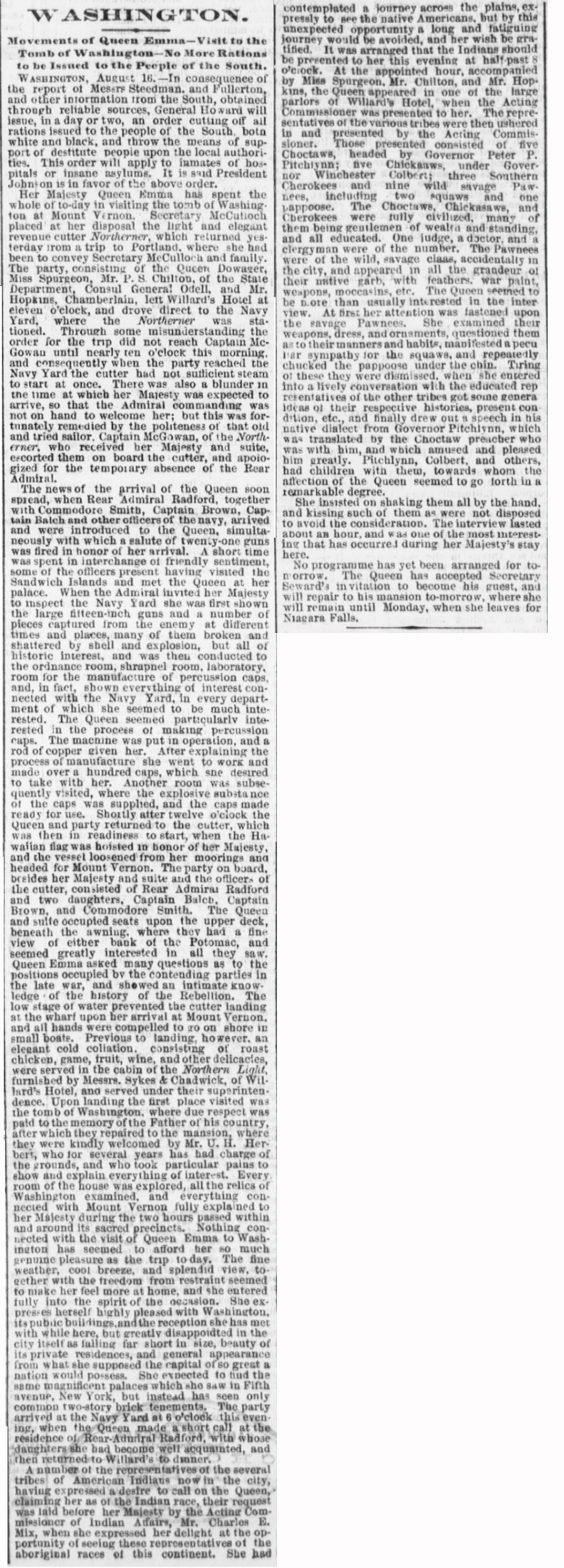
WASHINGTON.

The Evening Telegraph, Volume VI, Number 40, Page 1. August 17, 1866.

Local coverage of Queen Emma’s visit to New York, 1866.

LOCAL NEWS.

NEW YORK AND THE VICINITY.

Movements of the Queen Dowager of Hawaii—She attends church twice yesterday—Interesting interview with deaf mutes—Queen Emma passed a comparatively quiet day on Saturday. She had her photographs taken in various positions at two photographic galleries in the morning, being accompanied by Miss Spurgin, Major Hopkins, her maid servant, and Mr. John Welsh. She also, in company with Miss Spurgin, did some shopping on Broadway during the day. The Rev. Dr. Gallaudet, Rector of St. Ann’s Church for Deaf Mutes, visited Her Majesty in the evening, and invited her to attend his church yesterday. The invitation was accepted. Gen. Darling and Col. Gerhard, of Gov. Fenton’s staff, also called and extended a formal invitation to the Queen to visit Albany, which she promised to do on her return from Boston, in the evening Her Majesty and suite dined with Hon Moses H. Grinneli and suite, and at 10 o’clock the royal party returned to the Brevcort House.

Early yesterday morning Old Trinity was crowded in every part by visitors, who, from appearances, had been attracted there by the announcement that the Queen would be present. At about half-past ten  her Majesty entered the Church accompanied by her suite, and proceeded up the main aisle, proceeded by the sexton and Rev. Dr. Vinton, who conducted her to the pew which the Prince of Wales occupied when he was here. The royal [unclear line] In the first pew were her Majesty Queen Emma, and Mr. Odel (Hawaiian Consul) and [unclear] Second—Major Hopkins, Miss Spurgin, and Mr. Chilton, Government Agent from Washington. Third—Mr. John Walsh, Mr. J. V. B. Marshall and the Swiss maid servant. As her Majesty entered the pew she knelt and remained some moments in silent prayer, and as she rose an elegant prayer book bearing a suitable inscription, and bound in royal purple with illuminated rubrics was presented to her. A suitable writing was also within the book, staiting that it was presented to her Majesty in memory of her visit and her fellowship with the Apostolic Church. Morning prayer was intoned throughout by the Rev. Dr. Vinton; the first lesson was read by Rev. Joseph J. Kinegood, of Eastern Pennsylvania. The second by Rev. Sidney Corbett, of Quincy, Ill. In the ante-communion service the epistic was read by Rev. Mr. Elesegood, and the gospel by Rev. Dr. Vinton. The music was splendid and consisted of Onseley’s service in G. the anthem, “O! Lord our Governor.” Ps. VIII, V. 1, 3, 4, by Marcello, also in G. This was the anthem sung at the Coronation of the Queen of England, and at the visit of the Prince of Wales to Trinity Church. The 41st hymn concluded the musical portion of the exercices. The solos were by Master Knowles and Mr. Yatman. In the anthem both organs were used, as they were in the [unclear] Voluntary (hallelujah chorus) Organists, Mr. W. A. M. Diller and Mr. Arthur G. Messeter. In the morning service the prayer for a safe return from sea was said, it having special reference to the Royal party. The Rev. Dr. Vinton preached the sermon from the words, “If I perish, I perish.” Esther IV: 16. He gave an account of the deposition of Queen Vashti and the elevation of Queen Esther, and remarked that this must have been no chance work, but was pre-ordained by the Almighty for the preservation of her people. He concluded by directing all to do their duty fearlessly in this world and Christ would hold out the golden sceptre of his love to those and bring them to this presence. A collection was then taken up for the benefit of the church in the Sandwich Islands, after which the congregation retired. As the Queen entered her carriage she was loudly cheered by the crowds who had collected outside the church. The party then retired to the hotel. The Queen and suite again attended St. Ann’s Church on Eighteenth street, near Fifth avenue, at 3 1/2 P. M. and witnessed the service for deaf mutes. The Rev. Dr. Gallandet explained many of the signs before the service commenced and stated some interesting circumstances connected with the church. The services were conducted by Rev. Dr. Vinton, and the sermon was preached by the Rev. Eastman Benjamin, the whole being interpreted by Rev. Dr. Gallaudet in the sign language. At the close an address was delivered by Rev. Dr. Vinton, who stated that the present was an occasion of thankfulness, inasmuch as a lady born in one of the isles of the sea and who had been lifted to a throne, had come among them to witness the miracle which had been performed, of causing the deaf to hear and the dumb to speak. It was delightful to show this miracle to her Majesty, whom God had made the instrument of making a nation Christian, which only a few years ago had been steeped in heathenism. She was now on a mission for the purpose of raising houses of mercy in her own land, and he hoped God would prosper it. By invitation, the Queen and suite remained after service, and a number of questions were asked the mutes and answered. Her Majesty, who by the way writes an elegant female hand, wrote the following, and handed it to one of the lady deaf mutes:—”My delight has been very great at being able to have prayed with you this day. I shall always remember brothers and sisters in you here when I am far away in my own land, far off, in my prayers. Do you believe we shall meet in Heaven and why?—Emma R.” The lady mute immediately wrote the following—”We, deaf mutes, are very happy to see her Majesty Queen Emma, of the Sandwich Islands to-day; and moreover we are greatly delighted in sitting with you in the house of the Lord. For myself I believe that there will be a mutual recognition in heaven.” Her Majesty then shook hands with several of the mutes, and also with the clergyman. She was accompanied to the carriage by the Rev. Dr. Gallaudet, who pressed her hand  and said, “God bless you.” She thanked him with a smile, and was driven to the hotel. This morning the Queen and suite will take the eight o’clock train to Philadelphia, en route to Washington. Mr. Cheiton, the special envoy from Mr. Seward, will accompany the royal party. The Queen will be received at Washington by Attorney General Stansbury, Acting Secretary of State.

(New York Sun, 8/13/1866, p. 1)

LOCAL NEWS.

The New York Sun, Year 33, Number 10,629, Page 1. August 13, 1866.

Queen Emma’s foreign travels and patriotism abroad, 1866.

Hawaiian Boy in New York.

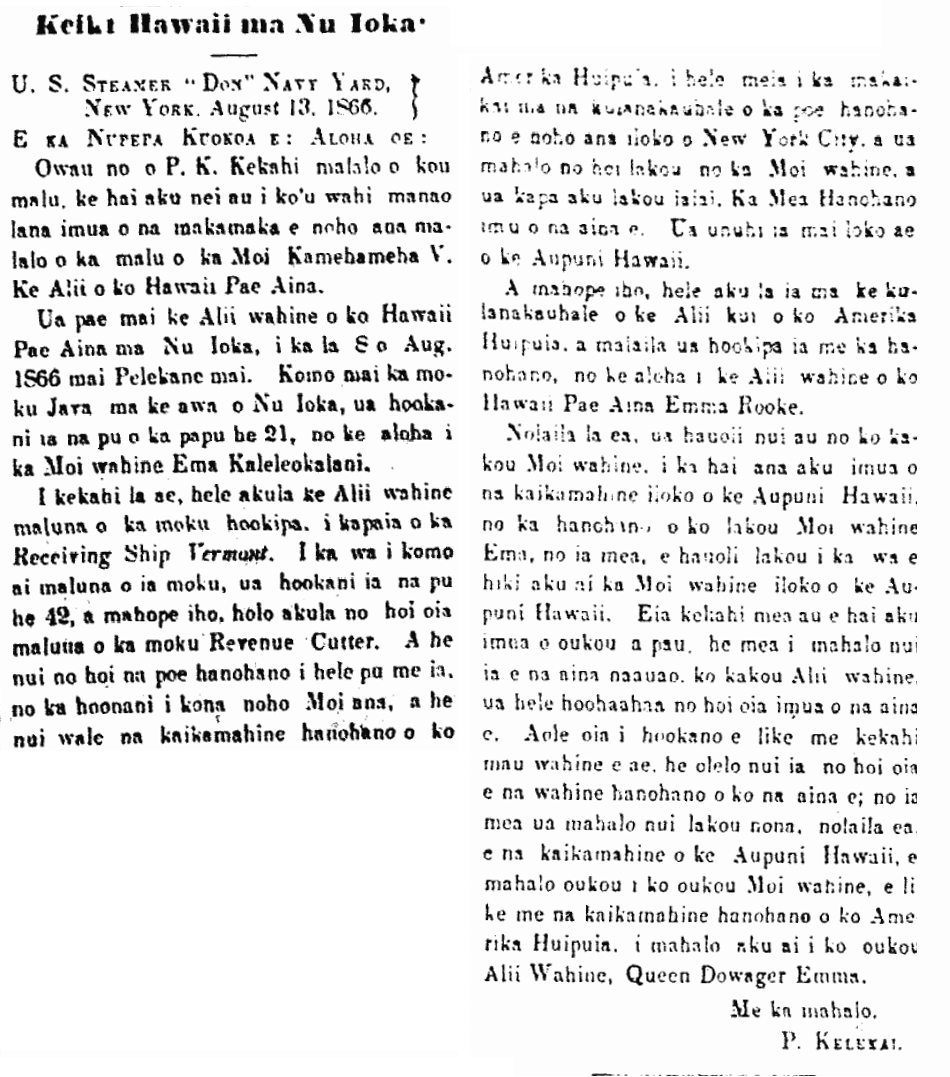
U. S. Steamer “Don” Navy Yard,

New York, August 13, 1866.

O Kuokoa Newspaper: Aloha oe:

I am P. K. Someone under your care; I am stating my hope before the friends living under the protection of King Kamehameha V, the King of the Hawaiian Islands.

The Queen of the Hawaiian Archipelago landed in New York on the 8th of August, 1866 from Britain. The ship Java entered New York harbor and a 21 gun salute was sounded at the fort, in aloha for Queen Emma Kaleleonalani.

Another day thereafter, the Queen went aboard the welcoming vessel called the Receiving Ship Vermont. When she went aboard, a 42 gun salute was sounded, and afterwards, she went aboard the Revenue Cutter ship. There were many distinguished people who went along with her to show honor to her Queenship, and there were many prominent girls of the United States of America who went touring along with her within New York City, and they felt admiration for the Queen and they called her Her Excellency before all other foreign lands [? imua o na aina e]. She was brought from the Nation of Hawaii.

Thereafter, she went to the city of the president [? alii kui] of the United States, where she was hosted with dignity for their aloha for the Queen of the Hawaiian Islands, Emma Rooke.

Therefore, I am overjoyed for our Queen, as I speak before the girls of the Nation of Hawaii about the grandeur of their Queen Emma, and because of this they should be joyful when the Queen arrives in the Hawaiian Nation. Here is another thing which I say before you all, our Queen is someone who is greatly honored by the enlightened nations, by her travelling in foreign lands with humility. She is not pretentious like some other women; she is greatly spoken of by reputable women of other nations, and they hold her in high esteem; therefore, O Girls of the Hawaiian Nation, be respectful of your Queen, like the fine girls of the United States who admire your Queen, the Queen Dowager Emma.

With appreciation,

P. Kelekai.

(Kuokoa, 10/ 13/1866, p. 3)

Keiki Hawaii ma Nu Ioka

Ka Nupepa Kuokoa, Buke V, Helu 41, Aoao 3. Okatoba 13, 1866.

The birthday of Queen Emma, 1880.

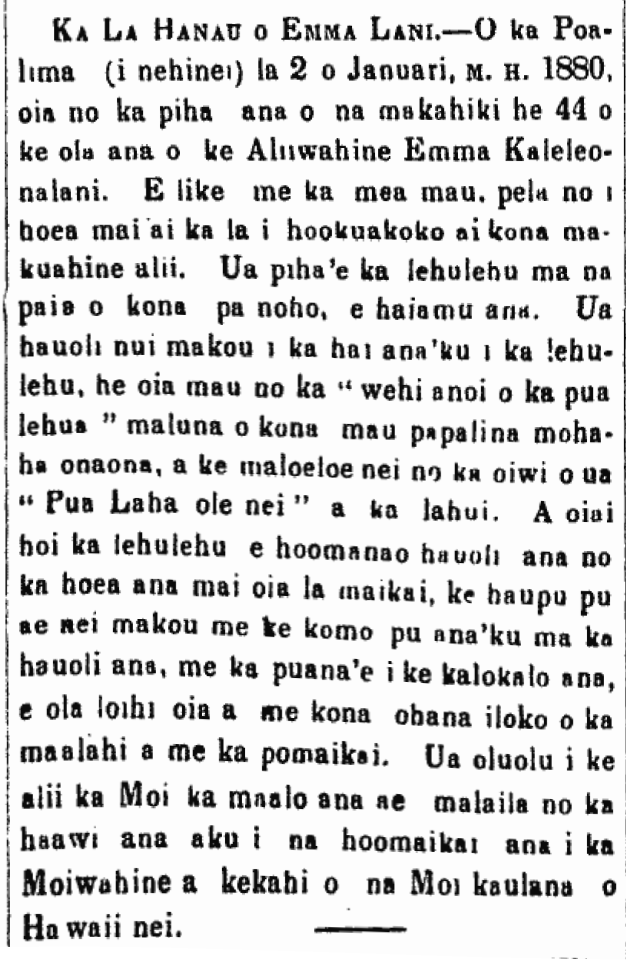
The Birthday of Emma Lani.—Friday (yesterday), the 2nd of January, 1880, was the 44th birthday of the life of Queen Emma Kaleleonalani. Just as usual, the day on which her royal mother suffered birthing pains arrived. There were throngs gathered at the walls of her estate. We are very happy to inform the public that as always the “beloved elegance of lehua blossoms” top her sweet rounded cheeks, and the figure of that “Rare Blossom” of the people is in fine shape. And as the people happily celebrate the arrival of this fine day, we also reminisce as we join in the celebration, while we utter a prayer, wishing that she and her family live long in ease and prosperity. The King kindly made his way by to give his congratulations to the Queen of one of the famous Kings of Hawaii nei.

[The Daughters of Hawaii announced that today, 1/2/2014, in honor of Queen Emma’s 178th birthday, there will be a new exhibit opening, along with free admission to Hanaiakamalama, with a short program at 11 a. m. So if you are on Oahu, this sounds like a good way to spend the Queen’s birthday!]

(Kuokoa, 1/3/1880, p. 2)

Ka La Hanau o Emma Lani.

Ka Nupepa Kuokoa, Buke XIX, Helu 1, Aoao 2. Ianuari 3, 1880.

Kahili from Washington Place to go to Hanaiakamalama, 1918.

KAHILI TO BE RETURNED TO THE HOME OF EMMA.

Because Washington Place [Wakinekona Hale] will be placed under the care of Governor McCarthy, as a home for him to live in with his family, twenty-six feather standards were returned from Washington Place to the old home of Queen Emma, in the uplands of Nuuanu, under the care of the Association, the Daughters of Hawaii [Na Kaikamahine o Hawaii].

During the funeral of Queen Liliuokalani, and while her body lay in state at Kawaiahao Church and in the throne room of the palace, those kahili were something the public could visit, however, as the result of an agreement between the trustees of Queen Liliuokalani’s estate and the Association of the Daughters of Hawaii, the caring for the kahili has been transferred to the association. As has been the custom from ancient times, it was during the night that kahili of those types were moved from one place to another, and so it was that the kahili were returned in the dark of night on Sunday two weeks ago.

However, because there were not enough people to carry the kahili and march on the roads to its new home where it is hoped to be cared for, the kahili were put on cars and it was on these cars which the people who held the kahili stood.

When the cars and the kahili arrived at the entrance to the yard of the home of Queen Emma in the uplands of Nuuanu, the kahili were taken by the leaders of the Association of the Daughters of Hawaii, and its care was transferred to them.

(Kuokoa, 10/18/1918, p. 2)

HOIHOIIA NA KAHILI MA KA HOME O EMA.

Ka Nupepa Kuokoa, Buke LVI, Helu 42, Aoao 2. Okatoba 18, 1918.

A public event at Hanaiakamalama, 2013.

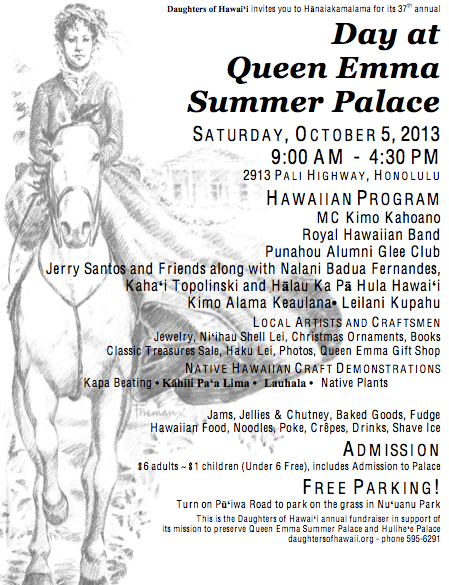
Day at Queen Emma Summer Palace

Although the party held 89 years ago was only open to the members of the Daughters of Hawaii, the event this Saturday, October 5, 2013, is open to one and all. Queen Emma Summer Palace is under the care of the Daughters of Hawaii. It seems like it will be a great event with proceeds going to the organization. Let’s give them support for their care of this historic home of Ke Alii Kaleleonalani as well as Hulihee Palace in Kona!!

Check out our various posts on the Daughters of Hawaii!]

Day at Queen Emma Summer Palace

Day at Queen Emma Summer Palace

Daughters of Hawaii and Hanaiakamalama, 1924.

ANNOUNCEMENT.

Na Kaikamahine o Hawaii.

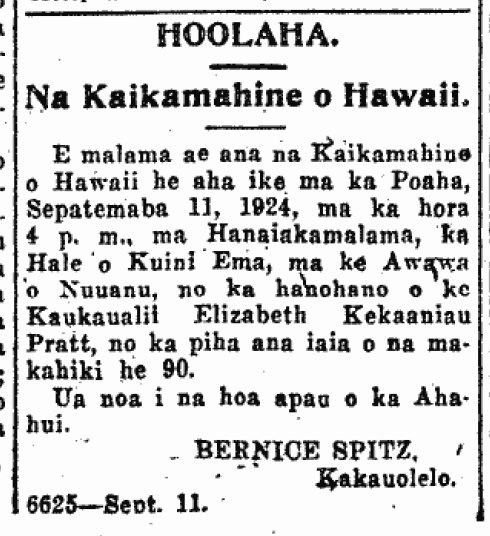
The Daughters of Hawaii will hold a social, this Thursday, September 11, 1924, at 4 p. m., at Hanaiakamalama, the Home of Queen Emma, in Nuuanu Valley, to honor the honorable Kaukaualii Elizabeth Kekaaniau Pratt, for her 90th birthday.

This is open to all the member of the Association.

BERNICE SPITZ,

Secretary.

(Kuokoa, 9/11/1924, p. 6)

HOOLAHA. Na Kaikamahine o Hawaii.

Ka Nupepa Kuokoa, Buke LXIII, Helu 37, Aoao 6. Sepatemaba 11, 1924.

More on the Wahiawa “healing stones,” 1927.

THE SUPERNATURAL ROCKS WILL BE LEFT IN THEIR PLACE.

At the meeting of the Daughters of Hawaii last week Wednesday in the Home of Queen Emma Kaleleonalani in Nuuanu, the association decided not to move the “Healing Stones” from where the two stand in Wahiawa; they made no decision to perhaps not move them for a time between three and six months and after that time, to take up again the question of those rocks.

When ayes and nays were asked for per the request explained earlier by Mrs. Julie Judd Swanzy and added to with small changes made by Mrs. F. A. Potter, there were three members who were opposed to the changes.

The decision by the association agreed upon that day, was in accordance with the decision by the President of the Board of Health, F. E. Trotter, that there would be no action upon on the matter of the rocks and that they’d be left where they stand now without being moved. With this decision by the Daughters of Hawaii, the ones who have responsibility over the rocks, dashed was the hope and request of 400 citizens of Wahiawa made to this association in a petition to remove the rocks from Wahiawa.

Another subject considered and decided upon by the association was this: there shall be no monuments built upon heiau. At that meeting, announced were pledges of $588, and cash donations of $1712, and funds of $341.72 for the restoration of that palace in Kailua, Kona, Hawaii [Hulihee].

Because of the rumor that the enthusiasm over the healing powers of the rocks are dwindling, which was known because less people go to worship the stones and because of less donations, this is the reason for the postponement by the association on action to be taken in regard to the rocks, with their belief that perhaps in a short few months the craze of the people over worshiping them will decrease drastically.

At that meeting of the association, there were many letters read by the President, Mrs. Swanzy, in front of the members gathered there, from different people dealing with the stones.

One of these letters was a petition by 400 people of Wahiawa asking to remove these rocks from there; three of the people who signed their names to the document asked that their names not be publicized and to take out their names from the list; there was a letter against the moving of the rocks to the Bishop Museum, where the stones would just be a “Collection” there; in another letter, it was asked to move the rocks to an area near the new road in Koko Head.

Mrs. Charles Clark asked to return these stones to the grounds of Kukaniloko; her idea was opposed by the majority of the members for the reason that the ancient history of these stones have nothing to do with the history dealing with the alii born at Kukaniloko, and therefore, it is not right to move them there. The rocks were moved to Kukaniloko at the order of Galbraith, because he thought they might be broken up where they stood beneath the stream.  The association does not want to return the stones there; they have been something much cared for by the Filipinos and others, and other stones of Kukaniloko have been cracked because of candles placed upon them, and the grounds are full of rotting fruits and flowers; and seeing those things which marred the beauty of the area was why they were moved to where they stand now. Those stones will not be considered again for return to Kukaniloko.

As for the $3000 in the bank, it is from donations made by people who went to worship the stones, but the association has not agreed to take a cent of the money, but it will instead be appropriated for use for works benefiting the people of Wahiawa.

(Kuokoa, 11/24/1927, p. 4)

E WAIHOIA ANA NO NA POHAKU KUPUA MA KO LAUA WAHI.

Ka Nupepa Kuokoa, Buke LXVI, Helu 52, Aoao 4. Novemaba 24, 1927.

Kiliwehi Hoapili Kaauwai, 1873.

[Found under: “Local News.”]

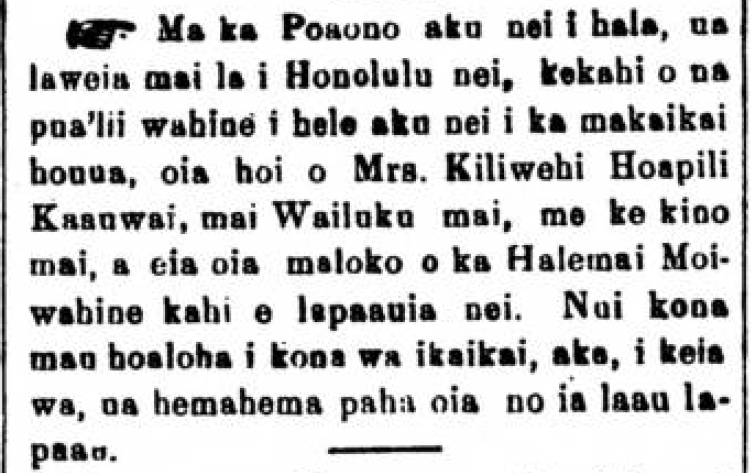
Last Saturday, brought to Honolulu from Wailuku was one of the royal women who had gone on a tour of the world, that being Mrs. Kiliwehi Hoapili Kaauwai, with an ailing body, and here she is now at the Queen’s Hospital being treated. She had many a friend when she was in good health, but now, she perhaps is lacking in this medicine.

(Kuokoa, 10/18/1873, p. 2)

Ma ka Poaono aku nei i hala...

Ka Nupepa Kuokoa, Buke XII, Helu 42, Aoao 2. Okatoba 18, 1873.

The First Kamehameha Day, 1872.

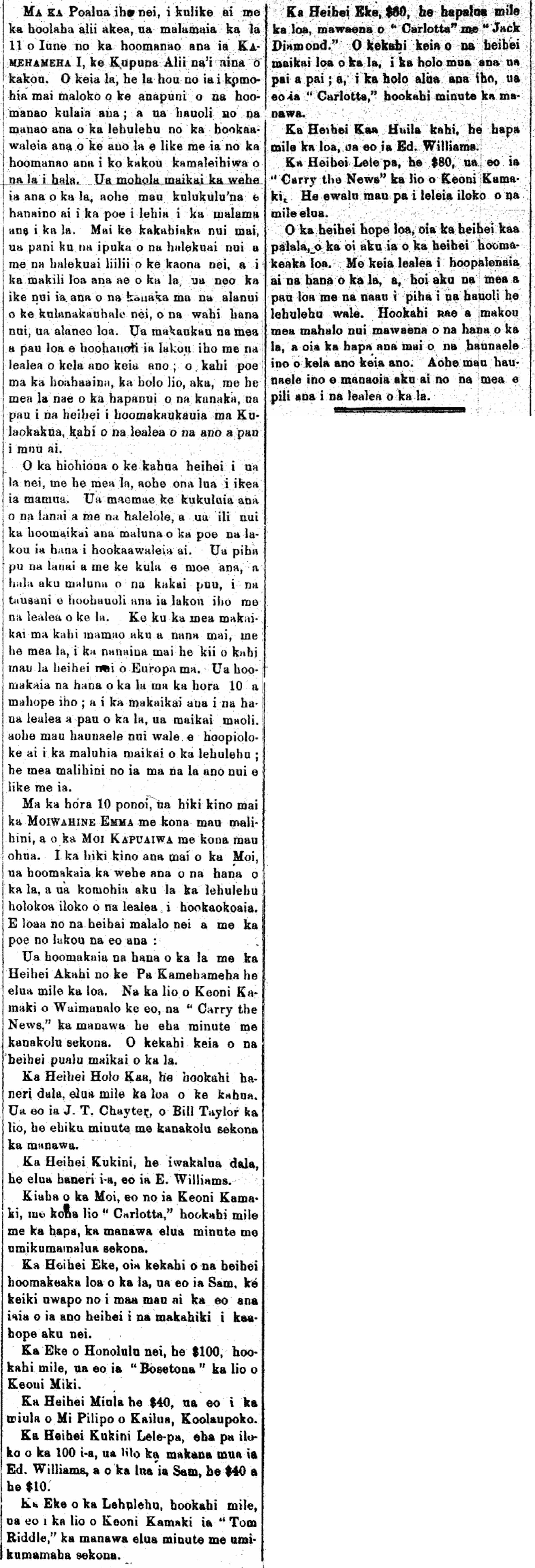
This past Tuesday, as per the Royal Proclamation, the 11th of June was observed as the day to commemorate Kamehameha I, our Royal Ancestor who conquered the land. This is a new day included in the realm of holidays; and the people were joyous at the designating of a day like this for the remembering of our precious beloved one of days gone by. The day opened beautifully, without any drops to bother the people who were well adept to celebrate the day. From early morning, the doors of the large and small shops of town were closed shut, and when the sun came out, nonexistent the sight of many people on the streets of this town, and the places of work were deserted. Everyone was ready to entertain themselves with pleasures of all sorts; some people with feasts or horse riding, but it seemed as if most of the people were at the races set up at Kulaokahua, where enjoyments of all sorts took place [? i muu ai].

The sight of the race track on that day, was as if like no other before. The lanai and tents were nicely built, and congratulations go to those responsible for that distinguished job. The lanai and grounds were filled all the way atop the hills with thousands enjoying themselves with the festivities of the day. Should a visitor stand far away and look forth, it was as if it was a scene from great racing days in Europe. The events of the day began at 10 o’clock or thereafter; and to take in all of the many fun activities of the day was great; there were no big uproars to disturb the peace; that is something unusual for big days like this.

At 10 o’clock sharp, Queen Emma made an appearance with her guests, and King Kapuaiwa with his suite. At the arrival of the King, the activities of the day were opened, and all the people joined in the festivities set aside. There are the races below as well as those who won.

The activities of the day began with the First Race for the Kamehameha Plate, which was two miles long. John A. Cummins [Keoni Kamaki] of Waimanalo won, with “Carry the News,” with a time of four minutes and thirty seconds. This was one of the fine open races [heihei pualu] of the day.

Trotting Race [Heihei Holo Kaa], for one hundred dollars, two mile long course. J. T. Chayter won with the horse Bill Taylor, with a time of seven minutes and thirty seconds.

Foot Race [Heihei Kukini], for twenty dollars, two hundred yards, won by E. Williams [Edward Williams].

King’s Cup, won by John A. Cummins [Keoni Kamaki], with his horse, “Carlotta,” one mile and  a half, with a time of two minutes and twelve seconds.

Sack Race [Heihei Eke], was one of the most humorous races of the day, won by Sam, the harbor boy who is used to winning that type of race in past years.

Honolulu Purse [Eke Honolulu nei], of $100, one mile, won by “Bosetona,” the horse of Keoni Miki [John Meek].

Mule Race [Heihei Miula], $40, won by the mule of Mr. Pilipo of Kailua, Koolaupoko.

Foot Hurdle Race [Heihei Kukini Lele-pa], four hurdles in a hundred yards; the first place went to Ed. Williams, and the second to Sam; $40 and $10.

Public Purse [Eke o ka Lehulehu], one mile, the horse of John A. Cummins [Keoni Kamaki], “Tom Riddle,” won, with a time of two minutes and fourteen seconds.

$60 Purse [Heihei Eke $60], half a mile long, between “Carlotta” and “Jack Diamond.” This was one of the best races of the day, in the first running, they were head to head; but on the second race, “Carlotta” won with a time of one minute.

Velocipede Race [Heihei Kaa Huila kahi], half a mile long, won by Edward Williams.

Hurdle Race [Heihei Lele pa], for $80, won by “Carry the News,” the horse of John A. Cummins [Keoni Kamaki]. Eight hurdles were jumped over in two miles.

The final race was the wheelbarrow race [heihei kaa palala], which was the most comical. With this race, the activities of the day came to a close, and everyone went home with hearts filled with much joy. There is one thing amongst all the activities which we appreciate greatly, that is the fraction of various sorts of commotions. There were no disturbances believed to have resulted from the gaiety of the day.

[This is quite a different type of celebration compared to today. Whatever you may have planned for today, let there be remembering of the one who unified the islands, Kamehameha Paiea.]

(Au Okoa, 6/13/1872, p. 2)

Ma ka Poalua iho nei...

Ke Au Okoa, Buke VIII, Helu 9, Aoao 2. Iune 13, 1872.