E o, e Kaleleonalani! Queen Emma and Kamehameha Schools, 1887.

KAMEHAMEHA SCHOOL.

The gates of the Kamehameha School for boys will open in October of this current year. The imperfections of one of the dormitories of 30 x 64 [feet] are almost smoothed out, and another was complete before. These dormitories are two storied, bottom floor and top floor, and each of them have 24 rooms of 8 x 12, and a hallway [keena waena loloa]. One room of each house is furnished with facilities to wash up and clean, and the rest of the rooms are bedrooms, each being supplied with a iron bed, desk, chair, closet, and some other furnishings. The rooms are clean and lighted, and well-furnished for the student.

The dining hall of 29 x 81 feet is a separate building, and it is 18 feet from the bottom to the ceiling, and it will fit two-hundred people. A stone building will be built behind this, which will be the kitchen and and a place to store the food and all cookware and dinnerware.

A proper schoolhouse will be built after the buildings that are desired to be completed quickly are done, and in the meantime, parts of the dining hall will be set aside as school rooms.

A clear spring will supply the school with water and it is by steam pumps that the water will be brought up and filled into a separate water tank, and from there into many pipes laid all over the grounds and buildings.

The curriculum at this school teaches thoroughly the branches of the English language; and outside of that are the teaching of industrial arts. Some rooms of the school house will be set aside as rooms for carpentry, printing, tailoring, blacksmithing, and masonry. The instruction will take place under the direction of a mechanic [mekanika]. Some time will also be set aside for military drilling, physical development, and so forth.

There are fun and cheerful activities for the students. This school sits on a serene site, living there is pleasant, and it is separated from the town of Honolulu.

In a section of this paper, the reader will see the advertisement dealing with this School. This is the educating home established for the benefit of Hawaii’s children who seek education, and built by way of the estate of the late Dowager Queen Ema Kaleleonalani. This home stands in the plain of Kaiwiula in Kalihi, and it is near completion. On the first Tuesday of October 1887, this school will open to students.

It has been heard that the assets of the school will be increased for the good of the children, and for now, parents who want their children to progress forward are being urged to rush to this new home where knowledge is increased. Much benefits will be gained if patient and if the aloha of the royal parent Ema Kaleleonalani is held resolute as well by Hawaii’s children, the one who left this great gift behind. Look at its published notice.

[On this, the day after Queen Emma’s 177th birthday, i thought it would be a good thing  to look back at her role in the establishment of the Kamehameha Schools, a role which she is not recognized often for today.

Notice the difference between the article appearing in the May 24th edition of the Hawaiian Gazette, “The Kamehameha Schools.” (probably what the article is based upon) and this Hawaiian-Language article.]

(Kuokoa, 5/28/1887, p. 2)
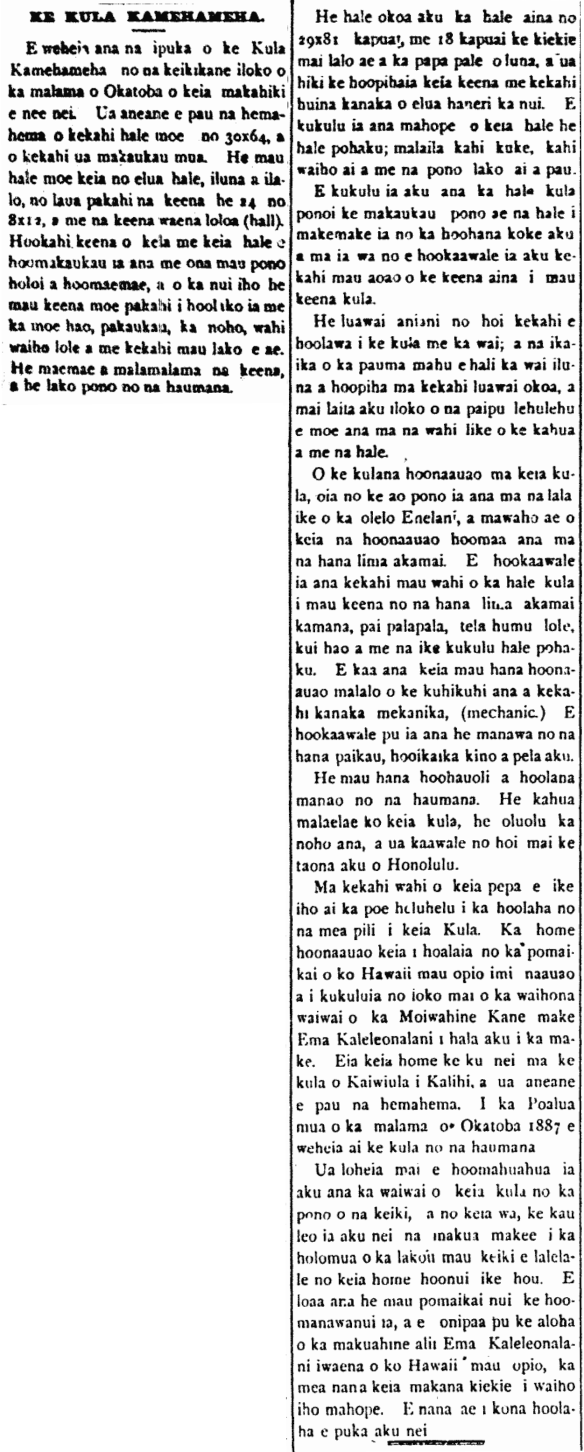
KE KULA KAMEHAMEHA.

Ka Nupepa Kuokoa, Buke XXVI, Helu 22, Aoao 2. Mei 28, 1887.
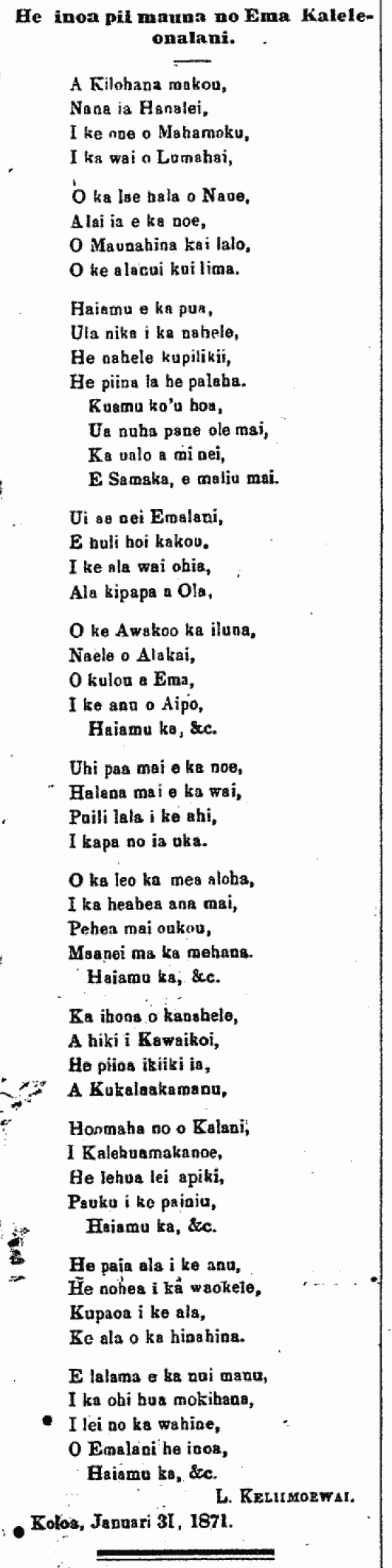
Another mountain-climbing mele for Emalani, 1871.

A mountain-climbing name song for Ema Kaleleonalani.

A Kilohana makou,
Nana ia Hanalei,
I ke one o Mahamoku,
I ka wai o Lumahai,

O ka lae hala o Naue,
Alai ia e ka noe,
O Maunahina kai lalo,
O ke alanui kui lima.

Haiamu e ka pua,
Ula nika i ka nahele,
He nahele kupilikii,
He piina la he palaha.
Kuamu ko’u hoa,
Ua nuha pane ole mai,
Ka ualo a mi nei,
E Samaka, e maliu mai.

Ui ae nei Emalani,
E huli hoi kakou,
O ke ala wai ohia,
Ala kipapa a Ola,

O ke Awakoo ka iluna,
Naele o Alakai,
O kulou a Ema,
I ke anu o Aipo,
Haiamu ka, &c.

Uhi paa mai e ka noe,
Halana mai e ka wai,
Puili lala i ke ahi,
I kapa no ia uka.

O ka leo ka mea aloha,
I ka heahea ana mai,
Pehea mai oukou,
Maanei ma ka mehana.
Haiamu ka, &c.

Ka ihona o kanahele,
A hiki i Kawaikoi,
He piina ikiiki ia,
A kukalaakamanu,

Hoomaha no o Kalani,
I Kalehuamakanoe,
He lehua lei apiki,
Pauku i ke painiu,
Haiamu ka, &c.

He paia ala i ke anu,
He nohea i ka waokele,
Kupaoa i ke ala,
Ke ala o ka hinahina.

E lalama e ka nui manu,
I ka ohi hua mokihana,
I lei no ka wahine,
O Emalani he inoa,
Haiamu ka, &c.

L. Keliimoewai.

Koloa, Januari 31, 1871.

[This is another mele honoring Queen Emma and her famous travels through Kauai. It seems the eight lines starting “Haiamu e ka pua” is repeated like a chorus after every two verses.

This seems to be a more “complete” version of the one printed in “He Lei no Emalani,” pp. 90–91.]

(Au Okoa, 2/9/1871, p. 1)

He inoa pii mauna no Ema Kaleleonalani.

Ke Au Okoa, Buke VI, Helu 43, Aoao 1. Feberuari 9, 1871.

Mele for Queen Emma on her mountain-climbing expedition, Kauai, 1871.

He inoa pii kuahiwi no Kaleleonalani.

1.

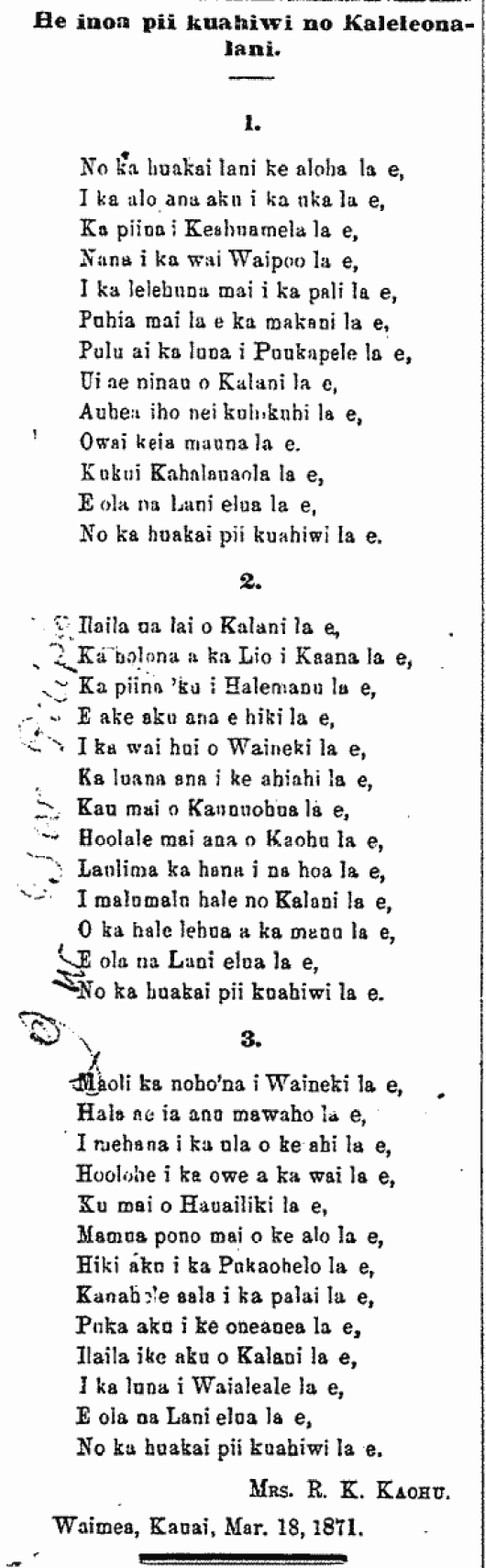
No ka huakai lani ke aloha la e,
I ka alo ana aku i ka uka la e,
Ka piina i Keahuamela la e,
Nana i ka wai Waipoo la e,
I ka lelehuna mai i ka pali la e,
Puhia mai la e ka makani la e,
Pulu ai ka luna i Puukapele la e,
Ui ae ninau o Kalani la e,
Auhea iho nei kuhikuhi la e,
Owai keia mauna la e,
Kukui Kahalauaola la e,
E ola na Lani elua la e,
No ka huakai pii kuahiwi la e.

2.

Ilaila ua lai o Kalani la e,
Ka holona a ka Lio i Kaana la e,
Ka piina ‘ku i Halemanu la e,
E ake aku ana e hiki la e,
I ka wai hui o Waineki la e,
Ka luana ana i ke ahiahi la e,
Kau mai o Kaunuohua la e,
Hoolale mai ana o Kaohu la e,
Laulima ka hana i na hoa la e,
I malumalu hale no Kalani la e,
O ka hale lehua a ka manu la e,
E ola na Lani elua la e,
No ka huakai pii kuahiwi la e.

3.

Maoli ka noho’na i Waineki la e,
Hala ae ia anu mawaho la e,
I mehana i ka ula o ke ahi la e,
Hoolohe i ka owe a ka wai la e,
Ku mai o Hauailiki la e,
Mamua pono mai o ke alo la e,
Hiki aku i Pukaohelo la e,
Kanahele aala i ka palai la e,
Puka aku i ke oneanea la e,
Ilaila ike aku o Kalani la e,
I ka luna o Waialeale la e,
E ola na Lani elua la e,
No ka huakai pii kuahiwi la e.

Mrs. R. K. Kaohu.

Waimea, Kauai, Mar. 18, 1871.

[For more mele in honor of Queen Emma, see “He Lei no Emalani”.]

(Au Okoa, 4/13/1871, p. 1)

He inoa pii kuahiwi no Kaleleonalani.

Ke Au Okoa, Buke VI, Helu 52, Aoao 1. Aperila 13, 1871.

History of the Hawaiian Flag. 1862.

“The Beautiful Flag of Hawaii,
Let it forever wave.”

The Hawaiian Flag

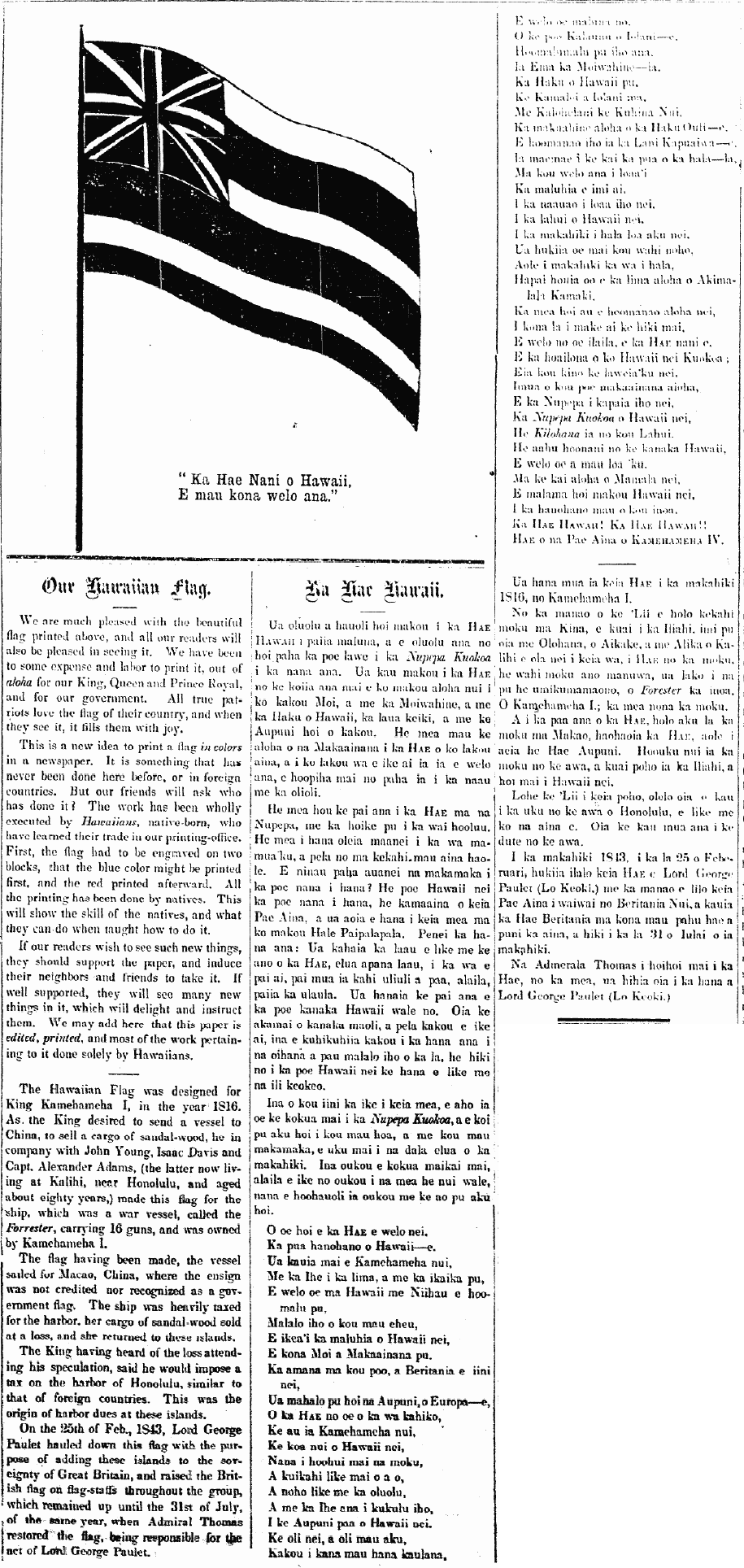
We are pleased and happy about the Hawaiian Flag printed above, and the people subscribing to Ka Nupepa Kuokoa will be delighted to see it. We display the Flag, urged to do so by our great aloha for our King, Queen, and Ka Haku o Hawaii, their son, as well as for our Nation. The love by the people for their flag of their country is customary, and when they see her fluttering, it fills their hearts with joy.

The printing of the Flag in a Newspaper is something new, along with the displaying of its colors*. This is something not done previously here, as well as in some foreign countries. Perhaps our friends will inquire as to who did this work. Some Hawaiians did the work, people from this Archipelago, and they were taught to do this in our Printing Office. Here is how it was done: Woodblocks were carved in the fashion of the flag using two blocks. When it was printed, first the blue was printed, allowed to set, then the red was printed. This printing was done solely by Hawaiians. Such is the intelligence of the kanaka maoli, and that is how we recognize it. If we are instructed to do any task under the sun, Hawaiians can do the same as the white-skinned people.

If you should want to see this, you should support Ka Nupepa Kuokoa, and urge your acquaintances and friends to pay the two dollars a year. If you would kindly help, you will see many things that will gladden and instruct you.

You, O fluttering Flag,
The proud blossom of Hawaii.
Established by Kamehameha the great,
With Spear in hand, with strength,
Flutter over Hawaii and Niihau, and give protection.
Beneath your wings,
So that the peace of Hawaii be known,
By her King and the people as well.
The cross on your crest that Britain holds dear,
The Nations of Europe also give acclaim,
You are the Flag of old,
The time of Kamehameha the great,
The bravest warrior of Hawaii,
He who joined the islands,
With unity from end to end,
Living as one in contentment,
Along with the Spear upon which he erected,
The steadfast Nation of Hawaii.
We rejoice, and rejoice for all time,
His famed accomplishments,
You wave there above,
The crown of Iolani, the king
While giving shelter,
To Emma, the Queen.
Along with Ka Haku o Hawaii.
The Royal child of Iolani and Emma,
And Kalohelani, the Regent, Victoria Kamamalu.
The loving aunt of the young lord, Prince Albert,
Do remember his His Highness, Lot Kapuaiwa,
Cleansing the fruit of the pandanus in the sea,
Your fluttering has garnered
The peace that allowed us to seek,
The knowledge that has come,
To the Hawaiian populace.
That year long ago.
You were taken from your proper place.
Not a year passed,
You were raised by the loving hands of Admiral Thomas.
The one you fondly recall,
On the day of his death when it approaches,
You will wave there, O beautiful Flag.
O symbol of Hawaii’s Independence ;
Here is your body, being brought.
Before your beloved people,
By the Newspaper called,
Ka Nupepa Kuokoa of Hawaii,
The Excellence of your Nation.
A garment that adorns the Hawaiian People,
Wave forever.
Over the beloved sea of Mamala,
We, Hawaii, will cherish always,
The eternal glory of thy name.
The Hawaiian Flag! The Hawaiian Flag!!
The Flag of the Islands of Kamehameha IV.

This Flag was first designed in the year 1816 for Kamehameha I.

The King, wanting a ship to sail to China to sell Sandalwood, searched along with John Young, Isaac Davis, and Captain Alexander Adams of Kalihi, who is still living, for a Flag for the ship. It was a man-o-war, called the Forrester, carrying sixteen guns. Kamehameha I owned the ship.

When the Flag was completed, the ship sailed to Macao. The Flag was puzzled over, and was not accepted as a National Flag. The ship was charged exorbitantly for harbor fees, the Sandalwood was sold for a loss, and the ship returned to Hawaii.

The King learned of this loss, and he said that a tax should be placed on the harbor of Honolulu like those of foreign lands. That is when duty was first charged for the harbor.

In 1843, the 25th of February, this Flag was taken down by Lord George Paulet [Lo Keoki], with the intent that this Archipelago be taken as a possession of Great Britain. The British flag was raised on flag poles all around the land, until the 31st of July of that year.

It was Admiral Thomas who restored the Flag, for he disputed the actions of Lord George Paulet.

[Notice the English column to the left, which gives a translation of the Hawaiian. It seems this issue of the Kuokoa was sent to home by many a missionary, to show the progress they were making…

*A word of clarification: This is not the first time color appears in a newspaper. For more on this topic, see Hana Hou Magazine, August/September 2011: “Read All About It!” by Ron Williams.

For more flag articles, just click here!]

(Kuokoa, 1/1/1862, p. 1)

"Ka Hae Nani o Hawaii...

Ka Nupepa Kuokoa, Buke I, Helu 6, Aoao 1. Ianuari 1, 1862.

Monument to Kamehameha III planned by Daughters of Hawaii, 1911.

Monument Planned

Daughters of Hawaii Plan to Build Monument to Kamehameha III

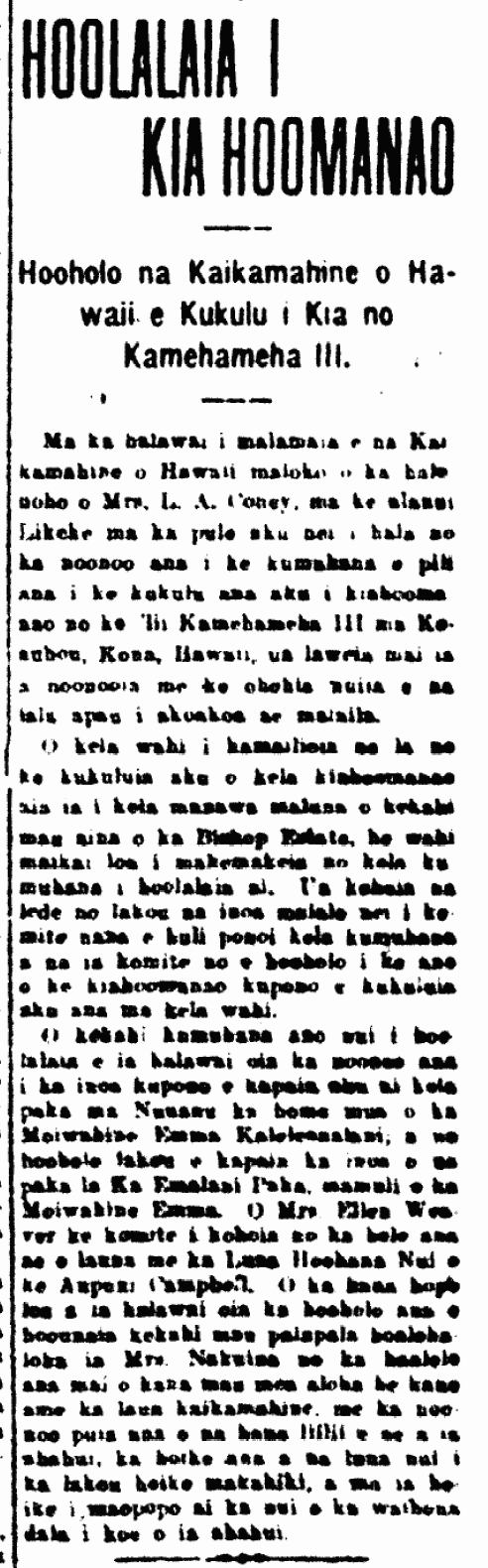
In a meeting held by the Daughters of Hawaii at the residence of Mrs. L. A. Coney, on Richards Street last week, to think over the subject of building a monument to the alii, Kamehameha III, at Keauhou, Kona, Hawaii; it was undertaken and considered with much enthusiasm by all members present.

The place mentioned above for the building of monument is currently upon lands of the Bishop Estate, and is a very good area desired for that planned project. The ladies named below were chosen as a committee to decide the kind of monument that would be appropriate to be built at that place.

Another subject on the agenda of that meeting was the considering of a proper name for the park in Nuuanu, the first home of Queen Emma Kaleleonalani, and they decided that the park would be called “Emalani Park,” after Queen Emma. Mrs. Ellen Weaver was the committee chosen to go to meet with the Chief Executive Officer of the Campbell Estate. The last subject of that meeting was the decision to send letters of sympathy to Mrs. Nakuina for the passing of her loved ones, her husband and their daughter; with consideration of other small organization business—the presentation by the regents of their annual reports, and as a result of these presentations, the remaining funds of the organization was made clear.

(Kuokoa, 10/27/1911, p. 1)

HOOLALAIA I KIA HOOMANAO

Nupepa Kuokoa, Buke XLVII, Helu 43, Aoao 1. Okatoba 27, 1911.