Hana mourns the death of the Queen, 1917.

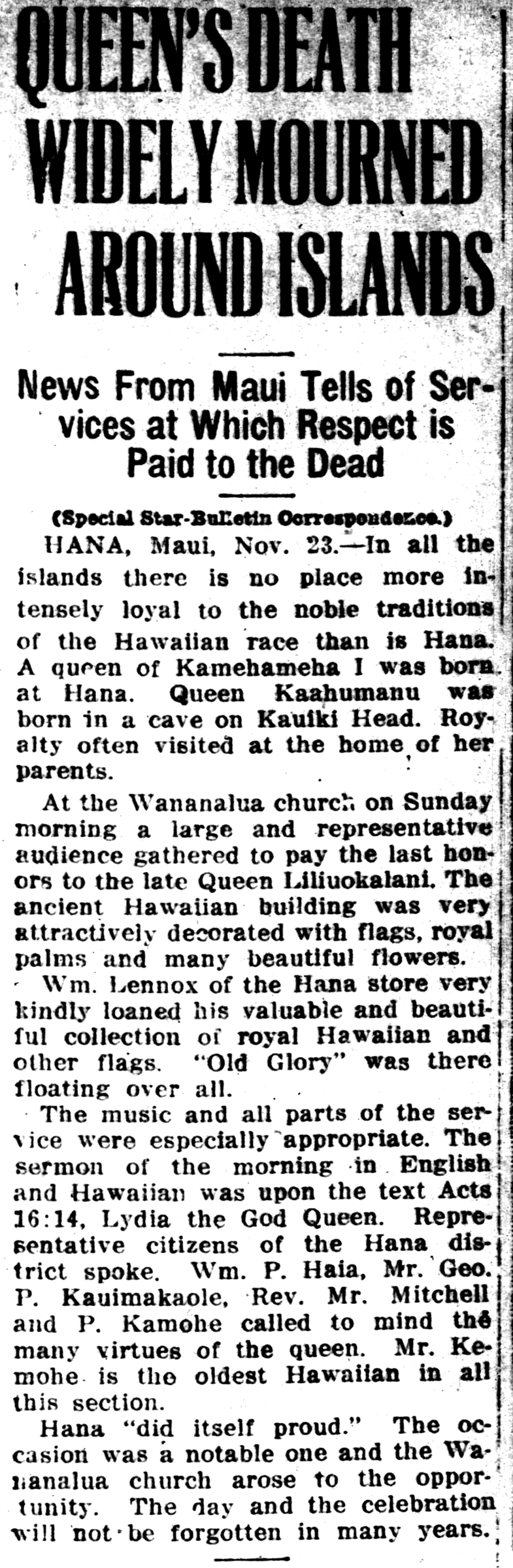
QUEEN’S DEATH WIDELY MOURNED AROUND ISLANDS

News From Maui Tells of Services at Which Respect is Paid to the Dead

(Special Star-Bulletin Correspondence.)

HANA, Maui, Nov. 23.—In all the islands there is no place more intensely loyal to the noble traditions of the Hawaiian race than in Hana. A queen of Kamehameha I was born at Hana. Queen Kaahumanu was born in a cave on Kauiki Head. Royalty often visited at the home of her parents.

At Wananalua church on Sunday morning a large and representative audience gathered to pay the last honors to the late Queen Liliuokalani. The ancient Hawaiian building was very attractively decorated with flags, royal palms and many beautiful flowers.

William Lennox of the Hana store very kindly loaned his valuable and beautiful collection of royal Hawaiian and other flags. “Old Glory” was there floating over all.

The music and all parts of the service were especially appropriate. The sermon of the morning in English and Hawaiian was upon the text Acts 16:14, Lydia the God Queen. Representative citizens of the Hana district spoke. William P. Haia, Mr. George P. Kauimakaole, Rev. Mr. Mitchell and P. Kamohe called to mind the many virtues of the queen. Mr. Kemohe is the oldest Hawaiian in all this section.

Hana “did itself proud.” The occasion was a notable one and the Wananalua church arose to the opportunity. The day and the celebration will not be forgotten in many years.

(Honolulu Star-Bulletin, 11/24/1917, p. 37)

QUEEN'S DEATH WIDELY MOURNED AROUND ISLANDS

Honolulu Star-Bulletin, Volume XXV, Number 7993, Page 37. November 24, 1917.

On Kaumualii and Kaahumanu, 1880.

[From: “Ka Moolelo o Kaahumanu”]

Kaahumanu was one of them who made a circuit of Maui, Oahu, and Kauai with Liholiho. When Kaahumanu arrived on Kauai, she took Kaumualii, the alii of Kauai, as a kane [husband] for herself. When Liholiho returned to Oahu, it was with Haakulou, the woman of Kaumualii; because Liholiho took Haakulou as a wahine [wife] for himself, along with his other wahine.

Kaahumanu lived on Kauai along with Kaumualii in the year 1822. Perhaps in the month of August.

Kaahumanu wanted to seek out Nihoa. It was the very first time that Nihoa was found, that tiny island to the North-West of Niihau. Continue reading

Z. P. K. Kawaikaumaiikamakaokaopua’s treatise on canoe building, 1922.

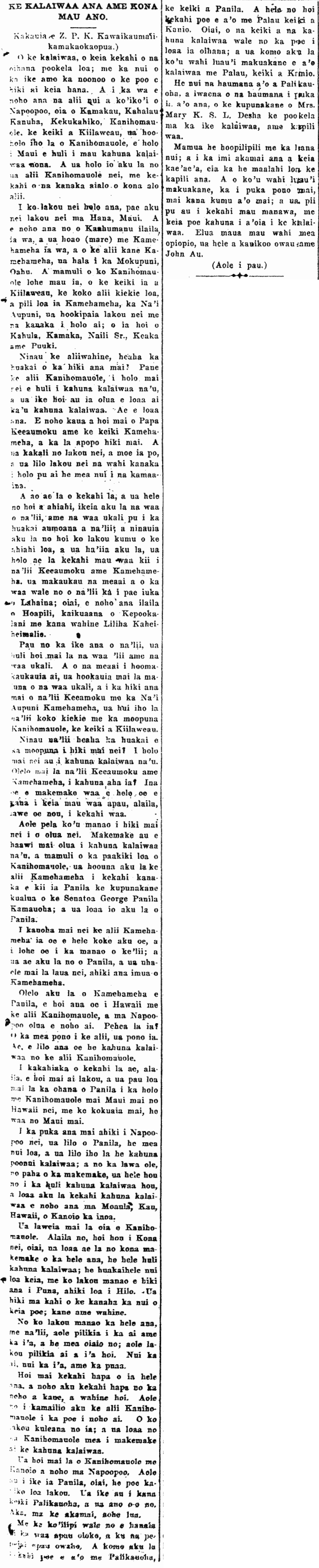
CANOE BUILDING AND ITS CHARACTERISTICS.

(Written by Z. P. K. Kawaikaumaiikamakaokaopua.)

Canoe building is one of the greatest trades; it is with great knowledge and thought that this is done. And when the important high chiefs of Napoopoo were living, they being Kamakau; Kahalau; Kanuha; Kekukahiko; and Kanihomauole, the son of Kiilaweau; Kanihomauole decided to go to Maui in search of a number of canoe building kahuna for himself. And that alii Kanihomauole did indeed go with some attendants from his royal court.

When they went, they landed at Hana, Maui. Kaahumanu was there living at the time, and was married (hoao) with Kamehameha, who was away on Oahu. And because it was heard often that Kanihomauole was the child of Kiilaweau, the alii of highest blood, and that he was kin to Kamehameha, the Conqueror of the Nation, they were welcomed along with those who came, they being Kahula, Kamaka, Naili Sr., Keaka and Puuki.

The queen asked, “why have you come?” The alii Kanihomauole replied, “I have come in search of a kahuna kalaiwaa for myself, and I have come to see the two of you to get my kahuna kalaiwaa.” “Yes, you will have one. Let us remain until Papa Keeaumoku and the boy Kamehameha returns; they will be back tomorrow.” And they waited, and spent the night, and those that came were treated well by the kamaaina of the place.

[This is how the piece on canoes by Kalokuokamaile begins on 10/26/1922, and it continues on in the Kuokoa until 2/15/1923. This is one of the many priceless translations appearing in the Bernice Pauahi Bishop Museum’s Hawaiian Ethnographic Notes (HEN) Collection.  HEN: Newspapers, October 26, 1922.

Kalokuokamaile was very prolific. This series is then followed by yet another, this time on net making!]

(Kuokoa, 10/26/1922, p. 7)

KE KALAIWAA ANA AME KONA MAU ANO.

Ka Nupepa Kuokoa, Buke LXI, Helu 43, Aoao 7. Okatoba 26, 1922.

Monument to Kauikeaouli on his 100th birthday, 1914.

UNVEILING OF THE DONATED TABLET

The Populace Gathers in Kawaiahao on the Evening of this Past Tuesday.

It was a scene from the sacred times when the Islands were ruled under monarchs, that was before a great crowd of people which arrived at Kawaiahao Church in the afternoon of this past Tuesday, when a memorial service for the hundredth birthday of King Kauikeaouli, Kamehameha III was held, and unveiled was the stone tablet dedicated to him that will be stood at the place of his birth at Keauhou, North Kona, Hawaii.

Before the hour set aside for that remembrance, at four o’clock in the afternoon, the crowd entered the church: from the members of the organizations of this town, the students of the Kamehameha Schools, the heads of the government, to the general public, filled up the church, with some people standing.

Outside of the church grounds was the Royal Hawaiian Band entertaining the people, with a majority of the people there, because they could not get a seat in the church.

Before the pulpit stood a painting of King Kauikeaouli, Kamehameha III, and right below the painting was the tablet with clear lettering that said: “Kauikeaouli, Kamehameha III, ke keiki a Kamehameha III ame Keopuolani. Hanauia i Maraki 17,1814. Ka Moi lokomaikai.”

Continue reading

More mele from Mary Jane Montano, 1927.

SOME OLD MELE OF HAWAII NEI.

Mr. Solomon Hanohano, Editor of the Kuokoa Newspaper:—Please publish the following mele from times past, when the land was filled with alii.

This is a name song [mele inoa] for the royal one Ahumanu [Kaahumanu], which was inherited by Kaumakaokane II, the mother of Kuakini (John Adams Cummins) during the youth of Kaumaka, and that royal woman [Kaahumanu] then called Kaumakaokane, by the name Papaleaiaina.

This name is the name that Kalaniahumanu [Kaahumanu] called the Royal One, Paiea Kamehameha I, and it is answered to today by the granddaughter of the Hon. J. A. Cummins, that being Matilda Papaleaiaina Walker Constable.

It would be best that these jewels of Hawaii nei be shown, for some of us will live on as teachers for the impertinent questions, as like the one who questioned in the Advertiser newspaper, about my dear brother, the Hon. J. A. Cummins, the “backbone” [iwikuamoo] of the chiefly ones who have passed into the next realm.

Kaumakaokane he inoa,
Hanau a koa he kupuna,
Eia ua aliiwahine nei,
Ke holo mai nei o ka moku,
Me ka hae o kau weloweloula,
Ku’ilua ka pu,
He aloha ia,
Aole i ike ka haole,
Wahi a Kalanikauleleiaiwi,
Iwi ka maka,
Holoholo ka onohi,
Lele ka puuwai i ka makemake,
I ka wai olu o Lanipo-e,
Nau ke ku’i haukeke ka auwae,
I hemahema i ka wa kamalii,
O ko’u wa naaupo no ia,
E laua la e,
Papaleaiaina kuu aloha e—
O kau ka haili aloha i o’u nei,
O ka welelau o kuu lima ka i pa aku,
Pa i ka lihi o Kilauea.

And here is the genealogy of the lei to adorn the neck of Ahia (Mrs. Capt. George Beckley), that being John Adams Cummins.

Liloa is the father who dwelt with Akahiakuleana, born was Umi. Umi, dwelt with Piikea, born was Aihakoko, Kumulaenuiaumi. Kumulaenui, dwelt with Kumunuipawalau, born was Kekapuhelemai; Kekapuhelemai dwelt with Piilani, born was Lonoikauakini.

Lonokauakini, dwelt with Kapukaheiau, born was Lonoikahaupo; Lonoikahaupo, dwelt with Ninauaiwi, born was Kekapalakea. Kekapalakea dwelt with Kelahuna, born was Kowali; Kolwali dwelt with Kaumaokaokane, born was Keaweaua. Keaweaua dwelt with Kaahaiku, born was Keauiaole; Keauiaole dwelt with Liloa, born was Kaumakaokane, Kameeiamoku.

Kaumakaokane (f) dwelt with Thomas Cummins, born was John Adams Cummins.

Kelahuna (f) is a descendant of Kelahunapaikua (m) and Ahia (f) and Kelahunapaikua (m) is a child of Kakuhihewa and Kolimoalani, that being Koaekea (f), the grandchild of Akahinuikameenoa (f), the woman that I placed a kapu upon.

Kelahuna (f) is the younger sister of Kamehaiku, these being female alii of Kau, Hawaii, and Kamehaiku is the woman of Keeaumoku, the father of Kaahumanu who slept with Kalanianoano and begot Kanehoa, the grandfather of Kaleianoano, Hoapili, and so forth, as well as Jesse Hakainai [Makainai ?], and so forth.

Sincerely, this is I

Ako-kuia ka hale lehua o ka manu,
Kauwewe i ka liko o ka ohia,
He uanoe he uaawa no ka mauna,
Uli ka nahele o Ookuauli,
Uli ka nahu hoomau a ka makani,
A makani a lei a lea,
Lea i na kauna ami a ka ua,
Alohi Maukele anapa i ka la e,
Okioki a hoe,
O ke aho no ia a ka ua Polohinalo,
A pikipiki ka lei,
Me he nu’a kapa la,
Popo ka lei a waiho malie,
Nana aku o kuu apana hala iuka o Panaewa,
Mamina ino no kuu kula lehua,
A’u i kawili mua ai,
Ua maka-pa ua eena ka manu,
He ena kai olohia ia no ke kanaka e—

The is the origin of my name from the heavenly one, Kauikeaouli; Kekulani is the name appended to Keoni Ana Opio [John Young, Jr.] when Kauikeaouli died and returned.

E o mai oe i kou inoa e Kekulani,
O ka lani no ka i ku,
I ka papa holu i ka makani,
A o oe no ke o mai e,

MARYJANE AHIA AHUENA KEKULANI MONTANO.

(Kuokoa, 3/31/1927, p. 1)

KEKAHI MELE KAHIKO O HAWAII NEI.

Ka Nupepa Kuokoa, Buke LXVI, Helu 13, Aoao 1. Maraki 31, 1927.

Here is Davida Malo’s kanikau for Kaahumanu as it was first published, 1834/1835.

HE KANIKAU NO KAAHUMANU.

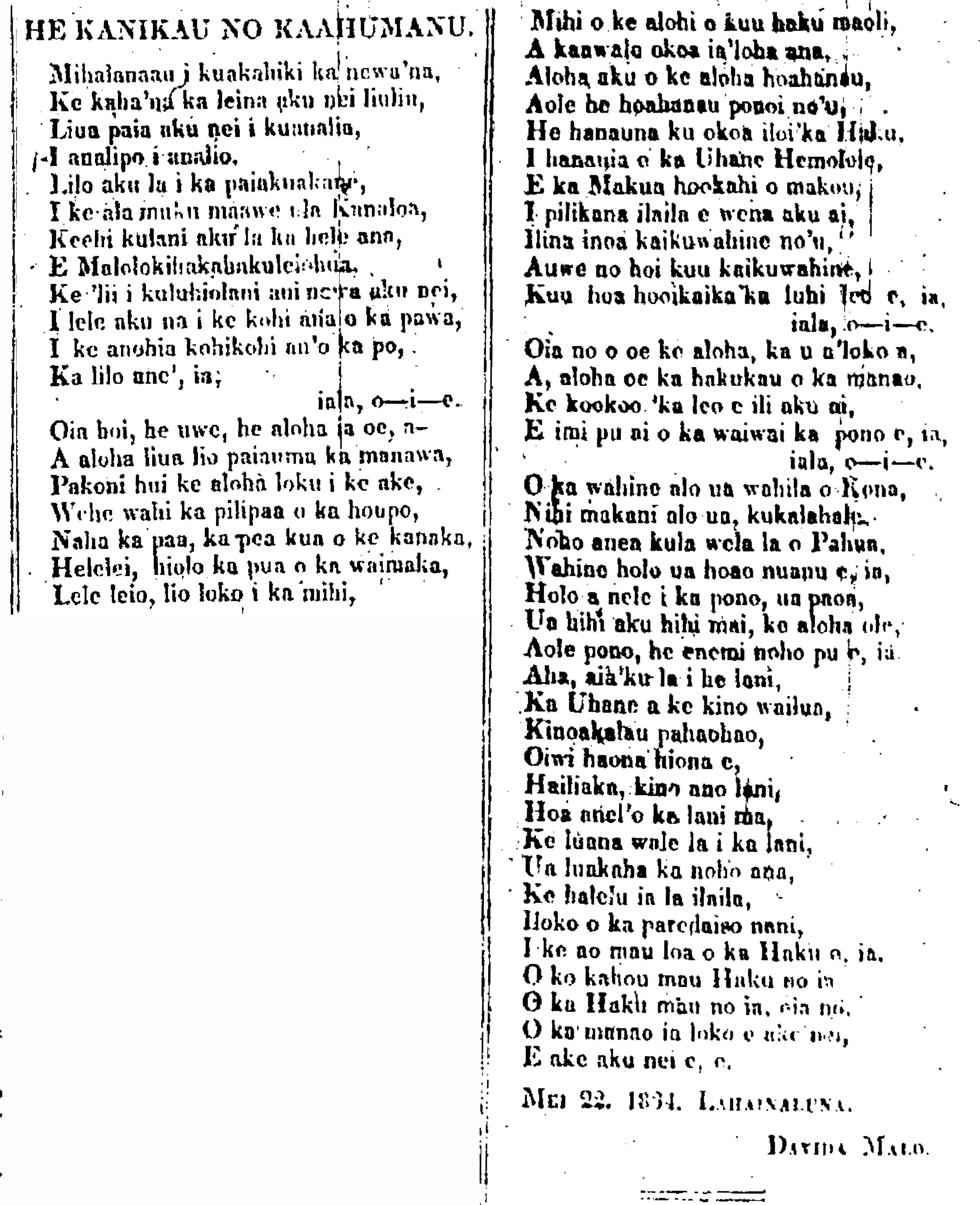
Mihalanaau i kuakahiki ka newa’na,
Ke kaha’na ka leina aku nei liuliu,
Liua paia aku nei i kuanalia,
I analipo i analio.
Lilo aku la i ka paiakuakane,
I ke ala muku maawe ula Kanaloa,
Keehi kulani aku la ka hele ana,
E Malolokihakahakuleiohua.
Ke ‘lii i kuluhiolani aui newa aku nei,
I lele aku na i ke kohi ana o ka pawa,
I ke anohia kohikohi an’o ka po,
Ka lilo ane’, ia,
Oia hoi, he uwe, he aloha ia oe, aiala, o—i—e.
A aloha liua lio paiauma ka manawa,
Pakoni hui ke aloha loku i ke ake,
Wehe wahi ka pilipaa o ka houpo,
Naha ka paa, ka pea kua o ke kanaka,
Helelei, hiolo ka pua o ka waimaka,
Lele leio, lio loko i ka mihi,
Mihi o ke alohi o kuu haku maoli,
A kaawale okoa ia’loha ana,
Aloha aku o ke aloha hoahanau,
Aole he hoahanau ponoi no’u,
He hanauna ku okoa iloi ka Haku,
I hanauia o ka Uhane Hemolele,
E ka Makua hookahi o makou,
I pilikana ilaila e wena aku ai,
Ilina inoa kaikuwahine no’u,
Auwe no hoi kuu kaikuwahine,
Kuu hoa hooikaika ka luhi leo e, ia, iala, o—i—e.
Oia no o oe ke aloha, ka u a’loko a,
A, aloha oe ka hakukau o ka manao,
Ke kookoo ‘ka leo e ili aku ai,
E imi pu ai o ka waiwai ka pono e, ia, iala, o—i—e.
O ka wahine alo ua wahila o Kona,
Nihi makani alo ua, kukalahale.
Noho anea kula wela la o Pahua,
Wahine holo ua hoao nuanu e, ia,
Holo a nele i ka pono, ua paoa,
Ua hihi aku hihi mai, ke aloha ole,
Aole pono, he enemi noho pu e, ia.
Aha, aia’ku la i he lani,
Ka Uhane a ke kino wailua,
Kinoakalau pahaohao,
Oiwi haona hiona e,
Hailiaka, kino ano lani,
Hoa anel’o ka lani ma,
Ke luana wale la i ka lani,
Ua luakaha ka noho ana,
Ke halelu ia la ilaila,
Iloko o ka paredaiso nani,
I ke ao mau loa o ka Haku e, ia.
O ko kahou mau Haku no ia
O ka Haku mau no ia, oia no.
O ka manao ia loko e ake nei,
E ake aku nei e, e.
MEI 22, 1834. LAHAINALUNA.
DAVIDA MALO.

[As mentioned by Kuamoolelo, here is the earliest published appearance of Malo’s famous kanikau for Kaahumanu. Unfortunately the image is not so legible, i had to go back to the original to check it. Hopefully one day soon, some entity will understand how important clear images of the newspapers are, and they will fund this priceless undertaking!!]

(Lama Hawaii, 8/8/1834, p. 3)
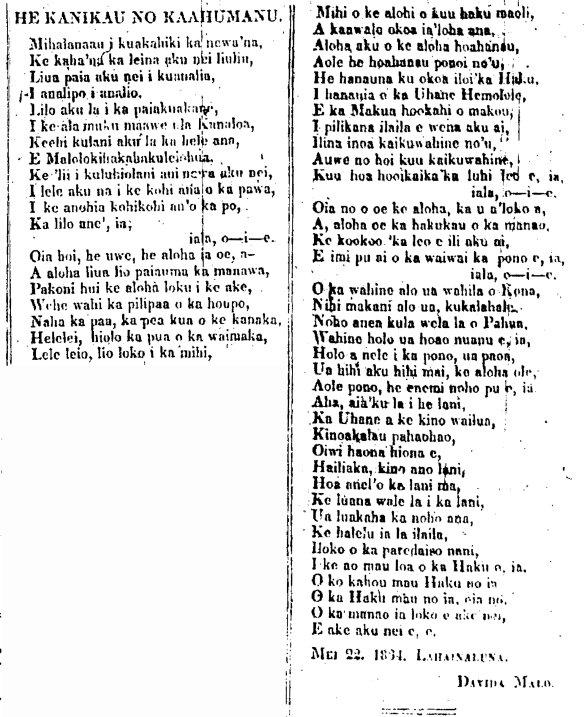
HE KANIKAU NO KAAHUMANU

Ka Lama Hawaii, Makahiki 1, Helu 17, Aoao 3. Augate 8, 1834.


HE KANIKAU NO KAAHUMANU.

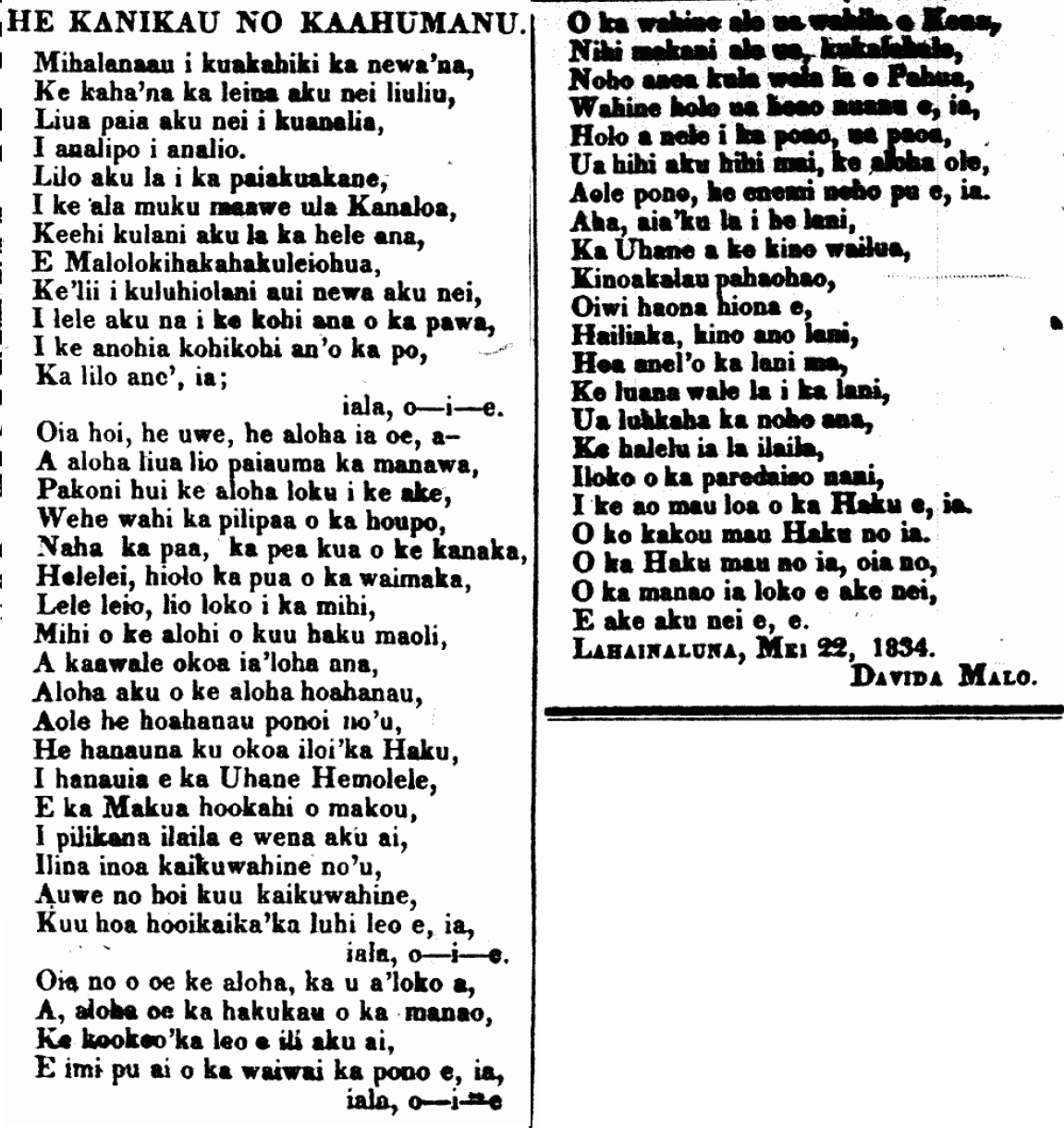
Mihalanaau i kuakahiki ka newa’na,
Ke kaha’na ka leina aku nei liuliu,
Liua paia aku nei i kunolia,
I analipo i analio.
Lilo aku la i ka paiakuakane,
I ke ala muku maawe ula Kanaloa,
Keehi kulani aku la ka hele ana,
Ke’lii i kuluhiolani aui newa aku nei,
I lele aku na i ko kohi ana o ka pawa,
I ke anohia kohikohi an’o ka po,
Ka lilo ane’, ia;
iala, o—i—e.
Oia hoi, he uwe, he aloha ia oe, a—
A aloha liua lio paiauma ka manawa,
Pakoni hui ke aloha loku i ke ake,
Wehe wahi ka pilipaa o ka houpo,
Naha ka paa, ka pea kua o ke kanaka,
Helelei, hiolo ka pua o ka waimaka,
Lele leio, he loko i ka mihi,
Mihi a ke alohi o kuu haku maoli,
A kaawale okoa ia’loha ana,
Aloha aku o ke aloha hoahanau,
Aole he hoahanau ponoi no’u,
He hanauna ku okoa ilo’ika Haku,
I haupuia e ka Uhane Hemolele,
E ka Makua hookahi o makou,
I pilikana ilaila e wena aku ai,
Ilina inoa kaiakwahine no’u,
Auwe no hoi kuu kaikuwahine,
Kuu hoa hooikaika’ka luhi leo e, ia,
iala, o—i—e.
Oia no o oe ke aloha, ka u’aloko a,
A, aloha oe ka hakukau o ka manao,
Ke kookoo’ka leo e ili aku ai,
E imi pu ai o ka waiwai ka pono, e ia,
iala, o—i—e.
O ka wahine alo ua wahila o Kona,
Nihi makani alo ua, kukalahale,
Noho anea kula wela la o Pahua,
Wahine holo ua hoao auanu e, ia,
Holo a nele i ka pono, ua paoa,
Ua hihi aku hihi mai, ke aloha ole,
Aole pono, he enemi noho pu e, ia.
Aha, aia’ku la i he lani,
Ka Uhane a ke kino wailua,
Oiwi haona hiona e,
Hailiaka, kino ano lani,
Hea anei’o ka lani ma,
Ke luana wale la i ka lani,
Ua luakaha ka noho ana,
Ke halelu ia la ilaila,
Iloko o ka paredaiso nani,
I ke ao mau loa o ka Haku e, ia.
O ko lakou mau Haku no ia.
O ka Haku mau no ia, oia no,
O ka manao ia loko e ake nei,
E ake aku nei e, e.
LAHAINALUNA, MEI 22, 1834.

DAVIDA MALO.

[This is the second known publication of the kanikau. The image is a clearer, but not totally clear.]

(Kumu Hawaii, 10/28/1835, p. 176)
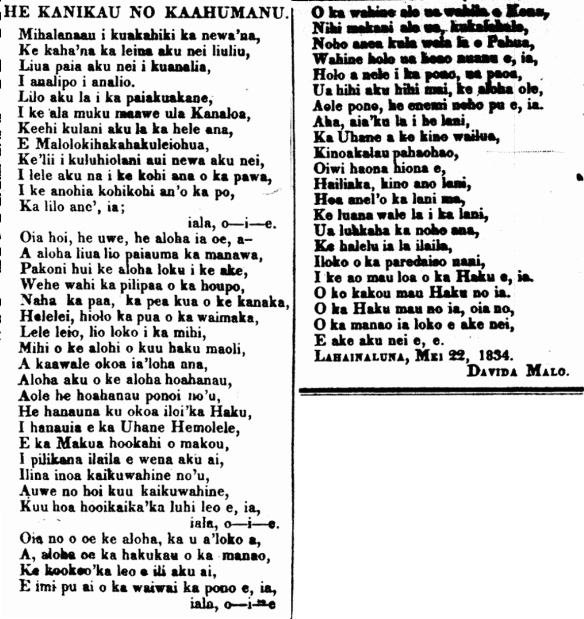
HE KANIKAU NO KAAHUMANU.

Ke Kumu Hawaii, Buke 1, Pepa 22, Aoao 176, Okatoba 28, 1835.

Davida Malo remembered, 1907.

A DIRGE FOR KAAHUMANU.

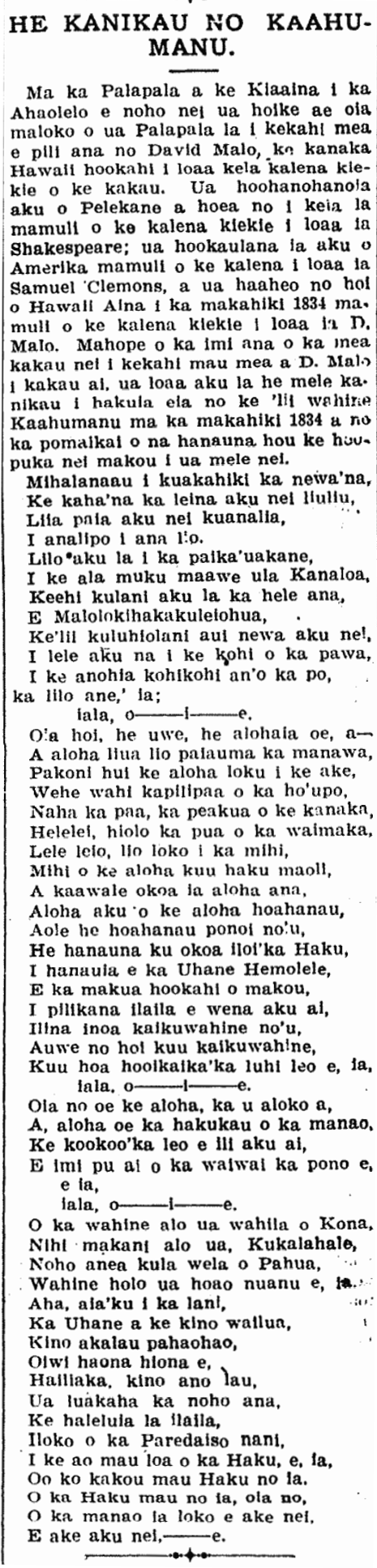
In the Document by the Governor [George Robert Carter] to the current Legislature, he spoke of in the Document about David Malo, the single Hawaiian who had a excellent talent for writing. Britain is famed to this day for the high talent of Shakespeare; America is made famous because of the talent of Samuel Clemens [Mark Twain], and Hawaii was proud indeed in the year 1834, because of the great talent of D. Malo. After your writer searched for things written by D. Malo, this kanikau was found, composed by him for the queen, Kaahumanu, in 1834; and for the benefit of the new generations, we are reprinting that mele.

Mihalanaau i kuakahiki ka newa’na,
Ke kaha’na ka leina aku nei liuliu,
Liia paia aku nei kuanalia,
I analipo i ana lio,
Lilo aku la i ka paika’uakane,
I ke ala muku maawe ula Kanaloa,
Keehi kulani aku la ka hele ana,
E Malolokihakakuleiohua,
Ke’lii kuluhiolani aui newa aku nei,
I lele aku na i ke kohi o ka pawa,
I ke anohia kohikohi an’o ka po, ka lilo ane,’ ia;
iala, o———i———e,
Oia hoi, he uwe, he alohaia oe, a—
A aloha liua lio paiauma ka manawa,
Pakoni hui ke aloha loku i ke ake,
Wehe wahi kapilipaa o ka ho’upo,
Naha ka paa, ka peakua o ke kanaka,
Helelei, hiolo ka pua o ka waimaka,
Lele leio, lio loko i ka mihi,
Mihi o ke aloha kuu haku maoli,
A kaawale okoa ia aloha ana,
Aloha aku o ke aloha hoahanau,
Aole he hoahanau ponoi no’u,
He hanauna ku okoa iloi’ka Haku,
I hanauia e ka Uhane Hemolele,
E ka makua hookahi o makou,
I pilikana ilaila e wena aku ai,
Ilina inoa kaikuwahine no’u,
Auwe no hoi kuu kaikuwahine,
Kuu hoa hooikaika’ka luhi leo e, ia,
iala, o———i———e.
Oia no oe ke aloha, ka u aloko a,
A, aloha oe ka hakukau o ka manao,
Ke kookoo’ka leo e ili aku ai,
E imi pu ai o ka waiwai ka pono e,
e ia,
iala, o———i———e.
O ka wahine alo ua wahila o Kona,
Nihi makani alo ua, Kukalahale,
Noho anea kula wela o Pahua,
Wahine holo ua hoao nuanu e, ia.
Aha, aia’ku i ka lani,
Ka Uhane a ke kino wailua,
Kina akalau pahaohao,
Oiwi haona hiona e,
Hailiaka, kino ano lau,
Ua luakaha ka noho ana,
Ke haleluia la ilaila,
Iloko o ka Paredaiso nani,
I ke ao mau loa o ka Haku, e, ia,
Oo ko kakou mau Haku no ia,
O ka Haku mau no ia, oia no,
O ka manao ia loko e ake nei,
E ake aku nei,———e.

(Kuokoa, 4/26/1907, p. 5)

HE KANIKAU NO KAAHUMANU.

Ka Nupepa Kuokoa, Buke XLII, Helu 17, Aoao 5. Aperila 26, 1907.