150 years ago—The beginnings of the Kaahumanu Society, 1864.

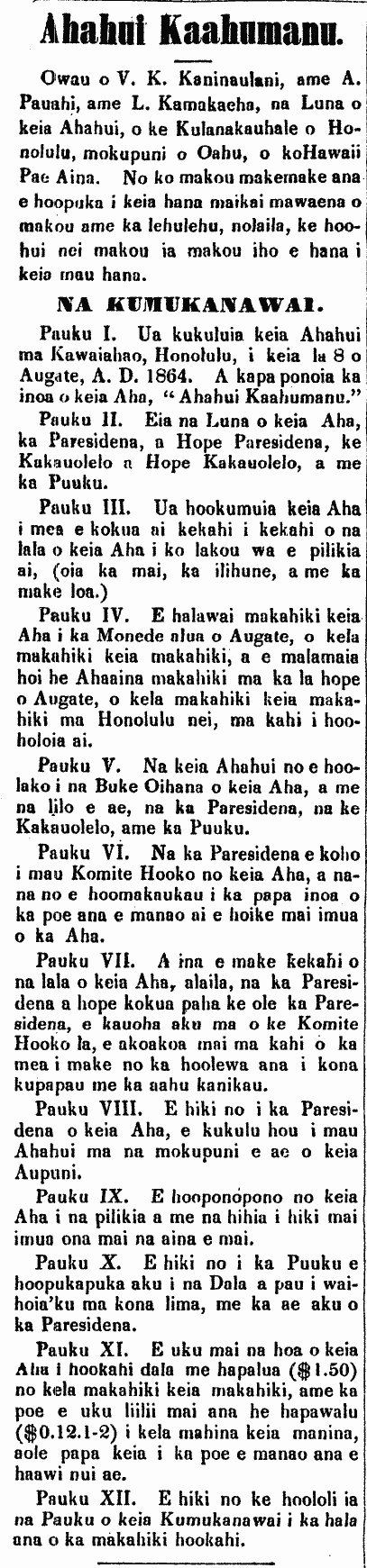
Ahahui Kaahumanu.

I am V. K. Kaninaulani, along with A. Pauahi,¹ and L. Kamakaeha, are the Officers of this Association, of the Town of Honolulu, Island of Oahu, of the Hawaiian Archipelago. Because of our desire to announce this fine endeavor amongst ourselves and the people, we come together to undertake these tasks.

CONSTITUTION.

Clause I. This Association was established at Kawaiahao, Honolulu, on this day the 8th of August, 1864. This Association is officially called, “Ahahui Kaahumanu.”

Clause II. The Officers of this Association are the President, the Vice President, the Secretary, the Vice Secretary, and the Treasurer.

Clause III. This Association was established to assist each other member of this Association when they are in need (in sickness, poverty, and death)

Clause IV. The yearly meeting of this Association will be on the second Monday of August of each year, and a yearly Banquet will be held on the last day of August every year in Honolulu nei, at the location designated.

Clause V. The Association will supply Record Books [Buke Oihana] of the Association, as well as any other expenses for the President, Secretary, and the Treasurer.

Clause VI. The President will select Executive Committees for this Association, and they will prepare lists of names of those who want to present themselves before the Association.

Clause VII. Should a member of this Association die, then the President or if not the President, then a representative will order by Executive Committee to gather in mourning attire at the place of the deceased for the funeral over her body.

Clause VIII. The President of this Association is empowered to establish other Associations on the other islands of this Nation.

Clause IX. The Association shall resolve all problems and difficulties brought before it from other lands.

Clause X. The Treasurer may expend all funds at her disposal with the approval of the President.

Clause XI. Members of this Association shall pay a dollar and a half ($1.50) yearly, or installments of an eighth ($0.12.1-2) every month; it is not prohibited to give more.

Clause XII. Clauses of this Constitution may be changed after one year.

¹Pauahi is often referred to as A. Pauahi. [Would there be anyone who knows what that initial stands for?]

(Kuokoa, 8/20/1864, p. 4)
Ahahui Kaahumanu.

Ka Nupepa Kuokoa, Buke III, Helu 34, Aoao 4. Augate 20, 1864.

Consul General from Japan, S. Shimizu, found, 1895 / 2014.

With the kind help of Bishop Museum volunteer Mr. K. Suzuki, the mystery is solved. The Consul General Representative for 1895 from Japan here in Hawaii nei who appears in “Hawaii’s Story by Hawaii’s Queen” was Seizaburō Shimizu.

[As per a listing of the Japanese consul generals stationed in Honolulu, which is printed in Sōga, Yasutarō. 1953. Gojūnenkan no Hawai Kaiko. Tokyo: Kankōkai.]

On the search for the Japanese consul, F. Schmibu, 1895 / 2014.

We see in “Hawaii’s Story,” some of those present at the Queen’s trial were:

“The diplomatic corps, Mr. Albert F. Willis, minister of the United States, A. G. S. Hawes, British commissioner, Monsieur De Verlet, French commissioner, Senior Canavarro, Portuguese commissioner, and Mr. F. Schmibu, the Japanese consul…”

[According to Thrum’s Hawaiian Annual of 1895, Japan’s diplomatic representative was “F. Schimiczu, Eleve-Consul.”

In the Hawaii newspapers of the day, both English and Hawaiian-Language, there are also references to Consul-General Shimizu (Kanikela Kenerala Shimizu). But i still have yet to find any specific information on this man.

The four others are: Albert S. Willis, Albert G. S. Hawes, Henri L. Verleye, and Antonio de Souza Canavarro.]

Thrum

Thrum’s Hawaiian Annual for 1895, p. 156.

On this day, perhaps it is appropriate to remember further indignity faced by the Queen, 1901.

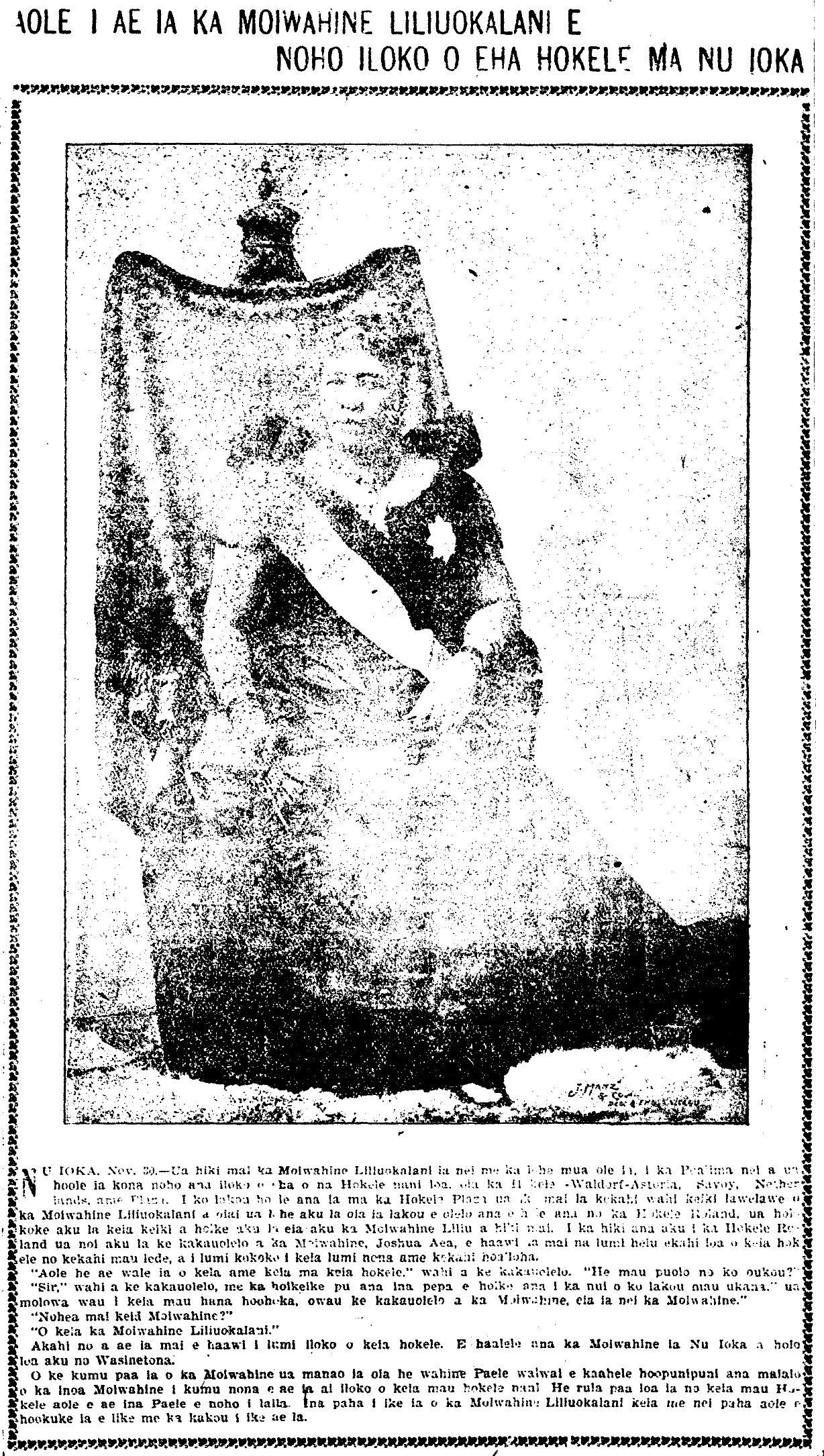
Queen Liliuokalani was Refused Stay at Four Hotels in New York.

New York. Nov. 30.—Queen Liliuokalani arrived here last Friday unannounced, and she was refused stay at four posh hotels: The Waldorf-Astoria, Savoy, Netherlands, and Plaza. After being refused by the Plaza, one of the Queen’s servants saw this and and being that he heard them saying they were headed to the Hotel Roland, he went at once and announced that the Queen would be arriving. When Joshua Aea, her secretary, asked for their best room for some ladies, and for a room nearby for him and his friends.

“Not just anyone is allowed admittance here to this hotel,” said the hotel staff [“kakauolelo” seems to be a misprint]. “Do you have baggage?”

“Sir,” the secretary said while showing a list of their baggage, “I have had enough of all of these frustrations; I am the secretary of the Queen; the Queen is here.”

“Where is this Queen from?”

“This is the Queen Liliuokalani.

Only then was a room in the hotel given. The Queen will be leaving New York for Washington.

The reason  the Queen was barred was that she was thought to be a rich Black [Paele] woman going around trying to pass as a Queen, so that she would be allowed to stay at these beautiful hotels. All of those hotels have a policy not to allow Blacks to stay there. Perhaps if they knew she was the Queen, perhaps she would not have been driven off as we have seen above.

(Kuokoa, 12/13/1901, p. 1)

AOLE I AE IA KA MOIWAHNE LILIUOKALANI E NOHO ILOKO O EHA HOKELE MA NU IOKA

Ka Nupepa Kuokoa, Buke XXXIX, Helu 24, Aoao 1. Dekemaba 13, 1901.

The Queen’s Protest, 1893.

KUKALA KUE A KE ALIIAIMOKU.

“O wau, Liliuokalani, ma ka lokomaikai o ke Akua, malalo o ke Kumukanawai o ke Aupuni Hawaii, Moiwahine, ma keia ke hoike paa nei i Ko’u kue i kekahi hana a mau hana paha a pau i lawelawe ia e kue ana Ia’u iho a me ke Aupuni Kumukanawai o ke Aupuni Hawaii e kekahi poe e koi ana ua kukulu lakou he Aupuni Kuikawa no ka manawa no keia Aupuni.

“Ke ae wale nei no Au mamuli o ka mana oi ikaika o Amerika Huipuia nona hoi ke Kuhina Elele Nui, ka Meamahaloia John L. Stevens, ua kauoha aku i na koa o Amerika Huipuia e hoopae ia mai ma Honolulu, a ua kukala ae e kokua no oia i ua Aupuni Kuikawa ʼla no ka Manawa i oleloia.

“Nolaila, i mea e kaupale aku ai i na hookuia ana o na puali i hoolawa ia me na lako kaua, a malia paha o hoopoino ia ke ola; nolaila, malalo o keia Kuahaua Kue a i kauhola ia hoi e ua mana ikaika ʼla, ke ae wale nei no Au e panee aku i Ko’u Mana a hiki i ka manawa a ke Aupuni o Amerika Huipuia, mamuli o na mea oiaio e waiho ia aku ai imua ona, e hoololi ai i na hana a kona Luna Aupuni a e hoonoho hou Ia’u maluna o ka mana A’u e koi nei ma ke ano Aliiaimoku o ka Paeaina Hawaii.”

“Hanaia ma Honolulu, i keia la 17 o Ianuari, M. H. 1893.”

“[Kakauinoaia:]

LILIUOKALANI, R.

Samuel Parker,
Kuhina o ko na Aina E.

Wm. H. Cornwell,
Kuhina Waiwai.

Jno. F. Colburn,
Kuhina Kalaiaina.

A. P. Peterson,
Loio Kuhina.

“Ia S. B. Dole a me kekahi poe e ae o ke Aupuni Kuikawa no ka Manawa o ka Paeaina Hawaii.”

[The Queen’s protest was printed in entirety the very next day in the Hawaiian-Language Newspaper, Hawaii Holomua. Images of this paper are unfortunately not available online, and it is only word searchable at nupepa.org, and not at papakilodatabase.com, but click the link below for an image of the page in which the protest was printed.

For English, see for instance: p. 120 of Report of Commissioner to the Hawaiian Islands, 1893.]

(Hawaii Holomua, 1/18/1893, p. 2)

HawaiiHolomua_1_18_1893_2

The Queen leaves Washington, D. C., 1900.

LILIU ARRIVES IN SAN FRANCISCO

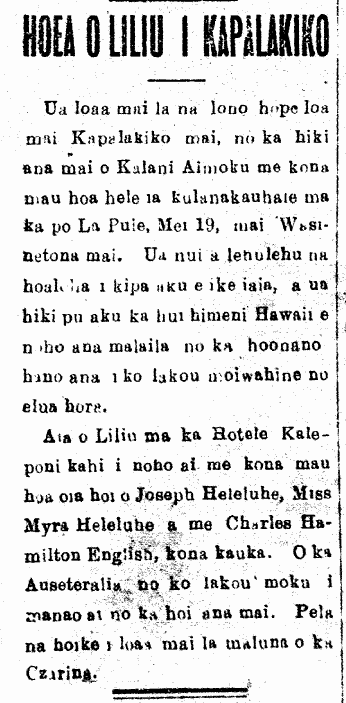
We have received the latest news from San Francisco [Kapalakiko], about the arrival of the Queen and her travelling companions in that city on Sunday, May 19th from Washington. There are many friends who visit to see her, and the Hawaiian singing group living there came to honor their queen for two hours.

Liliu is at the California Hotel with her companions, Joseph Heleluhe; Miss Myra Heleluhe; and Charles Hamilton English, her doctor. They are planning to return home on the Australia. That is what we hear from the Czarina.

(Aloha Aina, 6/2/1900, p. 4)

HOEA O LILIU I KAPALAKIKO

Ke Aloha Aina, Buke VI, Helu 22, Aoao 4. Iune 2, 1900.

Joseph Heleluhe, 1900.

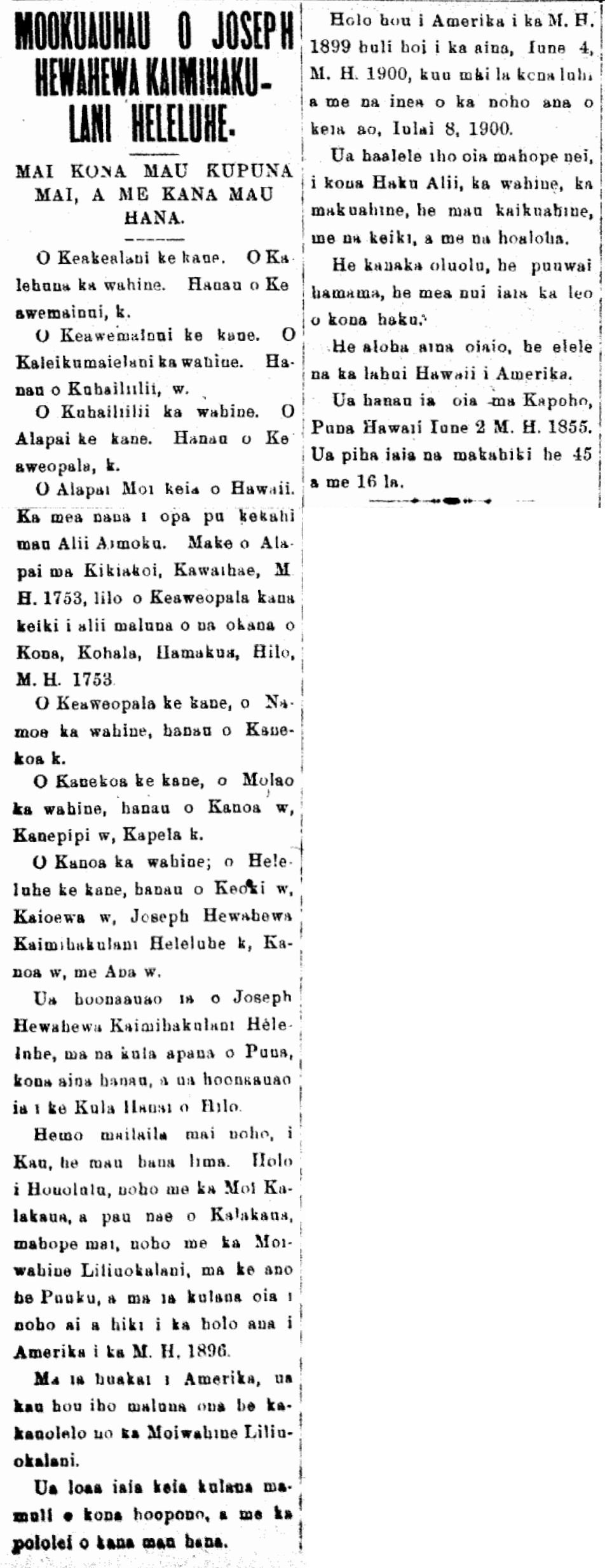
THE GENEALOGY OF JOSEPH HEWAHEWA KAIMIHAKULANI HELELUHE.

FROM HIS KUPUNA, ALONG WITH HIS ACCOMPLISHMENTS.

Keakealani was the man. Kalehuna was the woman. Born was Keawemainui (m).

Keawemainui was the man. Kaleikumaielani was the woman. Born was Kuhailiilii (f).

Kuhailiilii was the woman. Alapai was the man. Born was Keaweopala (m).

This was Alapai, the King of Hawaii. The one who crushed a number of Rulers [Alii Aimoku]. Alapai died at Kikiakoi, Kawaihae, in the year 1753, and Keaweopala his child became the ruler of the districts [okana] of Kona, Kohala, Hamakua, and Hilo, in 1753.

Keaweopala was the man. Namoe was the woman. Born was Kanekoa (m).

Kanekoa was the man. Molao was the woman. Born was Kanoa (f), Kanepipi (f), and Kapela (m).

Kanoa was the woman. Heleluhe was the man. Born was Keoki (f), Kaioewa (f), Joseph Hewahewa Kaimihakulani Heleluhe (m), Kanoa (f), and Ana (f).

Joseph Hewahewa Kaimihakulani Heleluhe was educated in the district schools of Puna, his land of birth, and educated at Hilo Boarding School [Kula Hanai o Hilo].

He graduated, and then lived in Kau, and did physical labor. He moved to Honolulu and lived with King Kalakaua, and after Kalakaua was done, he then lived with Queen Liliuokalani as her Steward [Puuku], and remained in that capacity until they went to America in 1896.

On that journey to America, upon him was also placed the duty of secretary to Queen Liliuokalani.

He received that position because of his propriety, and his meticulousness.

They went once again to America in 1899 and returned home to the aina on June 4, 1900; he left behind his labors and hardships of life in this world on July 8, 1900.

He left behind him, his Royal Mistress [Haku Alii], his wife, his mother, a number of sisters, his children, and his friends.

He was an amicable man with an open heart, and the voice of his Queen was important to him.

He was a true patriot, and he was an envoy from the Hawaiian nation to America.

He was born in Kapoho, Puna, Hawaii, on June 2, 1855. He made 45 years old and 16 days.

(Aloha Aina, 7/28/1900, p. 1)

MOOKUAUHAU O JOSEPH HEWAHEWA KAIMIHAKULANI HELELUHE.

Ke Aloha Aina, Buke VI, Helu 30, Aoao 1. Iulai 28, 1900.

Contemporary reactions to “Hawaii’s Story by Hawaii’s Queen”? 1898.

There was a question posed as to what sort of reaction the Hawaiian-language translation of “Hawaii’s Story by Hawaii’s Queen” was getting. What indeed were the people saying about it and the book in general in the “Aloha Aina” and the other papers, both Hawaiian and English (as well as in the papers outside of Hawaii)?

Now that might be a nice Master’s thesis, or perhaps someone receiving funding might consider this as a project for which to do in-depth research! Any takers?

[In the new edition of “Hawaii’s Story,” see also David Forbes’ introduction for coverage on this topic.]

Wakeke Heleluhe to take the place of Kia Kahele Nahaolelua, 1897.

Returning Home.

It is heard that Mrs. Kahele Nahaolelua is returning on the steamer Monowai this coming Thursday and left behind the Queen [Aliiaimoku]. The reason for this return is unclear to us, however, there are all sorts of rumors; some say she is sick, some say that she misses her family, some say that she has urgent business, and so forth; the truth will be known only when she returns. And because she is coming home, in her stead will be Mrs. Wakeke Heleluhe, who will leave on the steamship Australia of this coming Wednesday. Her departure is certain, for her wardrobe is being made for her trip to foreign lands. So this is a confirmation of the truth of Captain Palmer’s words that it is unclear when the Queen will return and her stay there is not limited.

[The Queen states:

In the early part of May it became necessary for my companion, Mrs. Kia Nahaolelua, to return to Honolulu. Three months was the length of time I had expected to be absent when I asked her to accompany me; but five months had passed away, and her husband and large family of children needed her. So I sent her to San Francisco under the charge of Captain Palmer, where he was to meet Mrs. Joseph Heleluhe, and conduct her to Washington.

See another article on Mrs. Heleluhe’s departure.]

(Makaainana, 5/3/1897, p. 8)

E Huli Hoi Mai Ana.

Ka Makaainana, Buke VII—-Ano Hou, Helu 18, Aoao 8. Mei 3, 1897.