Changing Hawaiian Language, 1844.

February 20, 1844.

Aloha to you, O Nonanona.

This is my gift to you, some unclear words; and it is for you to asks the skilled, the wise, the seekers of knowledge to clarify their nature, so that it is understood by us. And here are those unclear words.

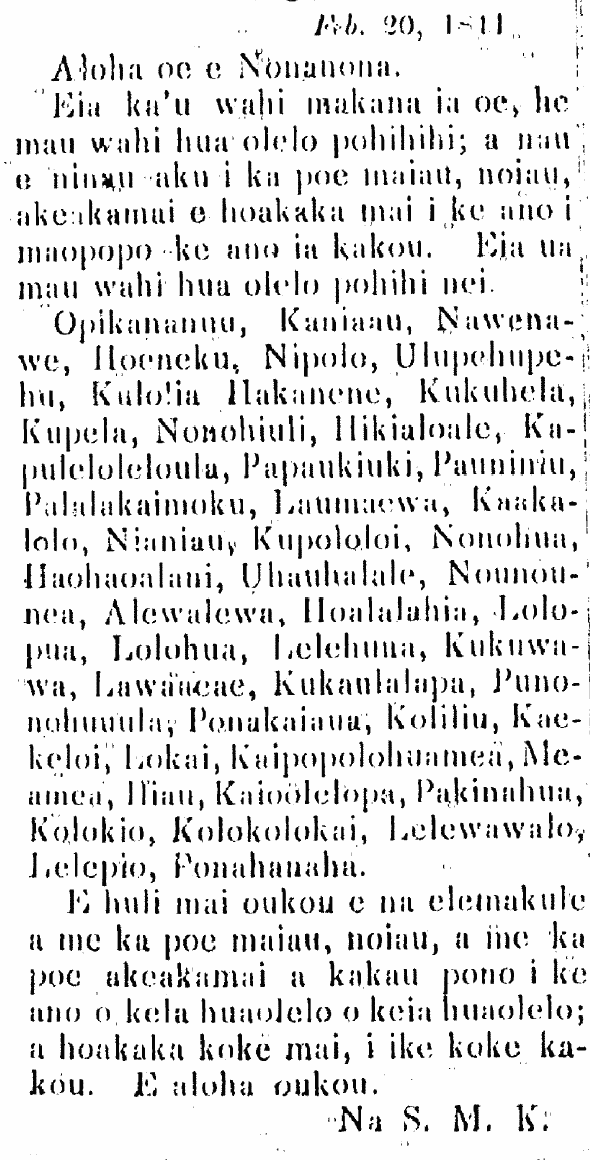
Opikananuu, Kaniaau, Nawenawe, Hoeneku, Nipolo, Ulupehupehu, Kulolia, Hakanene, Kukuhela, Kupela, Nonohiuli, Hikialoale, Kapuleloleloula, Papaukiuki, Pauniniu, Palalakaimoku, Laumaewa, Kaakalolo, Nianiau, Kupololoi, Nonohua, Haohaoalani, Uhauhalale, Nounounea, Alewalewa, Hoalalahia, Lolopua, Lolohua, Lelehuna, Kukuwawa, Lawaaeae, Kukaulalapa, Punonohuuula, Ponakaiaua, Koliliu, Kaekeloi, Lokai, Kaipopolohuamea, Meamea, Iliau, Kaioolelopa, Pakinahua, Kolokio, Kolokolokai, Lelewawalo, Lelepio, Ponahanaha.

All you oldsters, and the skilled, the wise, and the seekers of knowledge, set down in writing the meanings of each word, and clarify them soon so that we may quickly know. Aloha to you all.

By S. M. K. [Samuel Manaiakalani Kamakau]

[It is only 1844, and the young Kamakau is asking for clarification of vocabulary. The Hawaiian language apparently is already changing quickly, and Kamakau has already began collecting. He will be printing many traditional mele in the papers and does his famous history in the 1860s…]

(Nonanona, 3/5/1844, p. 109.)

Feb. 20, 1844...

Ka Nonanona, Buke 3, Pepa 21, Aoao 109. Maraki 5, 1844.

The changing Hawaiian language, 1880.

SOME THOUGHTS ON THE HAWAIIAN LANGUAGE.

Before the arrival of the teachers and the educated haole from foreign lands, documents were not written in the Hawaiian language. But not long after the teachers began living here, they sought to write down this language, and in the year 1822, the first book was printed in Hawaiian. From that time until this day, the progress of book printing has been quick.

In the year 1834, the first Hawaiian-language newspaper was published. These days, newspaper publishing has become a big industry, and the nation is enriched by the spreading of knowledge and enlightenment by reading the newspapers.

This blessing described above has been accompanied by a problem, and I would like to express some thoughts on the subject. Therefore, O Readers, please be kind as I explain to you some things on the topic.

If we observe a newborn child, he comes into the world not knowing how to speak; but after a few months, he takes up this new task and attempts speaking a few words.

When a child gets new ideas and learns new things, he searches for new words, and along with the increase in his knowledge and awareness, so too does his number of words he can properly produce; and should he later become enlightened, he will be very well equipped with words for all of his thoughts.

By this, we understand that words are manifestations of thought.

Just as a child searches for new words, so too does a people when they acquire a new idea, or new things; they want to search for new fitting words to represent those new ideas or things. With the spreading of knowledge in this land, Hawaiians have come to know many new things which they did not think of before, like animals, plants, food, clothing, tools, usable electricity, iron, copper, silver, gold, and names for foreign lands, as well as descriptions for many new ideas. If the new vocabulary added to the Hawaiian language by educated foreigners and by Hawaiians searching for knowledge were counted, they probably would total no less than a thousand, or a number of thousands. The majority of these words are valuable words for the people, valuable for those who ponder and search for knowledge; however, a small fraction of these words are useless, and has been included in our language in error; and as a result of this mistaken inclusion, the true nature of the Hawaiian language has nearly been altered, and it has become strange and confusing. When the Bible was translated into Hawaiian, it was not possible without also introducing new words into the Hawaiian language.

Here are some words we gained through this translation: anela [angel], liona [lion], berita [covenant (from Hebrew, b’rith)], kumumanao [subject], and there are many new words of that sort.These words were not introduced into the language without thought, it was done with careful consideration with much thought as to the nature of the word being translated.

But during the years gone by, many words have crawled into the language and are being printed in the newspaper that are very strange, not at all akin to how the old people of Hawaii really spoke.

The majority of these improper new words are spread through the newspapers; they are holes always left wide open where may enter, if not watched over, foreign words not understood in the language of Hawaii nei.

I should perhaps tell you some of these worthless words which I have seen, lest someone asks, “Where are these words which you have decided to criticize? We don’t know them.”

Here are some of those words: duke [duke], visakauna [viscount], baroneti [baroness]. What in the world are these things? Who will answer? These words were seen and continue to be seen in some newspapers printed in Honolulu.

Here is one more: kakela. In my mind, as I understand it, the word kakela is not a Hawaiian word, but a recently acquired word. The haole word that was altered and became that which was written above is castle.

What it is, is a fortified structure solidly built to fend off robbers or enemies [it is interesting that the word “enemi” is used here, because it is also one of those Hawaiianized English words of which he speaks]. Who would understand the meaning of this word if he didn’t speak English? Here is yet another: bateri [battery]. It is a brand new word. Who can say what it means? Only after perhaps agreeing on a loan of a million dollars, with which they would purchase a number of huge cannons, would Hawaiians understand the meaning of bateri.

The word hokele (English, hotel) has perhaps become a Hawaiian word, so I suppose I can’t criticize it. But what is a coroneta [coronet]? Let one who knows answer.

As for the word kanikela [consul], I guess I can’t criticize it much, for it has almost become a fixed word that is understood in Hawaiian.

Here however is a word that has only just entered recently which I thought over with consternation, that is fea (fair in English). Only the kamaaina here in Honolulu will most likely know the meaning of this word, and not the general public.

These are some atrocious words: Regimana (English, regiment), a thousand soldiers; kaina, “all sorts of kaina” (English, kind); this is really bad; materemonio (English, matrimony), marriage; uko ole (English, useless). These words should be discarded for good.

In the consideration of those knowledgeable and skilled in the subject of the appropriateness of words, it is clear that these are words that should be allowed into the Hawaiian language, for if they are allowed to be included, then this language will be a thing that is scorned. There are many other words that I can give, but those were maybe sufficient.

Here is another problem with allowing these words in, because good, clear words from the past will be forced out.

These new words which I criticize resemble shadows, or a gust of wind, because it is just a wind or dust without substance within.

For a word is a manifestation of thought, and void of thought, a word becomes nothing.

This critique does not apply to all words, as was said earlier. Because like a child, when he has a new idea or ideas, he desires new words as representations for his thoughts, and so too must a people that are progressing search for and acquire new vocabulary—good representations for the new ideas that come up and are incorporated. However, before taking up these new representations, it is necessary to consider it carefully, for we may already have in the gracious, native Hawaiian language, a representation very similar to this new word, this malihini that we are about to welcome.

It is a fact that the Hawaiian people have discarded their blunt stone chisels of the olden days, because they are no longer valued now that we have sharp metal chisels; but that is no reason to set aside the stone poi pounder, or even the ulu maika stone—these are still valuable to this day, and if these were abandoned, then the lahui would be made poor. This is can be well applied to the vocabulary of Hawaii nei. For it is true that the Hawaiian language has acquired many words from the outside, and thus the language has benefited and been enriched. But for this reason, if important words from the past were abandoned, and these new words not understood by the many were grabbed haphazardly, the Hawaiian language would become a thing worthless, emaciated and castrated.

Regular old words taken and used regularly by people from the old times to this day, those are the blood, the breath, the prize of the true language of the Hawaiian Archipelago. And the abandoning, the leaving to the side, and the forgetting of these familiar words that were sanctified by Hawaii’s kupuna from ancient times, would be wrong in my mind; and the taking up of brand new inappropriate words as replacement for the old words that were abandoned—the foolishness of this is like abandoning fish and poi and instead filling the stomach with just haole food, snacks that are no good.

“A lahui that takes up another language and forgets their own, that lahui will live conquered and defeated.” That is what was said by an educated man.

This being said, it is not my desire to criticize the educated search in the English language or perhaps other foreign languages; it is a good and much appreciated thing.

I do however want to raise an emphatic voice and to ward off the speedy acceptance without proper consideration of strange new words with no worth, making the Hawaiian language a mixed up and unclear thing.

For this reason, the heads of newspapers; the translators of stories from foreign languages into Hawaiian; and all knowledgeable ones wanting the well being, the steadfastness, and the independence of Hawaii nei; must all be vigilant and guard against the improper inclusion of words that are ill-fitting and ill-suited to the inherent nature of the fine, melodic [palale?] language of the Hawaiian Islands.

N. B. Emerson.

Honolulu, April 26, 1880.

(Ko Hawaii Pae Aina, 7/31/1880, p. 4)

HE MAU MANAO NO KA OLELO HAWAII.

Ko Hawaii Pae Aina, Buke III, Helu 31, Aoao 4. Iulai 31, 1880.

Death Announcements and the importance of checking all available sources.—1912.

GEORGE NAALEHU SHAW PASSED AWAY.

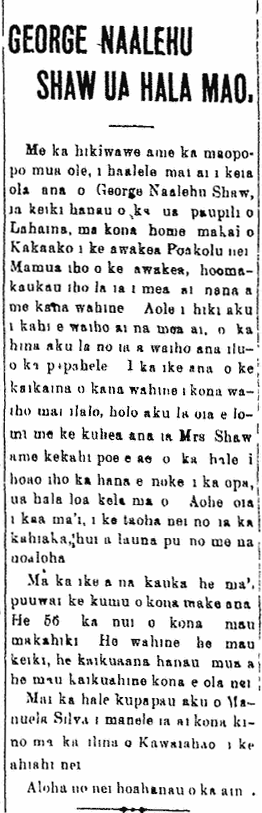
Quickly, without any previous knowledge, George Naalehu Shaw left this life, that native son of the Paupili rain of Lahaina, at his home makai of Kakaako, at noontime on Wednesday. Before noon, he was preparing food for him and his wife. He did not reach the place to put the food, when he collapsed and lay on the floor. When the younger sister of his wife saw him lying there, she went to massage him and called out to Mrs. Shaw and others in the house who continued to massage him; but he passed on. He was not sickly, and was in town in the morning meeting with friends.

According to the doctors, he died of heart disease. He was 56 years old. Surviving him are his wife, children, an older brother, and sisters.

His body was carried from the mortuary of Manuel Silva to the cemetery of Kawaiahao yesterday evening.

Aloha to this brother of the land.

(Kuokoa Home Rula, 3/1/1912, p. 1)

GEORGE NAALEHU SHAW UA HALA MAO.

Kuokoa Home Rula, Buke X, Helu 9, Aoao 1. Maraki 1, 1912.

[It is important to check all available sources and not just one! Look at this announcement of George N. Shaw’s death in Aloha Aina. Although it may seem short and uninformative, it adds to the information given above!]

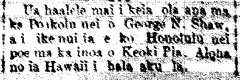
George N. Shaw left this life on this past Wednesday; he is well known to Honolulu’s people as Keoki Pia [George Pia]. Aloha to that Hawaiian who has gone.

(Aloha Aina, 3/2/1912, p. 1)

Ua haalele mai i keia ola ana...

Ke Aloha Aina, Buke XVI, Helu 9, Aoao 1. Maraki 2, 1912.

[Even the Vital Statistics column from the Kuokoa that we posted earlier this week, although just two lines, gives added information!]

Vital Statistics column from Kuokoa, 3/1/1912, p. 8.

[I just did a search for “George Shaw” in the Hawaii papers in 1912 on Chronicling America, but found nothing. This does NOT mean that there are no announcements there, because sometimes words and names come out garbled and are not findable using the word search. If you have the luxury of knowing when an event occurred, it is always best to do a manual search of the newspapers around that date!]

More Hawaiians playing music afar, 1908.

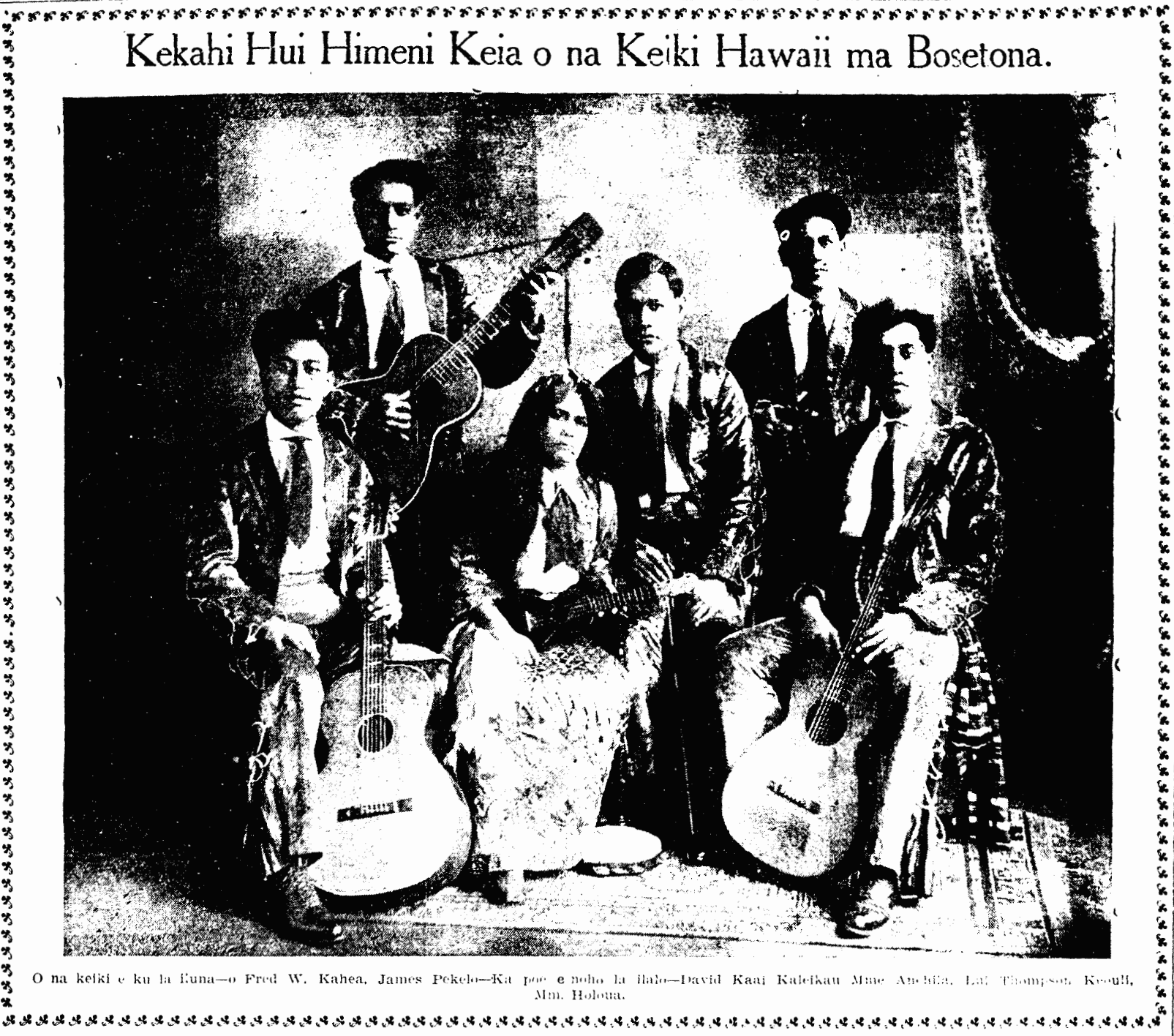
This is a Singing Group of Hawaiian Youths in Boston.

The ones standing–Fred W. Kahea, James Pekelo. Those sitting–David Kaai Kaleikau [Kaleikoa], Madame Anehila [Hobron], Lui Thompson Keouli, Monsieur [William] Holoua

[Plus check out this awesome brochure from the same time put up by the University of Iowa! The Honolulu Students from the Hawaiian Islands. Sometimes the internet is such a good thing!]

(Kuokoa 2/7/1908, p. 6)

Kekahi Hui Himeni Keia o na Keiki Hawaii ma Bosetona.

Ka Nupepa Kuokoa, Buke XLIII, Helu 6, Aoao 6. Feberuari 7, 1908.

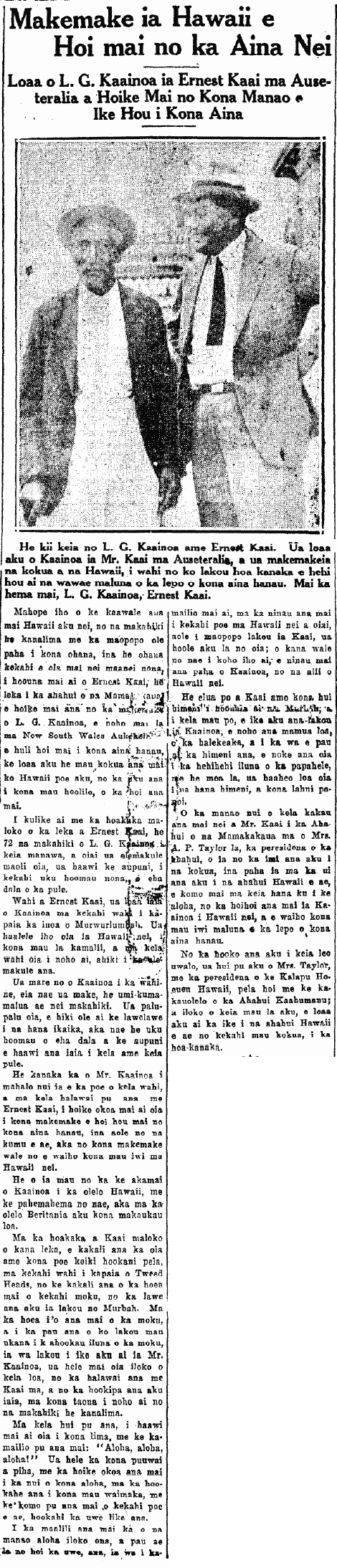
More Ernest Kaai—meeting a Hawaiian living in Australia, 1925.

That Hawaiian Wants to Come Back Here

Ernest Kaai Finds L. G. Kaainoa in Australia, and He Tells of His Desire to See Once Again His Land

This is a picture of L. G. Kaainoa and Ernest Kaai. Mr. Kaai found Kaainoa in Australia, and he wants the help from Hawaiians to provide him a means for him to once again tread upon the land of his birth. From the left, L. G. Kaainoa, Ernest Kaai.

L. G. Kaainoa has been away from Hawaii for 50 years now without his family’s knowledge, or knowing even if he has ohana left alive here; Ernest Kaai sent a letter to the Ahahui Mamakakaua [Sons and Daughters of Hawaiian Warriors] telling them of the desire of Kaainoa (who now lives in New South Wales, Australia), to return to his homeland were he to receive assistance from Hawaii’s people to pay his expenses for the return.

According to the explanation in the letter of Ernest Kaai, L. G. Kaainoa is now 72 years old, and being that he is very old, the government provides him a pension of 4 dollars a week.

Ernest Kaai says he found Kaainoa at a place called Murwillumbah. He left Hawaii nei in his youth and it is there that he lived until his old age.

He married a woman, but she died 12 years earlier. He is infirm and cannot do hard labor. But he is given benefits by the government of 4 dollars every week.

Kaainoa is well liked by the people there, and when he met with Ernest Kaai, he made clear his hope to return to his homeland, if not for any other reason, but for his desire to leave his bones in Hawaii nei.

He is still very good at Hawaiian, yet is somewhat clumsy, but he is most fluent in English.

According to Kaai in his letter, he was staying along with his fellow musicians at a place called Tweed Heads, where they were waiting for the arrival of a ship to take them to Murbah. When the ship arrived, and after they loaded their belongings aboard, it was then they saw Mr. Kaainoa. He came all the way to meet with Kaai folk, and to welcome him to his town where he has lived for 50 years.

At their meeting, Kaainoa gave his hand, saying, “Aloha, aloha, aloha!” His heart was full while he expressed his great aloha as his tears flowed, while some others joined in with him.

After those feelings of aloha calmed within him, and his crying stopped, it was then that he began to speak, asking about some people in Hawaii nei. And as Kaai did not know them, he told him so. All he could think of that Kaainoa could ask of was the alii of Hawaii nei.

Kaai and his musical group spent two nights at Murbah, and on those two nights, they saw Kaainoa sitting way up front of the theater house. And when the singing was over, he continued to stomp on the floor as if he was so proud of this singing of his very own people.

The main reason Mr. Kaai wrote to the Ahahui Mamakakaua by way of Mrs. A. P. Taylor, the president of the Association, was to look for assistance; if she could ask the other Hawaiian associations to join in on this charitable endeavor to bring Kaainoa back to Hawaii nei for him to leave his bones in the soil of his homeland.

To follow through on this plea, Mrs. Taylor met with the president of the Hawaiian Civic Club [Kalapu Hoeueu Hawaii], and the secretary of the Kaahumanu Society; and in the upcoming days, the other Hawaiian organizations will learn about this assistance of their fellow Hawaiian.

(Kuokoa 3/5/1925, p. 1)

Makemake ia Hawaii e Hoi mai no ka Aina Nei

Ka Nupepa Kuokoa, Buke LXIV, Helu 10, Aoao 1. Maraki 5, 1925.

More music—Ernest Kaai, 1906.

ERNEST KAAI LEFT ON HIS MUSICAL TOUR OF KAUAI.

Last evening, Professor Ernest Kaai of the town of Honolulu nei left for the island of Kauai along with his fellow musicians to hold concerts in the places where they will visit, and they will not be left without being welcomed by the people of Kauai.

Travelling along with him are Mrs. Nane [Nani] Alapai, the singer of the Royal Hawaiian Band; Miss Keala; Mr. Holokahiki; and John Noble, Jr., a youth skilled on the flute [hoopiopio?]. They number five in total, and they are members of that band that is moving quickly through the places they visit.

After arriving on Kauai, Lihue is the first port where they stop, and it is there that they will hold their first concert tomorrow. After that, their tour will go all the way to Koloa where they will have a concert on the coming Monday, the 6th.

Then their musical tour will move on to Eleele, where they will have a musical assembly on the next Tuesday, the 7th. From there they will arrive at Waimea, and they will open another concert on Tuesday [Wednesday] the 8th. And then onto Makaweli where they will have another concert on the next day, the 9th.

Ernest Kaai and his band mates will spend a number of days on Kauai, and when they reach Makaweli, and hold a concert there on the day shown, it is then that they will know where their tour will move to next.

On this tour, Professor Kaai has time to give benefit concerts for good causes if it will be beneficial, but this all depends on the scheduling.

Mr. Kaai is a young Hawaiian that is well known in this town among the Hawaiians and among the haole that love playing music, for the regular job of that young man is teaching music. There are many haole women and haole men and Hawaiians as well who were taught by him and graduated in music.

[If this post looks familiar to some of you, it is because I posted it some time ago on the old Hoolaupai Facebook page. I found that it is not easy to find anything on that page, so started the blog at http://nupepa-hawaii.com, where it is a whole lot easier to find posts! So I will be on occasion reposting articles so that they will be findable in one location. They will all be under the category “Repost”.]

(Kuokoa, 8/3/1906, p. 8)

UA HALA AKU O ERNEST KAAI I KE KAAHELE HIMENI NO KAUAI.

Ka Nupepa Kuokoa, Buke XLV, Helu 31, Aoao 8. Augate 3, 1906.

Honolulu Glee Club, 1911.

THE SINGING GROUP, “HONOLULU GLEE CLUB” OF THE HAWAIIAN BOYS.

Led by Ah Choy Tim Sin.

Front row—R. K. Kumulala [Kumululu? Kumuliilii?], D. W. Waipa, Ah Choy Tim Sin, R. M. Kamaunu, F. W. Keao. Back row—S. Kanekoa, J. Kahikina.

This Singing Group will arrive in the districts of North Kohala, South Kohala, Hamakua, Hilo, and Puna, should they not meet with any troubles on their road. This group is under the direction of Ah Choy, a skilled youth [line hidden by fold].

[Line hidden by fold?] with the melodic flute, and included in this group is the skilled hands of Mr. Waipa, the prince of Kona and Kohala.

Therefore, rise, O Friends, join hands with the sweet beloved of Kohala and sing along to this song of aloha for his birth land:

“Maikai ka makani o Kohala,
I pa ia e ka Inuwai,
Ka wai no ia pono kaua,
Ka wai kaulana o ka aina,
He aloha, he aloha ka’u mea nui,
He makana, he makana na ka puuwai.”

Please fill their singing audience; they will arrive in North Kohala on August 5, 1911.

[This is one of many pages of the Hawaiian-Language Newspapers that are difficult to read because the image originally taken was not clean. These need to be reshot before it is too late. You can’t get much information from something that is illegible.]

(Kuokoa Home Rula, 7/28/1911, p. 1)

KA PUALI HIMENI "HONOLULU GLEE CLUB" O NA KEIKI HAWAII

Kuokoa Home Rula, Buke IX, Helu 30, Aoao 1. Iulai 28, 1911.

[Here is the same image found in the Evening Bulletin. Perhaps this is not such a great image, but it is way better than the one from Kuokoa Home Rula! And yet, the information given pales to what is found in the Hawaiian article…]

MEMBERS OF HONOLULU GLEE CLUB

Evening Bulletin, Number 4993, Page 8. August 1, 1911.

Vital Statistics, 1912.

MARRIAGES.

George E. Gall to Helen Bruns, Feb. 19.
Edwin Ernest Brandt to Annie Kane, Feb. 23.
William Kahoii to Rose Castino, Feb. 23.
L. K. Aiu to Henrietta Apa, Feb. 24.
August Reimann, Jr. to Helene Kulolia, Feb. 24.

BIRTHS.

To Sam Kakelaka and Luisa Apo, a son, Feb. 20.
To Thomas Naehu and Lehua Kalani, a son, Feb. 20.
To Henry Akau and Lokalia Puaalaa [?], a son, Feb. 23.
To Mr. and Mrs. Pascal, a daughter, Feb. 27.
To Sam Kalili and Lokalia Perry, a son, Feb. 28.

DEATHS.

Miss Rebecca Koo, on Ilaniwai Street, Feb. 16.
Keola Naeole, at Kalihi Hospital, Feb. 19.
Ahea Kalani, at Leahi Home, Feb. 19.
Bernice pa, on Luso Street, Feb. 19.
Imiola, on Kukui Street, Feb. 22.
Malie Gehan, on Insane Asylum Street, Feb. 22.
Solomon Hinai, on Kukui Street, Feb. 22.
Louis Foster, on Beritania Street, Feb. 23.
Charles Yim On, Jr. on Kauluwela Lane, Feb. 25.
Kealoha Kepano, on Keawe Street, Feb. 25.
Alex McCandless, at Queen’s Hospital, Feb. 25.
George N. Shaw, on Ilaniwai Street, Feb. 28.

(Kuokoa, 3/1/1912, p. 8)

MARE / HANAU / MAKE

Ka Nupepa Kuokoa, Buke XLVIII, Helu 9, Aoao 8. Maraki 1, 1912.

Leap year, 1896.

Irregular Increase in Time

This is a leap year [makahiki lele oi], in other words, there are 29 days in this month, and there will be no more leap years until the year 1904, a span of eight years. When reaching 1904, there will not be another for another 200 years. There are these types of irregular leaps, as was explained above, every 200 years. This occurrence which is happening this year, took place 200 years ago, that being in the year 1696 and then in 1704 the leaping began again. Amongst the haole, this is the time for women and young men to pull in their hooks, that is if there is good bait on it. And what of our youth, will they be haphazard?

[Not sure what kind of math is happening here…]

(Makaainana, 2/24/1896, p. 7)

Oioi Kikoi o ka Manawa.

Ka Makaainana, Buke V, Helu 8, Aoao 7. Feberuari 24, 1896.

More Ahahui Na’i Aupuni, 1925.

ANNOUNCEMENT.

Ahahui Na’i Aupuni.

All members of the Na’i Aupuni Association are requested to gather at Kawaiahao Church in full uniform of the association on this Sunday, March 29, 1925, to celebrate Kuhio Day.

Kaihua Robins.

[I wonder what the relationship between Mary Keliiaukaiokaahumanu Robins and this Kaihua Robins is.]

(Kuokoa, 3/26/1925, p. 2)

HOOLAHA.

Ka Nupepa Kuokoa, Buke LXIV, Helu 13, Aoao 2. Maraki 26, 1925.