[Found under: “NOTES OF THE WEEK.”]
Messrs. Black and Auld, having erected a new printing office on Merchant street, adjoining Rawson’s watch shop, have moved into the same, Continue reading


Messrs. Black and Auld, having erected a new printing office on Merchant street, adjoining Rawson’s watch shop, have moved into the same, Continue reading
At the hour of 8 in the evening of the 7th of January, the loving hand of the Almighty took way the last breath of the Father Rev. S. Kamakahiki at his home in Keanae, Maui, Continue reading
Editor The Star-Bulletin: May I be permitted through the medium of your column to call the attention of the descendants of the Hawaiian missionaries to a great event which linked the lives of their ancestors to the ministry in Micronesia and elsewhere in the Pacific ocean? Continue reading
Plucked by death.—We received news that on the 18th of March, at Keanae, Mrs. Maraea Pomaikai Kamakahiki left this life, and was taken by the cruel-handed messenger of death, in her old age living in this unfamiliar world. She was a Christian woman, and died as a good and proper servant for the Lord in which she had faith. Here is a short story about her. In the year 1855, the two of them left their land of birth and sailed to the small islands of Micronesia where they served as Missionaries for the Almighty, Continue reading
Social Circles Bright and Buzzing in Spite of Bad Weather.
The weather still continues inclement, the roads uninviting; ergo, news notes are scarce.
Mrs. J. C. Lorenzen and niece, Miss Etta Daniels of Honolulu, are visiting their friends, Mr. and Mrs. H. Z. Austin, at “Ocean View,” Kapaa, where we had the pleasure of meeting the Bishop of Panopolis and accompanying priests—Father Marratian and Father Levi. The Bishop is an old-time acquaintance of the Austins, dating back from their first residence on Maui, where he had charge of the mission at Wailuku. Continue reading
By EMMA LYONS DOYLE
The appearance in Hawaiian Holiday of an article on Kamehameha III two weeks ago revived interest among old timers in a question that in years gone by aroused both query and controversy.
Was Kauikeaouli’s birthday Aug. 11, or was it March 17?
The latter date until recent years this writer believed to be the correct one. It was known to have been observed during the king’s lifetime, with flag flying, celebrations and official calls.
Makua Laiana’s [Lorenzo Lyons’] journal, dated Waimea, March 17, 1849, records: “The King’s birthday. People ordered not to do any work. Public meeting, but Royal Proclamation disregarded by many.”
Kauikeaouli, it must be remembered, was born in a period when time was reckoned by the unwritten Hawaiian calendar, one that was established, detailed and well arranged, but so different from the later-adopted haole calendar that it would not be strange if confusion sometimes occurred.
The August date was affirmed by Fornander, and appears in Alexander’s Brief History of the Hawaiian People. Hawaiian Holiday’s article was timed and written in acceptance of these statements, and its length being limited, did not include mention of the controversy.
In August, 1847, there appeared in the Hawaiian publication Elele Hawaii [10/6/1847, pp. 99–100] an article by G. S. Keliumiumi, vehemently and poetically protesting the celebration of the king’s birthday in March.
He quotes Keaweamahi as one authority, and says in part, “Know then by this document the correct and the truth of King Kamehameha being born on the 11th day of the month of Hinaiaeleele, which is August…
David Malo, in 1847, also disputed the March date, saying he was present at Keauhou when the king was born. “I did not know how to reckon months at that time,” he wrote, but he cited a fishing season and certain events that would mark the period.
Fornander, in a chronological table that appeared in Hitchcock’s English – Hawaiian dictionary, says for 1813: “Kauikeaouli, afterward Kamehameha III, was born on Aug. 11 to Kamehameha and Keopuolani. The day of his birth, however was in after years conventionally fixed for March 17, but the above date is the testimony of his nurse, Emilia Keaweamahi, wife of Kaieoewa [Kaikioewa], Governor of Kauai. (Kamakau mentions Kaikeoewa as the infant’s protector.)
And now for a surprise!
Very unexpectedly, the writer has been given permission to use and extract from the journal of no less a person than John Young:
“Kawaihae, March, 1813.
“News came by bearer a few days hence of the birth of a child who will be declared kabu as an heir to this kingdom’s throne.
“Tamehameha is overjoyed. He declares a great feast and a number of sacrifices, and a time of great celebration.
“Mother and I go to celebrate. Grace is ill today. Fanny, John, James and the kahus shall go with me.”
As this journal probably has never seen publication, it may be that our story represents a scoop on a human interest item 145 years old, a journalistic triumph for a historian.
In any case, let’s hope March 17, 1959, will be duly celebrated. Twice within the span of a year is not too often to remember the good king.
(Advertiser, 8/24/1958, Hawaiian Holiday, p. 7)
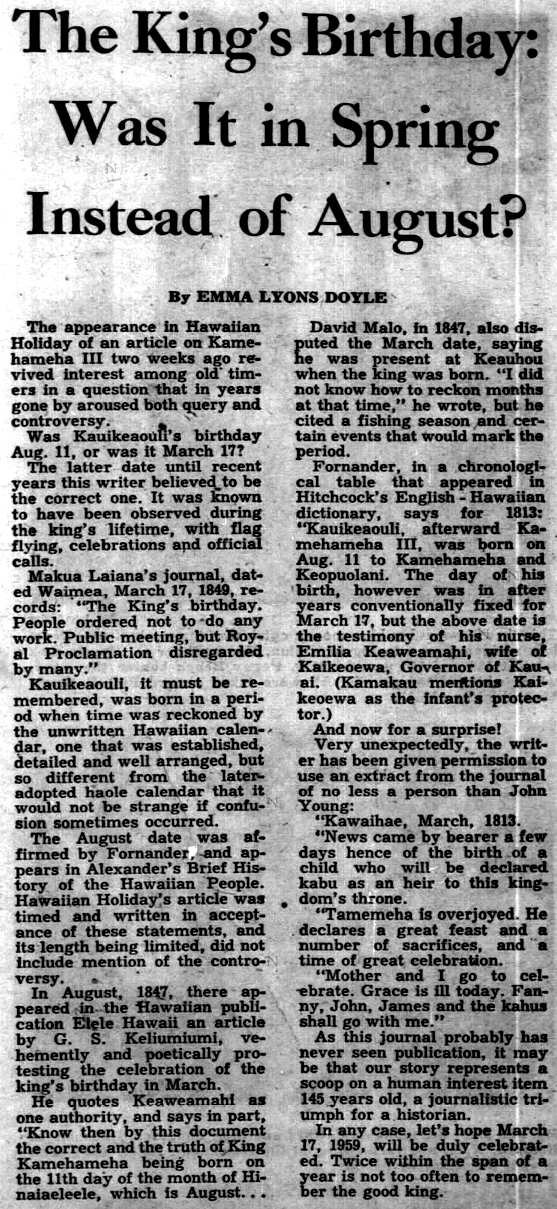
Honolulu Advertiser, 102nd Year, Number 34,394, Hawaiian Holiday, Page 7. August 24, 1958.
The Daughters of Hawaii residing in Honolulu have decided to build a Memorial to Kamehameha III, the kindhearted Alii, in the place where the alii was born in Keauhou, and sent Miss Ana Paris to look at the place and report back to the Association. Continue reading
A new paper made its appearance yesterday in the Hawaiian language. Continue reading
On the 16th of March, at Hilo, Hawaii, the friends and intimates of Mr. Charles E. Richardson Continue reading
In Kawaiahao Church, on Sunday, the 16th of March, the Kaahumanu society will hold a commemoration for King Kauikeaouli, like the announcement that was printed in this paper, and all the members of the Kaahumanu Societies are wanted to have a commemorative gathering of that type on their islands.
(Kuokoa, 3/6/1924, p. 1)

Ka Nupepa Kuokoa, Buke LXIII, Helu 10, Aoao 1. Maraki 6, 1924.
 nupepa