Unknown's avatar

About nupepa

Just another place that posts random articles from the Hawaiian Newspapers! It would be awesome if this should become a space where open discussions happen on all topics written about in those papers!! And please note that these are definitely not polished translations, but are just drafts!!! [This blog is not affiliated with any organization and receives no funding. Statements made here should in now way be seen as a reflection on other organizations or people. All errors in interpretation are my own.]

Samuela Kekuiapoiwa, 1903.

He was a True Kamehameha

The story printed in the Kuokoa pertaining to the death of Samuel Kekuiapoiwa on the 23rd of June past on the shores of Hanapepe; that he was well known for his good deeds and there was a expression of love for him in our Kilohana* on July 17; he was none other than a descendant of Kamehameha V. This is his whole name—Kapuaiwa Kamehameha V Kekuiapoiwa.

Here is the explanation: Kapuaiwa Kamehameha V was with Maheha and born was Keanolani (f); Continue reading

Lanai purchased a hundred years ago by the Baldwins, 1917.

The island of Lanai was purchased by F. F. and H. A. Baldwin, as per what was reported last Thursday. The new owners of the island, the two of them, said that they will turn the place into a ranch.

The price paid is said to have been $588,000.

(Puuhonua, 3/9/1917, p. 1)

Puuhonua_3_9_1917_1.png

Ka Puuhonua, Buke IV, Helu 10, Aoao 1. Maraki 9, 1917.

Another “blue” story translated by J. W., 1862.

[Unuhiia no ke Kuokoa.]

UMIUMI ULIULI.

MAMUA AKU NEI, E NOHO ANA kekahi kanaka waiwai loa, paapu kona mau hale maikai, o kona mau pa, he gula a me ke dala; o na moe a me na noho, ua uhiia i ke kilika maikai loa, o kona mau kaa, ua hamoia i ke gula a maikai loa. O ka mea i apiki loa ai o ua kanaka nei, o ke ahinahina o ka umiumi; nolaila, weliweli ke nana aku, a makau na wahine o kona wahi ke hui aku i kona Comepane. He wahine hanohano e noho ana ma ia wahi, a elua ana mau kaikamahine, he mau wahine ui no laua a elua.

[This is the beginning of J. W.’s translation of Charles Perrault’s “Bluebeard.” Continue reading

The Blue Bird, 1862.

KA MANU ULIULI.

[Unuhiia no ke Kuokoa.]

HELU 1.

I KEKAHI MANAWA, E NOHO ANA kekahi Moi waiwai loa; a o kana wahine, ua make; a noho iho la ia me ka oluolu ole. Ewalu la o kona noho ana iloko o kekahi lumi uuku, o kana hana ka hookui i ke poo ma ka paia; aka, ua uhiia nae i ka pulu  i mea e eha ole ai ia. O na makaainana ona a pau loa, manao iho la e hele aku e ike, a e hooluolu ia ia; aole nae ona manao i ka lakou olelo. A Mahope, hele aku imua ona, he wahine i uhiia a paa i ka lole eleele, me ka uhimaka kanikau, me ka uwe ikaika loa, a kunana iho la ua Alii nei. Hookomo mai la ua Alii nei me ka oluolu, a no ka lilo loa i ke kamailio; nolaila, aole o laua olelo no ke kumu o ko laua pilikia.

[This is the beginning of another foreign kaao translated by J. W. Continue reading

Hawaiian version of “Beauty and the Beast,” 1893.

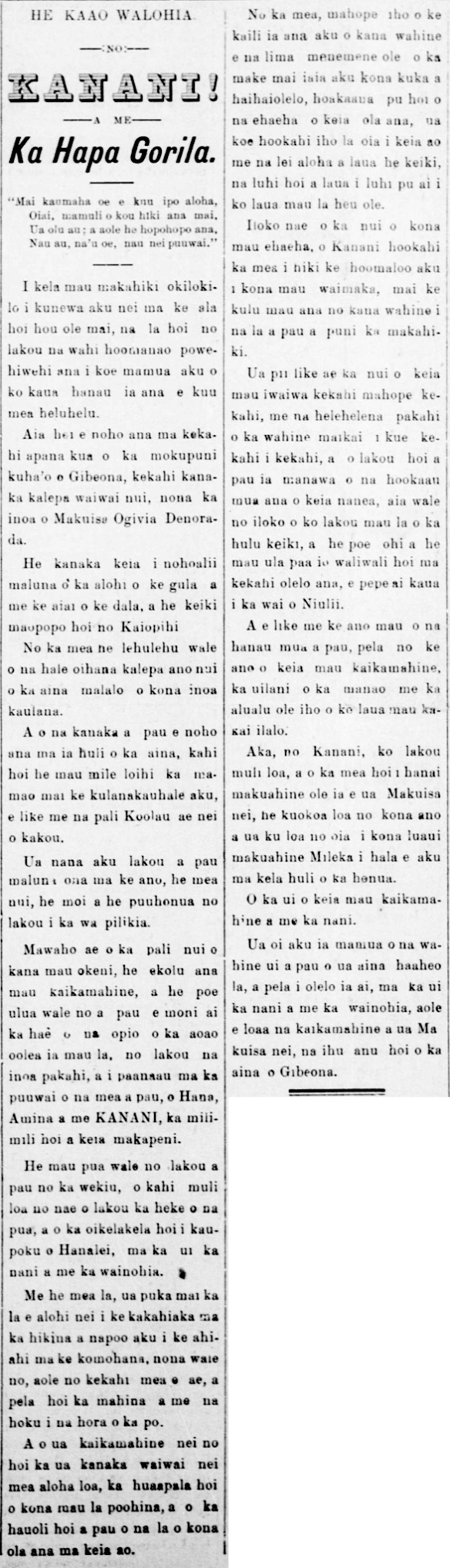
HE KAAO WALOHIA
—:NO:—
KANANI!
—:A ME:—
Ka Hapa Gorila.

“The Heart-Wrenching Tale of Beauty and the Half Gorilla” ran in Hawaii Holomua from 4/10/1893 and concluded on 5/26/1893. There is no attributed translator. I am not sure what work it was translated from.

[Much earlier in 1862, Jeanne-Marie LePrince de Beaumont’s “Beauty and the Beast” was translated as “He Kaao no Kanani! me ka Holoholona,” by J. W. Click here for my earlier post.]

(Hawaii Holomua, 4/10/1893, p. 1)

HawaiiHolomua_4_10_1893_1.png

Hawaii Holomua, Buke III, Helu 197, Aoao 1. Aperila 10, 1893.

Chicken or egg? Did this come before the still popular mele, “Kukuna o ka La”? 1921.

HULA HA’I MEAHOU.

O ke anuenue ko’u papale,
Hokuwelowelo ko’u lipine.
Hae ka ilio ma Puuloa,
He alahula ia na Kaahupahau.
Nanea i ka holo a ke kaaahi,
Ua like me ka lio waha uaua.
Ka ihona au a o Kekele,
Ike i ka nani a o Kilohana.
Hele kuu hoa a maeele,
Aole wai e maalili ai. Continue reading

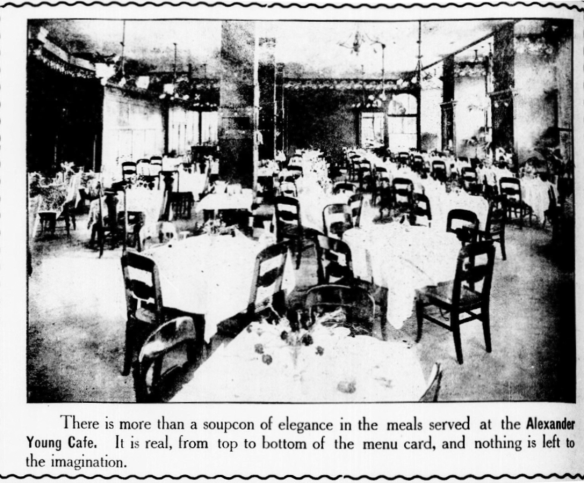
Alexander Young Cafe, 1910.

There is more than soupcon of elegance in the meals served at the Alexander Young Cafe. It is real, from top to bottom of the menu card, and nothing is left to the imagination.

[I was just told by someone who knew the establishment that the cheese bread that came out of the bakery was the best. But she heard that the baker took the recipe with him when he passed on… And you don’t hear the word “soupçon” very often these days!]

(Pacific Commercial Advertiser, 5/1/1910, p. 18)

PCA_5_1_1910_18.png

The Pacific Commercial Advertiser, Volume VII, Number 382, Page 18. May 1, 1910.