At 6 p. m. at the home of her grandson, James Hakuole [Harbottle], at Kunawai, the angel of death came and took the life breath of Mrs. Kekuialono Harbottle at eighty years of age. Her land of birth was Maui.
(Kuokoa, 2/24/1905, p. 2)
At 6 p. m. at the home of her grandson, James Hakuole [Harbottle], at Kunawai, the angel of death came and took the life breath of Mrs. Kekuialono Harbottle at eighty years of age. Her land of birth was Maui.
(Kuokoa, 2/24/1905, p. 2)
This past week the kamaaina of the land renowned for the Apaapaa Wind, of Kohala with its hills that move along together, Kalahikiola and Pili, that is John Harbottle, and after some days he returned to his famous lands.
Looking at him, he is still in good health, he has not changed, as if it is still in the days of his youth, when I first met him 27 years ago, when I arrived in his famous aina.
He spent some days with his daughter and son-in-law, Mr. and Mrs. Eddie Nelson, of Keaukaha.
(Hoku o Hawaii, 9/8/1943, p. 1)
Language Matters asks what we lose when languages die and how we can save them. It was filmed around the world: on a remote island off the coast of Australia, where 400 Aboriginal people speak 10 different languages, all at risk; in Wales, where Welsh, once in danger, is today making a comeback; and in Hawaii, where a group of Hawaiian activists is fighting to save the native tongue.
Language Matters is a co-production of David Grubin Productions and Pacific Islanders in Communications. Major funding provided by the National Endowment for the Humanities with additional funding provided by the Corporation for Public Broadcasting, the Arthur Vining Davis Foundations, the National Endowment for the Arts.
[This showed on PBS on 1/19/2015. It might be a long show, but don’t skip to the back, it is well worth watching from the beginning! Click the picture below.]
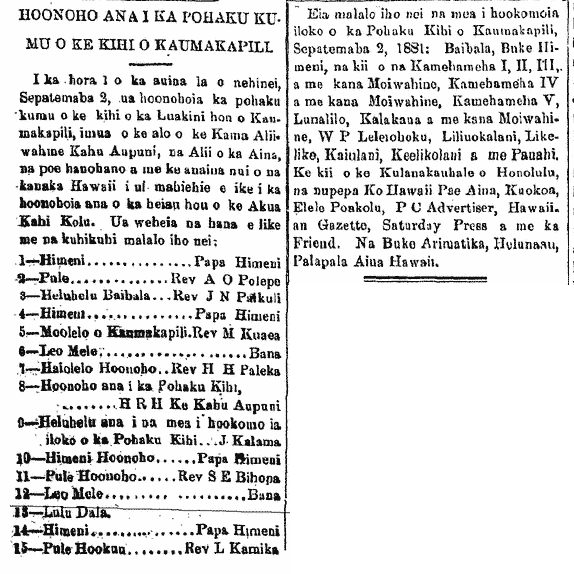
At 1 o’clock yesterday afternoon, September 2, the cornerstone [pohaku kumu o ke kihi] of Kaumakapili Church was laid, before the Princess Regent [Liliuokalani], the Alii of the Land, dignitaries, along with a huge contingent of Hawaiian people who were finely dressed to see the laying out of the new heiau of the Trinity. The ceremony opened like the program below:
1—Hymn . . . . . Choir
2—Prayer . . . . . Rev. Anderson Oliver Forbes [A. O. Polepe]
3—Bible Reading . . . . . Rev. J. N. Paikuli
4—Hymn . . . . . Choir
5—History of Kaumakapili . . . . . Rev. M. Kuaea
6—Song . . . . . Band
7—Speech for the Laying of the Cornerstone . . . . . Rev. H. H. Parker [H. H. Paleka]
8—Laying of the Cornerstone . . . . . Her Royal Highness, The Princess Regent
9—Reading of the contents of the Cornerstone . . . . . J. Kalama
10—Hymn for the Laying of the Cornerstone . . . . . Choir
11—Prayer for the Laying of the Cornerstone . . . . . Rev. S. E. Bishop [S. E. Bihopa]
12—Song . . . . . Band
13—Monetary Donations
14—Hymn . . . . . Choir
15—Closing Prayer . . . . . Rev. L. Smith [L. Kamika]
Here below are the things put inside of the Cornerstone of Kaumakapili on September 2, 1881: Baibala, Buke Himeni, pictures of Kamehameha I, II, III and his Queen, Kamehameha IV and his Queen, Kamehameha V, Lunalilo, Kalakaua and his Queen, W. P. Leleiohoku, Liliuokalani, Likelike, Kaiulani, Keelikolani and Pauahi. A picture of the Town of Honolulu, the newspapers, Ko Hawaii Pae Aina, Kuokoa, Elele Poakolu, P. C. Advertiser, Hawaiian Gazette, Saturday Press, and the Friend. The books, Arimatika, Helunaau, Palapala Aina Hawaii.
(Ko Hawaii Pae Aina, 9/3/1881, p. 2)
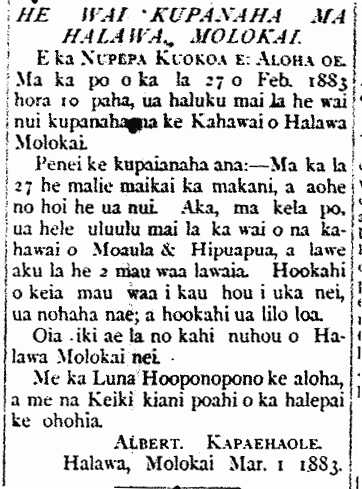
O Kuokoa Newspaper: Aloha oe.
On the night of February 27, 1883, at perhaps 10 o’clock, a shockingly huge amount of water rushed down the river of Halawa, Molokai.
Here is what was shocking:—On the 27th, the wind was perfectly calm, and there was no big rain. However, that night, the waters of the rivers of Moaula and Hipuapua came violently down and swept away 2 fishing canoes. One of these canoes was brought back on land but was broken up; the other is gone.
That is just some small news from here in Halawa, Molokai.
Aloha to the Editor and to the typesetting Boys of the press my delight.
Albert Kapaehaole
(Kuokoa, 3/10/1883, p. 3)
On the 10th of July, I will commence at my place. Number 31, Fort Street, Honolulu, a Clinic for Hawaiian, men, women, children, everyone; with any illness, from Hawaii to Kauai. These are the hours for you all to come by, from 9 o’clock in the morning until 12 on weekdays [la noa]. Therefore, come all; there is no pay for the indigent, and you will get proper medicine with enlightened treatment.
G. P. Judd, (Kauka.)
[Although the title of this advertisement, “Lapaau Hawaii,” can be seen as “Treatment for Hawaiians,” I think the first idea that comes to mind would be “Hawaiian Medicine.” I wonder if that was done on purpose…]
(Au Okoa, 7/20/1871, p. 2)
Our beloved King died from the night of Tuesday to the day of Wednesday [February 3, 1874], at 8 o’clock and 50 minutes in the evening. 44 hours went by after his birthday, and he died at 39 years old.
His death was quick without a struggle. He died before the alii, Ke alii Pauahai, F. Naea, R. Keelikolani, the Minister of Finance Sterling, Dr. Trousseau (Kauka Palani), and Dr. Oliver.
We visited the Palace and saw the makaainana murmuring about with worried faces, saying, “The King is dead.” The Lahui are sad and grieve over the quick passing of Lunalilo. The Lahui must at once look with hope to his Replacement, the one who will occupy the throne, and there is but one who is fitting, that is Kalakaua.
(Nuhou Hawaii, 2/10/1874, p. 3)
The columns of the Aloha Aina are open to publishing ideas and letters from friends on all sorts of topics, however it should be based on intelligent and proper subjects. We do not believe in personal criticisms and reviling. We do not take responsibility for the letters and editorials from friends, but this falls under their own names. We want all letters and editorials to come in Monday evenings. Write clearly.
(Aloha Aina, 2/13/1915, p. 2)
Masked Entertainment.—In the evening of this past Saturday, a party was held in the Palace by the monarchs and those who were invited to go there. Each person was hidden behind a mask [maka kii], and everyone was befuddled because the features of people could not be seen. You went up to someone to figure out who it was, maybe by their figure, or the back of the head. You turned away, and you were confused once again, as people’s features were hidden.
(Kuokoa, 5/2/1874, p. 2)
The celebration [hi’uwai] of the people of China [Aina Pua] is approaching, but perhaps there will only be a few because New Years was celebrated by some Chinese on this past New Years Day.
[Konohi is the lunar calendar new year. It probably comes from the Hawaiianization of the Chinese Kung Hei as in Kun Hei Fat Choi (恭喜發財).]
(Aloha Aina, 2/6/1915, p. 3