Unknown's avatar

About nupepa

Just another place that posts random articles from the Hawaiian Newspapers! It would be awesome if this should become a space where open discussions happen on all topics written about in those papers!! And please note that these are definitely not polished translations, but are just drafts!!! [This blog is not affiliated with any organization and receives no funding. Statements made here should in now way be seen as a reflection on other organizations or people. All errors in interpretation are my own.]

E o, e Namaka! 1921.

[Found under: “Nuhou Kuloko”]

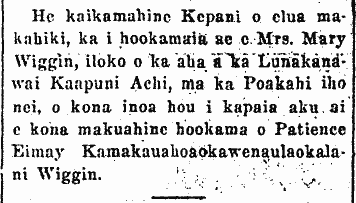
A Japanese girl of two years old was adopted by Mrs. Mary Wiggin, in the court of the Circuit Court Judge Achi, on this past Monday; her new name that she is being called by her adopted mother is Patience Eimay Kamakauahoaokawenaulaokalani [Namakauahoaokawenaulaokalaniikiikikalaninui] Wiggin.

See much more in Nanea Armstrong Wassel’s Instagram post!

[Hauoli la hanau, e Aunty!]

(Kuokoa, 8/19/1921, p. 4)

He kaikamahine Kepani...

Ka Nupepa Kuokoa, Buke LIX, Helu 33, Aoao 4. Augate 19, 1921.

First birthday celebration of Keelikolani’s birthday, 1871.

Birthday of the Alii, the governess of Hawaii.

O Nupepa Kuokoa; Aloha oe:—

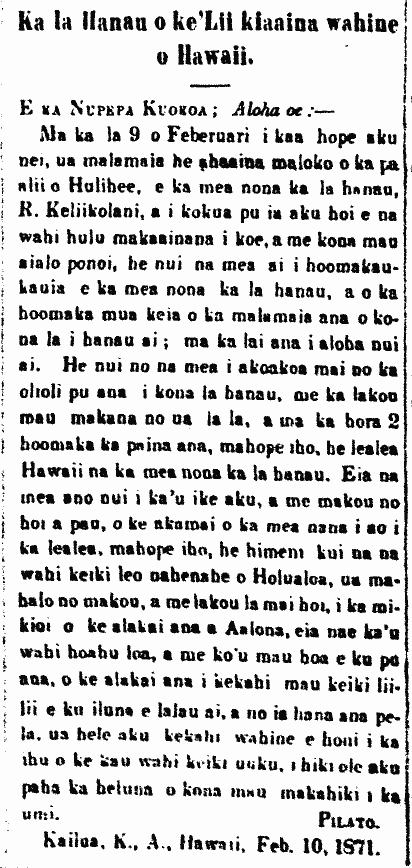
On the 9th of February past, a banquet was held on the estate of Hulihee by the person whose birthday it was, R. Keelikolani, assisted by her dear makaainana remaining, and her personal attendants; there was much food prepared by the one whose birthday it was, this being the very first celebration of her birthday; and it was appreciated for the calmness of the day. There were many gathered to celebrate her day of birth, with their gifts for that day, and at 2 o’clock, the feast began, followed by Hawaiian entertainment [lealea Hawaii] furnished by the one whose birthday it was. Here are is the main thing which I saw and all of us as well, that being the skill of the person who instructed the entertainment [o ke akamai o ka mea nana i ao i ka lealea], and this was followed by a joint choir of the sweet-voiced children of Holualoa; we and they give praise to the excellent leadership of Aalona; but this is what I did not like the most, along with my friends who stood with me, that being the guiding of some children to stand up and go astray [eia nae ka’u wahi hoahu loa, a me ko’u mau hoa e ku pu ana, o ke alakai ana i kekahi mau keiki liilii e ku iluna e lalau ai], and for that some women went and “kissed the nose” [honi i ka ihu] of the small children who were probably no more than ten years old.

Pilato.

Kailua, Kona Akau, Hawaii, Feb. 10, 1871.

[Many times people will be referred to by their position and not by their actual name. When doing searches for Keelikolani for instance, she is often referred to as the governor of the island of Hawaii, ke kiaaina o ka mokupuni o Hawaii (1855–1874).]

(Kuokoa, 2/25/1871, p. 2)

Ka la Hanau o Ke'lii kiaaina wahine o Hawaii.

Ka Nupepa Kuokoa, Buke X, Helu 8, Aoao 2. Feberuari 25, 1871.

Champion follows the Iwalani, 1894.

The Champion [Kamepion] Leaves.

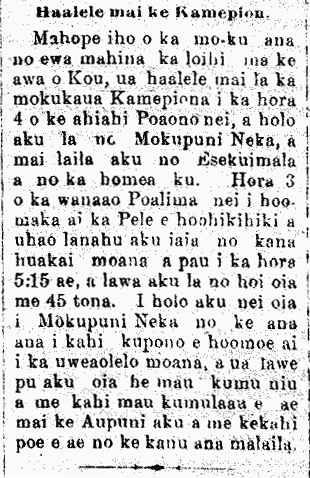
After remaining in the port of Kou for nine months, the warship Champion left at 4 in the late afternoon this past Saturday, and headed to Necker Island [Mokupuni Neka], and from there on to Esquimalt [Esekuimala] and then on home. At 3 o’clock in the dawn of the following Friday, the Pele began to fetch and scoop up coal for its long ocean voyage, and was through at 5:15, and it was filled with 45 tons. It left for Necker Island to map the proper route to lay the ocean telegraph cable [uweaolelo moana], and he took with them some coconut trees  and some other trees from the Government with some others to plant there.

(Makaainana, 8/27/1894, p. 1)

Haalele mai ke Kamepion.

Ka Makaainana, Buke II—-Ano Hou, Helu 9, Aoao 1. Augate 27, 1894.

Necker claimed for Hawaii, 1894.

THE JOURNEY OF THE IWALANI!

NECKER BECOMES HAWAII’S!

The Islands of the Hawaiian Archipelago!

In the afternoon of May 25, this town was all astir at the news that the steamship Iwalani was headed on a long expedition. At 5:20 of that evening, the Iwalani sailed on its mystifying mission. On board was J. A. King, Minister of the Interior, and the crew was increased by ten more sailors. Ka Leo¹ newspaper was much alarmed thinking that the Provisional Government was looking for a place to keep all of the royalists [anee alii]. The royalists proved this worthless piece of news by Ka Leo printing a letter that they found in some dung, but the people…

THE HAWAIIAN ARCHIPELAGO.

…of proper thinking, they were not anxious. The wonder of the people was highly escalated because the British warship Champion followed half an hour after the Iwalani left. And as is usual in Honolulu nei, news soon spoke of the warship chasing after the Iwalani. These senseless ideas were let go when the Iwalani returned on Tuesday evening, May 29.

From what was said by Captain Freeman of the Iwalani, they passed Nihoa in the evening of Saturday, May 26, and at 11 o’clock on the following morning, May 27, the anchor of the Iwalani was let down on the leeward side of Necker [Neka] Island, 41 hours sailing from Honolulu. The skiff was let down and Captain King, Captain Freeman, engineer Norton, along with seven sailors went on.

NECKER ISLAND.

This island is a heap of rocks, and is 260 feet tall. There is a steep cliff rising from the ground, and it was with great effort that they climbed up until a proper place to where Captain King stood a flagpole and the Hawaiian flag waved in the wind. This island was annexed to the Hawaiian nation, and this is the proclamation that Captain King read: Continue reading

Hawaiians come to Hawaii for the first time, 1940.

Hawaiian Malihini.

The picture above is a picture of a Hawaiian family who came to Hawaii as malihini to this land. They are Hawaiians by skin, but they are newcomers to the land. This is the first time they are seeing in person the land of their parents and kupuna. Arrived by the Aorangi was Mrs. Antone Pai, who was born in San Francisco, and her children who were born in Portland, Oregon. In the front line is Robert, 3; Sylvia, 6, and Antone Jr., 4. In the middle line is Katherine, 9; Antoinette, 8; and Helena, 11. In the back is Mrs. Pai and her brother, Francis Sylvia, who was born in Seattle.

Hawaiians Visiting Hawaii

Question: When is a Hawaiian called a malihini?

Answer: When they have not seen Hawaii before.

These are two generations of Hawaiians that saw Hawaii for the first time when they arrived in Honolulu last week on the Steamer Aorangi from Vancouver. Neither Mrs. Pai nor her children had seen Hawaii before, nor had her brother, Francis Sylvia, 22, who arrived with this family. All of them were born in America to Hawaiian families.

“It is just so beautiful,” according to Mrs. Pai as her voice choked up.

“You see that everything is green,” said one of her children. Continue reading

Maika, the half Indian, half Hawaiian, 1892–1893.

THE REMARKABLE ENTERTAINMENT

—ABOUT—

MAIKA

THE BOY THAT WAS

Half Indian and

Half Hawaiian.

THE FIRST MAN TO SHOOT THE BEAR GOD GREATLY FEARED BY THE INDIANS—AS WELL AS THE TERROR OF THE WHITE SKINS–AND THE MASSACRE OF THE THEATRICAL GROUP OF LEE.

When the first brown skins were first contracted on Whaling ships, a man named Akamai boarded and their ship left for the Arctic [Atika] where that kind of huge fish lives to this day, that being the Whale [Kohola].

When their ship was let go in fair winds, and in the middle of the night, while everyone was enjoying their sleep, there was one of them awake then, that being the man who was bent over the oar of that ark of theirs.

While he was crouched over the oar of their ark, that little ship of theirs came upon a storm, and all the gear was blown away by the wind and the masts were snapped and the oars were broken; and because of this storm they ran into, they couldn’t do a thing; all they could do was to sit calmly looking out for land or a ship to save their lives.

While they waited for their end, and when the rays of the sun burst forth, their souls were gladdened to see that they had landed on land; they jumped off to land, and wandered about here and there, and as they wandered around…

[And so begins the amazing story of the hapa Ilikini, hapa Hawaii, named Maika. It runs in the newspaper Leo o ka Lahui (a daily, Mondays to Fridays) from 11/21/1892, and the last installment is found on 6/12/1893.]

(Leo o ka Lahui, 11/21/1892, p. 1)

HE NANEA KAMAHAO NO MAIKA

Ka Leo o ka Lahui, Buke II, Helu 586, Aoao 1. Novemaba 21, 1892.

Vote John K. Naiwi, 1922.

JOHN K. NAIWI

A Hawaiian youth to be chosen by the makaainana as a Representative in the Fifth District, in the Republican Party [Aoao Repubalika]. Make him your obedient servant [kauwa hoolohe], for the benefit and the progress of the land.

(Kuokoa, 9/28/1922, p. 3)

JOHN K. NAIWI

Ka Nupepa Kuokoa, Buke LXI, Helu 39, Aoao 3. Sepatemaba 28, 1922.

Commemorative Kamani planted at Kamehameha Schools, 1904.

Kamehameha Schools.

The Kamehameha Schools held their exhibition on this past Friday, starting with the Boys’ Primary School. On that day the exhibition of that school was held, and on this past Monday for the Girls’ School.

On Monday afternoon, the boys’ senior class held a tree planting to memorialize the days of living in hardship at this home of learning, and present were those invited to watch the activities. The tree that they planted was a kamani, and the area where it was planted was upland of their chapel.

Later that night, speeches and songs were performed by the Girls’ School in their chapel. These were speeches by the students graduating this year. There were eight girls: Edith Leilani Dunn, Annie Claire Davidson, Hattie Hiilani Jones, Victoria Kekaihaakuloulani Mahikoa, Iwakilaukapu Augusta Scholtz, Hannah Keakalani Sheldon, Hakamaikalani Wongkong [Hakamaikalani Wong Kong] and Henrietta Weloulani Scholtz.

(Kuokoa, 6/10/1904, p. 2)

Na Kula Kamehameha.

Ka Nupepa Kuokoa, Buke XLII, Helu 24, Aoao 2. Iune 10, 1904.

The Blue and White revived, 1904.

THE BLUE AND WHITE

The New Kamehameha School Paper of Students.

“Blue and White” is the title of a very neat four page paper published by the students of the Kamehameha Schools. The initial number was issued yesterday. The staff is composed of the following:

Abel Ah You, editor-in-chief; George Wells, assistant editor; Charles Lyman, athletics; David Desha, exchange editor; Charles Williams, superintendent of printing; associate editors, Enoch Hussey, Henry Sniffen, David Mahukona.

The leading editorial is devoted to a synopsis of an address made before the Kamehameha Alumni meeting held on June 8, 1904, as follows:

And now a serious word about Kamehameha. Kamehameha with all it means is the Hawaiian heritage. If ever an institution belonged to a people, this belongs to you. It is yours to guard, to use, to cherish. And to my mind, Kamehameha is the last hope of the Hawaiian people. But it is enough. Continue reading

“Ka Momi o ka Pakipika” advertisement, 1898.

KA MOMI O KA PAKIPIKA

This is a Weekly newspaper of entertaining stories for the Hawaiian Home taken directly from a number of very famous story books, and they will be printed along with their own illustrations to decorate its slim body for the benefit of the people, it will also be published with scientific material.

It will be published regularly in Honolulu every Friday of every Week.

It will begin with its first issue next week, on Friday, the 29th of July 1898.

For one copy—.10

For orders and subscription payment, send it to the two who are named below:

Cash payment only

We need your orders soon lest you friends go without the first issue.

Ioela K. Kamakea

Editor.

George Haili,

Junior Editor.

(Aloha Aina, 7/30/1898, p. 8)

KA MOMI O KA PAKIPIKA

Ke Aloha Aina, Buke IV, Helu 31, Aoao 8. Iulai 30, 1898.