The marriage of Kauikeaouli to Kalama Kapakuhaili, 1837.

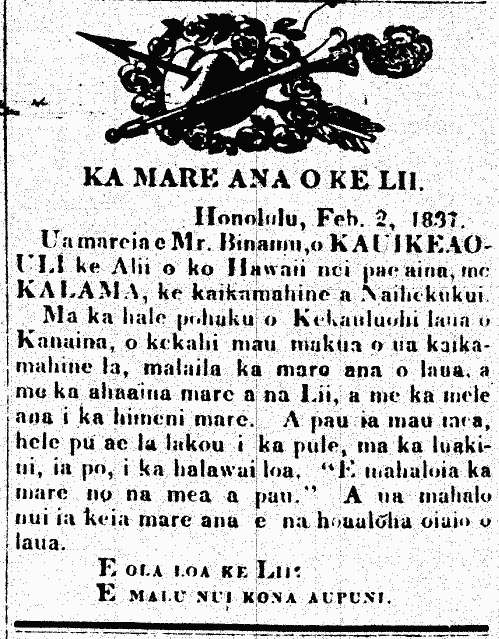
MARRIAGE OF THE KING.

Honolulu, Feb. 2, 1837.

KAUIKEAOULI the King of the Hawaiian archipelago and KALAMA, the daughter of Naihekukui was wed by Mr. Bingham [Binamu].

At the stone house of Kekauluohi and Kanaina, the aunty and uncle [makua] of that girl, is where their marriage took place, and the wedding reception of the Alii, and the singing of the marriage hymn. After that, they went to pray at the church that night at the great assembly. “Marriage is honourable in all.” And this marriage is greatly respected by their true friends.

Long live the King!

May his kingdom have great peace.

(Kumu Hawaii, 2/1/1837, p. 72)

KA MARE ANA O KE LII.

Ke Kumu Hawaii, Buke 2, Pepa 18, Aoao 72. Feberuari 1, 1837.

Political mele by Samuel Lia Kalainaina for Prince Kuhio, 1916.

HE HOOHENO LEI NO KALANIANAOLE.

1

E ho mai i na pua nani o ka wao,
Wehi lei no Kalanianaole,
Elele i Wakinekona.
E kui mai no a lawa,
Hiiia mai no Kalani.

2

E Hawaii Mano o Kalanipo,
Kui mai i lei no ke Alii,
Elele i Wakinekona.
Ohu lei mokihana,
Kau papahi lei nona.

3

E Niihau e, e o mai oe,
O kau lei no Kalanianaole,
Elele i Wakinekona.
I wehi lei rube,
I pulu-pe i ka hunakai.

4

E Oahu i ke kaona nui,
Ho mai i lei no ke Alii,
Ka Elele i Wakinekona.
I wehi lei carnation,
I wiliia me ka ilima.

5

E o e Molokai nui a Hina,
O kau lei no Kalanianaole,
Ka Elele i Wakinekona.
I wehi lei kukui,
Kau ohu ia no Kalani.

6

Eaha ana hoi oe e Lanai,
E wiki, i ohu no ke Alii,
Ka Elele i Wakinekona.
I lei pua hinahina,
I pulupe i ka hunakai.

7

E Maui i ka Honoapiilani,
O kau lei hoi no ke Alii,
Ka Elele i Wakinekona.
I wehi lei roselani,
Moani aala i ka poli.

8

E Hawaii nui Moku o Keawe,
Kui ae i wehi no ke Alii,
Ka Elele i Wakinekona.
I na lehua o Panaewa,
I wiliia me ka maile.

9

Hainaia mai ana ka puana,
Na wehi lei o Kalanianaole,
Ka Elele i Wakinekona.
Kii mai no e lei,
I ohu nou e Kalani.

Hakuia e ka HENE WAI O HIILAWE.

By Samuel L. Kalainaina.

[A Lei of Affection for Kalanianaole.

1 Bring forth the beautiful flowers of the forests,
A lei to adorn Kalanianaole,
Representative to Washington.
String them and bind fast,
To be carried for the Heavenly One.

2 O Hawaii of Manokalanipo,
String a lei for the Alii,
Representative to Washington.
An adornment of mokihana lei
Your lei to honor him.

3 O Niihau, answer,
Your lei for Kalanianaole,
Representative to Washington.
An adornment of rubies,
Drenched by the sea spray.

4 O Oahu of the great town,
Bring forth a lei for the Alii,
Representative to Washington.
An adornment of carnation lei,
Entwined with ilima.

5 Answer, O Great Molokai of Hina,
Your lei for Kalanianaole,
Representative to Washington.
An decoration of kukui lei,
Your adornment for the Heavenly One.

6 What are you doing, O Lanai,
Be quick, for an adornment for the Alii,
Representative to Washington.
A hinahina blossom lei,
Drenched by the sea spray.

7 O Maui with the bays of Piilani,
Your lei for the Alii,
Representative to Washington.
An adornment of roselani lei,
Fragrantly wafting in the bosom.

8 O Great Hawaii, Island of Keawe,
String an adornment for the Alii,
Representative to Washinton.
The lehua of Panaewa,
Entwined with maile.

9 Let the story be told,
Kalanianaole’s lei of adornment,
Representative to Washington.
Come take and wear these lei,
As an adornment for you, O Kalani.

Composed by the HENE WAI O HIILAWE.

By Samuel L. Kalainaina.

I was reminded of this mele after watching the video documentary “Liʻa” by Eddie Kamae.]

(Kuokoa, 11/10/1916, p. 3)
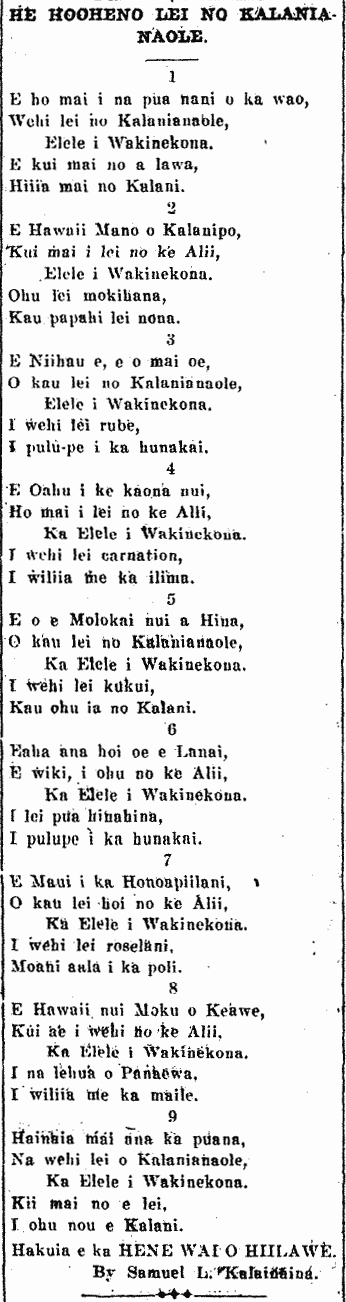
HE HOOHENO LEI NO KALANIANAOLE.

Ka Nupepa Kuokoa, Buke LIV, Helu 45, Aoao 3. Novemaba 10, 1916.
Coconut grove of Kamehameha V at Kalamaula, Molokai, 1923.

[Found under: “NA ANOAI”]

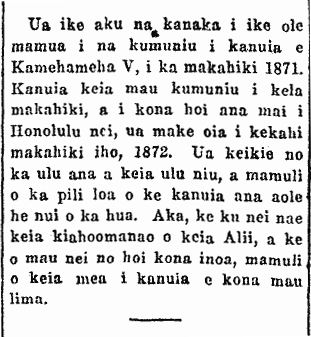
Those who did not know before of the coconut grove planted by Kamehameha V in 1871 now know. These coconut trees were planted that year, and when he returned here to Honolulu, he died a year later in 1872. This coconut grove has grown very tall, and because they were planted close together, there are not much fruit. But it stands as a monument to this Alii, and is called by his name because it was planted by his own hands.

[Check out Nanea Armstrong-Wassel’s post on more famous ulu niu!

It is also interesting to note that in the article “KA HUAKAI MAKAIKAI IA MOLOKAI” by W. J. Coelho, describing a trip around Molokai, found in Kuokoa, 7/6/1922, p. 3, it says:

I spoke of the coconut grove of Kamehameha V in Kalamaula. It is said that it was Kamehameha V who planted that coconut grove in 1864. The truth is that it was Meyer senior [Maea makua]—during the time of the King, Kamehameha IV who planted it. That was when Meyer married the mother of the Meyer family. When they were wed, they went upland of Kalae, and built a little house. It was a grass hut. Meyer began to work hard and peddled butter. After, Meyer was granted the care over the lands of Kamehameha IV, he planted coconuts by the beach, as a place to go for his lord the alii. It was Meyer who planted them, and not anyone else. Meyer himself told an important man of Honolulu, and it was from him I got this information.]

(Kuokoa, 4/26/1923, p. 2)

Ua ike aku na kanaka i ike ole mamua...

Ka Nupepa Kuokoa, Buke LXII, Helu 17, Aoao 2. Aperila 26, 1923.

Maui story of Eleio, the kahu of Kakaalaneo, the alii, by W. N. Pualewa, 1863.

THE STORY

—OF—

ELEIO.

SECTION 1.

WE PERHAPS SHOULD SPEAK here of Eleio, the caretaker of Kakaalaneo, an Alii of Maui, and thereafter, let’s speak of Kaululaau, the actual child of Kakaalaneo and a chiefess of Hawaii, Kelekeleiokaula, the daughter of Kaleihaohia, a chief of Hawaii.

It is said that Eleio was a kahu of Kakaalaneo, an Alii of Maui, and it is thought that Kakaalaneo was the fifth generation of Maui Chiefs. If their genealogy was laid out properly from Kumuhonua to Kakaalaneo, then it would actually come to five generations.

But in speaking about Eleio, we must speak about him.

Eleio was a fast runner, and because of Eleio’s speed, Kakaalaneo chose Eleio to fulfill his needs in very far places.

This is how we will see how fast Eleio was.

When the Steward of Kakaalaneo was preparing the poi and the ti-leaf wrapped fish of the Alii, at that time, the Alii sent Eleio to go get awa for Him; and the feast of the Alii would begin with the arrival of the awa fetched by Eleio.

But the location of the awa that Eleio was to fetch for the Alii was at a place very far, and that place was in the Koolau side of Maui, at a place named Waiohue.

 If Eleio went to get the awa at Waiohule when the ti-leaf wrapped fish was not cooked, he would return before the meal of the Alii began. This is something Eleio did all the time, fetching the awa for the Chief; the place the Chief lived was mauka of Kekaa, that hill standing at Kaanapali, makai side of Kealakikeekee a Maui.

[This is the beginning of the story of Eleio, it begins in the Kuokoa from 9/5/1863, and concludes on 11/21/1863. This story was written down by W. N. Pualewa (who seems to have died at Kalawao on 12/26/1873).

The closing by Pualewa of his telling of the story is interesting:

And there is this, at this point, we will end our Story of Eleio and Kaululaau; because, we have come to the place where there is great entanglements, and not because the Story is completed, but because of the complexity of putting into order, for there are five sections left of this Moolelo, and within those five parts, divided are the branches of the alii, the genealogy of the kahuna, and the ancestors of the kanaka, and because of this difficulty, I am ending Kaululaau at this Section, and it is for someone that is versed in the Moolelo who should fill this empty space of the paper. With thanks. W. N. Pualewa.]

(Kuokoa, 9/5/1863, p. 1)

KA MOOLELO O ELEIO.

Ka Nupepa Kuokoa, Buke II, Helu 36, Aoao 1. Sepatemaba 5, 1863.

Kamehameha Day proclaimed, 1871.

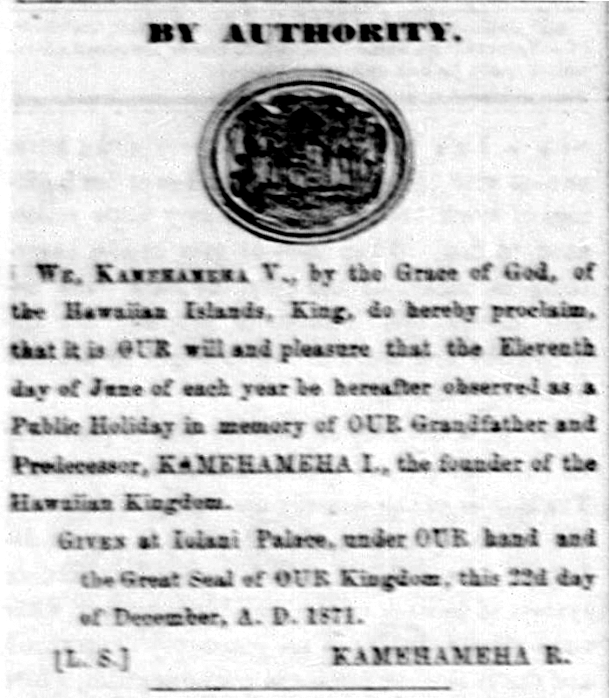
BY AUTHORITY.

We, Kamehameha V., by the Grace of God, of the Hawaiian Islands, King, do hereby proclaim, that it is OUR will and pleasure that the Eleventh day of June of each year be hereafter observed as a Public Holiday in memory of OUR Grandfather and Predecessor, KAMEHAMEHA I, the founder of the Hawaiian Kingdom.

Given at Iolani Palace, under OUR hand and the Great Seal of OUR Kingdom, this 22nd day of December, A. D. 1871.

[Legal Seal] KAMEHAMEHA R.

(Hawaiian Gazette, 12/27/1871, p. 2)

BY AUTHORITY.

Hawaiian Gazette, Volume VII, Number 50, Page 2. December 27, 1871.

Official Proclamation of the first Kamehameha Day Holiday, 1872.

[Found under: “MA KE KAUOHA.”]

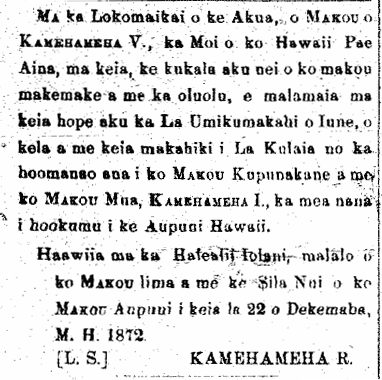
By the Blessings of God, We, Kamehameha V., the King of the Hawaiian Islands, through this, proclaim that it is our desire and pleasure that from here forth, the eleventh day of June, of every year will be a Holiday to memorialize Our Grandfather and Our Progenitor, Kamehameha I., the one who founded the Nation of Hawaii.

Given at Iolani Palace, by Our hand and Great Seal of Our Nation on this 22nd of December, 1872.

[Legal Seal] KAMEHAMEHA Rex.

(Au Okoa, 12/28/1871, p. 2)

Ma ka Lokomaikai o ke Akua...

Ke Au Okoa, Buke VII, Helu 37, Aoao 2. Dekemaba 28, 1871.

Announcing the first Kamehameha Day, 1872.

[Found under: “NU HOU KULOKO.”]

National Holiday.–According to the spokesman of the nation [Ke Au Okoa], seen under the heading, “By Order,” was proclaimed the word of the king that the 11th of June every year will be observed as a national holiday to memorialize Kamehameha I, the King who unified the kingdom into one. It is not known whether it is his birthday, or whether it is the day that the islands of Hawaii were united under his rule. Time will clear up the confusion.

(Kuokoa, 12/30/1871, p. 2)

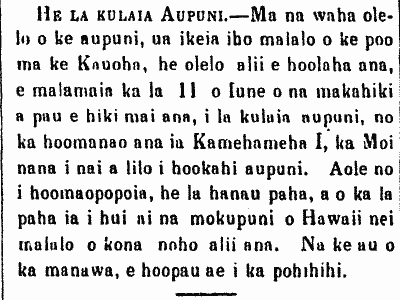
He la kulaia Aupuni.

Ka Nupepa Kuokoa, Buke X, Helu 52, Aoao 2. Dekemaba 30, 1871.

More on the first Kamehameha Day, 1872.

On this upcoming Tuesday, the 11th of June; this is the day which pleases our benevolent King, to set aside as a memorial holiday where the Hawaiian people should rejoice in honor of the progenitor Kamehameha I, who established the Hawaiian nation and who united the archipelago beneath one King, as it is today. The festivities of the day can be seen in the announcements column and it is desired that all enjoy themselves within the proper bounds.

(Au Okoa, 6/6/1872, p. 2)

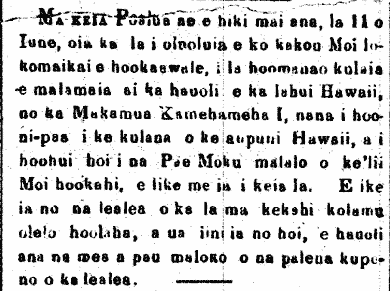
Ma keia Poalua ae e hiki mai ana...

Ke Au Okoa, Buke VIII, Helu 8, Aoao 2. Iune 6, 1872.

The first Kamehameha Day, 1872.

On this past Tuesday, in accordance with the royal proclamation, the 11th of June was celebrated as a day of remembrance of Kamehameha I, the Royal Ancestor who conquered our aina. This is a new day included in the circle of holidays, and the minds of the populace are happy about this type of day set aside to remember our cherished one of days gone by. The day dawned beautifully; there were no droplets to interfere with those who skillfully took care of the day. From early morning the doors of the shops of the town, both large and small, were shut. And when the sun came all the way out, there were not many people seen on the streets of town, and the great work places were deserted. All things meant to entertain themselves were prepared—some people made parties while others rode horses; however, it seemed as if most of the people were all at the races organized at Kulaokahua, the usual place for all types of entertainment.

The atmosphere of the race tracks that day seemed better than all previous days. Lanai and tents were set up impeccably, and those that undertook that task received much appreciation. The lanai, fields, and hills were filled with thousands who amused themselves with the events of the day. If an observer stood and watched from afar, it was as if he were seeing a picture of a race day somewhere like in Europe. The events of the day started at 10 or so, and after watching all the day’s activities, it was truly wonderful. There were no great commotions to disturb the peace among the crowd–this is something unfamiliar on special days like these.

At 10 o’clock sharp, Queen Emma arrived with her guests, and King Kapuaiwa with his entourage. At the appearance of the King, the activities of the day commenced, and all of the crowd joined in the gaieties that were set up. Below, you will find the races and those that won.

[Various horse races, winners, and prizes are listed.]

The final race, the wheelbarrow race was the most humorous. This entertainment marked the close of the festivities of the day. And everyone left with hearts filled with much glee. We are greatly pleased with one thing, and that is the decrease in the number of outbreaks of various sorts. There were no big riots thought to be related to the events of the day.

(Au Okoa, 6/13/1872, p. 2)

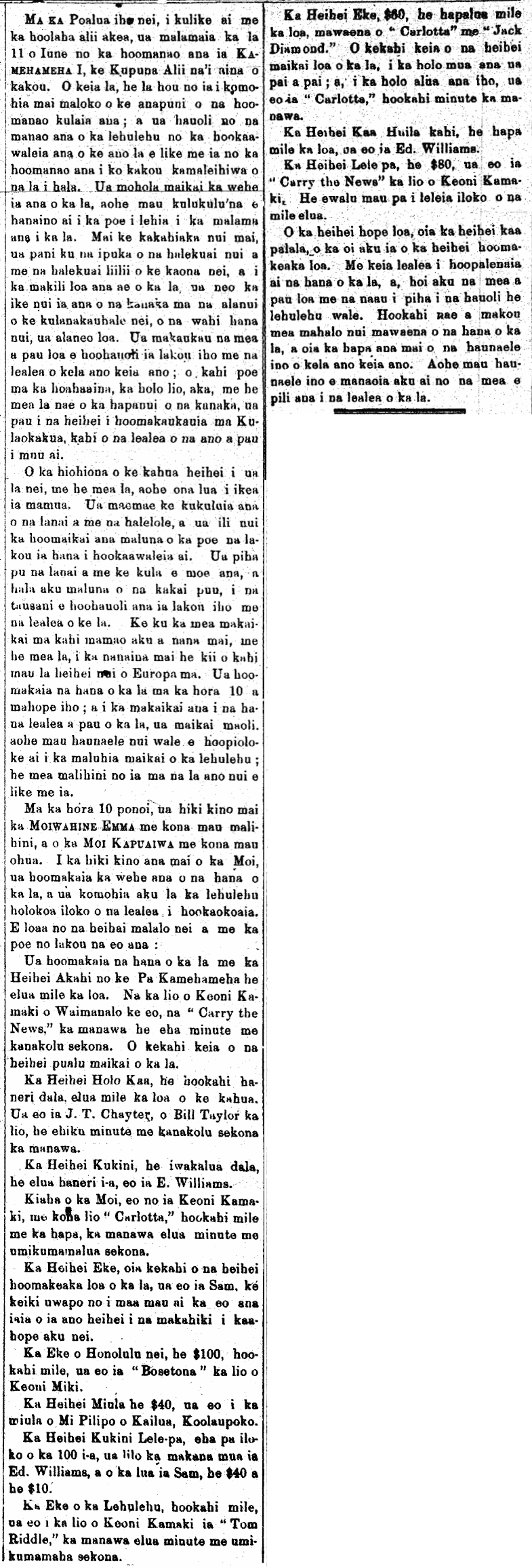
Ma ka Poalua iho nei...

Ke Au Okoa, Buke VIII, Helu 9, Aoao 2. Iune 13, 1872.

Maunaala, 1899.

ROYAL MAUSOLEUM

(THIS IMPOSING STRUCTURE STANDS ON AN ELEVATION PROMINENT IN THAT PORTION OF NUUANU CEMETERY ON THE WAIKIKI SIDE OF THE AVENUE. WITHIN WILL BE DEPOSITED THE REMAINS OF PRINCESS KAIULANI.)

WITHIN THE TOMB.

(This paper, February 16, 1891.)

On a beautiful lawn at the entrance of Nuuanu valley, overlooking this city, the harbor and ocean beyond, stands the Royal Mausoleum, erected by the Hawaiian Government, as the resting place of the remains of the Royal Family of Hawaii and a few of their greatest benefactors. It is built in the Gothic style of architecture, of concrete stone, with the lawn handsomely laid out with walks and studded with trees, the whole presenting from the avenue an attractive appearance. Continue reading