Crown Room of Iolani Palace, 1936.

THE CROWN ROOM OF IOLANI PALACE TO BE REDONE

ACTING GOVERNOR HITE REVEALED HIS THOUGHTS

This past Thursday, June 25, acting Governor [kokua Kiaaina] Charles M. Hite revealed his thoughts to redo the crown room of Iolani Palace in the upcoming days to bring back once again the commemoration of the alii of Hawaii who passed on; the pulo’ulo’u, the paintings hanging upon the walls, the throne, and also the other chairs which decorated the crown room. Continue reading

Hanaiakamalama rules, 1916.

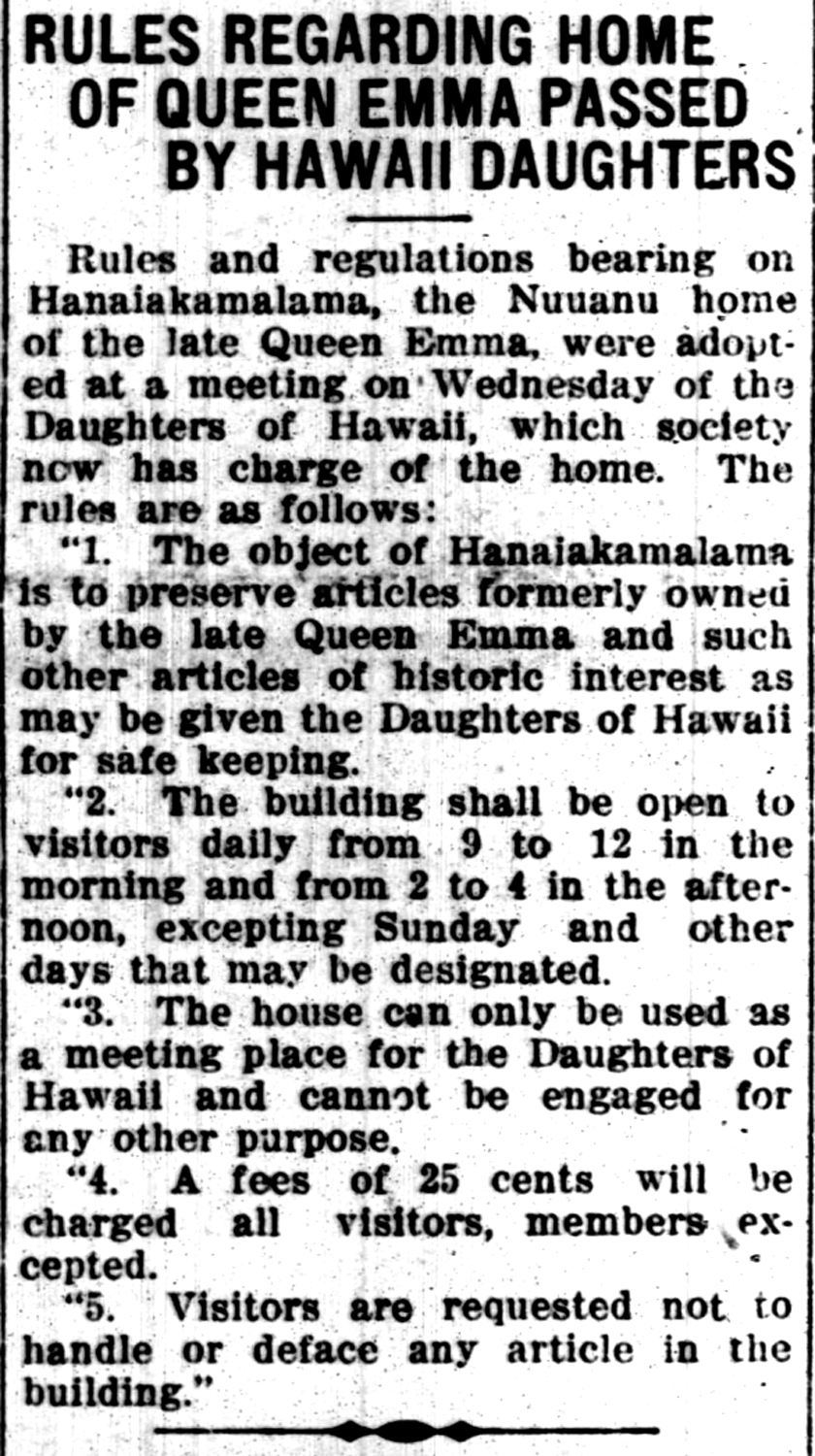
RULES REGARDING HOME OF QUEEN EMMA PASSED BY HAWAII DAUGHTERS

Rules and regulations bearing on Hanaiakamalama, the Nuuanu home of the late Queen Emma, were adopted at a meeting on Wednesday of the Daughters of Hawaii, which society now has charge of the home. The rules are as follows:

“1. The object of Hanaiakamalama is to preserve articles formerly owned by the late Queen Emma and such other articles of historic interest as may be give the Daughters of Hawaii for safe keeping.

“2. The building shall be open to visitors daily from 9 to 12 in the morning and from 2 to 4 in the afternoon, excepting Sunday and other days that may be designated.

“3. The house can only be used as a meeting place for the Daughters of Hawaii and cannot be engaged for any other purpose.

“4. A fee of 25 cents will be charged all visitors, members excepted.

“5. Visitors are requested not to handle or deface any article in the building.”

(Star-Bulletin, 10/19/1916, p. 3)

RULES REGARDING HOME OF QUEEN EMMA PASSED BY HAWAII DAUGHTERS

Honolulu Star-Bulletin, Volume XXIV, Number 7651, Page 3. October 19, 1916.

The Fairview Hotel, 1890.

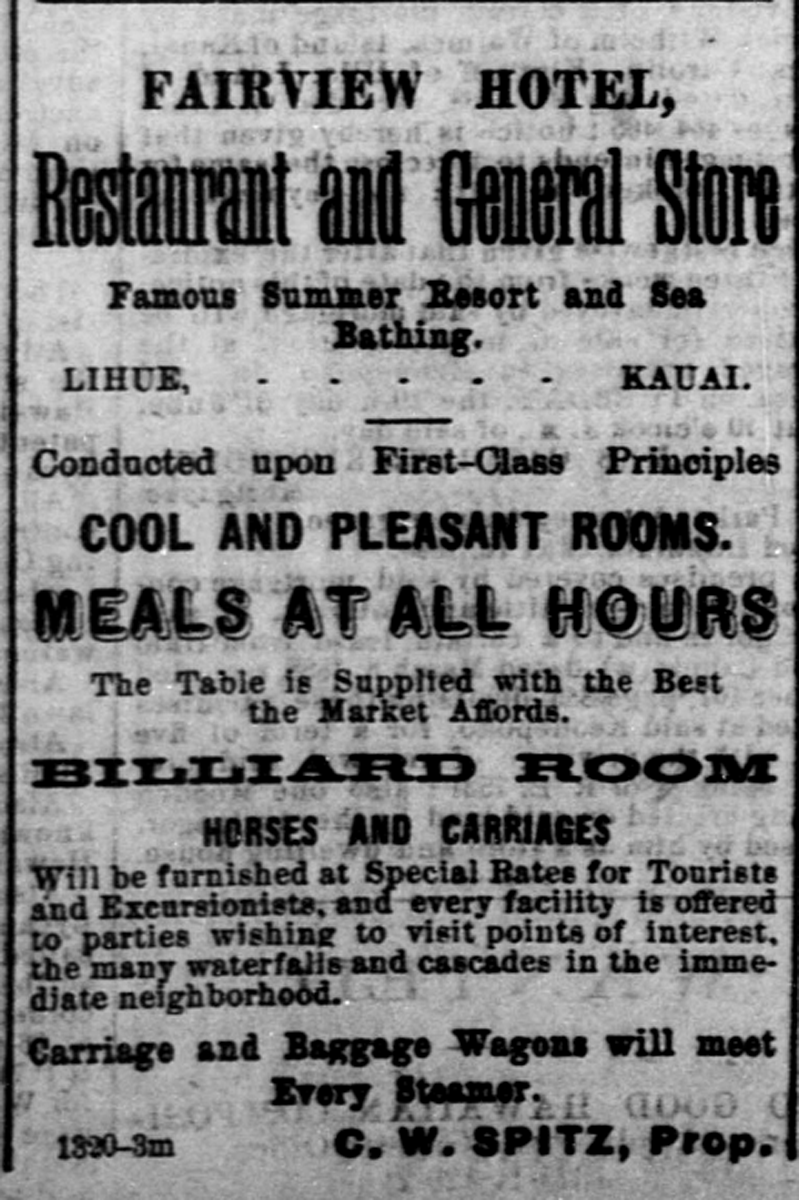
FAIRVIEW HOTEL,

Restaurant and General Store

Famous Summer Resort, and Sea
Bathing.

LIHUE, – – – – – KAUAI.

Conducted upon First-Class Principles

COOL AND PLEASANT ROOMS.

MEALS AT ALL HOURS

The Table is Supplied with the Best the Market Affords.

BILLIARD ROOM

HORSES AND CARRIAGES

Will be furnished at Special Rates for Tourists and Excursionists, and every facility is offered to parties wishing to visit points of interest, the many waterfalls and cascades in the immediate neighborhood.

Carriage and Baggage Wagons will meet Every Steamer.

C. W. SPITZ, Prop.

(Hawaiian Gazette, 6/3/1890, p. 9)

FAIRVIEW HOTEL,

Hawaiian Gazette, Volume XXV, Number 22, Page 9. June 3, 1890.

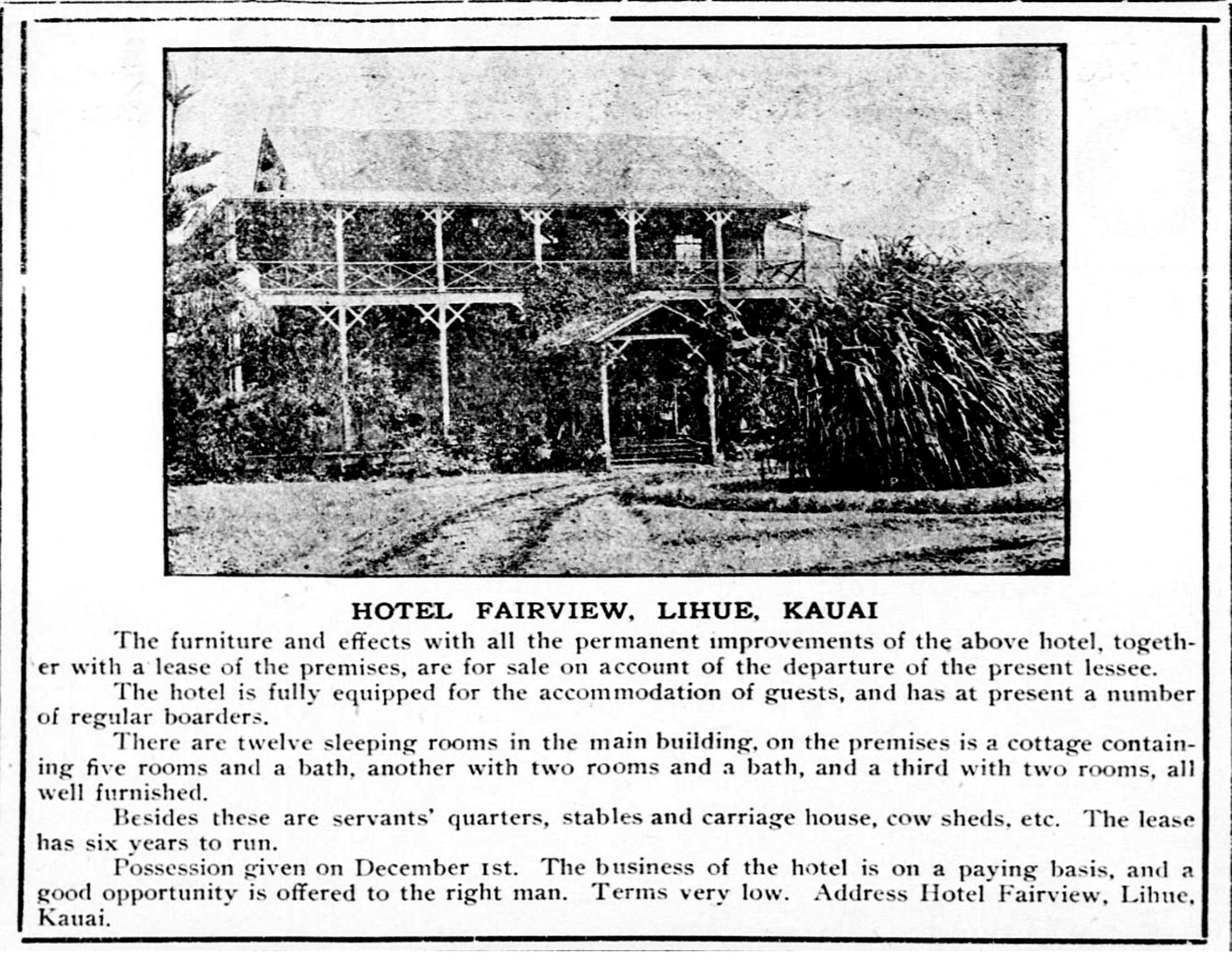
Hotel Fairview, Lihue, 1906.

HOTEL FAIRVIEW, LIHUE, KAUAI

The furniture and effects with all the permanent improvements of the above hotel, together with a lease of the premises, are for sale on account of the departure of the present lessee.

The hotel is fully equipped for the accommodation of guests, and has at the present a number of regular boarders.

There are twelve sleeping rooms in the main building, on the premises is a cottage containing five rooms and a bath, another with two rooms and a bath, and a third with two rooms, all well furnished.

Besides these are servants’ quarters, stables and carriage house, cow sheds, etc. The lease has six years to run.

Possession given on December 1st. The business of the hotel is on a paying basis, and a good opportunity is offered to the right man. Terms very low. Address Hotel Fairview, Lihue, Kauai.

(Pacific Commercial Advertiser, 11/15/1906, p. 6)

HOTEL FAIRVIEW, LIHUE, KAUAI

The Pacific Commercial Advertiser, Volume XLIV, Number 7573, Page 6. November 15, 1906.

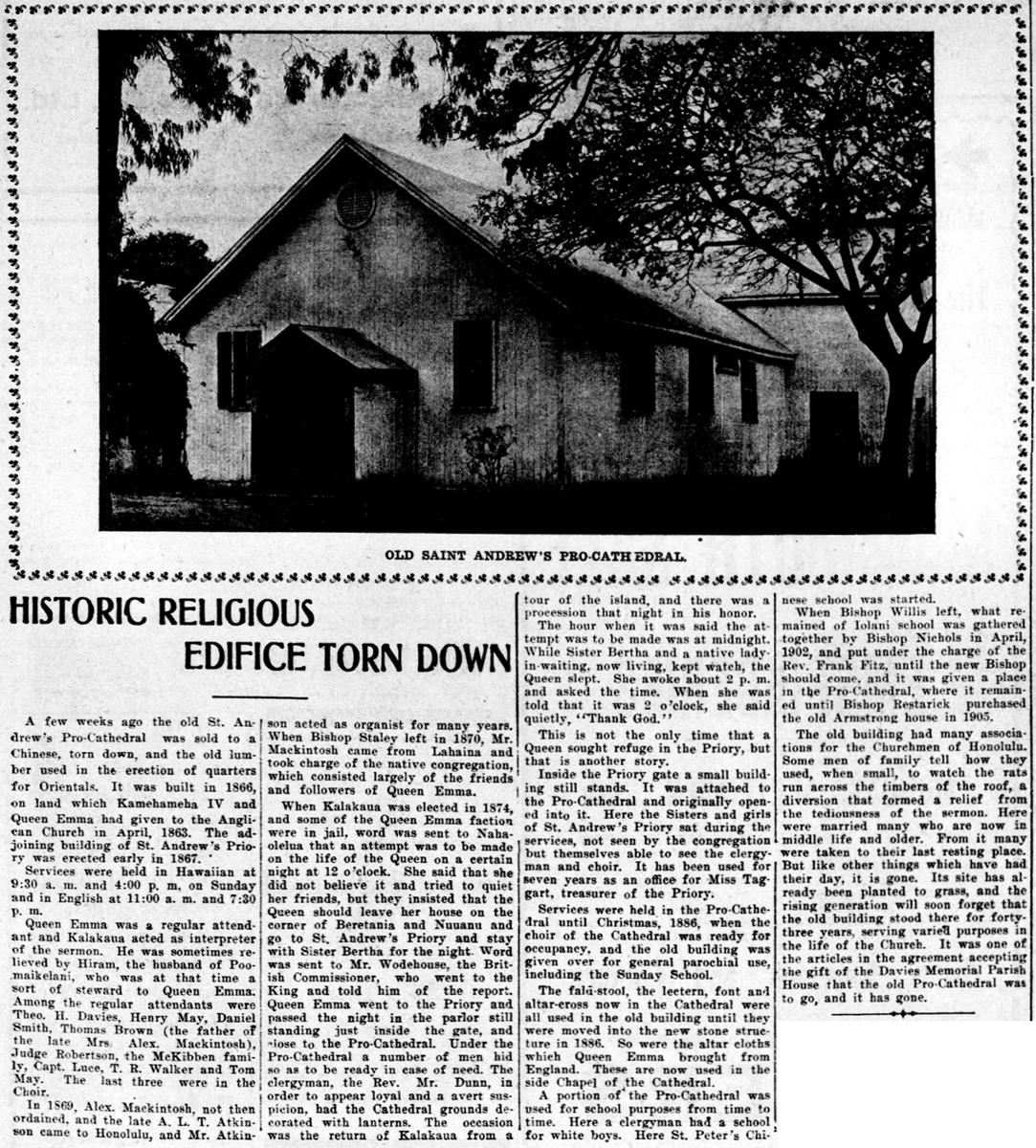
St. Andrew’s, the early days, 1909.

OLD SAINT ANDREW’S PRO-CATHEDRAL.

RELIGIOUS EDIFICE TORN DOWN

A few weeks ago the old St. Andrew’s Pro-Cathedral was sold to a Chinese, torn down, and the old lumber used in the erection of quarters for Orientals. It was built in 1866, on land which Kamehameha IV and Queen Emma had given to the Anglican Church in April 1863. The adjoining building of St. Andrew’s Priory was erected in 1867.

Services were held in Hawaiian at 9:30 a. m. and 4:00 p. m. on Sunday and in English at 11:00 a. m. and 7:30 p. m.

Queen Emma was a regular attendant and Kalakaua acted as interpreter of the sermon. He was sometimes relieved by Hiram, the husband of Poomaikelani, who was at that time a sort of steward to Queen Emma. Among the regular attendants were Theo. H. Davies, Henry May, Daniel Smith, Thomas Brown (the father of the late Mrs. Alex. McKintosh), Judge Robertson, the McKibben family, Capt. Luce, T. R. Walker and Tom May. The last three were in the Choir.

In 1869, Alex. Mackintosh, not then ordained, and the late A. L. T. Atkinson came to Honolulu, and Mr. Atkinson acted as organist for many years. When Bishop Staley left in 1870, Mr. Mackintosh came from Lahaina and took charge of the native congregation, which consisted largely of the friends and followers of Queen Emma.

When Kalakaua was elected in 1874, and some of the Queen Emma faction were in jail, word was sent to Nahaolelua that an attempt was to be made on the life of the Queen on a certain night at 12 o’clock. She said that she did not believe it and tried to quiet her friends, but they insisted that the Queen should leave her house on the corner of Beretania and Nuuanu and go to St. Andrew’s Priory and stay with Sister Bertha for the night. Word was sent to Mr. Wodehouse, the British Commissioner, who went to the King and told him of the report. Queen Emma went to the Priory and passed the night in the parlor still standing just inside the gate, and close to the Pro-Cathedral. Under the Pro-Cathedral a number of men hid so as to be ready in case of need. The clergyman, the Rev. Mr. Dunn, in order to appear loyal and a avert suspicion, had the Cathedral grounds decorated with lanterns. The occasion was the return of Kalakaua from a tour of the island, and there was a procession that night in his honor.

The hour when it was said the attempt was to be made was at midnight. While Sister Bertha and a native lady-in-waiting, now living, kept watch, the Queen slept. She awoke about 2 p. m. and asked the time. When she was told that it was 2 o’clock, she said quietly, “Thank God.”

This is not the only time that a Queen sought refuge in the Priory, but that is another story.

Inside the Priory gate a small building still stands. It was attached to the Pro-Cathedral and originally opened into it. Here the Sisters and girls of St. Andrew’s Priory sat during the services, not seen by the congregation but themselves able to see the clergyman and choir. It has been used for seven years as an office for Miss Taggart, treasurer of the Priory.

Services were held in the Pro-Cathedral until Christmas, 1886, when the choir of the Cathedral was ready for occupancy, and the old building was given over for general parochial use, including the Sunday School.

The fald-stool, the lectern, font and altar-cross now in the Cathedral were all used in the old building until they were moved into the new stone structure in 1886. So were the altar cloths which Queen Emma brought from England. These are now used in the side Chapel of the Cathedral.

A portion of the Pro-Cathedral was used for school purposes from time to time. Here a clergyman had a school for white boys. Here St. Peter’s Chinese school was started.

When Bishop Willis left, what remained of Iolani school was gathered together by Bishop Nichols in April, 1902, and put under the charge of the Rev. Frank Fitz, until the new Bishop should come, and it was given a place in the Pro-Cathedral, where it remained until Bishop Restarick purchased the old Armstrong house in 1905.

The old building had many associations for the Churchmen of Honolulu. Some men of family tell how they used, when small, to watch the rats run across the timbers of the roof, a diversion that formed a relief from the tediousness of the sermon. Here were married many who are now in middle life and older. From it many were taken to their last resting place. But like other things which have had their day, it is gone. Its site has already been planted to grass, and the rising generation will soon forget that the old building stood there for forty-three years, serving varied purposes in the life of the Church. It was one of the articles in the agreement accepting the gift of the Davies Memorial Parish House that the old Pro-Cathedral was to go, and it has gone.

(Pacific Commercial Advertiser, 9/18/1909, p. 3)
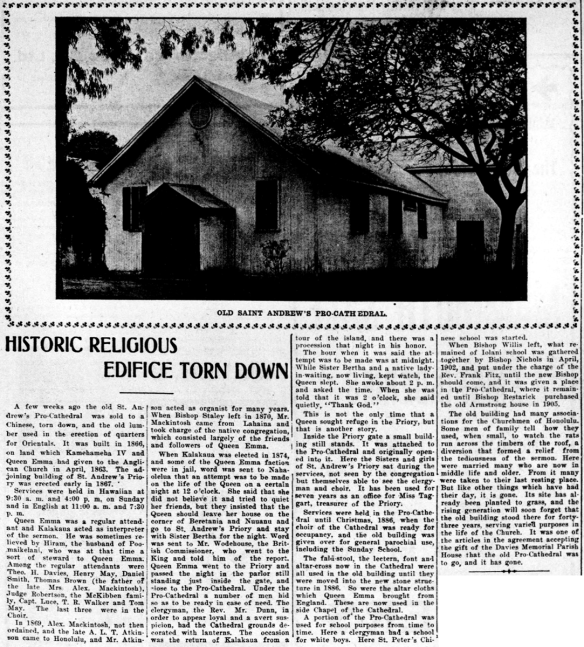
HISTORIC RELIGIOUS EDIFICE TORN DOWN

The Pacific Commercial Advertiser, Volume L, Number 8459, Page 3. September 18, 1909.

Death of Kekelaokalani, 1880.

FUNERAL.

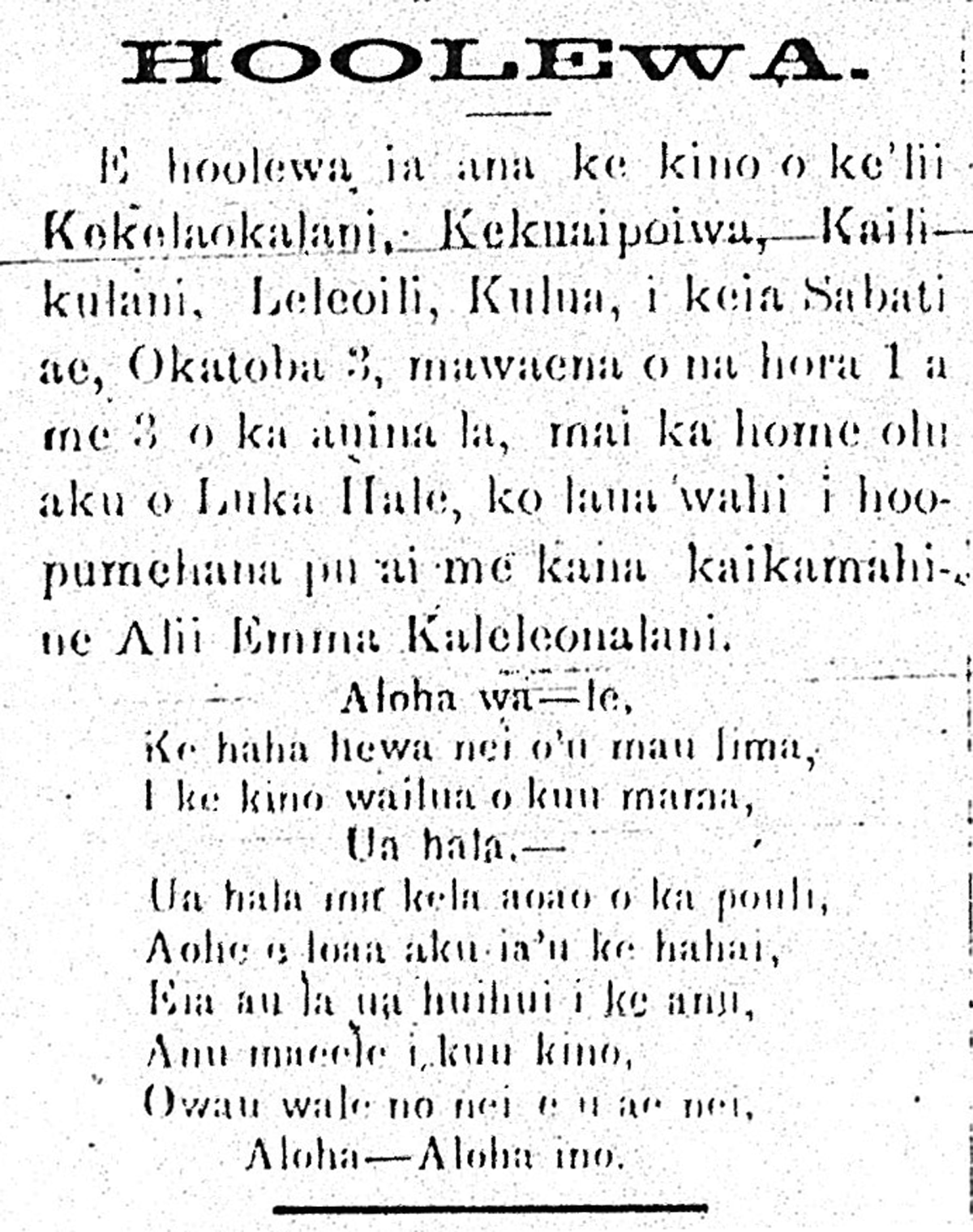
A service will be held over the remains of Kekelaokalani, Kekuaipoiwa [Kekuiapoiwa], Kailikulani, Leleoili, Kulua, on the following Sunday, October 3, between the hours of 1 and 3 in the afternoon, at the pleasant home, Rooke House [Luka Hale], the place where they made warm with their daughter, the Royal One, Emma Kaleleonalani.

Aloha wa—le,
Ke haha hewa nei o’u mau lima,
I ke kino wailua o kuu mama,
Ua ha—la,
Ua hala ma kela aoao o ka pouli,
Aohe e loaa aku ia’u ke hahai,
Eia au la ua huihui i ke anu,
Anu maeele i kuu kino,
Owau wale no nei e u ae nei,
Aloha—Aloha ino.

[Much Aloha,
My hands search in vain,
Over the body of my dear mama,
She has gone,
She has gone to the other side of the darkness,
I shall not catch her should I follow after her,
Here I am chilled in the cold,
My body is numbed,
It is I alone who mourns,
Aloha—How woeful.]

(Elele Poakolu, 9/29/1880, p. 1)

HOOLEWA.

Ka Elele Poakolu, Buke I, Helu 4, Aoao 1. Sepatemaba 29, 1880.

St. Louis School, 1880.

The New Catholic School.

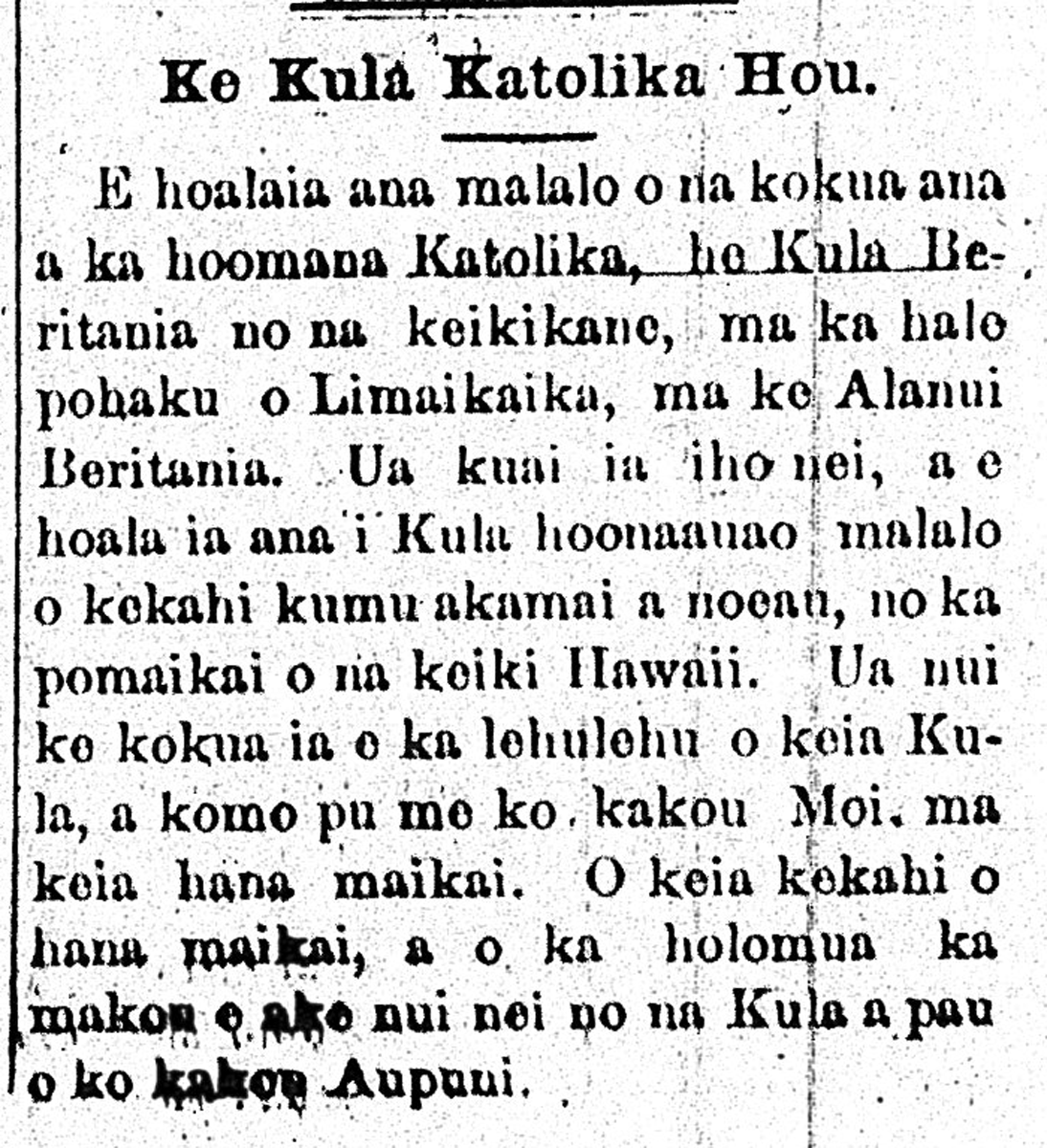
There will be established under the Catholic Faith, an English school for boys, at the stone building of Armstrong [Limaikaika], on Beritania Street. It was recently purchased, and a school of learning will be set up for the benefit of Hawaiian boys. This school is greatly supported by the public, along with our King, at this fine endeavor. This is one of the fine works, and is progress that we greatly desire for all of the Schools of our Nation.

(Elele Poakolu, 9/22/1880, p. 1)

Ke Kula Katolika Hou.

Ka Elele Poakolu, Buke I, Helu 3, Aoao 1. Sepatemaba 22, 1880.

Hula and the play “Umi-a-Liloa,” 1917.

TRULY HAWAIIAN IS ‘UMI-A-LILOA’

The hula alaapapa will be one of the special entre act features of the performance of “Umi-a-Liloa” at the opera house next Thursday evening. This hula is danced standing in contradiction to the older hulas which is called for a sitting position. It will be interpreted by a band of four young girls, who are experts in the art of the real Hawaiian dance. They are assisted by a man who beats the hula drum in old-time style. It is only in recent years that the hula has been accompanied by the music of instruments.

The second act contains an elaborate representation of the court of the king of Hawaii in the year 1640 and during the scene of the royal festivity some of the very ancient dances are introduced. They are danced, if one may call it so, sitting cross-legged upon the floor and the beauty of the performance lies in the grace and graphic intensity of the gestures of the body and arms of the dancers. Continue reading

Hula from Kahuku at the Orpheum, 1905.

RURAL HULA DANCERS AT THE ORPHEUM

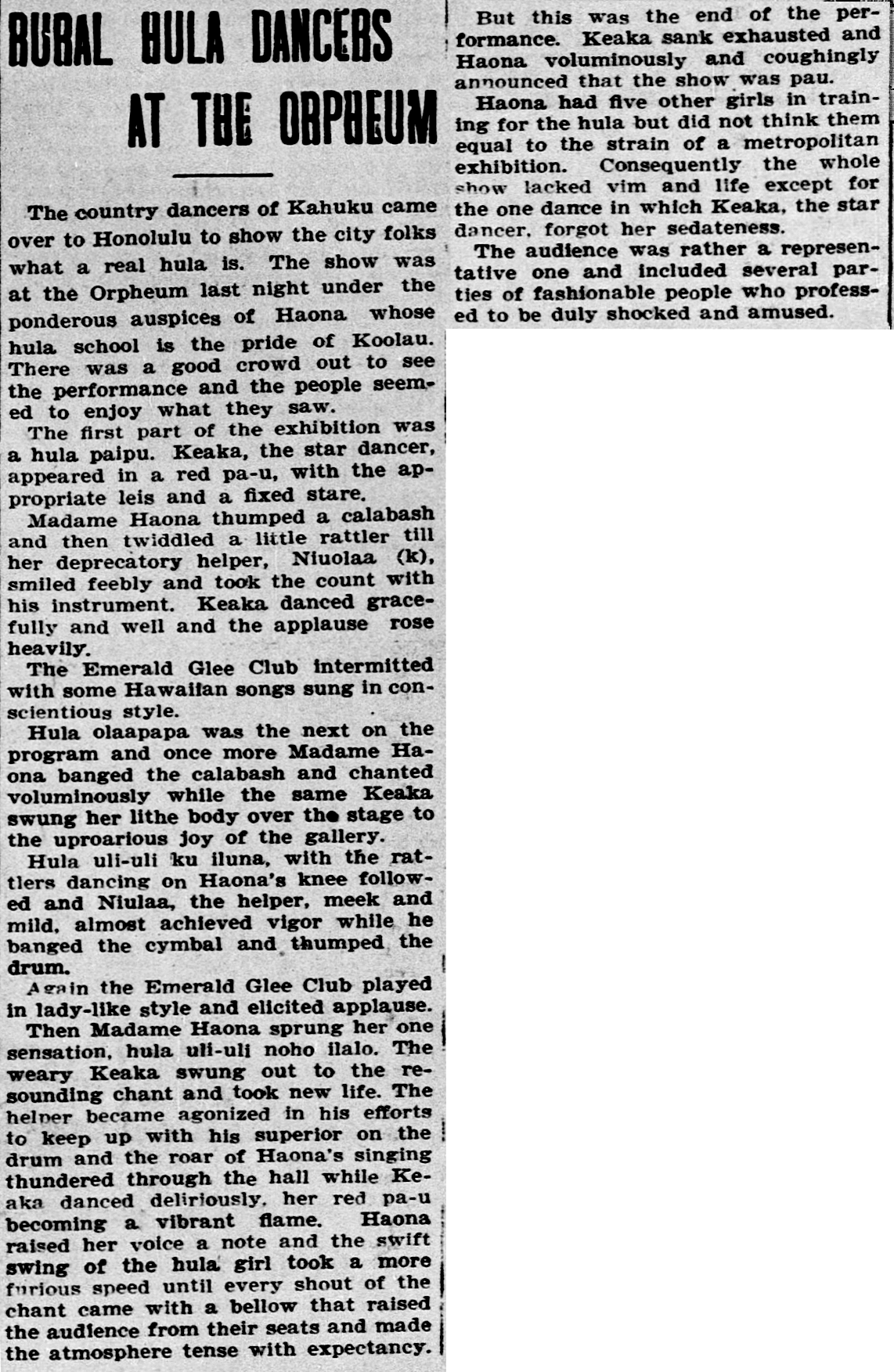
The country dancers of Kahuku came over to Honolulu to show the city folks what a real hula is. The show was at the Orpheum last night under the ponderous auspices of Haona whose hula school is the pride of Koolau. There was a good crowd out to see the performance and the people seemed to enjoy what they saw.

The first part of the exhibition was a hula paipu. Keaka, the star dancer, appeared in a red pa-u, with the appropriate leis and a fixed stare.

Madame Haona thumped a calabash and then twiddled a little rattler till her deprecatory helper, Niuolaa (k), smiled feebly and took the count with his instrument. Keaka danced gracefully and well and the applause rose heavily.

The Emerald Glee Club intermitted with some Hawaiian songs sung in conscientious style.

Hula olaapapa was the next on the program and once more Madame Haona banged the calabash and chanted voluminously while the same Keaka swung her lithe body over the stage to the uproarious joy of the gallery.

Hula uli-uli ku iluna, with the rattlers dancing on Haona’s knee followed and Niulaa, the helper, meek and mild, almost achieved vigor while he banged the cymbal and thumbed the drum.

Again the Emerald Glee Club played in lady-like style and elicited applause.

Then Madame Haona sprung her one sensation, hula uli-uli noho ilalo. The weary Keaka swung out to the resounding chant and took new life. The helper became agonized in his efforts to keep up with his superior on the drum and the roar of Haona’s singing thundered through the hall while Keaka danced deliriously, her red pa-u becoming a vibrant flame. Haona raised her voice a note and the swift swing of the hula girl took a more furious speed until every shout of the chant came with a bellow that raised the audience from their seats and made the atmosphere tense with expectancy.

But this was the end of the performance. Keaka sank exhausted and Haona voluminously and coughingly announced that the show was pau.

Haona had five other girls in training for the hula but did not think them equal to the strain of a metropolitan exhibition. Consequently the whole show lacked vim and life except for the one dance in which Keaka, the star dancer, forgot her sedateness.

The audience was rather a representative one and included several parties of fashionable people who professed to be duly shocked and amused.

(Pacific Commercial Advertiser, 10/15/1905, p. 1)

RURAL HULA DANCERS AT THE ORPHEUM

The Pacific Commercial Advertiser, Volume III, Number 146, Page 1. October 15, 1905.

On dancing and an unnoticed eclipse, 1906.

DANCE AT KAHILIAULANI HALL.

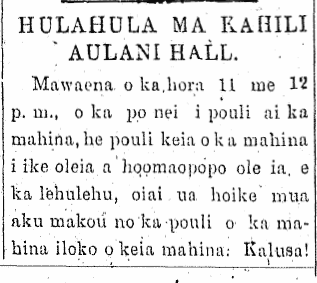
Between the hours of 11 and 12 p. m., last night, there was a lunar eclipse; it was an eclipse that was not seen and known by the public, being that we announced the eclipse of the moon this month: Kalusa!

[Has anyone seen the use of the exclamation, “Kalusa!”???]

(Na’i Aupuni, 8/4/1906, p. 2)

HULAHULA MA KAHILIAULANI HALL

Ka Na’i Aupuni, Buke II, Helu 54, Aoao 2. Augate 4, 1906.